Cardamome de Java
(Amomum maximum)
Pas d'illustration
pour le moment 😕

Une herbe de la famille du gingembre. La plante atteint une hauteur de 2 à 3 m. Il a une tige ou un rhizome souterrain épais. La tige de la feuille peut soit ne pas exister, ... (traduction automatique)
→suite


Cardamome de Java

Une herbe de la famille du gingembre. La plante atteint une hauteur de 2 à 3 m. Il a une tige ou un rhizome souterrain épais. La tige de la feuille peut soit ne pas exister, soit mesurer jusqu'à 8 cm de... (traduction automatique) →suite
Pas d'illustration
pour le moment 😕
Pas d'illustration
pour le moment 😕
Amomum maximum
Classification
- Classique : en haut de l'écran, sous le coeur.
- Phylogénétique :
- Clade 4 : Angiospermes ;
- Clade 3 : Monocotylédones ;
- Clade 2 : Commelinidées ;
- Ordre APN : Zingiberales ;
- Famille APN : Zingiberaceae ;
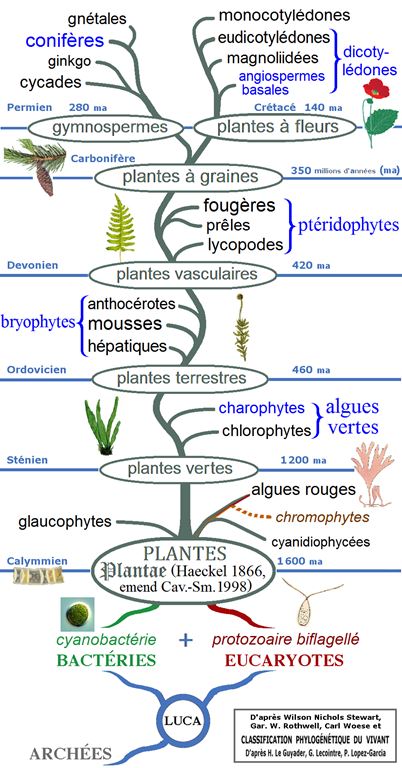
À droite, cet arbre phylogénétique des plantes montre les principaux clades et groupes traditionnels (monophylétiques en noir et paraphylétiques en bleu).
Dénominations
- Nom botanique : Amomum maximum Roxb. (1810)
- Synonymes français : gingembre du Yunnan
- Synonymes : Amomum dealbatum Roxb. 1820, Cardamomum dealbatum (Roxb.) Kuntze 1891, Cardamomum maximum (Roxb.) Kuntze 1891 ;
Dont basionyme : x ; - Noms anglais et locaux : Java cardamom, great winged amomum, Java-Kardamom (de), guo gu (cn transcrit), resah (jv), wresah (jv), hanggasa (jv)
Description et culture
Tableau récapitulatif
Parties comes-tibles Note comest. (1-5) Note medic. (1-5) (Zones de) Rusticité Besoins en 
Besoins en  (1-3)
(1-3)Périodes de semis et récoltes Graines au gramme Durée de viabilité Profon-deur semis Espace-ment plants Espace-ment lignes Durée germi-native Durée avant récolte J F M A M J
J A S O N D
J F M A M J
J A S O N D
- dont infos de 0FPI ("FOOD PLANTS INTERNATIONAL", en anglais) :
Description :
Une herbe de la famille du gingembre. La plante atteint une hauteur de 2 à 3 m. Il a une tige ou un rhizome souterrain épais. La tige de la feuille peut soit ne pas exister, soit mesurer jusqu'à 8 cm de long. Le limbe des feuilles est oblong et mesure 30 à 90 cm de long sur 10 à 20 cm de large. Il est vert vif sur le dessus. En dessous se trouve un revêtement blanc. Les épis de fleurs sont presque ronds et mesurent 5 cm de diamètre. Les bractées sont brunâtres et mesurent 2 à 2,5 cm de long. Ils sont velus mais tombent. La fleur est pâle avec des taches violettes. Le fruit est une capsule qui est vert violet et ovale. Il mesure 2,5-3 cm de long sur 1,8-2,4 cm de diamètre. Il a 9 ailes et de fins poils blancs. Les graines sont ovales et mesurent 5 mm de long sur 3 mm de large{{{0(+x) (traduction automatique).
Original : A ginger family herb. The plant grows 2-3 m tall. It has a thick underground stem or rhizome. The leaf stalk can either not exist or be up to 8 cm long. The leaf blade is oblong and 30-90 cm long by 10-20 cm wide. It is bright green on top. Underneath is has a white covering. The flower spikes are almost round and 5 cm across. The bracts are brownish and 2-2.5 cm long. They are hairy but fall off. The flower is pale with purple spots. The fruit is a capsule which is purple-green and oval. It is 2.5-3 cm long by 1.8-2.4 cm across. It has 9 wings and fine white hairs. The seeds are oval and 5 mm long by 3 mm wide{{{0(+x).
Culture :
Il peut être cultivé en utilisant les pointes des rhizomes qui ont des racines. Il peut également être cultivé à partir de graines{{{0(+x) (traduction automatique).
Original : It can be grown using tips of the rhizomes that have roots. It can also be grown from seeds{{{0(+x).
 Consommation (rapports de comestibilité, parties utilisables et usages alimentaires correspondants)
Consommation (rapports de comestibilité, parties utilisables et usages alimentaires correspondants)Fruit (fruis frais crus{{{174 [nourriture/aliment{{{(dp*)] ; capsules64 et graines27(+x),64 [assaisonnement : aromate{{{(dp*) (condiment172 aromatique(dp*)) et épice27(+x),64,173,174]) comestibles.
Détails :
Epice cultivé à Java{{{27(+x).
Partie testée :
feuilles{{{0(+x) (traduction automatique). Original : Leaves{{{0(+x) Risques et précautions à prendre
Risques et précautions à prendrenéant, inconnus ou indéterminés.
Autres infos
dont infos de 0FPI ("FOOD PLANTS INTERNATIONAL", en anglais) :
Statut :
C'est une plante alimentaire cultivée. Il est vendu sur les marchés locaux{{{0(+x) (traduction automatique).
Original : It is a cultivated food plant. It is sold in local markets{{{0(+x).
Distribution :
Une plante tropicale. Il pousse dans les forêts ombragées et sur les pentes des collines entre 600 et 800 m d'altitude dans le sud de la Chine. Il se trouve généralement dans les forêts sur des sols humides riches en humus. Au Yunnan{{{0(+x) (traduction automatique).
Original : A tropical plant. It grows in shady forests and on hill slopes between 600-800 m altitude in S. China. It is usually in forests on moist humus rich soils. In Yunnan{{{0(+x).
Localisation :
Andamans, Asie, Bangladesh, Chine, Himalaya, Inde, Indochine, Indonésie, Malaisie, Myanmar, Népal, Nouvelle-Guinée, Nord-est de l'Inde, Asie du Sud-Est, Sikkim, Thaïlande, Tibet{{{0(+x) (traduction automatique).
Original : Andamans, Asia, Bangladesh, China, Himalayas, India, Indochina, Indonesia, Malaysia, Myanmar, Nepal, New Guinea, Northeastern India, SE Asia, Sikkim, Thailand, Tibet{{{0(+x).
Notes :
Il existe environ 150 espèces d'Amomum. Ils sont pour la plupart tropicaux. Il est utilisé en médecine{{{0(+x) (traduction automatique).
Original : There are about 150 Amomum species. They are mostly tropical. It is used in medicine{{{0(+x).
Liens, sources et/ou références
Liens :
/ ;Sources et/ou références :
bibliographie (liste des sources et/ou références de l'encyclopédie)
dont classification : IPNI ("International Plant Names Index", en anglais) ; TPL ("The Plant List", en anglais) ; Kew (POWO - "Plant Of the World Online", "Royal Botanical Garden", en anglais) ;
dont livres et bases de données : 27Dictionnaire des plantes comestibles (livre, page 23, par Louis Bubenicek), 64"World Spice Plants : Economic Usage, Botany, Taxonomy" (livre en anglais, page 37, par Johannes Seidemann), 172"Chemistry of Spices" (livre en anglais, page 66, par V.A. Parthasarathy, B. Chempakam, T. John Zachariah), 173"Cultivation of Spice Crops" (livre en anglais, page 238, par Azhar Ali Farooqi, B.S. Sreeramu, K.N. Srinivasappa), 174"Food Plants of China" (livre en anglais, page 326, par Shiu-Ying Hu) ;
dont bibliographie/références de 0FPI ("FOOD PLANTS INTERNATIONAL", en anglais) :
Arora, R. K., 2014, Diversity in Underutilized Plant Species - An Asia-Pacific Perspective. Bioversity International. p 100 ; Burkill, I.H., 1966, A Dictionary of the Economic Products of the Malay Peninsula. Ministry of Agriculture and Cooperatives, Kuala Lumpur, Malaysia. Vol 1 (A-H) p 132 (As Amomum dealbatum) ; Fern, K., 2012, Tropical Species Database http://theferns.info/tropical/ (As Amomum dealbatum) ; Hazarika, T. K., et al, 2012, Studies on wild fruits of Mizoram, India used as ethno-medicines. Genetic Resources and Crop Evolution. Published on line 03 February, 2012 (As Amomum dealbatum) ; Hedrick, U.P., 1919, (Ed.), Sturtevant's edible plants of the world. p 50 ; Hu, Shiu-ying, 2005, Food Plants of China. The Chinese University Press. p 326 ; Kar, A., et al, 2013, Wild Edible Plant Resources used by the Mizos of Mizoram, India. Kathmandu University Journal of Science, Engineering and Technology. Vol. 9, No. 1, July, 2013, 106-126 (As Amomum dealbatum) ; Lalfakzuala, R., 2007, Ethnobotanical usages of plants in western Mizoram. Indian Journal of Traditional Knowledge. Vol 6(3) pp 480-493 (As Amomum dealbatum) ; Liu, Yi-tao, & Long, Chun-Lin, 2002, Studies on Edible Flowers Consumed by Ethnic Groups in Yunnan. Acta Botanica Yunnanica. 24(1):41-56 ; Martin, F.W. & Ruberte, R.M., 1979, Edible Leaves of the Tropics. Antillian College Press, Mayaguez, Puerto Rico. p 225 ; Medhi, P. & Borthakur, S. K., 2012, Phytoresources from North Cachur Hills of Assam -3: Edible plants sold at Hflong market. Indian Journal of Natural Products and Resources. 3(1) pp 84-109 ; Medhi, P. & Borthakur, S. K., 2013, Wild edible plants sold by the Zeme Nagas at the makeshift market of Mahur, Dima Hasao district of Assam. Pleione 7(1): 84 - 93. 2013 ; Medhi, P., Sarma, A and Borthakur, S. K., 2014, Wild edible plants from the Dima Hasao district of Assam, India. Pleione 8(1): 133-148 ; Pfoze, N. L., et al, 2012, Survey and assessment of floral diversity on wild edible plants from Senapati district of Manipur, Northeast India. Journal of Biodiversity and Environmental Sciences. 1(6):50-52 (As Amomum dealbatum) ; Ochse, J. J. et al, 1931, Vegetables of the Dutch East Indies. Asher reprint. p 734 ; PROSEA handbook Volume 13 Spices. p 274 (As Amomum dealbatum) ; Seidemann J., 2005, World Spice Plants. Economic Usage, Botany, Taxonomy. Springer. p 37 ; Sukarya, D. G., (Ed.) 2013, 3,500 Plant Species of the Botanic Gardens of Indonesia. LIPI p 1060 ; Terra, G.J.A., 1973, Tropical Vegetables. Communication 54e Royal Tropical Institute, Amsterdam, p 23 ; Verheij, E. W. M. and Coronel, R.E., (Eds.), 1991, Plant Resources of South-East Asia. PROSEA No 2. Edible fruits and nuts. Pudoc Wageningen. p 313 (As Amomum dealbatum) ; Wu Delin, Larsen, K., Zingiberaceae. Flora of China. (As Amomum dealbatum) ; Xu, You-Kai, et al, 2004, Wild Vegetable Resources and Market Survey in Xishuangbanna, Southwest China. Economic Botany. 58(4): 647-667.
Recherche de/pour :
- "Amomum maximum" sur Google (pages et
images) ;
GRIN ("Germplasm Resources Information Network", en anglais) ;
TROPICOS (en anglais) ;
Tela Botanica ;
Pl@ntNet ;
Pl@ntUse ;
"Plants For A Future" (en anglais) ;
"Useful Tropical Plants" (en anglais) ou
"Useful Temperate Plants" (en anglais) ;
- "Cardamome de Java" sur Google (pages, images et recettes) ;
- "Amomum maximum" sur Google (pages et
images) ;
GRIN ("Germplasm Resources Information Network", en anglais) ;
TROPICOS (en anglais) ;
Tela Botanica ;
Pl@ntNet ;
Pl@ntUse ;
"Plants For A Future" (en anglais) ;
"Useful Tropical Plants" (en anglais) ou
"Useful Temperate Plants" (en anglais) ;
Espèces du même genre (Amomum)
35 taxons
- Amomum acre Valeton
- Amomum aculeatum Roxb.
- Amomum anomalum R.W.Sm.
- Amomum aromaticum Roxb.
- Amomum blumeanum Valeton
- Amomum calophrys K.Schum.
- Amomum compactum Sol. ex Maton (Cardamome naine)
- Amomum coriandriodorum S.Q.Tong & Y.M.Xia
- Amomum dallachyi F.Muell.
- Amomum dealbatum Roxb.
- Amomum dimorphum M.F.Newman
- Amomum gagnepainii T.L.Wu, K.Larsen & Turland
- Amomum gracile Blume
- Amomum koenigii J.F.Gmel.
- Amomum kravanh
- Amomum lappaceum Ridl.
- Amomum lepicarpum Ridl.
- Amomum longiligulare T.L.Wu
- Amomum muricarpum Elmer
- Amomum neoaurantiacum T.L.Wu, K.Larsen & Turland
- Amomum ochreum Ridl.
- Amomum pseudo-foetens
- Amomum sericeum Roxb.
- Amomum siamense Craib
- Amomum speciosum
- Amomum stenocarpum Valeton
- Amomum subulatum Roxb. (Cardamome brune)
- Amomum testaceum Ridl.
- Amomum tomrey Gagnep.
- Amomum tsao-ko Crevost & Lemari
- Amomum uliginosum J.Koenig
- Amomum utriculosum
- Amomum villosum Lour. (Cardamome médicinale)
- Amomum xanthophlebium Baker
Espèces de la même famille (Zingiberaceae)
255 taxons
- Aframome blanc violacée (tp*)
- Alpinie pourprée
- Bangle
- Banjang
- Cardamome
- Cardamome brune
- Cardamome du cameroun
- Cardamome médicinale
- Cardamome naine
- Cardamome noire
- Curcuma
- Curcuma blanc
- Galanga
- Gingembre
- Gingembre coquille
- Gingembre d'ornement
- Gingembre du bengale
- Gingembre mangue
- Gingembre papillon
- Gingembre sauvage
- Hédychie de Gardner
- Hédychie écarlate
- Kencur
- Korarima
- Korarima des singes
- Krachaï
- Longoza
- Maniguette
- Mbongo
- Mioga
- Munong
- Petit galanga
- Zédoaire
- Achasma loroglossum
- Aframomum albiflorum Lock
- Aframomum alboviolaceum (Ridl.) K.Schum. (Aframome blanc violacée (tp*))
- Aframomum angustifolium (Sonn.) K. Schum. (Longoza)
- Aframomum cereum
- Aframomum citratum (C.Pereira) K.Schum. (Mbongo)
- Aframomum corrorima (C. Pereira) P. C. M. Jansen (Korarima)
- Aframomum daniellii (Hook.f.) K.Schum. (Cardamome du cameroun)
- Aframomum elliotii
- Aframomum exscapum (Sims) Hepper (Maniguette)
- Aframomum giganteum
- Aframomum laurentii
- Aframomum letestuanum Gagnep.
- Aframomum longiscapum
- Aframomum luteoalbum
- Aframomum mala
- Aframomum melegueta (Rosc.) K. Schum. (Maniguette)
- Aframomum polyanthum
- Aframomum pruinosum Gagnep.
- Aframomum rostratum K.Schum.
- Aframomum strobilaceum (Sm.) Hepper (Maniguette)
- Aframomum subsericeum
- Aframomum sulcatum
- Aframomum thonneri De Wild.
- Aframomum verrucosum Lock
- Aframomum zambesiacum (Baker) K.Schum. (Korarima des singes)
- Alpinia aquatica
- Alpinia arundelliana
- Alpinia athroantha Valeton
- Alpinia beamanii R.M.Sm.
- Alpinia blepharocalyx K.Schum.
- Alpinia caerulea (R.Br.) Benth. (Gingembre d'ornement)
- Alpinia calcarata
- Alpinia capitellata Jack
- Alpinia chinensis
- Alpinia conchigera Griff.
- Alpinia coriandriodora D.Fang
- Alpinia elegans
- Alpinia emaculata S.Q.Tong
- Alpinia galanga (L.) Willd. (Galanga)
- Alpinia glabra Ridl.
- Alpinia globosa
- Alpinia hainanensis K.Schum.
- Alpinia japonica
- Alpinia javanica Blume
- Alpinia kawakamii Hayata
- Alpinia kusshakuensis Hayata
- Alpinia kwangsiensis T.L.Wu & S.J.Chen
- Alpinia latilabris Ridl.
- Alpinia ligulata K.Schum.
- ...







 donne accès au menu
  - encyclopédies des plantes alimentaires ;
 - page de recherche - reconnaissance (identification) de plantes ;
 - page du calendrier lunaire et son générateur (au format PDF et JPG) ;
 - tableau récapitulatif ;
 - générateur de potées (soupes), avec estimation des apports nutrionnels et du coût;
 - générateur de codes QR ;
 - page des archives avec de nombreux documents sur différents thèmes complémentaires comme la botanique, les légumes,
les champignons, la cuisine, le bien-être ainsi que différents MOOC mais également des liens vers les archives de l'association ;
- page des archives avec de nombreux documents sur différents thèmes complémentaires comme la botanique, les légumes,
les champignons, la cuisine, le bien-être ainsi que différents MOOC mais également des liens vers les archives de l'association ;

 pour le fruit (et/ou les graines, la pulpe, etc...),
 pour les fleurs (et/ou pétales, calice...),
 pour les feuilles (et/ou la tige, les pousses...),
 pour les racines,
 pour le tronc (et/ou l'écorce, la sève...), et enfin
 pour les champignons,
puis les notes alimentaires et médicinales (de 1 à 5 étoiles), la rusticité (résistance au froid/gel)
et pour finir un résumé.
pour les champignons,
puis les notes alimentaires et médicinales (de 1 à 5 étoiles), la rusticité (résistance au froid/gel)
et pour finir un résumé. menant ici 🙂
 ,
,  et
et





 ,
,


 Encyclopédie(s)
 Recherche-Reconnaissance
 Tableau récapitulatif
 Codes QR
 Archives
 Calendrier(s) lunaire(s)
  Potées
 Re-naturation/naturalisation
 Affichettes, herbiers &
co.
Affichettes, herbiers &
co. menu
menu galerie


 (en bas à droite).
 (en bas à gauche).
