Taro chinois
(Alocasia cucullata)


-4°C
Une herbe. C'est une plante avec un tubercule et elle continue de croître d'année en année. Il ne peut pousser que pendant un an. Il atteint 1,5 m de haut. La tige peut mes ... (traduction automatique)
→suite


Taro chinois

Une herbe. C'est une plante avec un tubercule et elle continue de croître d'année en année. Il ne peut pousser que pendant un an. Il atteint 1,5 m de haut. La tige peut mesurer 50 cm de long et 5 cm de ... (traduction automatique) →suite
Alocasia cucullata
Classification
- Classique : en haut de l'écran, sous le coeur.
- Phylogénétique :
- Clade 4 : Angiospermes ;
- Clade 3 : Monocotylédones ;
- Ordre APN : Alismatales ;
- Famille APN : Araceae ;
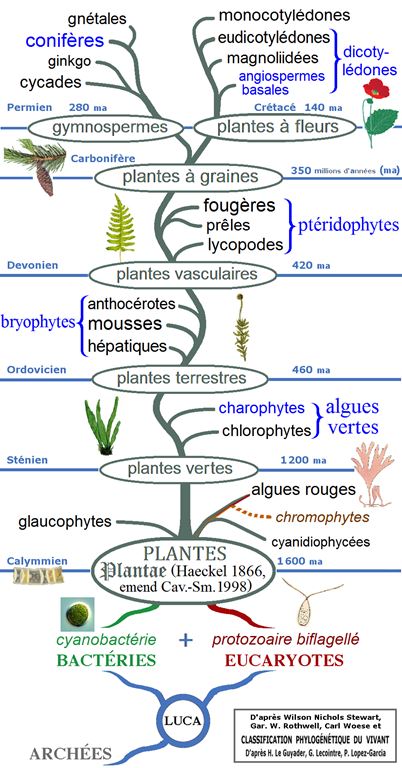
À droite, cet arbre phylogénétique des plantes montre les principaux clades et groupes traditionnels (monophylétiques en noir et paraphylétiques en bleu).
Dénominations
- Nom botanique : Alocasia cucullata (Lour.) G. Don (1839)
- Synonymes : Alocasia rugosa (Desf.) Schott 1854 ;
Dont basionyme : x ;
Dont homonyme(s) : Alocasia cucullata (Lour.) Schott 1832 ; - Noms anglais et locaux : Chinese ape, Chinese taro, giant taro, Kupfer-Pfeilblatt (de), inhame-chines (pt)
Description et culture
Tableau récapitulatif
Parties comes-tibles Note comest. (1-5) Note medic. (1-5) (Zones de) Rusticité Besoins en 
Besoins en  (1-3)
(1-3)Périodes de semis et récoltes Graines au gramme Durée de viabilité Profon-deur semis Espace-ment plants Espace-ment lignes Durée germi-native Durée avant récolte
-4°C J F M A M J
J A S O N D
J F M A M J
J A S O N D
- dont infos de 0FPI ("FOOD PLANTS INTERNATIONAL", en anglais) :
Description :
Une herbe. C'est une plante avec un tubercule et elle continue de croître d'année en année. Il ne peut pousser que pendant un an. Il atteint 1,5 m de haut. La tige peut mesurer 50 cm de long et 5 cm de large. La tige des feuilles mesure 1 m de long. La tige de la feuille rejoint le limbe au bord. La feuille est brillante et ovale à cœur. Il n'a que de courts lobes à la base. Il est vert. Le limbe mesure 40 cm de long sur 28 cm de large. Il forme librement des ventouses. Les fleurs ont une spathe de 9 à 15 cm de long{{{0(+x) (traduction automatique).
Original : A herb. It is a plant with a tuber and it keeps growing from year to year. It can grow for only one year. It grows to 1.5 m high. The stem can be 50 cm long and 5 cm wide. The leaf stalk is 1 m long. The leaf stalk joins the leaf blade at the edge. The leaf is glossy and oval to heart shaped. It only has short lobes at the base. It is green. The leaf blade is 40 cm long by 28 cm wide. It forms suckers freely. The flowers have a spathe 9-15 cm long{{{0(+x).
Culture :
Il est cultivé par division de la touffe ou à partir de compensations. Il peut également être cultivé à partir de graines{{{0(+x) (traduction automatique).
Original : It is grown by division of the clump or from offsets. It can also be grown from seed{{{0(+x).
 Consommation (rapports de comestibilité, parties utilisables et usages alimentaires correspondants)
Consommation (rapports de comestibilité, parties utilisables et usages alimentaires correspondants)Racine (cormes (rhizomes(27(+x)µ épaissis en tubercules écailleux) cuit (généralement dans plusieurs eaux)|{{{(dp*) [nourriture/aliment : légume{{{2(dp*),27(+x), féculent (amidon/fécule){{{2(dp*)]) comestible.(1*)
Partie testée :
corme{{{0(+x) (traduction automatique). Original : Corm{{{0(+x) Risques et précautions à prendre
Risques et précautions à prendre(1*)ATTENTION : plante toxique crue, voir genre Alocasia, pour plus d'informations{{{(dp*).
Galerie(s)
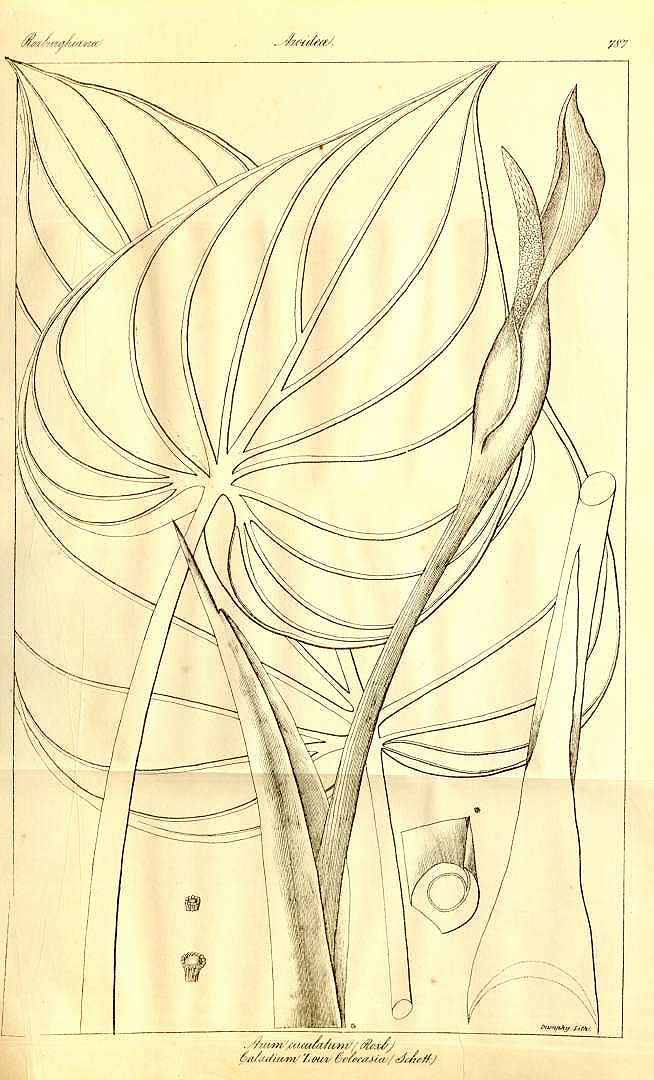
Par Wig
✖

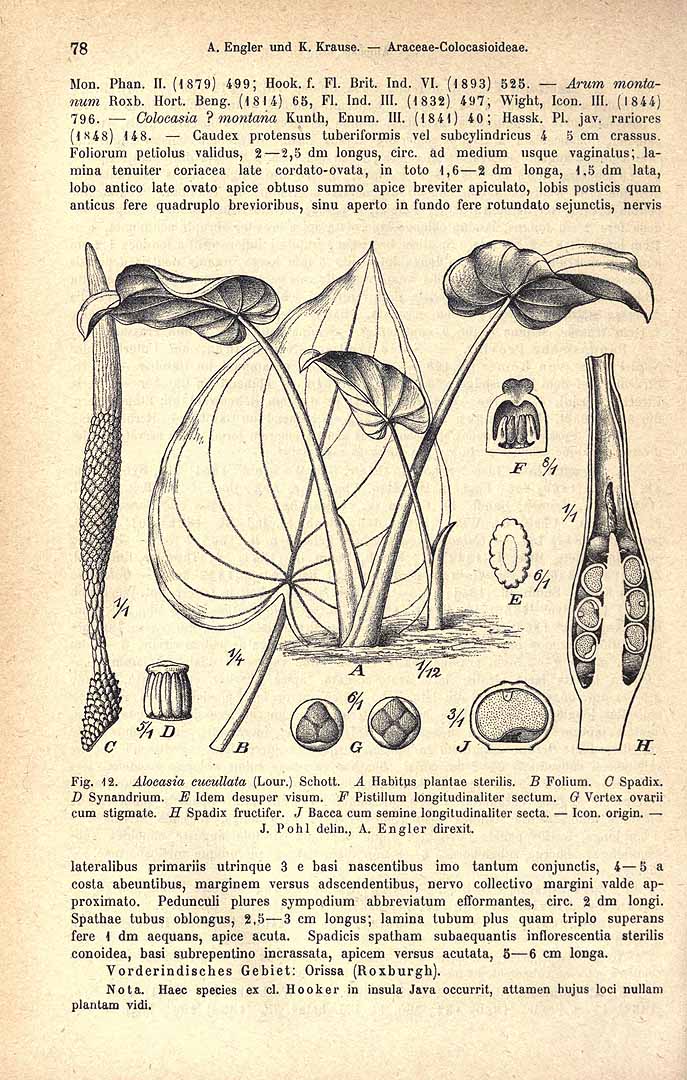
Par Engler, H.G.A., Pflanzenreich (1900-1968) Pflanzenr. vol. 23 (1920), via plantillustrations
✖

Autres infos
dont infos de 0FPI ("FOOD PLANTS INTERNATIONAL", en anglais) :
Statut :
Il est vendu sur les marchés locaux{{{0(+x) (traduction automatique).
Original : It is sold in local markets{{{0(+x).
Distribution :
Une plante tropicale. Il pousse dans les basses terres dans des endroits ouverts et humides. C'est l'un des Alocasias les plus résistants au froid. Jardin botanique de Cairns. Dans XTBG Yunnan. Au Sichuan{{{0(+x) (traduction automatique).
Original : A tropical plant. It grows in the lowlands in open, wet locations. It is one of the more cold hardy Alocasias. Cairns Botanical Garden. In XTBG Yunnan. In Sichuan{{{0(+x).
Localisation :
Asie, Australie, Bangladesh, Chine, Fidji, Hawaï, Himalaya, Inde, Indochine, Indonésie, Laos, Malaisie, Marquises, Îles Marshall, Micronésie, Myanmar, Nauru, Népal, Inde du nord-est, Pacifique, Rotuma, Asie du Sud-Est, Slovénie, Sri Lanka, Taiwan, Thaïlande, USA, Vietnam{{{0(+x) (traduction automatique).
Original : Asia, Australia, Bangladesh, China, Fiji, Hawaii, Himalayas, India, Indochina, Indonesia, Laos, Malaysia, Marquesas, Marshall Islands, Micronesia, Myanmar, Nauru, Nepal, Northeastern India, Pacific, Rotuma, SE Asia, Slovenia, Sri Lanka, Taiwan, Thailand, USA, Vietnam{{{0(+x).
Notes :
Il existe environ 60 à 70 espèces d'Alocasia{{{0(+x) (traduction automatique).
Original : There are about 60-70 Alocasia species{{{0(+x).
Rusticité (résistance face au froid/gel, climat)
-4°C
Liens, sources et/ou références
Liens :
/ ;Sources et/ou références :
bibliographie (liste des sources et/ou références de l'encyclopédie)
dont classification : TPL ("The Plant List", en anglais) ; 2GRIN ("Germplasm Resources Information Network", en anglais) ;
dont livres et bases de données : 27Dictionnaire des plantes comestibles (livre, page 19, par Louis Bubenicek) ;
dont bibliographie/références de 0FPI ("FOOD PLANTS INTERNATIONAL", en anglais) :
Ambasta S.P. (Ed.), 2000, The Useful Plants of India. CSIR India. p 29 ; Arora, R. K., 2014, Diversity in Underutilized Plant Species - An Asia-Pacific Perspective. Bioversity International. p 23 ; Bircher, A. G. & Bircher, W. H., 2000, Encyclopedia of Fruit Trees and Edible Flowering Plants in Egypt and the Subtropics. AUC Press. p 20 ; Brown, D., 2000, Aroids. Plants of the Arum family. Timber Press. (Second edition) p 262, 305 ; Burkill, I.H., 1966, A Dictionary of the Economic Products of the Malay Peninsula. Ministry of Agriculture and Cooperatives, Kuala Lumpur, Malaysia. Vol 1 (A-H) p 106 ; Devi, O.S., P. Komor & D. Das, 2010, A checklist of traditional edible bio-resources from Ima markets of Imphal Valley, Manipur, India. Journal of Threatened Taxa 2(11): 1291-1296 ; Jain et al, 2011, Dietary Use and Conservation Concern of Edible Wetland Plants at Indo-Burma Hotspot: A Case Study from Northeast India. Journal of Ethnobiology and Ethnomedicine 7:29 p 6 ; Kiple, K.F. & Ornelas, K.C., (eds), 2000, The Cambridge World History of Food. CUP p 1717 ; Konsam, S., et al, 2016, Assessment of wild leafy vegetables traditionally consumed by the ethnic communities of Manipur, northeast India. Journal of Ethnobiology and Ethnomedicine, 12:9 ; Kuo, W. H. J., (Ed.) Taiwan's Ethnobotanical Database (1900-2000), http://tk.agron.ntu.edu.tw/ethnobot/DB1.htm ; Li Heng, Araceae, Flora of China ; Lim, T. K., 2015, Edible Medicinal and Non Medicinal Plants. Volume 9, Modified Stems, Roots, Bulbs. Springer p 6 ; McClatchey, W., Thaman, R., & Vodonaivalu, S., 2000, A Preliminary Checklist of the Flora of Rotuma with Rotuman Names. Pacific Science (2000) Vol. 54, No. 4: 345-363 ; Medhi, P., Sarma, A and Borthakur, S. K., 2014, Wild edible plants from the Dima Hasao district of Assam, India. Pleione 8(1): 133-148 ; Onwueme, I.C., 1978, The Tropical Tuber Crops. Wiley, p 199 ; Pagag, K. & Borthakur, S.K., 2012, Wild edible wetland plants from Lakhimpur district of Assam, India. Pleione 6(2): 322 - 327 ; Patiri, B. & Borah, A., 2007, Wild Edible Plants of Assam. Geethaki Publishers. p 154 ; PROSEA handbook Volume 9 Plants yielding non-seed carbohydrates. p165 ; Staples, G.W. and Herbst, D.R., 2005, A tropical Garden Flora. Bishop Museum Press, Honolulu, Hawaii. p 599 (Drawing) ; Sukarya, D. G., (Ed.) 2013, 3,500 Plant Species of the Botanic Gardens of Indonesia. LIPI p 1055 ; R. Sweet, Hort. brit. ed. 3:631. 1839 "cucullatum" ; Thaman, R. R., et al, 1994, The Flora of Nauru. Atoll Research Bulletin No. 392. Smithsonian Institute p 39 ; USDA, ARS, National Genetic Resources Program. Germplasm Resources Information Network - (GRIN). [Online Database] National Germplasm Resources Laboratory, Beltsville, Maryland. Available: www.ars-grin.gov/cgi-bin/npgs/html/econ.pl (10 April 2000) ; Vander Velde, N, 2003, The Vascular Plants of Majuro Atoll, Republic of the Marshall Islands. Atoll research Bulletin. No. 503. Smithsonian Institute. p 16
Recherche de/pour :
- "Alocasia cucullata" sur Google (pages et
images) ;
IPNI ("International Plant Names Index", en anglais) ;
TROPICOS (en anglais) ;
Tela Botanica ;
Pl@ntNet ;
Pl@ntUse ;
"Plants For A Future" (en anglais) ;
"Useful Tropical Plants" (en anglais) ou
"Useful Temperate Plants" (en anglais) ;
- "Taro chinois" sur Google (pages, images et recettes) ;
- "Alocasia cucullata" sur Google (pages et
images) ;
IPNI ("International Plant Names Index", en anglais) ;
TROPICOS (en anglais) ;
Tela Botanica ;
Pl@ntNet ;
Pl@ntUse ;
"Plants For A Future" (en anglais) ;
"Useful Tropical Plants" (en anglais) ou
"Useful Temperate Plants" (en anglais) ;
Espèces du même genre (Alocasia)
11 taxons
- Alocasia acuminata Schott
- Alocasia brisbanensis
- Alocasia fallax Schott
- Alocasia fornicata
- Alocasia hollrungii Engl.
- Alocasia lancifolia Engl.
- Alocasia macrorrhizos (L.) G. Don (Oreille d'éléphant géante)
- Alocasia odora (Lindl.) K.Koch (Oreille d'éléphant)
- Alocasia portei Schott
- Alocasia sanderiana W.Bull
Espèces de la même famille (Araceae)
240 taxons
- Acore odorant
- Anguine
- Arisarum
- Arisème petit-prêcheur
- Arum
- Arum d'Italie
- Arum tacheté
- Belembe
- Caladion bicolore
- Canne à gratter
- Capuchon-de-moine
- Dragonne Serpentaire
- Ereriba
- Faux philodendron
- Koniaku
- Lenticule à trois lobes
- Lenticule bossue
- Lentille d'eau
- Lentille-d'eau
- Lysichite blanc
- Lysichiton américain
- Macabo
- Oreille d'éléphant
- Oreille d'éléphant géante
- Patte-d'oie
- Richarde
- Songe pâté
- Taro
- Taro géant des marais
- Tiquisque
- Typhonodore de Lindley
- Wolffie sans racines
- Acorus calamus L. (Acore odorant)
- Acorus gramineus Sol. ex Aiton
- Aglaonema costatum N.E.Br.
- Aglaonema philippinense Engl.
- Aglaonema pictum
- Alloschemone inopinata Bogner & P.C.Boyce
- Alocasia acuminata Schott
- Alocasia brisbanensis
- Alocasia fallax Schott
- Alocasia fornicata
- Alocasia hollrungii Engl.
- Alocasia lancifolia Engl.
- Alocasia macrorrhizos (L.) G. Don (Oreille d'éléphant géante)
- Alocasia odora (Lindl.) K.Koch (Oreille d'éléphant)
- Alocasia portei Schott
- Alocasia sanderiana W.Bull
- Amorphophallus abyssinicus Gombcz
- Amorphophallus albus P.Y.Liu & J.F.Chen
- Amorphophallus aphyllus
- Amorphophallus asterostigmatus Bogner & Hett.
- Amorphophallus bhandarensis S.R.Yadav, Kahalkar & Bhuskute
- Amorphophallus brevispathus Gagnep.
- Amorphophallus bulbifer
- Amorphophallus commutatus
- Amorphophallus consimilis Blume
- Amorphophallus dracontioides
- Amorphophallus gallaensis
- Amorphophallus glabra F.M.Bailey
- Amorphophallus gomboczianus Pic.Serm.
- Amorphophallus harmandii Engl. & Gehrm.
- Amorphophallus kachinensis Engl. & Gehrm.
- Amorphophallus konjac K.Koch (Koniaku)
- Amorphophallus konkanensis Hett., S.R.Yadav & K.S.Patil
- Amorphophallus koratensis Gagnep.
- Amorphophallus krausei Engl.
- Amorphophallus lyratus
- Amorphophallus margaritifer
- Amorphophallus muelleri Blume
- Amorphophallus paeoniifolius (Dennst.) Nicolson (Songe pâté)
- Amorphophallus prainii Hook.f.
- Amorphophallus purpurascens Kurz ex Hook.f.
- Amorphophallus rivieri
- Amorphophallus saraburiensis
- Amorphophallus stuhlmannii
- Amorphophallus sylvaticus
- Amorphophallus titanum
- Amorphophallus variabilis Blume
- Amorphophallus ximengensis H.Li
- Amorphophallus yuloensis H.Li
- Amorphophallus yunnanensis Engl.
- ...







 donne accès au menu
  - encyclopédies des plantes alimentaires ;
 - page de recherche - reconnaissance (identification) de plantes ;
 - page du calendrier lunaire et son générateur (au format PDF et JPG) ;
 - tableau récapitulatif ;
 - générateur de potées (soupes), avec estimation des apports nutrionnels et du coût;
 - générateur de codes QR ;
 - page des archives avec de nombreux documents sur différents thèmes complémentaires comme la botanique, les légumes,
les champignons, la cuisine, le bien-être ainsi que différents MOOC mais également des liens vers les archives de l'association ;
- page des archives avec de nombreux documents sur différents thèmes complémentaires comme la botanique, les légumes,
les champignons, la cuisine, le bien-être ainsi que différents MOOC mais également des liens vers les archives de l'association ;

 pour le fruit (et/ou les graines, la pulpe, etc...),
 pour les fleurs (et/ou pétales, calice...),
 pour les feuilles (et/ou la tige, les pousses...),
 pour les racines,
 pour le tronc (et/ou l'écorce, la sève...), et enfin
 pour les champignons,
puis les notes alimentaires et médicinales (de 1 à 5 étoiles), la rusticité (résistance au froid/gel)
et pour finir un résumé.
pour les champignons,
puis les notes alimentaires et médicinales (de 1 à 5 étoiles), la rusticité (résistance au froid/gel)
et pour finir un résumé. menant ici 🙂
 ,
,  et
et





 ,
,


 Encyclopédie(s)
 Recherche-Reconnaissance
 Tableau récapitulatif
 Codes QR
 Archives
 Calendrier(s) lunaire(s)
  Potées
 Re-naturation/naturalisation
 Affichettes, herbiers &
co.
Affichettes, herbiers &
co. menu
menu galerie


 (en bas à droite).
 (en bas à gauche).
