Prunier espagnol
(Spondias purpurea)
 |
****
|
****
Un arbre de taille moyenne. Il atteint une hauteur de 4 à 10 m. Il a un tronc irrégulier et une couronne large. Souvent, il est bas et tentaculaire. Il perd ses feuilles au ... (traduction automatique)
→suite


Prunier espagnol
Note alimentaire 

Un arbre de taille moyenne. Il atteint une hauteur de 4 à 10 m. Il a un tronc irrégulier et une couronne large. Souvent, il est bas et tentaculaire. Il perd ses feuilles au cours de l'année. Les feuille... (traduction automatique) →suite
Spondias purpurea
Classification
- Classique : en haut de l'écran, sous le coeur.
- Phylogénétique :
- Clade 4 : Angiospermes ;
- Clade 3 : Dicotylédones_vraies ;
- Clade 2 : Rosidées ;
- Clade 1 : Malvidées ;
- Ordre APN : Sapindales ;
- Famille APN : Anacardiaceae ;
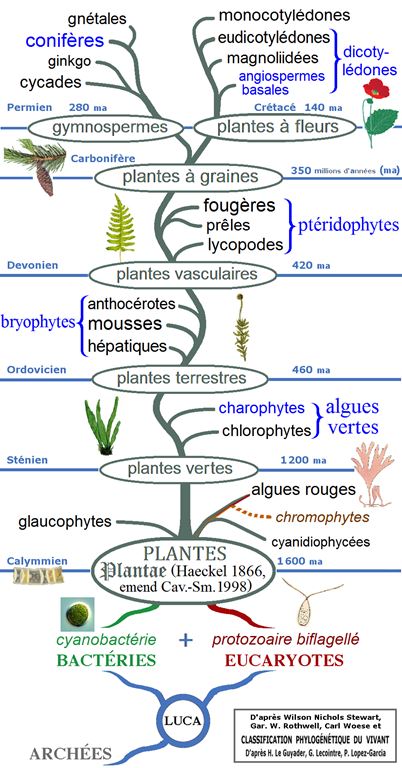
À droite, cet arbre phylogénétique des plantes montre les principaux clades et groupes traditionnels (monophylétiques en noir et paraphylétiques en bleu).
Dénominations
- Nom botanique : Spondias purpurea L. (1753)
- Synonymes : Spondias mombin L. (1759) non L. (1753), Spondias cirouella Tussac, Spondias crispula Beurl, Spondias macrocarpa Engl, Spondias mexicana S. Watson, Spondias mombin Descourt, Spondias myrobalanus L, Warmingia macrocarpa Engl, Warmingia pauciflora Engl
- Noms anglais et locaux : purple mombin
Description et culture
Tableau récapitulatif
Parties comes-tibles Note comest. (1-5) Note medic. (1-5) (Zones de) Rusticité Besoins en 
Besoins en  (1-3)
(1-3)Périodes de semis et récoltes Graines au gramme Durée de viabilité Profon-deur semis Espace-ment plants Espace-ment lignes Durée germi-native Durée avant récolte J F M A M J
J A S O N D
J F M A M J
J A S O N D
- dont infos de 0FPI ("FOOD PLANTS INTERNATIONAL", en anglais) :
Description :
Un arbre de taille moyenne. Il atteint une hauteur de 4 à 10 m. Il a un tronc irrégulier et une couronne large. Souvent, il est bas et tentaculaire. Il perd ses feuilles au cours de l'année. Les feuilles sont composées de 5 à 12 paires de folioles. Les folioles mesurent 2 à 4 cm de long et tombent avant la floraison. Les fleurs sont rouges et en groupes de 3 à 5 cm de long. Ils sont sur les petites branches. Les fruits sont petits et rouges et sous-acides. Ils sont ronds ou ovales et mesurent 2,5 à 5 cm de long. Ils poussent souvent en grappes de trois. Le fruit est comestible. Le fruit a un noyau ligneux qui contient la graine. La chair est jaune crème{{{0(+x) (traduction automatique).
Original : A medium sized tree. It grows 4-10 m high. It has an irregular trunk and broad crown. Often it is low and sprawling. It loses its leaves during the year. The leaves are made up of 5-12 pairs of leaflets. The leaflets are 2-4 cm long and they fall before flowering. The flowers are red and in groups 3-5 cm long. They are on the small branches. The fruit are small and red and sub-acid. They are round or oval and 2.5-5 cm long. They often grow in clusters of three. The fruit is edible. The fruit has a woody kernel which contains the seed. The flesh is creamy-yellow{{{0(+x).
Production :
Le fruit mûrit en 120 jours environ{{{0(+x) (traduction automatique).
Original : The fruit matures in about 120 days{{{0(+x).
Culture :
Les graines ne poussent normalement pas. Les plantes sont cultivées par boutures et pousses de tige. Des boutures droites de 6 cm d'épaisseur et 1,5 m de long sont utilisées. Les boutures sont effectuées au début de la production de feuilles. Les boutures sont conservées à l'ombre pendant quelques semaines. Ils sont ensuite plantés à 8 m l'un de l'autre et à une profondeur de 30 cm. Les fleurs bourgeonnent sur la croissance de l'année en cours, donc la taille peut être faite chaque année. La taille augmente la taille et le poids des fruits{{{0(+x) (traduction automatique).
Original : Seeds do not normally grow. Plants are grown by cuttings and stem sprouts. Straight cuttings 6 cm thick and 1.5 m long are used. The cuttings are made at the start of leaf production. The cuttings are kept in the shade for a couple of weeks. They are then planted 8 m apart and at a depth of 30 cm. Flowers bud on the current year's growth so pruning can be done yearly. Pruning increases the size and weight of fruit{{{0(+x).
 Consommation (rapports de comestibilité, parties utilisables et usages alimentaires correspondants)
Consommation (rapports de comestibilité, parties utilisables et usages alimentaires correspondants)Fruits consommés crus, cuits ou en confiture ; graines comestibles{{{27(+x).
Partie testée :
fruit{{{0(+x) (traduction automatique). Original : Fruit{{{0(+x)| Taux d'humidité (%) | Énergie (kj) | Énergie (kcal) | Protéines (g) |
|---|---|---|---|
| 76.2 | 347 | 83 | 83 0.16 |
| Pro- vitamines A (µg) |
Vitamines C (mg) | Fer (mg) | Zinc (mg) |
| 30 | 45 | 347 1.1 | 0 |
 Risques et précautions à prendre
Risques et précautions à prendrenéant, inconnus ou indéterminés.
Galerie(s)
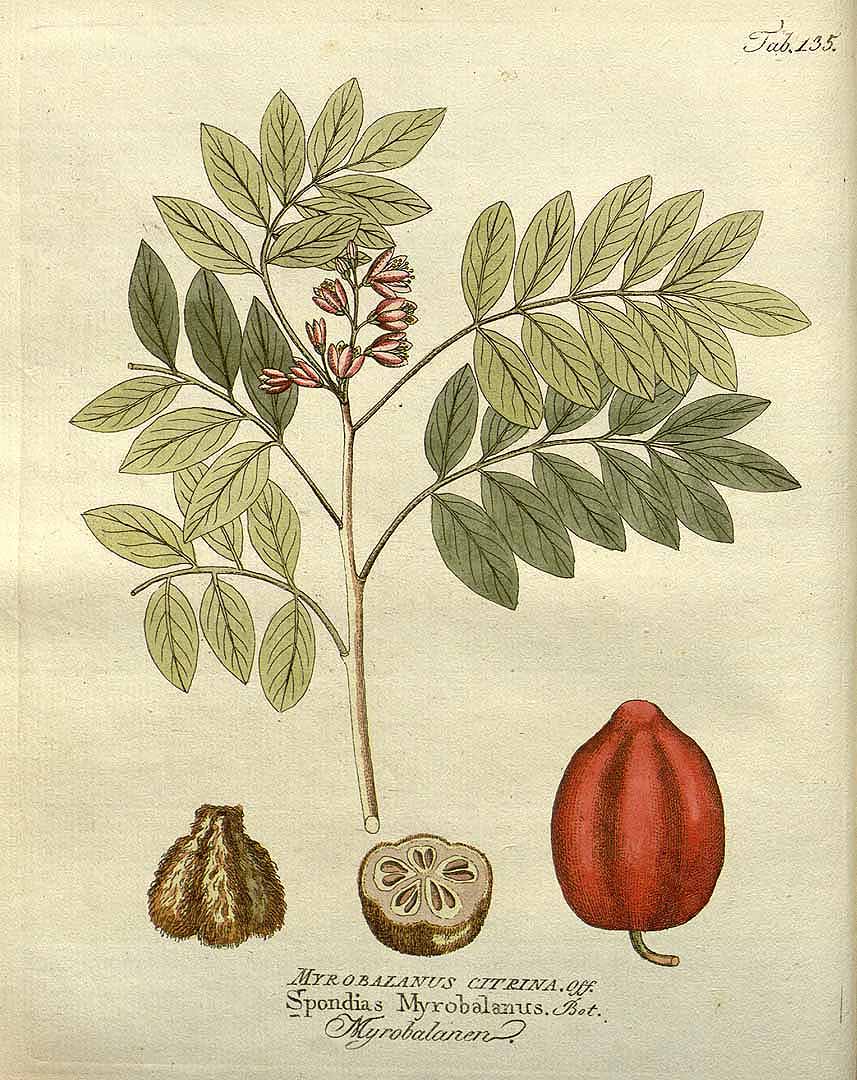
Par Vietz, F.B., Icones plantarum medico-oeconomico-technologicarum (1800-1822) Icones Pl. Med.-Oecon. vol. 2 (1804) t. 135, via plantillustrations
✖

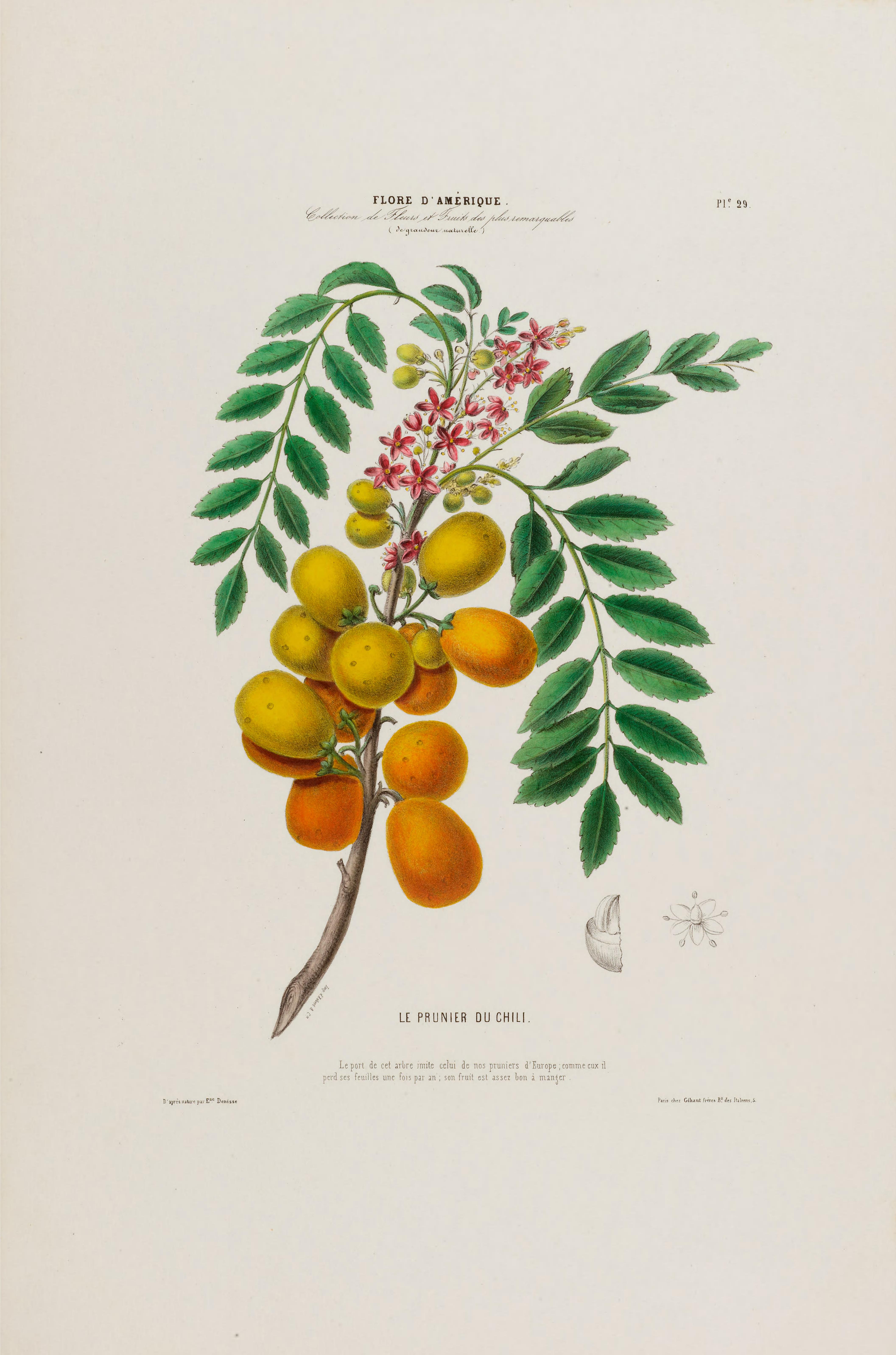
Par Denisse, E., Flore dAmérique (1843-1846) Fl. Amérique t. 29, via plantillustrations
✖

Autres infos
Plante cultivée au Brésil{{{27(+x).
Statut :
C'est une plante alimentaire cultivée. Les fruits sont vendus sur les marchés{{{0(+x) (traduction automatique).
Original : It is a cultivated food plant. Fruit are sold in markets{{{0(+x).
Distribution :
C'est une plante tropicale. Il convient aux basses terres tropicales chaudes. Il pousse naturellement en Amérique tropicale. Il résiste à la sécheresse. Il produira sur des sols pauvres. Ils poussent du niveau de la mer à 1 200 m d'altitude au Mexique{{{0(+x) (traduction automatique).
Original : It is a tropical plant. It suits the hot tropical lowlands. It grows naturally in tropical America. It is resistant to drought. It will produce on poor soils. They grow from sea level to 1,200 m altitude in Mexico{{{0(+x).
Localisation :
Afrique, Amazonie, Anguilla, Antigua-et-Barbuda, Asie, Aruba, Australie, Bahamas, Barbade, Belize, Bolivie, Brésil, Amérique centrale *, Colombie, Costa Rica, Cuba, République dominicaine, Équateur, El Salvador, Grenade, Guadeloupe, Guam , Guatemala, Guyane, Guinée-Bissau, Guyane, Haïti, Honduras, Jamaïque, Petites Antilles, Martinique, Mexique *, Nicaragua, Amérique du Nord, Pacifique, Panama, Pérou, Philippines, Porto Rico, Asie du Sud-Est, Sierra Leone, Amérique du Sud, Sainte-Lucie, Saint-Vincent-et-Grenadines, USA, Venezuela, Afrique de l'Ouest, Antilles{{{0(+x) (traduction automatique).
Original : Africa, Amazon, Anguilla, Antigua and Barbuda, Asia, Aruba, Australia, Bahamas, Barbados, Belize, Bolivia, Brazil, Central America*, Colombia, Costa Rica, Cuba, Dominican Republic, Ecuador, El Salvador, Grenada, Guadeloupe, Guam, Guatemala, Guiana, Guinea-Bissau, Guyana, Haiti, Honduras, Jamaica, Lesser Antilles, Martinique, Mexico*, Nicaragua, North America, Pacific, Panama, Peru, Philippines, Puerto Rico, SE Asia, Sierra Leone, South America, St. Lucia, St. Vincent and Grenadines, USA, Venezuela, West Africa, West Indies{{{0(+x).
Liens, sources et/ou références
Liens :
/ ;Sources et/ou références :
bibliographie (liste des sources et/ou références de l'encyclopédie)
dont classification : IPNI ("International Plant Names Index", en anglais) ; TPL ("The Plant List", en anglais) ; Kew (POWO - "Plant Of the World Online", "Royal Botanical Garden", en anglais) ;
dont livres et bases de données : 5PFAF ("Plants For A Future", en anglais) ; 27Dictionnaire des plantes comestibles (livre, page 292, par Louis Bubenicek) ;
dont bibliographie/références de 0FPI ("FOOD PLANTS INTERNATIONAL", en anglais) :
Altschul, S.V.R., 1973, Drugs and Foods from Little-known Plants. Notes in Harvard University Herbaria. Harvard Univ. Press. Massachusetts. no. 2493 ; Arellanes, Y., et al, 2013, Influence of traditional markets on plant management in the Tehuacan Valley. Journal of Ethnobiology and Ethnomedicine 9:38 ; Barfod, A. S. & Kvist, L. P., 1996, Comparative Ethnobotanical Studies of the Amerindian Groups in Coastal Ecuador. The Danish Academy of Sciences and Letters. p 76 ; Barwick, M., 2004, Tropical and Subtropical Trees. A Worldwide Encyclopedic Guide. Thames and Hudson p 380 ; Burkill, H. M., 1985, The useful plants of west tropical Africa, Vol. 1. Kew. ; Chizmar Fernandez, C., et al, 2009, Plantas comestibles de Centroamerica. Instituto de Biodiversidad, Costa Rica. p 29 ; Coe, F. G., and Anderson, G. J., 1996, Ethnobotany of the Garifuna of Eastern Nicaragua. Economic Botany 50(1) pp 71-107 ; Coe, F. G. and Anderson, G. J., 1999, Ethnobotany of the Sumu (Ulwa) of Southeastern Nicaragua and Comparisons with Miskitu Plant Lore. Economic Botany Vol. 53. No. 4. pp. 363-386 ; Coronel, R.E., 1982, Fruit Collections in the Philippines. IBPGR Newsletter p 8 ; Cruz, I. M., et al, 2015, Edible fruits and seeds in the State of Mexico. Revista Mexicana de Ciencias Agricolas. Vol. 6. Num. 2 pp 331-346 ; Darley, J.J., 1993, Know and Enjoy Tropical Fruit. P & S Publishers. p 121 ; Ding Hou, 1978, Anacardiaceae, in Flora Malesiana Ser 1 Vol 8(3) p 479-486. p 485 ; Facciola, S., 1998, Cornucopia 2: a Source Book of Edible Plants. Kampong Publications, p 11 ; FAO, 1993, Valor Nutritivo Y Usis en Alimantacion humana de Algunis Cultivos Autoctonos Subexplotados de Mesoamerica. FAO, Santiago, Chile. p 22 ; Flowerdew, B., 2000, Complete Fruit Book. Kyle Cathie Ltd., London. p 163 ; Food Composition Tables for use in East Asia FAO http://www.fao.org/infoods/directory No. 917 ; Grandtner, M. M., 2008, World Dictionary of Trees. Wood and Forest Science Department. Laval University, Quebec, Qc Canada. (Internet database http://www.wdt.qc.ca) ; Hedrick, U.P., 1919, (Ed.), Sturtevant's edible plants of the world. p 632 ; Hermandez Bermejo, J.E., and Leon, J. (Eds.), 1994, Neglected Crops. 1492 from a different perspective. FAO Plant Production and Protection Series No 26. FAO, Rome. p14, 111 ; Hibbert, M., 2002, The Aussie Plant Finder 2002, Florilegium. p 293 ; Janick, J. & Paul, R. E. (Eds.), 2008, The Encyclopedia of Fruit & Nuts. CABI p 34 ; Jardin, C., 1970, List of Foods Used In Africa, FAO Nutrition Information Document Series No 2.p 163 ; John, L., & Stevenson, V., 1979, The Complete Book of Fruit. Angus & Robertson p 154 ; JSTOR Global Plants edible ; Kermath, B. M., et al, 2014, Food Plants in the Americas: A survey of the domesticated, cultivated and wild plants used for Human food in North, Central and South America and the Caribbean. On line draft. p 834 ; Kiple, K.F. & Ornelas, K.C., (eds), 2000, The Cambridge World History of Food. CUP p 1785, 1856 ; Llamas, K.A., 2003, Tropical Flowering Plants. Timber Press. p 60 ; Lorenzi, H., Bacher, L., Lacerda, M. & Sartori, S., 2006, Brazilian Fruits & Cultivated Exotics. Sao Paulo, Instituto Plantarum de Estuados da Flora Ltda. p 357 ; Martin, F.W. & Ruberte, R.M., 1979, Edible Leaves of the Tropics. Antillian College Press, Mayaguez, Puerto Rico. p 55, 175 ; Martin, F. W., et al, 1987, Perennial Edible Fruits of the Tropics. USDA Handbook 642 p 15 ; Morton, J. F., 1987, Fruits of Warm Climates. Wipf & Stock Publishers p 242 ; NYBG Herbarium "edible" ; Omawale, 1973, Guyana's edible plants. Guyana University, Georgetown p 49 ; Plants of Haiti Smithsonian Institute http://botany.si.edu ; Popenoe, W., 1920, ; Purseglove, J.W., 1968, Tropical Crops Dicotyledons, Longmans. p 18 ; Recher, P, 2001, Fruit Spirit Botanical Gardens Plant Index. www.nrg.com.au/~recher/ seedlist.html p 3 ; Rivero, J. A., y Brunner, B. R., 2007, Arborels frutales exoticas y poco conocidos en Puerto Rico. Universidad de Puerto Rico. p 12 ; Sp. pl. ed. 2, 1:613. 1762 ; Tankard, G., 1990, Tropical fruit. An Australian Guide to Growing and using exotic fruit. Viking p 114 ; Terra, G.J.A., 1973, Tropical Vegetables. Communication 54e Royal Tropical Institute, Amsterdam, p 76 ; Timyan, J., 1996, Bwa Yo: Important Trees of Haiti. SE Consortium for International Development. Washington. p 220 ; Turreira-Garcia, N., et al, 2015, Wild edible plant knowledge, distribution and transmission: a case study of the Achi Mayans of Guatemala. Journal of Ethnobiology and Ethnomedicine. 11:52 ; USDA, ARS, National Genetic Resources Program. Germplasm Resources Information Network - (GRIN). [Online Database] National Germplasm Resources Laboratory, Beltsville, Maryland. Available: www.ars-grin.gov/cgi-bin/npgs/html/econ.pl (10 April 2000) ; Vael, L., 2015, Ethnobotanical study of the plant use in the natural landscape of two mestizo communities in the Ucayali region of the Peruvian Amazon. Universiteit Gent. ; van Wyk, B., 2005, Food Plants of the World. An illustrated guide. Timber press. p 355 ; Walter, A. & Sam C., 2002, Fruits of Oceania. ACIAR Monograph No. 85. Canberra. p 245 ; Wilson, M. R., Ethnobotanical List. PhD thesis: A Highland Maya People and Their Habitat. quantamike.ca ; Woodson, R. E. et al, 1967, Flora of Panama. Part 6. Family 101. Anacardiaceae. Annals of the Missouri Botanical Gardens, Vol. 54, No. 3 p 361 ; www.worldagroforestrycentre.org/treedb/ ; Zuchowski W., 2007, Tropical Plants of Costa Rica. A Zona Tropical Publication, Comstock Publishing. p 213
Recherche de/pour :
- "Spondias purpurea" sur Google (pages et
images) ;
GRIN ("Germplasm Resources Information Network", en anglais) ;
TROPICOS (en anglais) ;
Tela Botanica ;
Pl@ntNet ;
Pl@ntUse ;
"Useful Tropical Plants" (en anglais) ou
"Useful Temperate Plants" (en anglais) ;
- "Prunier espagnol" sur Google (pages, images et recettes) ;
- "Spondias purpurea" sur Google (pages et
images) ;
GRIN ("Germplasm Resources Information Network", en anglais) ;
TROPICOS (en anglais) ;
Tela Botanica ;
Pl@ntNet ;
Pl@ntUse ;
"Useful Tropical Plants" (en anglais) ou
"Useful Temperate Plants" (en anglais) ;
Espèces du même genre (Spondias)
20 taxons
- Spondias acida Blume
- Spondias admirabilis J.D.Mitch. & Daly
- Spondias axillaris Roxb.
- Spondias bipinnata Airy Shaw & Forman
- Spondias borbonica
- Spondias dulcis Parkinson (Pomme cythère)
- Spondias lakonensis Pierre
- Spondias macrocarpa Engl.
- Spondias malayana Kosterm.
- Spondias mombin L. (Prunier mombin)
- Spondias novoguineensis Kosterm.
- Spondias philippinensis
- Spondias pinnata (L. f.) Kurz
- Spondias radlkoferi Donn.Sm.
- Spondias testudinis J.D.Mitch. & Daly
- Spondias tuberosa Arruda (Umbu)
- Spondias tuberosa x Spondias mombin
- Spondias venosa Mart. ex Colla
- Spondias venulosa (Mart. ex Engl.) Engl.
Espèces de la même famille (Anacardiaceae)
322 taxons
- Anacardier
- Anacardier de l'Inde
- Anacardier géant
- Anacardier sauvage
- Baies à limonade (tp* de "lemonade berry")
- Binjai
- Faux-poivrier
- Faux-poivrier odorant
- Huigen
- Kemang
- Khinjuk
- Laitue d'eau
- Lapsi
- Manguier
- Manguier kalimantan
- Manguier parfumé
- Manguier pari
- Maprang
- Marula
- Noix de singes (tp* de "Monkey nut")
- Pistachier
- Pistachier de lAtlas
- Pistachier lentisque
- Pistachier térébinthe
- Pomme cythère
- Prune cafre
- Prunier mombin
- Raisin d'afrique
- Sambal
- Sumac
- Sumac à long pied
- Sumac à sucre (tp* de "sugar sumac")
- Sumac de virginie
- Sumac Fustet
- Sumac glabre
- Sumac hybride
- Umbu
- Allospondias sp.
- Amphipterygium adstringens (Schltdl.) Schiede ex Standl.
- Anacardium amapaense J.D.Mitch.
- Anacardium corymbosum Barb.Rodr.
- Anacardium excelsum (Bertero ex Kunth) Skeels (Anacardier sauvage)
- Anacardium fruticosum J.Mitch. & S.A.Mori
- Anacardium giganteum Hancock ex Engl. (Anacardier géant)
- Anacardium humile A.St.-Hil. (Noix de singes (tp* de "Monkey nut"))
- Anacardium macrocarpa Engler
- Anacardium microcarpum Ducke
- Anacardium microsepalum Loes.
- Anacardium nanum A.St.-Hil.
- Anacardium negrense Pires et Froes.
- Anacardium occidentale L. (Anacardier)
- Anacardium othonianum Rizzini
- Anacardium parvifolium Ducke
- Anacardium pumilum Walp.
- Anacardium spruceanum Benth. ex Engl.
- Antrocaryon amazonicum (Ducke) B.L.Burtt & A.W.Hill
- Antrocaryon klaineanum Pierre
- Antrocaryon micraster A.Chev. & Guillaumin
- Antrocaryon nannanii De Wild.
- Bouea macrophylla Griff. (Maprang)
- Bouea oppositifolia (Roxb.) Meisn.
- Buchanania arborescens F.Muell.
- Buchanania axillaris (Desr.) Ramamoorthy
- Buchanania cochinchinensis (Lour.) M.R.Almeida
- Buchanania lanceolata Wight
- Buchanania lancifolia Roxb.
- Buchanania nitida Engl.
- Buchanania obovata Engl.
- Buchanania reticulata Elmer
- Buchanania sessilifolia
- Buchanania siamensis Miq.
- Buchanania splendens Miq.
- Campnosperma oxyrachis
- Campnosperma panamense Standl.
- Choerospondias axillaris (Roxb.) B. L. Burtt & A. W. Hill (Lapsi)
- Comocladia mollissima Kunth
- Comocladia pinnatifolia L.
- Cotinus coggygria Scop. (Sumac Fustet)
- Cyrtocarpa edulis (Brandegee) Standl.
- Cyrtocarpa procera Kunth
- Dracontomelon costatum Blume
- Dracontomelon dao (Blanco) Merr. & Rolfe
- Dracontomelon duperreanum Pierre
- Dracontomelon lenticulatum H.P.Wilk.
- Dracontomelon macrocarpum H.L.Li
- Dracontomelon vitiense Engl.
- Euroschinus falcatus Hook.f.
- ...







 donne accès au menu
  - encyclopédies des plantes alimentaires ;
 - page de recherche - reconnaissance (identification) de plantes ;
 - page du calendrier lunaire et son générateur (au format PDF et JPG) ;
 - tableau récapitulatif ;
 - générateur de potées (soupes), avec estimation des apports nutrionnels et du coût;
 - générateur de codes QR ;
 - page des archives avec de nombreux documents sur différents thèmes complémentaires comme la botanique, les légumes,
les champignons, la cuisine, le bien-être ainsi que différents MOOC mais également des liens vers les archives de l'association ;
- page des archives avec de nombreux documents sur différents thèmes complémentaires comme la botanique, les légumes,
les champignons, la cuisine, le bien-être ainsi que différents MOOC mais également des liens vers les archives de l'association ;

 pour le fruit (et/ou les graines, la pulpe, etc...),
 pour les fleurs (et/ou pétales, calice...),
 pour les feuilles (et/ou la tige, les pousses...),
 pour les racines,
 pour le tronc (et/ou l'écorce, la sève...), et enfin
 pour les champignons,
puis les notes alimentaires et médicinales (de 1 à 5 étoiles), la rusticité (résistance au froid/gel)
et pour finir un résumé.
pour les champignons,
puis les notes alimentaires et médicinales (de 1 à 5 étoiles), la rusticité (résistance au froid/gel)
et pour finir un résumé. menant ici 🙂
 ,
,  et
et





 ,
,


 Encyclopédie(s)
 Recherche-Reconnaissance
 Tableau récapitulatif
 Codes QR
 Archives
 Calendrier(s) lunaire(s)
  Potées
 Re-naturation/naturalisation
 Affichettes, herbiers &
co.
Affichettes, herbiers &
co. menu
menu galerie


 (en bas à droite).
 (en bas à gauche).
