Richarde
(Zantedeschia aethiopica)
Pas d'illustration
pour le moment 😕
 |
*
-
*
|
*
-
*
Une herbe succulente. C'est une plante vivace. Les racines sont charnues et forment des organes de stockage souterrains. Il pousse de 90 à 120 cm de haut et de 50 à 75 cm de ... (traduction automatique)
→suite


Richarde
Note alimentaire 
Note médicinale 

Une herbe succulente. C'est une plante vivace. Les racines sont charnues et forment des organes de stockage souterrains. Il pousse de 90 à 120 cm de haut et de 50 à 75 cm de large. Les plantes forment de... (traduction automatique) →suite
Pas d'illustration
pour le moment 😕
Pas d'illustration
pour le moment 😕
Zantedeschia aethiopica
Classification
- Classique : en haut de l'écran, sous le coeur.
- Phylogénétique :
- Clade 4 : Angiospermes ;
- Clade 3 : Monocotylédones ;
- Ordre APN : Alismatales ;
- Famille APN : Araceae ;
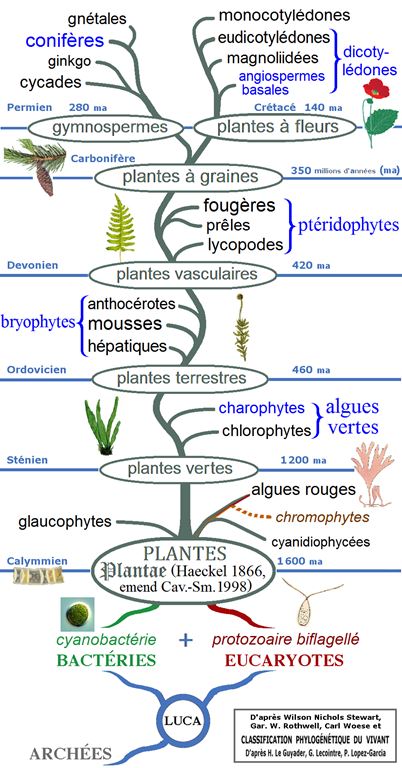
À droite, cet arbre phylogénétique des plantes montre les principaux clades et groupes traditionnels (monophylétiques en noir et paraphylétiques en bleu).
Dénominations
- Nom botanique : Zantedeschia aethiopica (L.) Sprengel
- Synonymes : Richardia africana Kunth, Calla aethiopica Linn
- Noms anglais et locaux : Arum Lily, Calla lily, White Calla Lily
Description et culture
Tableau récapitulatif
Parties comes-tibles Note comest. (1-5) Note medic. (1-5) (Zones de) Rusticité Besoins en 
Besoins en  (1-3)
(1-3)Périodes de semis et récoltes Graines au gramme Durée de viabilité Profon-deur semis Espace-ment plants Espace-ment lignes Durée germi-native Durée avant récolte Zones de rusticité : 8, 9, 10 J F M A M J
J A S O N D
J F M A M J
J A S O N D
Types de feuillage :
Persistant
- dont infos de 0FPI ("FOOD PLANTS INTERNATIONAL", en anglais) :
Description :
Une herbe succulente. C'est une plante vivace. Les racines sont charnues et forment des organes de stockage souterrains. Il pousse de 90 à 120 cm de haut et de 50 à 75 cm de large. Les plantes forment des touffes denses de feuilles. Les feuilles sont brillantes et en forme de flèche. Ils mesurent 40 cm de long. Les feuilles sont sur des tiges issues de la base de la plante. Les tiges peuvent mesurer 40 cm de long. Les tiges des feuilles ont une sève collante lorsqu'elles sont cassées. Les fleurs ont des spathes blanches et un spadice jaune. Les spathes blanches sont en forme d'entonnoir avec une fente sur le côté. La tige ou le spadice au centre a de vraies fleurs qui sont regroupées le long de celle-ci. Après la floraison, des baies jaunes ovales se forment et ont des graines rondes{{{0(+x) (traduction automatique).
Original : A succulent herb. It is a perennial plant. The roots are fleshy and form underground storage organs. It grows 90-120 cm high and 50-75 cm wide. Plants form dense clumps of leaves. The leaves are glossy and arrow-shaped. They are 40 cm long. The leaves are on stalks arising from the base of the plant. The stalks can be 40 cm long. The leaf stalks have a sticky sap when broken. The flowers have white spathes and a yellow spadix. The white spathes are funnel shaped with a split down the side. The stalk or spadix in the centre has true flowers are clustered along this. After flowering oval yellow berries form and these have round seed{{{0(+x).
Culture :
Les plantes peuvent être cultivées à partir de graines semées dès qu'elles sont mûres et à 21-27 ° C. Ils peuvent être cultivés par division de la touffe. Les tubercules sont plantés à 30-40 cm de distance et 10 cm de profondeur{{{0(+x) (traduction automatique).
Original : Plants can be grown from seed sown as soon as ripe and at 21-27°C. They can be grown by division of the clump. The tubers are planted 30-40 cm apart and 10 cm deep{{{0(+x).
 Consommation (rapports de comestibilité, parties utilisables et usages alimentaires correspondants)
Consommation (rapports de comestibilité, parties utilisables et usages alimentaires correspondants)Parties comestibles :
feuilles, légumes, attention{{{0(+x) (traduction automatique). Original : Leaves, Vegetable, Caution{{{0(+x).Détails :
ATTENTION: La tige de la fleur et les racines sont toxiques si elles sont consommées crues. Comme beaucoup de plantes de cette famille, elles contiennent des oxalates qui nécessitent un traitement spécial pour les éliminer. Les jeunes feuilles et les tiges de feuilles sont consommées comme légume. La torréfaction et l'ébullition suppriment la toxicité{{{0(+x) (traduction automatique).
Original : CAUTION: The flower stalk and the roots are poisonous if eaten raw. Like many plants in this family they contain oxalates that need special processing to remove these. The young leaves and leaf stalks are eaten as a vegetable. Roasting and boiling removes the toxicity{{{0(+x).
Partie testée :
/ Risques et précautions à prendre
Risques et précautions à prendrecf. consommation
Autres infos
dont infos de 0FPI ("FOOD PLANTS INTERNATIONAL", en anglais) :
Statut :
C'est un aliment de famine{{{0(+x) (traduction automatique).
Original : It is a famine food{{{0(+x).
Distribution :
C'est une plante tempérée. Il peut supporter de légères gelées. Il peut pousser naturellement le long des cours d'eau. Il convient aux zones marécageuses. Ils peuvent pousser en plein soleil ou à l'ombre légère. En Argentine, il passe du niveau de la mer à 1000 m au-dessus du niveau de la mer. Il convient aux zones de rusticité 8-11. Herbier de Tasmanie{{{0(+x) (traduction automatique).
Original : It is a temperate plant. It can stand light frosts. It can grow naturally along watercourses. It suits swampy areas. They can grow in full sun or light shade. In Argentina it grows from sea level to 1,000 m above sea level. It suits hardiness zones 8-11. Tasmania Herbarium{{{0(+x).
Localisation :
Afrique, Argentine, Asie, Australie, Botswana, Brésil, Amérique centrale, Chili, Costa Rica, Afrique de l'Est, Eswatini, Éthiopie, Guatemala, Inde, Indonésie, Lesotho, Mozambique, Pakistan, Île Norfolk, Asie du Sud-Est, Slovénie, Afrique du Sud, Afrique australe, Amérique du Sud, Swaziland, Tasmanie, Uruguay{{{0(+x) (traduction automatique).
Original : Africa, Argentina, Asia, Australia, Botswana, Brazil, Central America, Chile, Costa Rica, East Africa, Eswatini, Ethiopia, Guatemala, India, Indonesia, Lesotho, Mozambique, Pakistan, Norfolk Island, SE Asia, Slovenia, South Africa, Southern Africa, South America, Swaziland, Tasmania, Uruguay{{{0(+x).
Notes :
Il existe 6 à 8 espèces de Zantedeschia. Cela peut être invasif{{{0(+x) (traduction automatique).
Original : There are 6-8 Zantedeschia species. It can be invasive{{{0(+x).
Rusticité (résistance face au froid/gel, climat)
Zones de rusticité : 8, 9, 10
Liens, sources et/ou références
Liens :
/ ;Sources et/ou références :
bibliographie (liste des sources et/ou références de l'encyclopédie)
dont livres et bases de données : 5PFAF ("Plants For A Future", en anglais) ; 0FPI ("FOOD PLANTS INTERNATIONAL", en anglais) ;
Warning: Undefined variable $prex in /home/waso5761/public_html/inc/fiches.php on line 2607
dont bibliographie/références de 0FPI ("FOOD PLANTS INTERNATIONAL", en anglais) :
Ambasta, S.P. (Ed.), 2000, The Useful Plants of India. CSIR India. p 697 ; Bodkin, F., 1991, Encyclopedia Botanica. Cornstalk publishing, p 1033 ; Borrell, O.W., 1989, An Annotated Checklist of the Flora of Kairiru Island, New Guinea. Marcellin College, Victoria Australia. p 18 ; Brickell, C. (Ed.), 1999, The Royal Horticultural Society A-Z Encyclopedia of Garden Plants. Convent Garden Books. p 1067 ; Burkill, I.H., 1966, A Dictionary of the Economic Products of the Malay Peninsula. Ministry of Agriculture and Cooperatives, Kuala Lumpur, Malaysia. Vol 2 (I-Z) p 2326 ; Burnie, G.(Ed.), 2003, Annuals and Bulbs. The Gardener's Handbooks. Fog City Press. p 306 ; Cundall, P., (ed.), 2004, Gardening Australia: flora: the gardener's bible. ABC Books. p 1494 ; Dashorst, G.R.M., and Jessop, J.P., 1998, Plants of the Adelaide Plains & Hills. Botanic Gardens of Adelaide and State Herbarium. p 162 ; Flora of Australia Volume 49, Oceanic Islands 1, Australian Government Publishing Service, Canberra. (1994) p 416 ; Fox, F. W. & Young, M. E. N., 1982, Food from the Veld. Delta Books. p 96 ; Harris, S., Buchanan, A., Connolly, A., 2001, One Hundred Islands: The Flora of the Outer Furneaux. Tas Govt. p 249 ; Harter, J.(Ed.), 1988, Plants. 2400 copyright free illustrations. Dover p 26.4, 26.7 ; Hibbert, M., 2002, The Aussie Plant Finder 2002, Florilegium. p 310 ; http://www.botanic-gardens-ljubljana.com/en/plants ; Hussey, B.M.J., Keighery, G.J., Cousens, R.D., Dodd, J., Lloyd, S.G., 1997, Western Weeds. A guide to the weeds of Western Australia. Plant Protection Society of Western Australia. p 20 ; Jardin, C., 1970, List of Foods Used In Africa, FAO Nutrition Information Document Series No 2.p 111 ; Joyce, D., 1998, The Garden Plant Selector. Ryland, Peters and Small. p 278 ; Lamp, C & Collet F., 1989, Field Guide to Weeds in Australia. Inkata Press. p 331 ; Larios, et al., 2013, Plant management and biodiversity conservation in Náhuatl homegardens of the Tehuacán Valley, Mexico. Journal of Ethnobiology and Ethnomedicine 2013 9:74. ; Lazarides, M. & Hince, B., 1993, Handbook of Economic Plants of Australia, CSIRO. p 251 ; Llamas, K.A., 2003, Tropical Flowering Plants. Timber Press. p 87 ; Long, C., 2005, Swaziland's Flora - siSwati names and Uses http://www.sntc.org.sz/flora/ ; Marinelli, J. (Ed), 2004, Plant. DK. p 259, 471 ; Martin, F.W. & Ruberte, R.M., 1979, Edible Leaves of the Tropics. Antillian College Press, Mayaguez, Puerto Rico. p 176 ; Molla, A., Ethiopian Plant Names. http://www.ethiopic.com/aplants.htm ; Morley, B. & Everard, B., 1970, Wild Flowers of the World. Ebury press. Plate 88 ; Okigbo, B.N., Vegetables in Tropical Africa, in Opena, R.T. & Kyomo, M.L., 1990, Vegetable Research and development in SADCC countries. Asian Vegetable Research and development Centre. Taiwan. p 38 ; Paczkowska, G. & Chapman, A.R., 2000, The Western Australian Flora. A Descriptive Calatogue. Western Australian Herbarium. p 36 ; Peters, C. R., O'Brien, E. M., and Drummond, R.B., 1992, Edible Wild plants of Sub-saharan Africa. Kew. p 12 ; Plants for a Future database, The Field, Penpol, Lostwithiel, Cornwall, PL22 0NG, UK. http://www.scs.leeds.ac.uk/pfaf/ ; Romanowski, N., 2007, Edible Water Gardens. Hyland House. p 117 ; Sainty, G.R. & Jacobs, S.W.L., 1981, Waterplants of New South Wales. Water Resources Commission. NSW p 68 ; Slocum, P.D. & Robinson, P., 1999, Water Gardening. Water Lilies and Lotuses. Timber Press. p 103 ; Sukarya, D. G., (Ed.) 2013, 3,500 Plant Species of the Botanic Gardens of Indonesia. LIPI p 1143 ; Syst. veg. 3:765. 1826 ; Tasmanian Herbarium Vascular Plants list p 59 ; van Wyk, B., 2000, A Photographic Guide to Wild Flowers of South Africa. Struik Nature. p 9 ; Zuchowski W., 2007, Tropical Plants of Costa Rica. A Zona Tropical Publication, Comstock Publishing. p 365
Recherche de/pour :
- "Zantedeschia aethiopica" sur Google (pages et
images) ;
IPNI ("International Plant Names Index", en anglais) ;
TPL ("The Plant List", en anglais) ;
GRIN ("Germplasm Resources Information Network", en anglais) ;
TROPICOS (en anglais) ;
Pl@ntNet ;
Pl@ntUse ;
"Useful Tropical Plants" (en anglais) ou
"Useful Temperate Plants" (en anglais) ;
- "Richarde" sur Google (pages, images et recettes) ;
- "Zantedeschia aethiopica" sur Google (pages et
images) ;
IPNI ("International Plant Names Index", en anglais) ;
TPL ("The Plant List", en anglais) ;
GRIN ("Germplasm Resources Information Network", en anglais) ;
TROPICOS (en anglais) ;
Pl@ntNet ;
Pl@ntUse ;
"Useful Tropical Plants" (en anglais) ou
"Useful Temperate Plants" (en anglais) ;
Espèces du même genre (Zantedeschia)
3 taxons
Espèces de la même famille (Araceae)
240 taxons
- Acore odorant
- Anguine
- Arisarum
- Arisème petit-prêcheur
- Arum
- Arum d'Italie
- Arum tacheté
- Belembe
- Caladion bicolore
- Canne à gratter
- Capuchon-de-moine
- Dragonne Serpentaire
- Ereriba
- Faux philodendron
- Koniaku
- Lenticule à trois lobes
- Lenticule bossue
- Lentille d'eau
- Lentille-d'eau
- Lysichite blanc
- Lysichiton américain
- Macabo
- Oreille d'éléphant
- Oreille d'éléphant géante
- Patte-d'oie
- Songe pâté
- Taro
- Taro chinois
- Taro géant des marais
- Tiquisque
- Typhonodore de Lindley
- Wolffie sans racines
- Acorus calamus L. (Acore odorant)
- Acorus gramineus Sol. ex Aiton
- Aglaonema costatum N.E.Br.
- Aglaonema philippinense Engl.
- Aglaonema pictum
- Alloschemone inopinata Bogner & P.C.Boyce
- Alocasia acuminata Schott
- Alocasia brisbanensis
- Alocasia cucullata (Lour.) G. Don (Taro chinois)
- Alocasia fallax Schott
- Alocasia fornicata
- Alocasia hollrungii Engl.
- Alocasia lancifolia Engl.
- Alocasia macrorrhizos (L.) G. Don (Oreille d'éléphant géante)
- Alocasia odora (Lindl.) K.Koch (Oreille d'éléphant)
- Alocasia portei Schott
- Alocasia sanderiana W.Bull
- Amorphophallus abyssinicus Gombcz
- Amorphophallus albus P.Y.Liu & J.F.Chen
- Amorphophallus aphyllus
- Amorphophallus asterostigmatus Bogner & Hett.
- Amorphophallus bhandarensis S.R.Yadav, Kahalkar & Bhuskute
- Amorphophallus brevispathus Gagnep.
- Amorphophallus bulbifer
- Amorphophallus commutatus
- Amorphophallus consimilis Blume
- Amorphophallus dracontioides
- Amorphophallus gallaensis
- Amorphophallus glabra F.M.Bailey
- Amorphophallus gomboczianus Pic.Serm.
- Amorphophallus harmandii Engl. & Gehrm.
- Amorphophallus kachinensis Engl. & Gehrm.
- Amorphophallus konjac K.Koch (Koniaku)
- Amorphophallus konkanensis Hett., S.R.Yadav & K.S.Patil
- Amorphophallus koratensis Gagnep.
- Amorphophallus krausei Engl.
- Amorphophallus lyratus
- Amorphophallus margaritifer
- Amorphophallus muelleri Blume
- Amorphophallus paeoniifolius (Dennst.) Nicolson (Songe pâté)
- Amorphophallus prainii Hook.f.
- Amorphophallus purpurascens Kurz ex Hook.f.
- Amorphophallus rivieri
- Amorphophallus saraburiensis
- Amorphophallus stuhlmannii
- Amorphophallus sylvaticus
- Amorphophallus titanum
- Amorphophallus variabilis Blume
- Amorphophallus ximengensis H.Li
- Amorphophallus yuloensis H.Li
- ...







 donne accès au menu
  - encyclopédies des plantes alimentaires ;
 - page de recherche - reconnaissance (identification) de plantes ;
 - page du calendrier lunaire et son générateur (au format PDF et JPG) ;
 - tableau récapitulatif ;
 - générateur de potées (soupes), avec estimation des apports nutrionnels et du coût;
 - générateur de codes QR ;
 - page des archives avec de nombreux documents sur différents thèmes complémentaires comme la botanique, les légumes,
les champignons, la cuisine, le bien-être ainsi que différents MOOC mais également des liens vers les archives de l'association ;
- page des archives avec de nombreux documents sur différents thèmes complémentaires comme la botanique, les légumes,
les champignons, la cuisine, le bien-être ainsi que différents MOOC mais également des liens vers les archives de l'association ;

 pour le fruit (et/ou les graines, la pulpe, etc...),
 pour les fleurs (et/ou pétales, calice...),
 pour les feuilles (et/ou la tige, les pousses...),
 pour les racines,
 pour le tronc (et/ou l'écorce, la sève...), et enfin
 pour les champignons,
puis les notes alimentaires et médicinales (de 1 à 5 étoiles), la rusticité (résistance au froid/gel)
et pour finir un résumé.
pour les champignons,
puis les notes alimentaires et médicinales (de 1 à 5 étoiles), la rusticité (résistance au froid/gel)
et pour finir un résumé. menant ici 🙂
 ,
,  et
et





 ,
,


 Encyclopédie(s)
 Recherche-Reconnaissance
 Tableau récapitulatif
 Codes QR
 Archives
 Calendrier(s) lunaire(s)
  Potées
 Re-naturation/naturalisation
 Affichettes, herbiers &
co.
Affichettes, herbiers &
co. menu
menu galerie


 (en bas à droite).
 (en bas à gauche).
