Oreille d'éléphant géante
(Alocasia macrorrhizos)

 |
***
-
*
|
***
-
*
0 pour les parties aériennes et -3/-4 (durant une courte période) pour les racines
Une très grande herbe. Une plante de la famille taro. Il a un tronc robuste et dressé atteignant 4 m de haut. Cela a des feuilles verticales en forme de flèche. Les feuille ... (traduction automatique)
→suite
 pour les racines)
 pour les racines&pos=hor)
Oreille d'éléphant géante
Note alimentaire 
Note médicinale 

Une très grande herbe. Une plante de la famille taro. Il a un tronc robuste et dressé atteignant 4 m de haut. Cela a des feuilles verticales en forme de flèche. Les feuilles ont des lobes ronds en bas. ... (traduction automatique) →suite
Alocasia macrorrhizos
Classification
- Classique : en haut de l'écran, sous le coeur.
- Phylogénétique :
- Clade 4 : Angiospermes ;
- Clade 3 : Monocotylédones ;
- Ordre APN : Alismatales ;
- Famille APN : Araceae ;
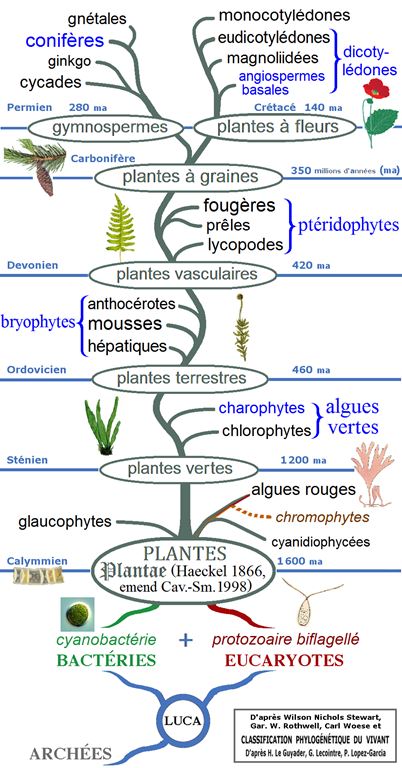
À droite, cet arbre phylogénétique des plantes montre les principaux clades et groupes traditionnels (monophylétiques en noir et paraphylétiques en bleu).
Dénominations
- Nom botanique : Alocasia macrorrhizos (L.) G. Don (1839)
- Synonymes français : taro géant, alocasie, alocasia, alocasie géante, alocasie à grande racine, alocasie à grosse racine, ape (Hawaï), oreille d'éléphant, songe caraïbe, songe papangue, grande tayove, taro
- Synonymes : Alocasia alba Schott 1852 (nom accepté et espèce différente/distincte, selon TPL), Alocasia crassifolia Engl. 1920 (synonyme d'Alocasia alba Schott 1852, selon TPL), Alocasia indica (Lour.) Schott 1854, Alocasia macrorrhiza (L.) Schott 1852, Arum indicum Lour. 1790, Caladium glycirrhizza (synonyme selon DPC), Colocasia indica (Lour.) Kunth 1841 ;
Dont basionyme : x ; - Noms anglais et locaux : ape, cunjevoi, giant alocasia, giant taro, pai, Alokasie (de)
Description et culture
Tableau récapitulatif
Parties comes-tibles Note comest. (1-5) Note medic. (1-5) (Zones de) Rusticité Besoins en 
Besoins en  (1-3)
(1-3)Périodes de semis et récoltes Graines au gramme Durée de viabilité Profon-deur semis Espace-ment plants Espace-ment lignes Durée germi-native Durée avant récolte
0 pour les parties aériennes et -3/-4 (durant une courte période) pour les racines J F M A M J
J A S O N D
J F M A M J
J A S O N D
- dont infos de 0FPI ("FOOD PLANTS INTERNATIONAL", en anglais) :
Description :
Une très grande herbe. Une plante de la famille taro. Il a un tronc robuste et dressé atteignant 4 m de haut. Cela a des feuilles verticales en forme de flèche. Les feuilles ont des lobes ronds en bas. Les feuilles sont coriaces et sont souvent ondulées sur le pourtour. Les veines secondaires ne sont pas proéminentes. Le limbe des feuilles peut mesurer de 1 à 1,2 m de long. La structure feuillue autour de la fleur est jaune dans la partie supérieure. Il forme un capuchon et tombe lorsque la fleur s'ouvre. Les fruits sont des baies rouge vif. Le bulbe est grand, souvent courbé et au-dessus du sol. Il a souvent de petits bulbes sur le côté. Les fibres brunes de la base des feuilles pendent souvent de la tige. Les feuilles et les pétioles contiennent des cristaux piquants{{{0(+x) (traduction automatique).
Original : A very large herb. A taro family plant. It has a stout erect trunk up to 4 m tall. This has upright leaves which are arrow shaped. Leaves have round lobes at the bottom. The leaves are leathery and are often wavy around the edge. The secondary veins are not prominent. The leaf blade can be 1-1.2 m long. The leafy structure around the flower is yellow in the upper section. It forms a hood and drops off as the flower opens. The fruit are bright red berries. The corm is large, often curved and above the ground. It often has small cormels at the side. Brown trailing fibres of the leaf bases often hang from the stem. The leaves and petioles contain stinging crystals{{{0(+x).
Production :
Des cormes de 8,5 à 40 kg ont été récoltées sur des plantes individuelles d'âge inconnu. Le temps de maturité est d'environ 12 mois, mais les plantes sont souvent laissées pendant 2-3 ans{{{0(+x) (traduction automatique).
Original : Corms of 8.5 to 40 kg have been harvested from individual plants of unknown age. The time to maturity is about 12 months but plants are often left for 2-3 years{{{0(+x).
Culture :
Le sommet du corme principal est planté. Les petits bulbes ronds peuvent être plantés, mais tardent à mûrir. Un espacement de 1,2 x 1,2 m convient. Étant donné que le taro géant met plus d'un an à être prêt à être récolté, il finit souvent par pousser dans un ancien jardin sans trop de soin ni de désherbage, jusqu'à ce que le propriétaire veuille le récolter. La bouche peut être irritée par la mastication de parties de plantes mal cuites en raison de produits chimiques appelés oxalates. Le taro géant contient de petits cristaux d'oxalate de calcium en forme d'aiguille dans les tissus. Il est nécessaire de les retirer pendant la préparation et la cuisson. La méthode d'épluchage est importante. Normalement, certaines femmes qui sont particulièrement expérimentées dans le pelage font ce travail. De plus, le corme de taro est souvent laissé à flétrir pendant une semaine après sa récolte et avant son utilisation. Aussi pour aider à éliminer certains des cristaux, la tige est cuite pendant une longue période ou bouillie dans plusieurs changements d'eau. Il est également important d'utiliser la bonne variété de taro géant car les variétés cultivées dans les jardins contiennent moins de produits chimiques que les sauvages{{{0(+x) (traduction automatique).
Original : The top of the main corm is planted. The small round cormels can be planted, but are slow to mature. A spacing of 1.2 x 1.2 m is suitable. Because the giant taro takes more than a year to be ready to harvest, it often ends up left growing in an old garden site without much care or weeding, until the owner wants to harvest it. The mouth can be irritated by chewing improperly cooked plant parts due to chemicals called oxalates. Giant taro contains small needle-like calcium oxalate crystals in the tissues. It is necessary to remove these during the preparation and cooking. The method of peeling is important. Normally some ladies who are especially experienced at peeling do this job. Also the taro corm is often left to wilt for a week after it is harvested and before it is used. Also to help remove some of the crystals, the stem is baked for a long time, or boiled in several changes of water. It is also important to use the right variety of giant taro because the kinds grown in gardens have less of the chemical than wild ones{{{0(+x).
 Consommation (rapports de comestibilité, parties utilisables et usages alimentaires correspondants)
Consommation (rapports de comestibilité, parties utilisables et usages alimentaires correspondants)Racine (cormes (rhizomes(27(+x)µ épaissis en tubercules écailleux{{{(dp*)) cuit27(+x) (généralement(dp*) dans plusieurs eaux{{{27(+x)) [nourriture/aliment : légume{{{2(dp*),27(+x), féculent (amidon/fécule){{{2(dp*)]) comestible.(1*)
Détails :
Plante importante localement, très cultivée dans les pays tropicaux.{{{27(+x)
Partie testée :
rhizome{{{0(+x) (traduction automatique). Original : Rhizome{{{0(+x)| Taux d'humidité (%) | Énergie (kj) | Énergie (kcal) | Protéines (g) |
|---|---|---|---|
| 63.2 | 0 | 0 | 3.3 |
| Pro- vitamines A (µg) |
Vitamines C (mg) | Fer (mg) | Zinc (mg) |
| 0 | 0 | 0 | 0 |
Risques et précautions à prendre
Risques et précautions à prendre(1*)ATTENTION : plante toxique crue, voir genre Alocasia, pour plus d'informations{{{(dp*).
Galerie(s)
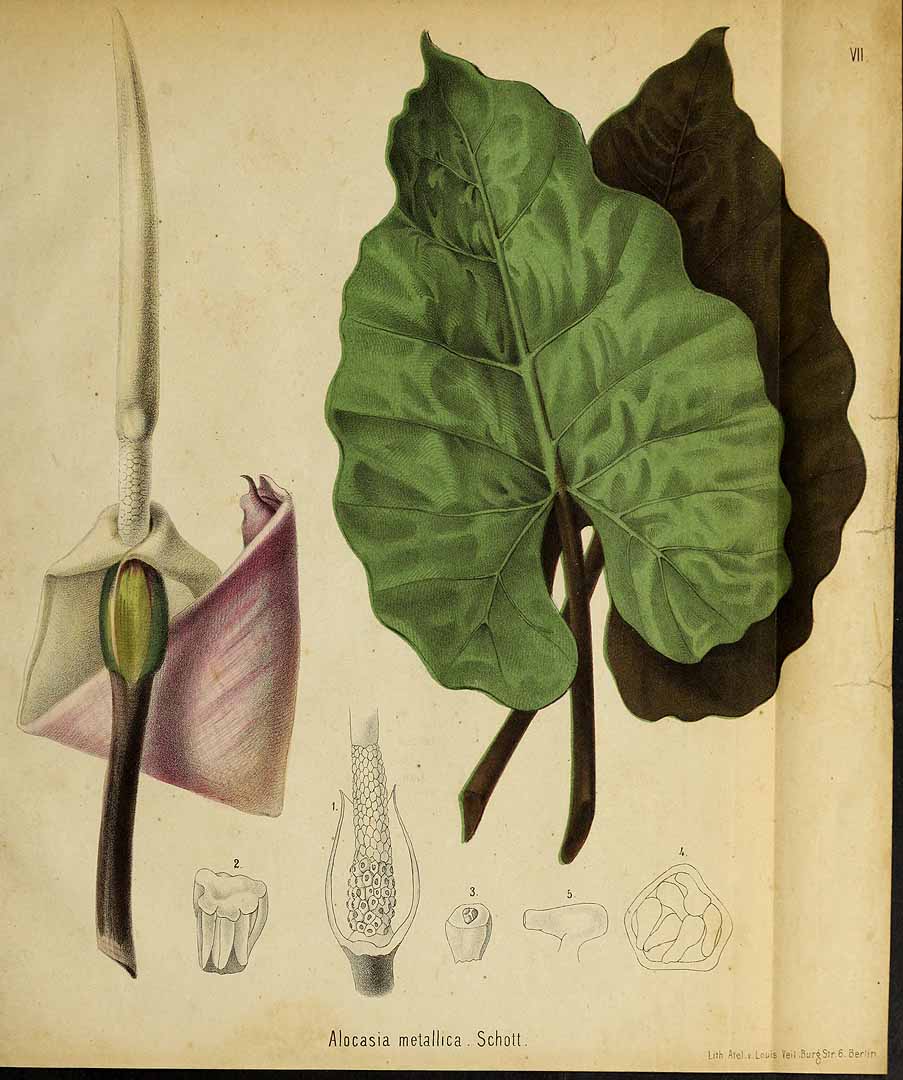
Par Berliner allgemeine Gartenzeitung Berl. Allg. Gartenzeitung vol. 25 (1857), via plantillustrations
✖

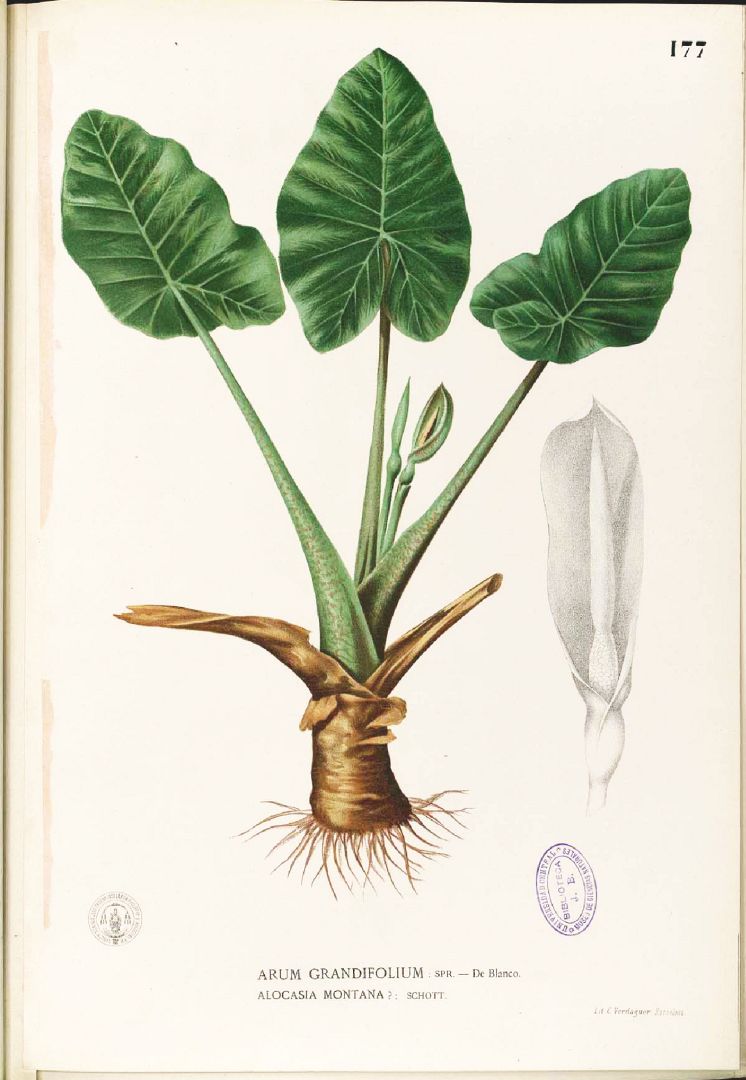
Par Blanco, M., Flora de Filipinas, ed. 3 (1877-1883) Fl. Filip., ed. 3, via plantillustrations
✖

Autres infos
dont infos de 0FPI ("FOOD PLANTS INTERNATIONAL", en anglais) :
Statut :
C'est un légume cultivé commercialement. Ce taro n'a d'importance locale que dans certaines zones côtières et îles de Papouasie-Nouvelle-Guinée, par exemple Rabaul, Namatanai. Il est important dans plusieurs îles du Pacifique et au Sri Lanka{{{0(+x) (traduction automatique).
Original : It is a commercially cultivated vegetable. This taro is of local importance only in some coastal areas and islands of Papua New Guinea e.g. Rabaul, Namatanai. It is important in several Pacific Islands and Sri Lanka{{{0(+x).
Distribution :
Une plante tropicale. Il est largement répandu dans les zones humides ouvertes et le long des cours d'eau et dans certains types de forêts humides. La plante pousse à l'état sauvage du niveau de la mer jusqu'à 2600 m d'altitude sous les tropiques. Le taro géant est une plante tropicale et ne poussera pas bien en dessous de 10 ° C. Il nécessite une pluviométrie bien répartie et ne tolère pas la sécheresse. Même s'il pousse le long des berges des ruisseaux, il ne peut tolérer un sol gorgé d'eau. Il n'est utilisé comme nourriture que dans quelques zones côtières. Les formes sauvages couramment observées en croissance sont amères et non utilisées. Cela ne marche pas bien sur les atolls. Il convient aux zones de rusticité 11-12{{{0(+x) (traduction automatique).
Original : A tropical plant. It is widely distributed in open wetlands and along streams and in some types of humid forest. The plant grows wild from sea level up to 2600 m altitude in the tropics. Giant taro is a tropical plant and will not grow well below 10°C. It requires a well distributed rainfall and does not tolerate drought. Even though it grows along creek banks it cannot tolerate waterlogged soil. It is only used as food in a few coastal areas. Wild forms commonly seen growing are bitter and not used. It does not do well on atolls. It suits hardiness zones 11-12{{{0(+x).
Localisation :
Afrique, Samoa américaines, Asie, Australie, Bangladesh, Cambodge, Îles Caroline, Amérique centrale, Chuuk, Îles Cook, Cuba, République dominicaine, Timor oriental, Île de Pâques, Fidji, Polynésie française, FSM, Guam, Guyanes, Haïti, Hawaï, Himalaya, Inde, Indochine, Indonésie, Jamaïque, Japon, Kiribati, Kosrae, Laos, Madagascar, Malaisie, Maldives, Mariannes, Marquises, Îles Marshall, Micronésie, Myanmar, Nauru, Nouvelle-Calédonie, Inde du nord-est, Amérique du Nord, Pacifique, Pakistan, Palau, Papouasie-Nouvelle-Guinée, PNG, Philippines, Pohnpei, Porto Rico, Rotuma, Samoa, Sao Tomé-et-Principe, Asie du Sud-Est, Singapour, Îles Salomon, Amérique du Sud, Sri Lanka, Suriname, Tahiti, Taiwan, Thaïlande, Timor-Leste, Tokelau, Tonga, Truk, Tuvalu, USA, Vanuatu, Vietnam, Afrique de l'Ouest, Antilles, Yap, {{{0(+x) (traduction automatique).
Original : Africa, American Samoa, Asia, Australia, Bangladesh, Cambodia, Caroline Islands, Central America, Chuuk, Cook Islands, Cuba, Dominican Republic, East Timor, Easter Island, Fiji, French Polynesia, FSM, Guam, Guianas, Haiti, Hawaii, Himalayas, India, Indochina, Indonesia, Jamaica, Japan, Kiribati, Kosrae, Laos, Madagascar, Malaysia, Maldives, Marianas, Marquesas, Marshall Islands, Micronesia, Myanmar, Nauru, New Caledonia, Northeastern India, North America, Pacific, Pakistan, Palau, Papua New Guinea, PNG, Philippines, Pohnpei, Puerto Rico, Rotuma, Samoa, Sao Tome and Principe, SE Asia, Singapore, Solomon Islands, South America, Sri Lanka, Suriname, Tahiti, Taiwan, Thailand, Timor-Leste, Tokelau, Tonga, Truk, Tuvalu, USA, Vanuatu, Vietnam, West Africa, West Indies, Yap{{{0(+x).
Notes :
Il existe environ 60 à 70 espèces d'Alocasia{{{0(+x) (traduction automatique).
Original : There are about 60-70 Alocasia species{{{0(+x).
Rusticité (résistance face au froid/gel, climat)
0 pour les parties aériennes et -3/-4 (durant une courte période) pour les racines
Liens, sources et/ou références
Liens :
/ ;Sources et/ou références :
bibliographie (liste des sources et/ou références de l'encyclopédie)
dont classification : TPL ("The Plant List", en anglais) ; 2GRIN ("Germplasm Resources Information Network", en anglais) ;
dont livres et bases de données : 5PFAF ("Plants For A Future", en anglais) ; 27Dictionnaire des plantes comestibles (livre, page 19, par Louis Bubenicek) ;
dont bibliographie/références de 0FPI ("FOOD PLANTS INTERNATIONAL", en anglais) :
Giant taro references ; Aberoumand, A. and Deokule, S. S., 2009, Determination of Elements Profile of Some Wild Edible Plants. Food Anal. Methods. 2:116-119 (As Alocasia indica) ; Allen, R.N., 1929, Photomicrographs of Philippine starches. Philipp. J.Sci., 38(2), 247. ; Ambasta S.P. (Ed.), 2000, The Useful Plants of India. CSIR India. p 29 (As Alocasia indica) ; Anderson, E. F., 1993, Plants and people of the Golden Triangle. Dioscorides Press. p 20 ; Ara, R. I. T., 2015, Leafy Vegetables in Bangladesh. Photon eBooks. p 116 (As Alocasia indica) ; Asthana, R.P., 1946, Bacterial leaf-spot on arum. Curr. Sci., 15(12), 356. ; Backer, C.A., & Brink,B.,van den, 1968, Flora of Java.p 118. ; Bandyopadhyay, S. et al, 2009, Wild edible plants of Koch Bihar district, West Bengal. Natural Products Radiance 8(1) 64-72 ; Bandyopadhyay, S., et al, 2012, A Census of Wild Edible Plants from Howrah District, West Bengal, India. Proceedings of UGC sponsored National Seminar 2012 (As Alocasia indica) ; Banerjee, A., et al, 2013, Ethnobotanical Documentation of Some Wild Edible Plants in Bankura District, West Bengal, India. The Journal of Ethnobiology and Traditional Medicine. Photon 120 (2013) 585-590 (As Alocasia indica) ; Baro, D., Baruah, S. and Borthukar, S. K. 2015, Documentation on wild vegetables of Baksa district, BTAD (Assam). Scholars Research Library. Archives of Applied Science Research, 2015, 7 (9):19-27 (As Alocasia indica) ; Barrau, J., 1958, Subsistence Agriculture in Melanesia. Bishop Museum Bulletin 219 p 43. ; Barrau, J., 1957, Les Aracees a tubercules alimentaires des iles du Pacifique sud. J.Agric. Trop. Bot. Appl. 4(1), 41-44. ; Barrau, J., 1976, Subsistence Agriculture in Polynesia and Micronesia. Bernice P. Bishop Museu, Bulletin 223 Honolulu Hawaii. Kraus reprint. p 39 ; Bois, D., 1927, Les Plantes Alimentaires. Vol. 1 p 527. ; Bodkin, F., 1991, Encyclopedia Botanica. Cornstalk publishing, p 68 ; Borrell, O.W., 1989, An Annotated Checklist of the Flora of Kairiru Island, New Guinea. Marcellin College, Victoria Australia. p 15, 156 (Also as Alocasia indica) ; Bourret, D., 1981, Bonnes-Plantes de Nouvelle-Caledonie et des Loyaute. ORSTOM. p 61 ; Brickell, C. (Ed.), 1999, The Royal Horticultural Society A-Z Encyclopedia of Garden Plants. Convent Garden Books. p 99 ; Brown, D., 2000, Aroids. Plants of the Arum family. Timber Press. (Second edition) p 262, 306, ; Brown, W.H., 1920, Wild Food Plants of the Philippines. Bureau of Forestry Bulletin No. 21 Manila. p 28 ; Brown, 1951, Useful Plants of the Philippines p 343. ; Burkill, H. M., 1985, The useful plants of west tropical Africa, Vol. 1. Kew. ; Burkill, I.H., 1966, A Dictionary of the Economic Products of the Malay Peninsula. Ministry of Agriculture and Cooperatives, Kuala Lumpur, Malaysia. Vol 1 (A-H) p 107 (As Alocasia indica) ; Cable, W.J., 1985, Growth of giant taro (Alocasia sp.) cultivars at Alafua, Western Samoa. Alafua Ag Bulletin v 10(3) p13-19 ; Cherikoff V. & Isaacs, J., The Bush Food Handbook. How to gather, grow, process and cook Australian Wild Foods. Ti Tree Press, Australia p 192, 194, 198 ; Chowdery, T., et al, 2014, Wild edible plants of Uttar Dinajpur District, West Bengal. Life Science Leaflets. 47:pp 20-36 http://lifesciencesleaflets.ning.com ; Chowdhury, M. & Mukherjee, R., 2012, Wild Edible Plants Consumed by Local Communities of Maldah of West Bengal, India. Indian J.Sci.Res.3(2) : 163-170 ; Coursey, D.G.,1967, The edible aroids. Wld.Crops. 20(4):25-30. ; Cribb, A.B. & J.W., 1976, Wild Food in Australia, Fontana. p 144 ; Cundall, P., (ed.), 2004, Gardening Australia: flora: the gardener's bible. ABC Books. p 133 (As Alocasia macrorrhizos) ; Dobriyal, M. J. R. & Dobriyal, R., 2014, Non Wood Forest Produce an Option for Ethnic Food and Nutritional Security in India. Int. J. of Usuf. Mngt. 15(1):17-37 ; Doi Shinji, 1944, Value of Dokuimo as a raw material for the fermentation industry. J.Agric. Chem.Japan 20,457-464. ; Dutta, U., 2012, Wild Vegetables collected by the local communities from the Churang reserve of BTD, Assam. International Journal of Science and Advanced Technology. Vol. 2(4) p 119 (As Alocasia indica) ; Elliot, W.R., & Jones, D.L., 1982, Encyclopedia of Australian Plants suitable for cultivation. Vol 2. Lothian. p 174 ; Englberger, L., et al, 2006, Documentation of the traditional food system of Pohnpei. Indigenous People's food systems. Chp 6 p 119 ; Ethnobotany of Karbis. Chapter 4 in p 82 ; Flora of Pakistan. www.eFloras.org ; French, B., 1986, Food Plants of Papua New Guinea, Asia Pacific Science Foundation p 6 ; French, B.R., 2010, Food Plants of Solomon Islands. A Compendium. Food Plants International Inc. p 6 ; Furtado,C.X.,1941, Alocasia macrorrhiza and its varieties. Gdn's Bull. Straits Settl.,11(3),244-257. ; Gerlach, W.W.P., 1986, Annotated list of diseases of taro (Colocasia esculenta, Ta'amu (Alocasia macrorrhiza) and taro papalagi (Xanthosoma sagittifolium) in western Samoa. Alafua Ag Bulletin v 11(2) p69-79. ; Gillaumin, R., 1954, Les Plantes utiles des Nouvelles-Hebrides (fin et complement) In: Journal d'agriculture tropicale et de botanique appliquee Vol. 1, No. 10-12 pp 453-460 ; Gilliland, H.B.,1962, Common Malayan Plants. Univ. of Malaya. p 11. ; Global Plants JSTOR ; Greig, D., 1996, Flowering Natives for Home Gardens. Angus & Robertson. p 48 ; Haudricourt, A., 1941, Les colocasiees alimentaires (taros et yautias). Les alocasia. Revue Bot. Appl. Agric. Trop. 21(1),55-58. ; Hedricks, U.P.(ed), 1919, Sturtevant's Edible Plants of the World. Dover, p 41, p 44 (As Alocasia indica) ; Henty, E.E., 1980, Harmful Plants in Papua New Guinea. Botany Bulletin No 12. Division Botany, Lae, Papua New Guinea. p 23, Pl. 8 ; Hiddins, L., 1999, Explore Wild Australia with the Bush Tucker Man. Penguin Books/ABC Books. p 137 ; Hinton, B & B., 1982, A Wilderness in Bloom. Wildflowers of tropical Australia. p 46 ; Hist. nat. veg. 12:47. 1846 (As Alocasia indica) ; Hooker,J.D.,1894, Flora of British India Vol.VI p526. ; Hossain, U. & Rahman, A., 2018, Study and quantitative analysis of wild vegetable floral diversity available in Barisal district, Bangladesh. Asian J. Med. Biol. Res. 2018, 4 (4), 362-371 ; Jones D, L, 1986, Ornamental Rainforest Plants in Australia, Reed Books, p 251 ; Kar, A., & Borthakur, S. K., 2008, Wild vegetables of Karbi - Anglong district, Assam, Natural Product Radiance, Vol. 7(5), pp 448-460 ; Kay, D.E., 1973, Root Crops. T.P.I. Crop & Product Digest No 2 p 71 ; Kays, S. J., and Dias, J. C. S., 1995, Common Names of Commercially Cultivated Vegetables of the World in 15 languages. Economic Botany, Vol. 49, No. 2, pp. 115-152 ; Kiple, K.F. & Ornelas, K.C., (eds), 2000, The Cambridge World History of Food. CUP p 1890 (Also as Alocasia indica) ; Kuhnlein, H. V., et al, 2009, Indigenous Peoples' food systems. FAO Rome p 119 ; Kumar, S. A., Manus, D. & Mallika, M., 2018, Impact of non-timber forest products on Forest and in Livelihood Economy of the People of Adjoining Areas of Jalpaiguri Forest Division, West Bengal, India. Int. J. of Life Sciences, 2018; 6 (2):365-385 ; Kundu,B.C., 1967, Some edible rhizomatous and tuberous crops of India. Proc. 1st Int. Sympos.Trop. Root Crops 1 Pt 1,124. ; Kuo, W. H. J., (Ed.) Taiwan's Ethnobotanical Database (1900-2000), http://tk.agron.ntu.edu.tw/ethnobot/DB1.htm ; Lazarides, M. & Hince, B., 1993, Handbook of Economic Plants of Australia, CSIRO. p 14 ; Lepofsky, D., 2003, The Ethnobotany of Cultivated Plants of the Maohi of the Society Islands. Economic Botany, Vol. 57, No. 1, pp. 73-92 ; Lim, T. K., 2015, Edible Medicinal and Non Medicinal Plants. Volume 9, Modified Stems, Roots, Bulbs. Springer p 6 ; Llamas, K.A., 2003, Tropical Flowering Plants. Timber Press. p 77 ; Lord, E.E., & Willis, J.H., 1999, Shrubs and Trees for Australian gardens. Lothian. p 148 ; Low, T., 1991, Wild Food Plants of Australia. Australian Nature FieldGuide, Angus & Robertson. p 84 ; Low, T., 1992, Bush Tucker. Australiaâ's Wild Food Harvest. Angus & Robertson. p (Contents) ; Macmillan, H.F. (Revised Barlow, H.S., et al) 1991, Tropical Planting and Gardening. Sixth edition. Malayan Nature Society. Kuala Lumpur. p 336 ; Macmillan, H.F. (Revised Barlow, H.S., et al) 1991, Tropical Planting and Gardening. Sixth edition. Malayan Nature Society. Kuala Lumpur. p 336 (As Alocasia indica) ; Maikhuri, R, K, and Gangwar, A. K., 1993, Ethnobiological Notes on the Khasi and Garo Tribes of Meghalaya, Northeast India, Economic Botany, Vol. 47, No. 4, pp. 345-357 (As Alocasia indica) ; Mandal, P. et al, 2010, Antioxidant activity in the extracts of two edible aroids. Inidan Journal of Pharmaceutical Sciences. 72(1): pp 105-108 ; Martin, F.W. & Ruberte, R.M., 1979, Edible Leaves of the Tropics. Antillian College Press, Mayaguez, Puerto Rico. p 175 (Also as Alocasia indica) ; Medhi, P. & Borthakur, S. K., 2012, Phytoresources from North Cachur Hills of Assam -3: Edible plants sold at Hflong market. Indian Journal of Natural Products and Resources. 3(1) pp 84-109 (As Alocasia indica) ; Mishra, N., et al, 2016, Indigenous knowledge in utilization of wetland plants in Bhadrak district, Odisha, India. Indian Journal of Natural Products and Resources. Vol. 7(1) pp. 82-89 ; Monsalud, M.R., Tongacan, A.L., Lopez, F.R., & Lagrimas, M.Q., 1966, Edible Wild Plants in Philippine Forests. Philippine Journal of Science. p 442 ; Massal, E and Barrau, J., 1973, Food Plants of the South Sea Islands. SPC Technical Paper No 94. Nounea, New Caledonia. p 6-10. ; Medhi, P., Sarma, A and Borthakur, S. K., 2014, Wild edible plants from the Dima Hasao district of Assam, India. Pleione 8(1): 133-148 ; Narzary, H., et al, 2013, Wild Edible Vegetables Consumed by Bodo tribe of Kokrajhar District (Assam), North-East India. Archives of Applied Science Research, 5(5): 182-190 (As Alocasia indica) ; Neal,C.M.,1965, In Gardens of Hawaii. Bishop Museum Press. ; Onwueme, I.C., 1978, The Tropical Tuber Crops. Wiley, p 199 (As Alocasia indica) ; Pagag, K. & Borthakur, S.K., 2012, Wild edible wetland plants from Lakhimpur district of Assam, India. Pleione 6(2): 322 - 327 ; Pancho, J.V.,1959, Notes on cultivated edible aroids in the Philippines: Baileya, 7(1),63-70. ; Parham,B.E.V.,1942, Some useful plants of the Fiji Islands. Fiji Agric. J.,13(2),41. ; Patiri, B. & Borah, A., 2007, Wild Edible Plants of Assam. Geethaki Publishers. p 155 (As Alocasia indica) ; Peekel, P.G., 1984, (Translation E.E.Henty), Flora of the Bismarck Archipelago for Naturalists, Division of Botany, Lae, PNG. p 72, 73 (As Alocasia indica) ; Pena, R.S.de la, 1970, The edible aroids in the Asian Pacific area. Proc. 2nd. Int. Symp. Trop. Root & Tuber Crops. 1 Pt 5,138-139. ; Plants of Haiti Smithsonian Institute http://botany.si.edu ; Plowman,T.,1969, Folk uses of the new world aroids. Econ. Bot. 23(2),100 ; Plucknett, D.L., 1970, Colocasia, Xanthosoma, Alocasia, Cyrtosperma, and Amorphophallus. Proc. 2nd Int. Symp. Trop. Root & Tuber Crops. 1Pt 5,127-135. ; Plucknett, D.L., Edible Aroids, in Simmonds, N.W., (Ed.), 1979, Evolution of Crop Plants. Longman. p 10 (As Alocasia indica) ; Polinag, M. A., 2003, Food from the Wilderness. Department of Environment and Natural Resources. Laguna. ; Pradheep, K., et al, 2016, Wild edible plants used by Konyak tribe in Mon district of Nagaland: Survey and inventorisation. Indian Journal of Natural Products and Resources. Vol 7(1) pp 74-81 ; Prafulla, S., 2017, Wild Food Diversity of Nawegaon-Nagzira Tiger Reserve in Gondia-Bhandara district of Maharashtra, India. Int. J. of Life Sciences, 2017, Vol. 5 (4): 620-626 ; Price, S.H. & J.L., Wild Food, Medicine and useful plants of the Wet tropics. Kwik Kopy, Cairns. p 4 ; Purseglove, J.W., 1972, Tropical Crops. Monocotyledons. Longmans p 58 ; Plucknett, D.L., Edible Aroids, in Simmonds, N.W., (Ed.), 1979, Evolution of Crop Plants. Longman. p 10 ; Rajapaksha, U., 1998, Traditional Food Plants in Sri Lanka. HARTI, Sri Lanka. p 70 (Also as Alocasia indica) ; Rahman, S. A., et al, 2013, ô°”ô°ºô°³ô°»ô°±ô±†ô°©ô°»ô°ô°¬ô°€ô°¡ô°³ô°©ô°¹ô°»ô°·ô°€ô°±ô°¹ô°€ô°»ô°°ô°ô°€ô°•ô°±ô±†ô°ô°¶ô°·ô°±ô°®ô°±ô°ô°¬ô°€ô°™ô°µô°´ô°ô°¯ô°©ô°¶ô°¬ô°ô°¹ô°·ô°”ô°ºô°³ô°»ô°±ô±†ô°©ô°»ô°ô°¬ô°€ô°¡ô°³ô°©ô°¹ô°»ô°·ô°€ô°±ô°¹ô°€ô°»ô°°ô°ô°€ô°•ô°±ô±†ô°ô°¶ô°·ô°±ô°®ô°±ô°ô°¬ô°€ô°™ô°µô°´ô°ô°¯ô°©ô°¶ô°¬ô°ô°¹ô°·Cultivated Plants in the Diversified Homegardens of Local Communities in Ganges Valley, Bangladesh. Science Journal of Agricultural Research and Management. Vol. 2013 ; Rashid, H. E., 1977, Geography of Bangladesh. Westview. p 264 (As Alocasia indica) ; Reark, J.B., 1953, Cultivation of the genus Alocasia in Florida. Proc. Fla.Sta.Hort.Soc., 66, 326-331. ; Recher, P, 2001, Fruit Spirit Botanical Gardens Plant Index. www.nrg.com.au/~recher/ seedlist.html p 4 ; Safford, W.E., 1905, Useful Plants of Guam. ; Sarma, H., et al, 2010, Updated Estimates of Wild Edible and Threatened Plants of Assam: A Meta-analysis. International Journal of Botany 6(4): 414-423 (As Alocasia indica) ; Schott. & Endl.,1832, Melet.18 ; Seeman, B., 1865-1873, Flora Vitiensis p 286 (Probably also confused with Cyrtosperma merkusii) ; Siemonsma, J. S. & Kasem Piluek, eds. 1993. Vegetables. In: Plant Resources of South-East Asia (PROSEA) 8:312 ; Singh, H.B., Arora R.K., 1978, Wild edible Plants of India. Indian Council of Agricultural Research, New Delhi. p 10, 17 ; Slocum, P.D. & Robinson, P., 1999, Water Gardening. Water Lilies and Lotuses. Timber Press. p 90 ; Smith, K., 1998. Growing Uncommon Fruits and Vegetables. New Holland. p 72 ; Srivastava, S.K. & Krishnan, P. S., 1959, Oxalate content of plant tissues. J. Sci. Res. (India) 18C(8), 146-148. ; Soyza, D. J. de, 1938, Yam cultivation in the Kegalla district. Trop. Agric. Mag. Ceylon. Agric. Soc., 90(2),73-75. ; Staples, G.W. and Herbst, D.R., 2005, A tropical Garden Flora. Bishop Museum Press, Honolulu, Hawaii. p 599 ; Sujanapal, P., & Sankaran, K. V., 2016, Common Plants of Maldives. FAO & Kerala FRI, p 24 ; Sukarya, D. G., (Ed.) 2013, 3,500 Plant Species of the Botanic Gardens of Indonesia. LIPI p 1056 ; Suksri, S., et al, 2005, Ethnobotany in Bung Khong Long Non-Hunting Area, Northeast Thailand. Kasetsart J., (Nat. Sci) 39: 519-533 ; R. Sweet, Hort. brit. ed. 3:631. 1839 "macrorhizon" ; Teron, R. & Borthakur, S. K., 2016, Edible Medicines: An Exploration of Medicinal Plants in Dietary Practices of Karbi Tribal Population of Assam, Northeast India. In Mondal, N. & Sen, J.(Ed.) Nutrition and Health among tribal populations of India. p 148 ; Terra, G. J. A., 1973, Tropical Vegetables. Communication 54e Royal Tropical Institute, Amsterdam, p 20, 21, 22 (Also as Alocasia indica) ; Thaman, R.R., 1976, The Tongan Agricultural System, University of the South Pacific, Suva, Fiji. p 378 ; Thaman, R. R., 1987, Plants of Kiribati: A listing and analysis of vernacular names. Atoll Research Bulletin No. 296 ; Thaman, R. R., et al, 1994, The Flora of Nauru. Atoll Research Bulletin No. 392. Smithsonian Institute p 39 ; Thaman, R. R, 2016, The flora of Tuvalu. Atoll Research Bulletin No. 611. Smithsonian Institute p 38 ; Tindall, H.D., 1983, Vegetables in the tropics. Macmillan p. 49 ; Townsend, K., 1994, Across the Top. Gardening with Australian Plants in the tropics. Society for Growing Australian Plants, Townsville Branch Inc. p 77 ; Uprety, Y., et al, 2016, Traditional use and management of NTFPs in Kangchenjunga Landscape: implications for conservation and livelihoods. Journal of Ethnobiology and Ethnomedicine (2016) 12:19 ; USDA, ARS, National Genetic Resources Program. Germplasm Resources Information Network - (GRIN). [Online Database] National Germplasm Resources Laboratory, Beltsville, Maryland. Available: www.ars-grin.gov/cgi-bin/npgs/html/econ.pl (10 April 2000) ; Valenzuela,A.& Wester,P.J.,1930, Philip. J.Sci. 41,85. ; Vander Velde, N, 2003, The Vascular Plants of Majuro Atoll, Republic of the Marshall Islands. Atoll research Bulletin. No. 503. Smithsonian Institute. p 16 ; Walter, A. & Lebot, V., 2007, Gardens of Oceania. ACIAR Monograph No. 122 p. 59 ; Wealth of India p 60 ; Whistler, W. A., 1988, Ethnobotany of Tokelau: The Plants, Their Tokelau Names, and Their Uses. Economic Botany 42(2): 155-176 ; Whitney, C. W., et al, 2014, Conservation and Ethnobotanical Knowledge of a Hmong Community in Long Lan, Luang Prabang, Lao Peopleâ's Democratic Republic. Ethnobotany Research and Applications 12:643-658 ; Wilson, S., 1997, Some Plants are Poisonous. Reed. p 11 ; Yuncker, T.G., 1959, Plants f Tonga, Bernice P. Bishop Museum, Hawaii, Bulletin 220. p 76 ; Zizka, G., 1991, Flowering Plants of Easter Island. Palmarum Hortus Francofurtensis
Recherche de/pour :
- "Alocasia macrorrhizos" sur Google (pages et
images) ;
IPNI ("International Plant Names Index", en anglais) ;
TROPICOS (en anglais) ;
Tela Botanica ;
Pl@ntNet ;
Pl@ntUse ;
"Useful Tropical Plants" (en anglais) ou
"Useful Temperate Plants" (en anglais) ;
- "Oreille d'éléphant géante" sur Google (pages, images et recettes) ;
- "Alocasia macrorrhizos" sur Google (pages et
images) ;
IPNI ("International Plant Names Index", en anglais) ;
TROPICOS (en anglais) ;
Tela Botanica ;
Pl@ntNet ;
Pl@ntUse ;
"Useful Tropical Plants" (en anglais) ou
"Useful Temperate Plants" (en anglais) ;
Sous-espèces, variétes...
3 taxons
Espèces du même genre (Alocasia)
11 taxons
Espèces de la même famille (Araceae)
240 taxons
- Acore odorant
- Anguine
- Arisarum
- Arisème petit-prêcheur
- Arum
- Arum d'Italie
- Arum tacheté
- Belembe
- Caladion bicolore
- Canne à gratter
- Capuchon-de-moine
- Dragonne Serpentaire
- Ereriba
- Faux philodendron
- Koniaku
- Lenticule à trois lobes
- Lenticule bossue
- Lentille d'eau
- Lentille-d'eau
- Lysichite blanc
- Lysichiton américain
- Macabo
- Oreille d'éléphant
- Patte-d'oie
- Richarde
- Songe pâté
- Taro
- Taro chinois
- Taro géant des marais
- Tiquisque
- Typhonodore de Lindley
- Wolffie sans racines
- Acorus calamus L. (Acore odorant)
- Acorus gramineus Sol. ex Aiton
- Aglaonema costatum N.E.Br.
- Aglaonema philippinense Engl.
- Aglaonema pictum
- Alloschemone inopinata Bogner & P.C.Boyce
- Alocasia acuminata Schott
- Alocasia brisbanensis
- Alocasia cucullata (Lour.) G. Don (Taro chinois)
- Alocasia fallax Schott
- Alocasia fornicata
- Alocasia hollrungii Engl.
- Alocasia lancifolia Engl.
- Alocasia odora (Lindl.) K.Koch (Oreille d'éléphant)
- Alocasia portei Schott
- Alocasia sanderiana W.Bull
- Amorphophallus abyssinicus Gombcz
- Amorphophallus albus P.Y.Liu & J.F.Chen
- Amorphophallus aphyllus
- Amorphophallus asterostigmatus Bogner & Hett.
- Amorphophallus bhandarensis S.R.Yadav, Kahalkar & Bhuskute
- Amorphophallus brevispathus Gagnep.
- Amorphophallus bulbifer
- Amorphophallus commutatus
- Amorphophallus consimilis Blume
- Amorphophallus dracontioides
- Amorphophallus gallaensis
- Amorphophallus glabra F.M.Bailey
- Amorphophallus gomboczianus Pic.Serm.
- Amorphophallus harmandii Engl. & Gehrm.
- Amorphophallus kachinensis Engl. & Gehrm.
- Amorphophallus konjac K.Koch (Koniaku)
- Amorphophallus konkanensis Hett., S.R.Yadav & K.S.Patil
- Amorphophallus koratensis Gagnep.
- Amorphophallus krausei Engl.
- Amorphophallus lyratus
- Amorphophallus margaritifer
- Amorphophallus muelleri Blume
- Amorphophallus paeoniifolius (Dennst.) Nicolson (Songe pâté)
- Amorphophallus prainii Hook.f.
- Amorphophallus purpurascens Kurz ex Hook.f.
- Amorphophallus rivieri
- Amorphophallus saraburiensis
- Amorphophallus stuhlmannii
- Amorphophallus sylvaticus
- Amorphophallus titanum
- Amorphophallus variabilis Blume
- Amorphophallus ximengensis H.Li
- Amorphophallus yuloensis H.Li
- Amorphophallus yunnanensis Engl.
- ...







 donne accès au menu
  - encyclopédies des plantes alimentaires ;
 - page de recherche - reconnaissance (identification) de plantes ;
 - page du calendrier lunaire et son générateur (au format PDF et JPG) ;
 - tableau récapitulatif ;
 - générateur de potées (soupes), avec estimation des apports nutrionnels et du coût;
 - générateur de codes QR ;
 - page des archives avec de nombreux documents sur différents thèmes complémentaires comme la botanique, les légumes,
les champignons, la cuisine, le bien-être ainsi que différents MOOC mais également des liens vers les archives de l'association ;
- page des archives avec de nombreux documents sur différents thèmes complémentaires comme la botanique, les légumes,
les champignons, la cuisine, le bien-être ainsi que différents MOOC mais également des liens vers les archives de l'association ;

 pour le fruit (et/ou les graines, la pulpe, etc...),
 pour les fleurs (et/ou pétales, calice...),
 pour les feuilles (et/ou la tige, les pousses...),
 pour les racines,
 pour le tronc (et/ou l'écorce, la sève...), et enfin
 pour les champignons,
puis les notes alimentaires et médicinales (de 1 à 5 étoiles), la rusticité (résistance au froid/gel)
et pour finir un résumé.
pour les champignons,
puis les notes alimentaires et médicinales (de 1 à 5 étoiles), la rusticité (résistance au froid/gel)
et pour finir un résumé. menant ici 🙂
 ,
,  et
et





 ,
,


 Encyclopédie(s)
 Recherche-Reconnaissance
 Tableau récapitulatif
 Codes QR
 Archives
 Calendrier(s) lunaire(s)
  Potées
 Re-naturation/naturalisation
 Affichettes, herbiers &
co.
Affichettes, herbiers &
co. menu
menu galerie


 (en bas à droite).
 (en bas à gauche).
