Symplocarpus foetidus
![Illustration Symplocarpus foetidus, Par Sweet, R., British flower garden (1823-1837) Brit. Fl. Gard. vol. 1 (1823-1825) [tt. 1-100] t. 57, via plantillustrations](inc/images/illustrations/symplocarpus_foetidus2.jpg)

 |
**
-
***
|
**
-
***
Une herbe qui pousse dans les marais. Il continue de croître d'année en année. Il atteint 30 à 60 cm de hauteur. Les feuilles sont vert pâle et mesurent 30 à 40 cm de la ... (traduction automatique)
→suite


Symplocarpus foetidus
Note alimentaire 
Note médicinale 
Note autre usage 

Une herbe qui pousse dans les marais. Il continue de croître d'année en année. Il atteint 30 à 60 cm de hauteur. Les feuilles sont vert pâle et mesurent 30 à 40 cm de large et jusqu'à 1,2 m de long.... (traduction automatique) →suite
![Illustration Symplocarpus foetidus, Par Curtis, W., Botanical Magazine (1800-1948) Bot. Mag. vol. 60 (1833) [tt. 3206-3289] t. 3224, via plantillustrations](inc/images/illustrations/symplocarpus_foetidus.jpg)
Classification
- Classique : en haut de l'écran, sous le coeur.
- Phylogénétique :
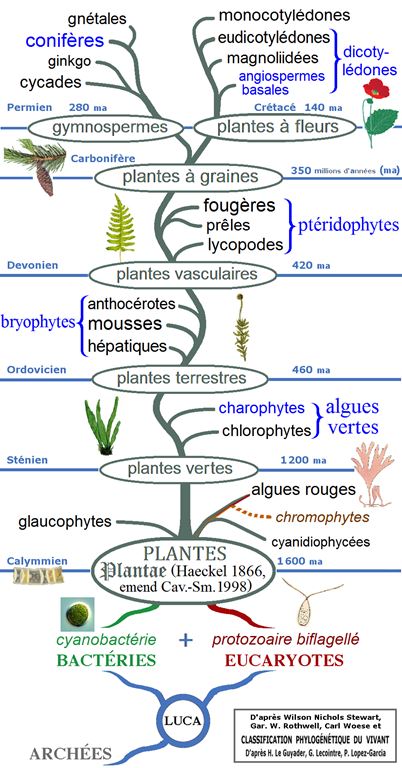
- Clade 4 : Angiospermes ;
- Clade 3 : Monocotylédones ;
- Ordre APN : Alismatales ;
- Famille APN : Araceae ;
À droite, cet arbre phylogénétique des plantes montre les principaux clades et groupes traditionnels (monophylétiques en noir et paraphylétiques en bleu).
Dénominations
- Nom botanique : Symplocarpus foetidus (Linnaeus) Salisbury ex W. P. C. Barton
- Synonymes : Dracontium foetidum Linnaeus, Ictodes foetidus (L.) Bogelow, Pothos foetidus (L.) Aiton, Spathyema foetida (L.) Raf, et d'autres
- Noms anglais et locaux : Skunk Cabbage
Description et culture
Tableau récapitulatif
Parties comes-tibles Note comest. (1-5) Note medic. (1-5) (Zones de) Rusticité Besoins en 
Besoins en  (1-3)
(1-3)Périodes de semis et récoltes Graines au gramme Durée de viabilité Profon-deur semis Espace-ment plants Espace-ment lignes Durée germi-native Durée avant récolte Zones de rusticité : 4, 5, 6, 7, 8 J F M A M J
J A S O N D
J F M A M J
J A S O N D
- dont infos de 0FPI ("FOOD PLANTS INTERNATIONAL", en anglais) :
Description :
Une herbe qui pousse dans les marais. Il continue de croître d'année en année. Il atteint 30 à 60 cm de hauteur. Les feuilles sont vert pâle et mesurent 30 à 40 cm de large et jusqu'à 1,2 m de long. Les fleurs sont violet verdâtre. Ils ont un spadice jaune verdâtre de 5 à 10 cm de long. Ils ont une spathe violette autour d'eux. La fleur peut dégager une odeur désagréable{{{0(+x) (traduction automatique).
Original : A herb that grows in swamps. It keeps growing from year to year. It grows 30-60 cm tall. The leaves are pale green and 30-40 cm wide and up to 1.2 m long. The flowers are greenish purple. They have a greenish yellow spadix 5-10 cm long. They have a purple spathe around them. The flower can give off an unpleasant smell{{{0(+x).
Culture :
Les plantes peuvent être cultivées à partir de graines fraîches semées dans la boue{{{0(+x) (traduction automatique).
Original : Plants can be grown from fresh seed sown into mud{{{0(+x).
 Consommation (rapports de comestibilité, parties utilisables et usages alimentaires correspondants)
Consommation (rapports de comestibilité, parties utilisables et usages alimentaires correspondants)Parties comestibles :
feuilles, racine, rhizome, attention{{{0(+x) (traduction automatique). Original : Leaves, Root, Rhizome, Caution{{{0(+x).Détails :
Les rhizomes ou tiges souterraines sont utilisés pour faire un pain poivré. Il est séché et transformé en farine. Root utilisé comme aliment d'urgence après séchage ou cuisson. Les jeunes feuilles sont cuites et consommées comme légume Attention: Les plantes de cette famille ont généralement des cristaux d'oxalate et nécessitent une préparation spéciale{{{0(+x) (traduction automatique).
Original : The rhizomes or underground stems are used to make a peppery bread. It is dried and made into flour. Root used as an emergency food after drying or baking. The young leaves are cooked and eaten as a vegetableCaution: Plants in this family usually have oxalate crystals and need special preparation{{{0(+x).
Partie testée :
/ Risques et précautions à prendre
Risques et précautions à prendrecf. consommation
Galerie(s)
Par Curtis, W., Botanical Magazine (1800-1948) Bot. Mag. vol. 60 (1833) [tt. 3206-3289] t. 3224, via plantillustrations
✖

Par Sweet, R., British flower garden (1823-1837) Brit. Fl. Gard. vol. 1 (1823-1825) [tt. 1-100] t. 57, via plantillustrations
✖


Par Meehan, T., native flowers and ferns of the United States (1878-1879) Native Fl. Ferns U.S. vol. 1 t. 15 p. 57 , via plantillustrations
✖

Par Barton, W.P.C., Vegetable materia medica of the United States (1817-1818) Veg. Mater. Med. U.S. vol. 1 (1817) t. 11, via plantillustrations
✖
Autres infos
dont infos de 0FPI ("FOOD PLANTS INTERNATIONAL", en anglais) :
Distribution :
Une plante tempérée. Il pousse dans les endroits humides et inondés de façon saisonnière{{{0(+x) (traduction automatique).
Original : A temperate plant. It grows in wet and seasonally flooded places{{{0(+x).
Localisation :
Grande-Bretagne, Canada, Chine, Europe, France, Allemagne, Italie, Japon, Pays-Bas, Amérique du Nord, Russie, USA{{{0(+x) (traduction automatique).
Original : Britain, Canada, China, Europe, France, Germany, Italy, Japan, Netherlands, North America, Russia, USA{{{0(+x).
Notes :
Il est utilisé en médecine. Il existe 3 espèces de Symplocarpus. Il contient de la 5-hyrdoxy-tryptamine qui peut affecter l'absorption de la sérotonine{{{0(+x) (traduction automatique).
Original : It is used in medicine. There are 3 Symplocarpus species. It contains 5-hyrdoxy-tryptamine that can effect Serotonine absorption{{{0(+x).
Rusticité (résistance face au froid/gel, climat)
Zones de rusticité : 4, 5, 6, 7, 8
Liens, sources et/ou références
Liens :
/ ;Sources et/ou références :
bibliographie (liste des sources et/ou références de l'encyclopédie)
dont livres et bases de données : 5PFAF ("Plants For A Future", en anglais) ; 0FPI ("FOOD PLANTS INTERNATIONAL", en anglais) ;
Warning: Undefined variable $prex in /home/waso5761/public_html/inc/fiches.php on line 2607
dont bibliographie/références de 0FPI ("FOOD PLANTS INTERNATIONAL", en anglais) :
Beckstrom-Sternberg, Stephen M., and James A. Duke. "The Foodplant Database."http://probe.nalusda.gov:8300/cgi-bin/browse/foodplantdb.(ACEDB version 4.0 - data version July 1994) (As Spathyema foetida) ; Brown, D., 2000, Aroids. Plants of the Arum family. Timber Press. (Second edition) p 270 ; HARRIS, (As Spathyema foetida) ; http://www.b-and-t-world-seeds.com/Aroideth.htm ; KEPHART, (As Spathyema foetida) ; Kermath, B. M., et al, 2014, Food Plants in the Americas: A survey of the domesticated, cultivated and wild plants used for Human food in North, Central and South America and the Caribbean. On line draft. p 845 ; Kiple, K.F. & Ornelas, K.C., (eds), 2000, The Cambridge World History of Food. CUP p 1852 ; Lim, T. K., 2015, Edible Medicinal and Non Medicinal Plants. Volume 9, Modified Stems, Roots, Bulbs. Springer p 79 ; MacKinnon, A., et al, 2009, Edible & Medicinal Plants of Canada. Lone Pine. p 165 ; Moerman, D. F., 2010, Native American Ethnobotany. Timber Press. p 548 ; PARKER, (As Spathyema foetida) ; Plants for a Future database, The Field, Penpol, Lostwithiel, Cornwall, PL22 0NG, UK. http://www.scs.leeds.ac.uk/pfaf/ ; Romanowski, N., 2007, Edible Water Gardens. Hyland House. p 116 ; RUSBY, (As Spathyema foetida) ; Veg. mater. med. U.S. 1:123. 1817 ; WAUGH, (As Spathyema foetida) ; Yanovsky, E., 1936, Food Plants of the North American Indians. United States Department of Agriculture Miscellaneous Publication No 237. Washington, D.C. (As Spathyema foetida)
Recherche de/pour :
- "Symplocarpus foetidus" sur Google (pages et
images) ;
IPNI ("International Plant Names Index", en anglais) ;
TPL ("The Plant List", en anglais) ;
GRIN ("Germplasm Resources Information Network", en anglais) ;
TROPICOS (en anglais) ;
Tela Botanica ;
Pl@ntNet ;
Pl@ntUse ;
"Useful Tropical Plants" (en anglais) ou
"Useful Temperate Plants" (en anglais) ;
- "Symplocarpus foetidus" sur Google (pages et
images) ;
IPNI ("International Plant Names Index", en anglais) ;
TPL ("The Plant List", en anglais) ;
GRIN ("Germplasm Resources Information Network", en anglais) ;
TROPICOS (en anglais) ;
Tela Botanica ;
Pl@ntNet ;
Pl@ntUse ;
"Useful Tropical Plants" (en anglais) ou
"Useful Temperate Plants" (en anglais) ;
Espèces de la même famille (Araceae)
240 taxons
- Acore odorant
- Anguine
- Arisarum
- Arisème petit-prêcheur
- Arum
- Arum d'Italie
- Arum tacheté
- Belembe
- Caladion bicolore
- Canne à gratter
- Capuchon-de-moine
- Dragonne Serpentaire
- Ereriba
- Faux philodendron
- Koniaku
- Lenticule à trois lobes
- Lenticule bossue
- Lentille d'eau
- Lentille-d'eau
- Lysichite blanc
- Lysichiton américain
- Macabo
- Oreille d'éléphant
- Oreille d'éléphant géante
- Patte-d'oie
- Richarde
- Songe pâté
- Taro
- Taro chinois
- Taro géant des marais
- Tiquisque
- Typhonodore de Lindley
- Wolffie sans racines
- Acorus calamus L. (Acore odorant)
- Acorus gramineus Sol. ex Aiton
- Aglaonema costatum N.E.Br.
- Aglaonema philippinense Engl.
- Aglaonema pictum
- Alloschemone inopinata Bogner & P.C.Boyce
- Alocasia acuminata Schott
- Alocasia brisbanensis
- Alocasia cucullata (Lour.) G. Don (Taro chinois)
- Alocasia fallax Schott
- Alocasia fornicata
- Alocasia hollrungii Engl.
- Alocasia lancifolia Engl.
- Alocasia macrorrhizos (L.) G. Don (Oreille d'éléphant géante)
- Alocasia odora (Lindl.) K.Koch (Oreille d'éléphant)
- Alocasia portei Schott
- Alocasia sanderiana W.Bull
- Amorphophallus abyssinicus Gombcz
- Amorphophallus albus P.Y.Liu & J.F.Chen
- Amorphophallus aphyllus
- Amorphophallus asterostigmatus Bogner & Hett.
- Amorphophallus bhandarensis S.R.Yadav, Kahalkar & Bhuskute
- Amorphophallus brevispathus Gagnep.
- Amorphophallus bulbifer
- Amorphophallus commutatus
- Amorphophallus consimilis Blume
- Amorphophallus dracontioides
- Amorphophallus gallaensis
- Amorphophallus glabra F.M.Bailey
- Amorphophallus gomboczianus Pic.Serm.
- Amorphophallus harmandii Engl. & Gehrm.
- Amorphophallus kachinensis Engl. & Gehrm.
- Amorphophallus konjac K.Koch (Koniaku)
- Amorphophallus konkanensis Hett., S.R.Yadav & K.S.Patil
- Amorphophallus koratensis Gagnep.
- Amorphophallus krausei Engl.
- Amorphophallus lyratus
- Amorphophallus margaritifer
- Amorphophallus muelleri Blume
- Amorphophallus paeoniifolius (Dennst.) Nicolson (Songe pâté)
- Amorphophallus prainii Hook.f.
- Amorphophallus purpurascens Kurz ex Hook.f.
- Amorphophallus rivieri
- Amorphophallus saraburiensis
- Amorphophallus stuhlmannii
- Amorphophallus sylvaticus
- Amorphophallus titanum
- Amorphophallus variabilis Blume
- Amorphophallus ximengensis H.Li
- Amorphophallus yuloensis H.Li
- ...
Par Sweet, R., British flower garden (1823-1837) Brit. Fl. Gard. vol. 1 (1823-1825) [tt. 1-100] t. 57, via plantillustrations







 donne accès au menu
  - encyclopédies des plantes alimentaires ;
 - page de recherche - reconnaissance (identification) de plantes ;
 - page du calendrier lunaire et son générateur (au format PDF et JPG) ;
 - tableau récapitulatif ;
 - générateur de potées (soupes), avec estimation des apports nutrionnels et du coût;
 - générateur de codes QR ;
 - page des archives avec de nombreux documents sur différents thèmes complémentaires comme la botanique, les légumes,
les champignons, la cuisine, le bien-être ainsi que différents MOOC mais également des liens vers les archives de l'association ;
- page des archives avec de nombreux documents sur différents thèmes complémentaires comme la botanique, les légumes,
les champignons, la cuisine, le bien-être ainsi que différents MOOC mais également des liens vers les archives de l'association ;

 pour le fruit (et/ou les graines, la pulpe, etc...),
 pour les fleurs (et/ou pétales, calice...),
 pour les feuilles (et/ou la tige, les pousses...),
 pour les racines,
 pour le tronc (et/ou l'écorce, la sève...), et enfin
 pour les champignons,
puis les notes alimentaires et médicinales (de 1 à 5 étoiles), la rusticité (résistance au froid/gel)
et pour finir un résumé.
pour les champignons,
puis les notes alimentaires et médicinales (de 1 à 5 étoiles), la rusticité (résistance au froid/gel)
et pour finir un résumé. menant ici 🙂
 ,
,  et
et





 ,
,


 Encyclopédie(s)
 Recherche-Reconnaissance
 Tableau récapitulatif
 Codes QR
 Archives
 Calendrier(s) lunaire(s)
  Potées
 Re-naturation/naturalisation
 Affichettes, herbiers &
co.
Affichettes, herbiers &
co. menu
menu galerie


 (en bas à droite).
 (en bas à gauche).
