Lasia spinosa
Pas d'illustration
pour le moment 😕

Une grosse herbe à feuilles. Il a souvent un rhizome rampant. Il atteint 40-120 cm de haut. Les tiges sont épineuses. Les feuilles poussent hors du sol. Ils sont en forme d' ... (traduction automatique)
→suite


Lasia spinosa

Une grosse herbe à feuilles. Il a souvent un rhizome rampant. Il atteint 40-120 cm de haut. Les tiges sont épineuses. Les feuilles poussent hors du sol. Ils sont en forme d'épée ou avec des lobes s'ét... (traduction automatique) →suite
Pas d'illustration
pour le moment 😕
Pas d'illustration
pour le moment 😕
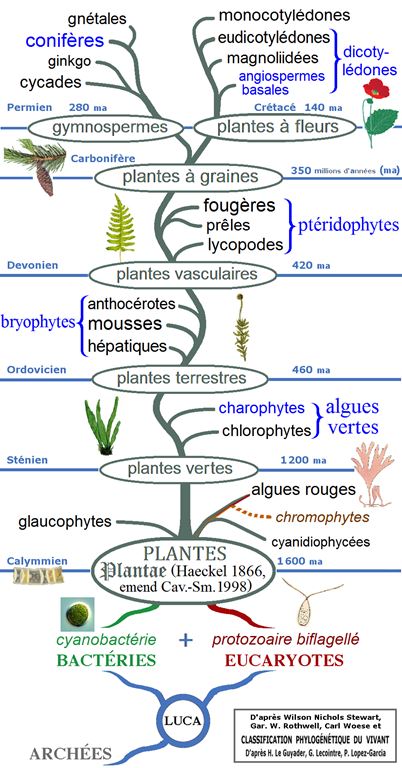
Classification
- Classique : en haut de l'écran, sous le coeur.
- Phylogénétique :
- Clade 4 : Angiospermes ;
- Clade 3 : Monocotylédones ;
- Ordre APN : Alismatales ;
- Famille APN : Araceae ;
À droite, cet arbre phylogénétique des plantes montre les principaux clades et groupes traditionnels (monophylétiques en noir et paraphylétiques en bleu).
Dénominations
- Nom botanique : Lasia spinosa (L.) Thwaites
- Synonymes : Dracontium spinosum Linnaeus, Lasia aculeata Lour, Lasia crassifolia Engl, Lasia descuscens Schott, Lasia hermannii Schott, Lasia heterophylla (Roxb.) Schott, Lasia jenkinsii Schott, Lasia roxburghii Griff, Lasia zollingeri Schott, Pothos heterophyllus Roxb, Pothos lasia Roxb, Pothos spinosus (L.) Buch.-Ham. ex Wall, Lasia macrophylla Schott, ?
- Noms anglais et locaux : Lasia, Livid flower, Unicorn plant
Description et culture
Tableau récapitulatif
Parties comes-tibles Note comest. (1-5) Note medic. (1-5) (Zones de) Rusticité Besoins en 
Besoins en  (1-3)
(1-3)Périodes de semis et récoltes Graines au gramme Durée de viabilité Profon-deur semis Espace-ment plants Espace-ment lignes Durée germi-native Durée avant récolte J F M A M J
J A S O N D
J F M A M J
J A S O N D
- dont infos de 0FPI ("FOOD PLANTS INTERNATIONAL", en anglais) :
Description :
Une grosse herbe à feuilles. Il a souvent un rhizome rampant. Il atteint 40-120 cm de haut. Les tiges sont épineuses. Les feuilles poussent hors du sol. Ils sont en forme d'épée ou avec des lobes s'étendant aux trois quarts de la nervure médiane. Les feuilles sont épineuses le long des nervures. Les feuilles mesurent 30 à 45 cm de long et 25 cm de large. La tige des feuilles mesure 25 à 50 cm de long. Les feuilles sont vert moyen. La structure en forme de feuille autour de la fleur est tordue et ne s'ouvre qu'à la base. Il mesure 15-30 cm de long et est brun. Les fleurs se produisent étroitement ensemble sans tiges florales. Les fleurs ont les deux sexes. Ils sont comme un cylindre et mesurent 2-3 cm de long sur 7,5 mm de large. Ils augmentent à trois fois cette taille. Le fruit est vert, charnu et épineux. Il est composé d'une baie qui est ovale et a une pointe acérée au sommet. Il mesure 1 cm de long. Les graines mesurent 5 mm de long et 3,5 mm de large{{{0(+x) (traduction automatique).
Original : A big leafy herb. It often has a creeping rhizome. It grows to 40-120 cm high. The stems are thorny. Leaves grow out of the ground. They are sword shaped or with lobes extending three-quarters of the way to the midrib. The leaves are thorny along the veins. Leaves are 30-45 cm long and 25 cm wide. The leaf stalk is 25-50 cm long. Leaves are medium green. The leaf like structure around the flower is twisted and opens out only at the base. It is 15-30 cm long and brown. The flowers occur tightly together without flower stalks. The flowers have both sexes. They are like a cylinder and 2-3 cm long by 7.5 mm wide. They increase to three times this size. The fruit is green, fleshy and spiny. It is composed of a berry which is oval and has a sharp point at the top. It is 1 cm long. The seed are 5 mm long and 3.5 mm wide{{{0(+x).
Culture :
Les plantes peuvent être cultivées par les tiges rampantes et aussi par les graines. Les petits tubercules des bulbes peuvent être plantés. Ils sont plantés dans un trou{{{0(+x) (traduction automatique).
Original : Plants can be grown by the creeping stems and also by seeds. The small tubers off the corms can be planted. They are planted in a hole{{{0(+x).
 Consommation (rapports de comestibilité, parties utilisables et usages alimentaires correspondants)
Consommation (rapports de comestibilité, parties utilisables et usages alimentaires correspondants)Parties comestibles :
feuilles, racines, fruits, fleurs, tige de feuille, rhizome{{{0(+x) (traduction automatique). Original : Leaves, Roots, Fruit, Flowers, Leaf stalk, Rhizome{{{0(+x).Détails :
Les jeunes feuilles sont consommées comme légumes. Ils doivent être cuits ou fermentés pour éliminer l'acide cyanhydrique amer et toxique. (Cela se décompose avec la cuisson) Les fruits sont consommés après avoir été mis dans de l'eau salée (saumure). Les tiges des feuilles sont pelées et utilisées dans les currys pour ajouter de la saveur. Le spadix de fleur est cuit comme légume. Les fleurs récoltées peuvent être conservées pendant 7 jours. Les tubercules sont consommés bouillis. Les bulbes peuvent être stockés pendant de longues périodes dans des pièces sèches et bien ventilées. Les feuilles peuvent être conservées pendant 3 jours{{{0(+x) (traduction automatique).
Original : Young leaves are eaten as vegetables. They must be cooked or fermented to remove the bitter and poisonous hydrocyanic acid. (This breaks down with cooking)The fruit are eaten after being put in salt water (brine). The leaf stalks are peeled and used in curries to add flavour. The flower spadix is cooked as a vegetable. The harvested flowers can be stored for 7 days. The tubers are eaten boiled. The corms can be stored for long periods in dry, well ventilated rooms. Leaves can be stored for 3 days{{{0(+x).
Partie testée :
corme{{{0(+x) (traduction automatique). Original : Corm{{{0(+x)| Taux d'humidité (%) | Énergie (kj) | Énergie (kcal) | Protéines (g) |
|---|---|---|---|
| 85 | 222 | 53 | 1.7 |
| Pro- vitamines A (µg) |
Vitamines C (mg) | Fer (mg) | Zinc (mg) |
| 0 | 22 | 0.4 | 0 |
 Risques et précautions à prendre
Risques et précautions à prendrecf. consommation
Autres infos
dont infos de 0FPI ("FOOD PLANTS INTERNATIONAL", en anglais) :
Statut :
Les plantes poussent à l'état sauvage et sont cultivées et sont vendues sur les marchés en Thaïlande. Il est couramment utilisé au Sri Lanka{{{0(+x) (traduction automatique).
Original : Plants grow wild and are cultivated and are sold in markets in Thailand.It is commonly used in Sri Lanka{{{0(+x).
Distribution :
Une plante tropicale. On le trouve dans les zones humides ombragées le long des rivières dans la forêt à feuilles persistantes. Il pousse dans les endroits marécageux et les zones humides. Il peut tolérer une eau légèrement saumâtre. Il a besoin d'une température comprise entre 25 et 35 ° C. En Papouasie-Nouvelle-Guinée, il passe du niveau de la mer à 500 m d'altitude. Au Vietnam, il passe du niveau de la mer à 1 000 m d'altitude. Au Yunnan{{{0(+x) (traduction automatique).
Original : A tropical plant. It is found in moist shady areas along rivers in evergreen forest. It grows in swampy places and wetlands. It can tolerate slightly brackish water. It needs a temperature between 25-35°C. In Papua New Guinea it grows from sea level to 500 m altitude. In Vietnam it grows from sea level to 1,000 m above sea level. In Yunnan{{{0(+x).
Localisation :
Asie, Australie, Bangladesh, Bhoutan, Brunei, Cambodge, Chine, Himalaya, Inde, Indochine, Indonésie, Laos, Malaisie, Myanmar, Népal, Nord-est de l'Inde, Pacifique, Papouasie-Nouvelle-Guinée, PNG, Asie du Sud-Est, Sri Lanka, Taïwan, Thaïlande , Tibet, Vietnam{{{0(+x) (traduction automatique).
Original : Asia, Australia, Bangladesh, Bhutan, Brunei, Cambodia, China, Himalayas, India, Indochina, Indonesia, Laos, Malaysia, Myanmar, Nepal, Northeastern India, Pacific, Papua New Guinea, PNG, SE Asia, Sri Lanka, Taiwan, Thailand, Tibet, Vietnam{{{0(+x).
Notes :
Les rhizomes et les feuilles sont utilisés en médecine. Il existe 2 espèces de Lasia{{{0(+x) (traduction automatique).
Original : Rhizomes and leaves are used in medicine. There are 2 Lasia species{{{0(+x).
Liens, sources et/ou références
Liens :
/ ;Sources et/ou références :
bibliographie (liste des sources et/ou références de l'encyclopédie)
dont livres et bases de données : 0FPI ("FOOD PLANTS INTERNATIONAL", en anglais) ;
Warning: Undefined variable $prex in /home/waso5761/public_html/inc/fiches.php on line 2607
dont bibliographie/références de 0FPI ("FOOD PLANTS INTERNATIONAL", en anglais) :
Altschul, S.V.R., 1973, Drugs and Foods from Little-known Plants. Notes in Harvard University Herbaria. Harvard Univ. Press. Massachusetts. no. 114 ; Ambasta, S.P. (Ed.), 2000, The Useful Plants of India. CSIR India. p 317 ; Anderson, E. F., 1993, Plants and people of the Golden Triangle. Dioscorides Press. p 214 ; Angami, A., et al, 2006, Status and potential of wild edible plants of Arunachal Pradesh. Indian Journal of Traditional Knowledge 5(4) October 2006, pp 541-550 ; Bandyopadhyay, S. et al, 2009, Wild edible plants of Koch Bihar district, West Bengal. Natural Products Radiance 8(1) 64-72 ; Baro, D., Baruah, S. and Borthukar, S. K. 2015, Documentation on wild vegetables of Baksa district, BTAD (Assam). Scholars Research Library. Archives of Applied Science Research, 2015, 7 (9):19-27 ; Burkill, I.H., 1966, A Dictionary of the Economic Products of the Malay Peninsula. Ministry of Agriculture and Cooperatives, Kuala Lumpur, Malaysia. Vol 2 (I-Z) p 1340 ; Chandrakumar, P., et al, 2015, Ethnobotanical studies of wild edible plants of Gond, Halba and Kawar tribes of Salekasa Taluka, Gondia District, Maharashtra State, India. International Research Journal of Pharmacy 6(8) ; Chowdery, T., et al, 2014, Wild edible plants of Uttar Dinajpur District, West Bengal. Life Science Leaflets. 47:pp 20-36 http://lifesciencesleaflets.ning.com ; Chowdhury, M. & Mukherjee, R., 2012, Wild Edible Plants Consumed by Local Communities of Maldah of West Bengal, India. Indian J.Sci.Res.3(2) : 163-170 ; Deb, D., et al, 2013, Wild Edible Plants and Their Utilization in Traditional Recipes of Tripura, Northeast India. Advances in Biological Research 7(5):203-211 ; Deka, N. & Devi, N., 2015, Wild edible aquatic and marshland angiosperms of Baka district, BTC area, Assam, India. Asian J. Plant Sci. Res. 5(1):32-48 ; Dobriyal, M. J. R. & Dobriyal, R., 2014, Non Wood Forest Produce an Option for Ethnic Food and Nutritional Security in India. Int. J. of Usuf. Mngt. 15(1):17-37 ; Dutta, U., 2012, Wild Vegetables collected by the local communities from the Churang reserve of BTD, Assam. International Journal of Science and Advanced Technology. Vol. 2(4) p 122 ; Eiadthong, W., et al, 2010, Management of the Emerald Triangle Protected Forests Complex. Botanical Consultant Technical Report. p 49 ; Ghorbani, A., et al, 2012, A comparison of the wild food plant use knowledge of ethnic minorities in Naban River Watershed Nature Reserve, Yunnan, SW China. Journal of Ethnobiology and Ethnomedicine; 8:17 ; Heyne, K., 1927 p 419 ; Hossain, U. & Rahman, A., 2018, Study and quantitative analysis of wild vegetable floral diversity available in Barisal district, Bangladesh. Asian J. Med. Biol. Res. 2018, 4 (4), 362-371 ; Jacquat, C., 1990, Plants from the Markets of Thailand. D.K. Book House p 112 ; Japanese International Research Centre for Agricultural Sciencewww.jircas.affrc.go.jp/project/value_addition/Vegetables ; Johns, R.J. & Hay, A., 1976, Monocotyledons of Papua New Guinea. Part 1 , Forestry College Bulolo, PNG p 63 ; Johnson, N., 2002, Environmental Change in northern Thailand: Impact on Wild Edible Plant Availability. Ecology of Food and Nutrition, 41: 5, 373-399 ; Kachenchart, B., et al, 2008, Phenology of Edible Plants at Sakaerat Forest. In Proceedings of the FORTROP II: Tropical Forestry Change in a Changing World. Bangkok, Thailand. ; Kar, A., & Borthakur, S. K., 2008, Wild vegetables of Karbi - Anglong district, Assam, Natural Product Radiance, Vol. 7(5), pp 448-460 ; Kumar, S. A., Manus, D. & Mallika, M., 2018, Impact of non-timber forest products on Forest and in Livelihood Economy of the People of Adjoining Areas of Jalpaiguri Forest Division, West Bengal, India. Int. J. of Life Sciences, 2018; 6 (2):365-385 ; Leach, G.J., & Osborne, P.L., 1985, Freshwater Plants of Papua New Guinea. UPNG Press, p 91 ; Lim, T. K., 2015, Edible Medicinal and Non Medicinal Plants. Volume 9, Modified Stems, Roots, Bulbs. Springer p 51 ; Lungphi, P., Wangpan, T. & Tangjang, S., 2018, Wild edible plants and their additional uses by the Tangsa community living in the Changlang district of Arunachal Pradesh, India. Pleione 12(2): 151 - 164. 2018. ; Macmillan, H.F. (Revised Barlow, H.S., et al), 1991, Tropical Planting and Gardening. Sixth edition. Malayan Nature Society. Kuala Lumpur. p 356 ; Maituthisakul, P., et al, 2007, Assessment of phenolic content and free radical-scavenging capacity of some Thai indigenous plants. Food Chemistry 100: 1409-1418 ; McMakin, P.D., 2000, Flowering Plants of Thailand. A Field Guide. White Lotus. p 44 ; Martin, F.W. & Ruberte, R.M., 1979, Edible Leaves of the Tropics. Antillian College Press, Mayaguez, Puerto Rico. p 176 ; Medhi, P. & Borthakur, S. K., 2012, Phytoresources from North Cachur Hills of Assam -3: Edible plants sold at Hflong market. Indian Journal or Natural Products and Resources. 3(1) pp 84-109 ; Medhi, P. & Borthakur, S. K., 2013, Wild edible plants sold by the Zeme Nagas at the makeshift market of Mahur, Dima Hasao district of Assam. Pleione 7(1): 84 - 93. 2013 ; Medhi, P., Sarma, A and Borthakur, S. K., 2014, Wild edible plants from the Dima Hasao district of Assam, India. Pleione 8(1): 133-148 ; Nakahara, K. et al, 2002, Antimutagenicity of Some Edible Thai Plants, and a Biocative Carbazole Alkaloid, Mahanine, Isolated from Micromelum minutum. Journal of Agricultural and Food Chemistry. 50: 4796-4892 ; Ochse, J.J. et al, 1931, Vegetables of the Dutch East Indies. Asher reprint. p 59 ; Ogle, B. M., et al, 2003, Food, Feed or Medicine: The Multiple Functions of Edible Wild Plants in Vietnam. Economic Botany 57(1): 103-117 ; Partha, P., 2014, Ethnobotany of the Laleng (Patra) Community in Bangladesh. Journal of Pharmacognosy and Phytochemistry. 2(6):173-184 ; Patiri, B. & Borah, A., 2007, Wild Edible Plants of Assam. Geethaki Publishers. p 158 ; Pegu, R., et al, 2013, Ethnobotanical study of Wild Edible Plants in Poba Reserved Forest, Assam, India. Research Journal of Agriculture and Forestry Sciences 1(3):1-10 ; Rajapaksha, U., 1998, Traditional Food Plants in Sri Lanka. HARTI, Sri Lanka. p 85 ; Reddy, K. N. et al, 2007, Traditional knowledge on wild food plants in Andhra Pradesh. Indian Journal of Traditional Knowledge. Vol. 6(1): 223-229 ; Romanowski, N., 2007, Edible Water Gardens. Hyland House. p 59 ; Sangma, A. j. T., 2018, Non-timber forest products (NTFPs) used by Garo tribe of Rongram block in West Garo Hills, Meghalaya. Indian Journal of Traditional Knowledge Vol 18 (1), pp 151-161 ; Sarma, H., et al, 2010, Updated Estimates of Wild Edible and Threatened Plants of Assam: A Meta-analysis. International Journal of Botany 6(4): 414-423 ; Seidemann J., 2005, World Spice Plants. Economic Usage, Botany, Taxonomy. Springer. p 198 ; Shin, T., et al, 2018, Traditional knowledge of wild edible plants with special emphasis on medicinal uses in Southern Shan State, Myanmar. Journal of Ethnobiology and Ethnomedicine (2018) 14:48 ; Singh, H.B., Arora R.K.,1978, Wild edible Plants of India. Indian Council of Agricultural Research, New Delhi. p13, 27 ; Somnasang, P., Moreno, G and Chusil K., 1998, Indigenous knowledge of wild hunting and gathering in north-east Thailand. Food and Nutrition Bulletin 19(4) p 359f ; Srichaiwong, P., et al, 2014, A Study of the Biodiversity of Natural Food Production to Support Community Upstream of Chi Basin, Thailand. Asian Social Science 10 (2): ; Sukarya, D. G., (Ed.) 2013, 3,500 Plant Species of the Botanic Gardens of Indonesia. LIPI p 1150 ; Tanaka, Y. & Van Ke, N., 2007, Edible Wild Plants of Vietnam: The bountiful garden. Orchid books. p 32 ; Teron, R. & Borthakur, S. K., 2016, Edible Medicines: An Exploration of Medicinal Plants in Dietary Practices of Karbi Tribal Population of Assam, Northeast India. In Mondal, N. & Sen, J.(Ed.) Nutrition and Health among tribal populations of India. p 149 ; Thitiprasert, W., et al, 2007, Country report on the State of Plant Genetic Resources for Food and Agriculture in Thailand (1997-2004). FAO p 95 ; G. H. K. Thwaites & J. D. Hooker, Enum. pl. zeyl. 336. 1864 ; USDA, ARS, National Genetic Resources Program. Germplasm Resources Information Network - (GRIN). [Online Database] National Germplasm Resources Laboratory, Beltsville, Maryland. Available: www.ars-grin.gov/cgi-bin/npgs/html/econ.pl (10 April 2000) ; WATT ; Xu, You-Kai, et al, 2004, Wild Vegetable Resources and Market Survey in Xishuangbanna, Southwest China. Economic Botany. 58(4): 647-667.
Recherche de/pour :
- "Lasia spinosa" sur Google (pages et
images) ;
IPNI ("International Plant Names Index", en anglais) ;
TPL ("The Plant List", en anglais) ;
GRIN ("Germplasm Resources Information Network", en anglais) ;
TROPICOS (en anglais) ;
Tela Botanica ;
Pl@ntNet ;
Pl@ntUse ;
"Plants For A Future" (en anglais) ;
"Useful Tropical Plants" (en anglais) ou
"Useful Temperate Plants" (en anglais) ;
- "Lasia spinosa" sur Google (pages et
images) ;
IPNI ("International Plant Names Index", en anglais) ;
TPL ("The Plant List", en anglais) ;
GRIN ("Germplasm Resources Information Network", en anglais) ;
TROPICOS (en anglais) ;
Tela Botanica ;
Pl@ntNet ;
Pl@ntUse ;
"Plants For A Future" (en anglais) ;
"Useful Tropical Plants" (en anglais) ou
"Useful Temperate Plants" (en anglais) ;
Espèces du même genre (Lasia)
7 taxons
Espèces de la même famille (Araceae)
240 taxons
- Acore odorant
- Anguine
- Arisarum
- Arisème petit-prêcheur
- Arum
- Arum d'Italie
- Arum tacheté
- Belembe
- Caladion bicolore
- Canne à gratter
- Capuchon-de-moine
- Dragonne Serpentaire
- Ereriba
- Faux philodendron
- Koniaku
- Lenticule à trois lobes
- Lenticule bossue
- Lentille d'eau
- Lentille-d'eau
- Lysichite blanc
- Lysichiton américain
- Macabo
- Oreille d'éléphant
- Oreille d'éléphant géante
- Patte-d'oie
- Richarde
- Songe pâté
- Taro
- Taro chinois
- Taro géant des marais
- Tiquisque
- Typhonodore de Lindley
- Wolffie sans racines
- Acorus calamus L. (Acore odorant)
- Acorus gramineus Sol. ex Aiton
- Aglaonema costatum N.E.Br.
- Aglaonema philippinense Engl.
- Aglaonema pictum
- Alloschemone inopinata Bogner & P.C.Boyce
- Alocasia acuminata Schott
- Alocasia brisbanensis
- Alocasia cucullata (Lour.) G. Don (Taro chinois)
- Alocasia fallax Schott
- Alocasia fornicata
- Alocasia hollrungii Engl.
- Alocasia lancifolia Engl.
- Alocasia macrorrhizos (L.) G. Don (Oreille d'éléphant géante)
- Alocasia odora (Lindl.) K.Koch (Oreille d'éléphant)
- Alocasia portei Schott
- Alocasia sanderiana W.Bull
- Amorphophallus abyssinicus Gombcz
- Amorphophallus albus P.Y.Liu & J.F.Chen
- Amorphophallus aphyllus
- Amorphophallus asterostigmatus Bogner & Hett.
- Amorphophallus bhandarensis S.R.Yadav, Kahalkar & Bhuskute
- Amorphophallus brevispathus Gagnep.
- Amorphophallus bulbifer
- Amorphophallus commutatus
- Amorphophallus consimilis Blume
- Amorphophallus dracontioides
- Amorphophallus gallaensis
- Amorphophallus glabra F.M.Bailey
- Amorphophallus gomboczianus Pic.Serm.
- Amorphophallus harmandii Engl. & Gehrm.
- Amorphophallus kachinensis Engl. & Gehrm.
- Amorphophallus konjac K.Koch (Koniaku)
- Amorphophallus konkanensis Hett., S.R.Yadav & K.S.Patil
- Amorphophallus koratensis Gagnep.
- Amorphophallus krausei Engl.
- Amorphophallus lyratus
- Amorphophallus margaritifer
- Amorphophallus muelleri Blume
- Amorphophallus paeoniifolius (Dennst.) Nicolson (Songe pâté)
- Amorphophallus prainii Hook.f.
- Amorphophallus purpurascens Kurz ex Hook.f.
- Amorphophallus rivieri
- Amorphophallus saraburiensis
- Amorphophallus stuhlmannii
- Amorphophallus sylvaticus
- Amorphophallus titanum
- Amorphophallus variabilis Blume
- Amorphophallus ximengensis H.Li
- Amorphophallus yuloensis H.Li
- ...







 donne accès au menu
  - encyclopédies des plantes alimentaires ;
 - page de recherche - reconnaissance (identification) de plantes ;
 - page du calendrier lunaire et son générateur (au format PDF et JPG) ;
 - tableau récapitulatif ;
 - générateur de potées (soupes), avec estimation des apports nutrionnels et du coût;
 - générateur de codes QR ;
 - page des archives avec de nombreux documents sur différents thèmes complémentaires comme la botanique, les légumes,
les champignons, la cuisine, le bien-être ainsi que différents MOOC mais également des liens vers les archives de l'association ;
- page des archives avec de nombreux documents sur différents thèmes complémentaires comme la botanique, les légumes,
les champignons, la cuisine, le bien-être ainsi que différents MOOC mais également des liens vers les archives de l'association ;

 pour le fruit (et/ou les graines, la pulpe, etc...),
 pour les fleurs (et/ou pétales, calice...),
 pour les feuilles (et/ou la tige, les pousses...),
 pour les racines,
 pour le tronc (et/ou l'écorce, la sève...), et enfin
 pour les champignons,
puis les notes alimentaires et médicinales (de 1 à 5 étoiles), la rusticité (résistance au froid/gel)
et pour finir un résumé.
pour les champignons,
puis les notes alimentaires et médicinales (de 1 à 5 étoiles), la rusticité (résistance au froid/gel)
et pour finir un résumé. menant ici 🙂
 ,
,  et
et





 ,
,


 Encyclopédie(s)
 Recherche-Reconnaissance
 Tableau récapitulatif
 Codes QR
 Archives
 Calendrier(s) lunaire(s)
  Potées
 Re-naturation/naturalisation
 Affichettes, herbiers &
co.
Affichettes, herbiers &
co. menu
menu galerie


 (en bas à droite).
 (en bas à gauche).
