Willughbeia edulis


 |
***
-
**
|
***
-
**
Un grimpeur ligneux ou une vigne. Il a une sève laiteuse. Les petites branches ont des côtes. Il a de longues vrilles ramifiées. Les feuilles sont oblongues et effilées ve ... (traduction automatique)
→suite


Willughbeia edulis
Note alimentaire 
Note médicinale 
Note autre usage 

Un grimpeur ligneux ou une vigne. Il a une sève laiteuse. Les petites branches ont des côtes. Il a de longues vrilles ramifiées. Les feuilles sont oblongues et effilées vers la pointe. Les feuilles son... (traduction automatique) →suite
Classification
- Classique : en haut de l'écran, sous le coeur.
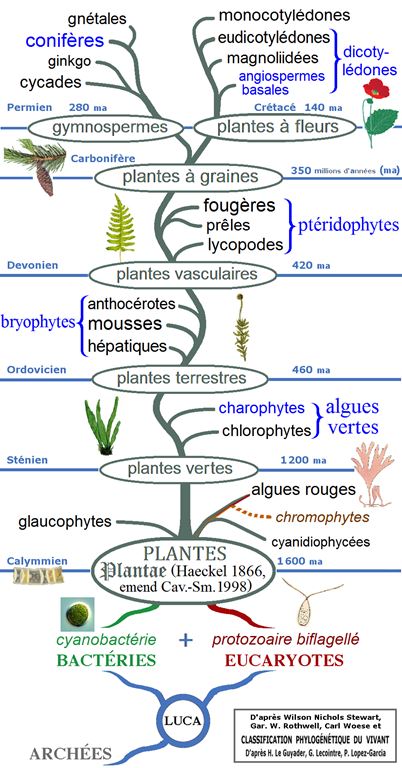
- Phylogénétique :
- Clade 4 : Angiospermes ;
- Clade 3 : Dicotylédones_vraies ;
- Clade 2 : Astéridées ;
- Clade 1 : Lamiidées ;
- Ordre APN : Gentianales ;
- Famille APN : Apocynaceae ;
À droite, cet arbre phylogénétique des plantes montre les principaux clades et groupes traditionnels (monophylétiques en noir et paraphylétiques en bleu).
Dénominations
- Nom botanique : Willughbeia edulis Roxb.
- Synonymes : Ancylocladus edulis (Roxb.) Kuntze, Willughbeia cochinchinensis (Pierre ex Pit.) K. Schum, Willughbeia dulcis Ridl, et d'autres
- Noms anglais et locaux : Gedraphol, Kuy
Description et culture
Tableau récapitulatif
Parties comes-tibles Note comest. (1-5) Note medic. (1-5) (Zones de) Rusticité Besoins en 
Besoins en  (1-3)
(1-3)Périodes de semis et récoltes Graines au gramme Durée de viabilité Profon-deur semis Espace-ment plants Espace-ment lignes Durée germi-native Durée avant récolte J F M A M J
J A S O N D
J F M A M J
J A S O N D
- dont infos de 0FPI ("FOOD PLANTS INTERNATIONAL", en anglais) :
Description :
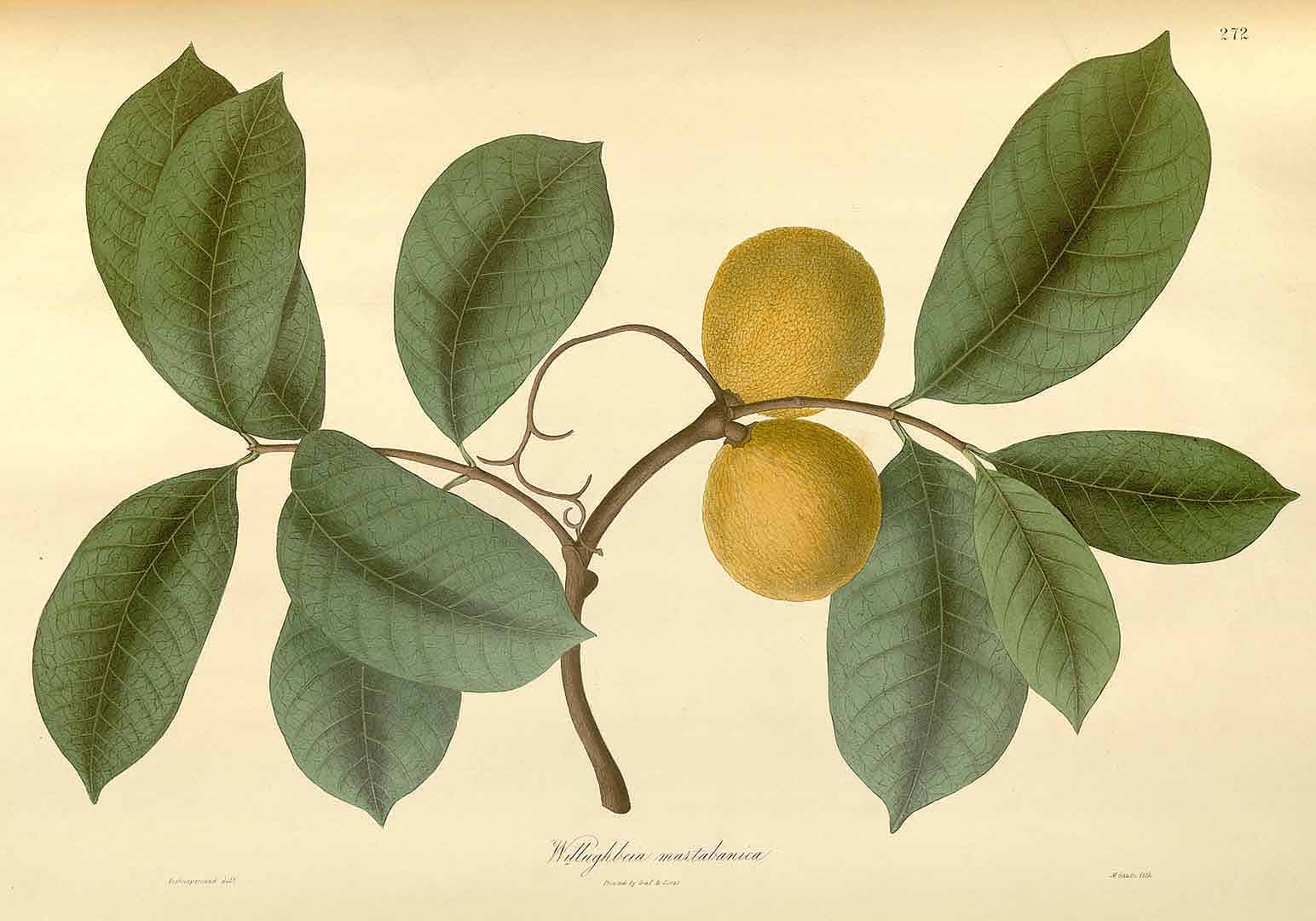
Un grimpeur ligneux ou une vigne. Il a une sève laiteuse. Les petites branches ont des côtes. Il a de longues vrilles ramifiées. Les feuilles sont oblongues et effilées vers la pointe. Les feuilles sont foncées dessus et brun rougeâtre dessous. Les fleurs sont jaunâtres. Ils ont un parfum. Le fruit est de couleur orange foncé. Il a la taille d'un citron et a une pulpe jaune tendre. Il y a quelques grosses graines{{{0(+x) (traduction automatique).
Original : A woody climber or vine. It has a milky sap. The small branches have ribs. It has long branched tendrils. The leaves are oblong and taper to the tip. The leaves are dark above and reddish-brown underneath. The flowers are yellowish. They have a scent. The fruit is a dark orange colour. It is the size of a lemon and has a soft yellow pulp. There are a few large seeds{{{0(+x).
Production :
Dans le nord-est de la Thaïlande, les fruits sont mûrs de mars à avril{{{0(+x) (traduction automatique).
Original : In NE Thailand fruit are ripe March to April{{{0(+x).
 Consommation (rapports de comestibilité, parties utilisables et usages alimentaires correspondants)
Consommation (rapports de comestibilité, parties utilisables et usages alimentaires correspondants)Parties comestibles :
fruits, latex - boisson{{{0(+x) (traduction automatique). Original : Fruit, Latex- drink{{{0(+x).Détails :
Les fruits mûrs sont consommés et sont acides mais populaires. Le latex est utilisé comme lait{{{0(+x) (traduction automatique).
Original : The ripe fruit are eaten and are acidic but popular.The latex is used as milk{{{0(+x).
Partie testée :
/ Risques et précautions à prendre
Risques et précautions à prendrenéant, inconnus ou indéterminés.
Galerie(s)
Par Wallich, N., Plantae Asiaticae Rariores (1830-1832) Pl. Asiat. Rar. vol. 3 (1832) t. 272, via plantillustrations
✖

Par Roxburgh, W., Plants of the coast of Coromandel (1795-1819) Pl. Coromandel vol. 3 (1819) t. 280, via plantillustrations
✖

Autres infos
dont infos de 0FPI ("FOOD PLANTS INTERNATIONAL", en anglais) :
Statut :
Les fruits sont vendus sur les marchés{{{0(+x) (traduction automatique).
Original : The fruit are sold in markets{{{0(+x).
Distribution :
Une plante tropicale. Il pousse dans les arbres des forêts denses{{{0(+x) (traduction automatique).
Original : A tropical plant. It grows in trees in dense forests{{{0(+x).
Localisation :
Asie, Cambodge, Himalaya, Inde, Indochine, Laos, Malaisie, Myanmar, Inde du Nord-Est, Pacifique, Philippines, Asie du Sud-Est, Thaïlande, Vietnam{{{0(+x) (traduction automatique).
Original : Asia, Cambodia, Himalayas, India, Indochina, Laos, Malaysia, Myanmar, Northeastern India, Pacific, Philippines, SE Asia, Thailand, Vietnam{{{0(+x).
Liens, sources et/ou références
Liens :
/ ;Sources et/ou références :
bibliographie (liste des sources et/ou références de l'encyclopédie)
dont classification : IPNI ("International Plant Names Index", en anglais) ; Kew (POWO - "Plant Of the World Online", "Royal Botanical Garden", en anglais) ;
dont livres et bases de données : 5PFAF ("Plants For A Future", en anglais) ; 0FPI ("FOOD PLANTS INTERNATIONAL", en anglais) ;
dont bibliographie/références de 0FPI ("FOOD PLANTS INTERNATIONAL", en anglais) :
Ambasta, S.P. (Ed.), 2000, The Useful Plants of India. CSIR India. p 689 ; Burkill, I.H., 1966, A Dictionary of the Economic Products of the Malay Peninsula. Ministry of Agriculture and Cooperatives, Kuala Lumpur, Malaysia. Vol 2 (I-Z) p 2302 (Also as Willughbeia dulcis) ; Cengel, D. J. & Dany. C., (Eds), 2016, Integrating Forest Biodiversity Resource Management and Sustainable Community Livelihood Development in the Preah Vihear Protected Forest. International Tropical Timber Organization p 110 ; Coronel, R.E., 1982, Fruit Collections in the Philippines. IBPGR Newsletter p 8 ; Davis, S.D., Heywood, V.H., & Hamilton, A.C. (eds), 1994, Centres of plant Diversity. WWF. Vol 1 or 2. p 139 ; Dobriyal, M. J. R. & Dobriyal, R., 2014, Non Wood Forest Produce an Option for Ethnic Food and Nutritional Security in India. Int. J. of Usuf. Mngt. 15(1):17-37 ; Ethnobotany of Karbis. Chapter 4 in p 106 ; Hedrick, U.P., 1919, (Ed.), Sturtevant's edible plants of the world. p 688 ; Kachenchart, B., et al, 2008, Phenology of Edible Plants at Sakaerat Forest. In Proceedings of the FORTROP II: Tropical Forestry Change in a Changing World. Bangkok, Thailand. ; Kar, A., et al, 2013, Wild Edible Plant Resources used by the Mizos of Mizoram, India. Kathmandu University Journal of Science, Engineering and Technology. Vol. 9, No. 1, July, 2013, 106-126 ; Majumdar, K and Datta, N., 2009, Traditional wild edible fruits for the forest dwellers of Tripura, India. Pleione 3(2) 167-178 ; Medhi, P., Sarma, A and Borthakur, S. K., 2014, Wild edible plants from the Dima Hasao district of Assam, India. Pleione 8(1): 133-148 ; Milow, P., et al, 2013, Malaysian species of plants with edible fruits or seeds and their evaluation. International Journal of Fruit Science. 14:1, 1-2 ; Patiri, B. & Borah, A., 2007, Wild Edible Plants of Assam. Geethaki Publishers. p 82 ; Phon, P., 2000, Plants used in Cambodia. © Pauline Dy Phon, Phnom Penh, Cambodia. p 633 ; Sang, D. T., & Mizoue, K. O. N., 2012, Use of Edible Forest Plants among Indigenous Ethnic Minorities in Cat Tien Biosphere Reserve, Vietnam. Asian Journal of Biodiversity Vol. 3 (1), p 23-49 (As Willughbeia cochinchinensis) ; Sarma, H., et al, 2010, Updated Estimates of Wild Edible and Threatened Plants of Assam: A Meta-analysis. International Journal of Botany 6(4): 414-423 ; Siong, K. H., 2003, Indigenous Fruits of Sarawak. ITTO & Sarawak Forest Department. p 17 ; Suksri, S., et al, 2005, Ethnobotany in Bung Khong Long Non-Hunting Area, Northeast Thailand. Kasetsart J., (Nat. Sci) 39: 519-533 ; Teron, R. & Borthakur, S. K., 2016, Edible Medicines: An Exploration of Medicinal Plants in Dietary Practices of Karbi Tribal Population of Assam, Northeast India. In Mondal, N. & Sen, J.(Ed.) Nutrition and Health among tribal populations of India. p 148 ; Turreira Garcia, N., et al, 2017, Ethnobotanical knowledgeof the Kuy and Khmer people in Prey Lang, Cambodia. Cambodian Journal of Natural History 2017 (1): 76-101
Recherche de/pour :
- "Willughbeia edulis" sur Google (pages et
images) ;
TPL ("The Plant List", en anglais) ;
GRIN ("Germplasm Resources Information Network", en anglais) ;
TROPICOS (en anglais) ;
Tela Botanica ;
Pl@ntNet ;
Pl@ntUse ;
"Useful Tropical Plants" (en anglais) ou
"Useful Temperate Plants" (en anglais) ;
- "Willughbeia edulis" sur Google (pages et
images) ;
TPL ("The Plant List", en anglais) ;
GRIN ("Germplasm Resources Information Network", en anglais) ;
TROPICOS (en anglais) ;
Tela Botanica ;
Pl@ntNet ;
Pl@ntUse ;
"Useful Tropical Plants" (en anglais) ou
"Useful Temperate Plants" (en anglais) ;
Espèces du même genre (Willughbeia)
5 taxons
Espèces de la même famille (Apocynaceae)
688 taxons
- Araujia
- Asclépiade de Curaçao
- Beaumontie à grandes fleurs
- Cascabèle thévétie
- Céropégie de Wood
- Chicle muyo
- Dompte-venin
- Drégée volubile
- Frangipanier blanc
- Frangipanier rouge
- Gingembre blanc
- Gonphocarpe
- Grande pervenche
- Gymnema sylvestre
- Herbe aux perruches
- Karonda
- Mada
- Num num
- Pearl
- Périploque
- Pervenche de Madagascar
- Petite pervenche
- Prunier du natal
- Sarpagandha de l'Inde
- Sorva
- Tabernémontane divariqué
- Tsicta
- Acokanthera oppositifolia (Lam.) Codd
- Acokanthera rotundata (Codd) Kupicha
- Acokanthera schimperi (A.DC.) Schweinf.
- Aganonerion polymorphum Pierre ex Spire
- Alafia lucida Stapf
- Alafia sp
- Alstonia angustiloba Miq.
- Alstonia costata Wall. ex Miq.
- Alstonia macrophylla Wall. ex G.Don
- Alstonia pacifica
- Alstonia scholaris
- Alstonia spatulata Blume
- Alyxia lucida Wall.
- Alyxia stellata
- Amalocalyx microlobus Pierre ex Spire
- Ambelania acida Aubl.
- Ambelania occidentalis Zarucchi
- Amphineuron marginatum
- Ancylobothrys amoena Hua
- Ancylobothrys capensis
- Ancylobothrys petersiana
- Ancylobothrys pyriformis Pierre
- Ancylobothrys scandens
- Ancylobothrys tayloris
- Angolluma laticorona
- Anodendron paniculatum A.DC.
- Apocynum cannabinum L.
- Apocynum venetum A.DC.
- Araujia angustifolia
- Araujia odorata
- Araujia plumosa Schltr.
- Araujia sericifera Brot. (Araujia)
- Asclepias adscendens
- Asclepias affinis De Wild.
- Asclepias albens
- Asclepias asperula
- Asclepias aurea
- Asclepias brevicuspis
- Asclepias buchwaldii
- Asclepias californica Greene
- Asclepias compressidens
- Asclepias crassinervis N.E.Br.
- Asclepias crispa P.J.Bergius
- Asclepias cucullata
- Asclepias cultriformis Harv. ex Schltr.
- Asclepias curassavica Griseb. (Asclépiade de Curaçao)
- Asclepias decumbens L.
- Asclepias densiflora N.E.Br.
- Asclepias dissona N.E.Br.
- Asclepias eminens
- ...
Par Roxburgh, W., Plants of the coast of Coromandel (1795-1819) Pl. Coromandel vol. 3 (1819) t. 280, via plantillustrations







 donne accès au menu
  - encyclopédies des plantes alimentaires ;
 - page de recherche - reconnaissance (identification) de plantes ;
 - page du calendrier lunaire et son générateur (au format PDF et JPG) ;
 - tableau récapitulatif ;
 - générateur de potées (soupes), avec estimation des apports nutrionnels et du coût;
 - générateur de codes QR ;
 - page des archives avec de nombreux documents sur différents thèmes complémentaires comme la botanique, les légumes,
les champignons, la cuisine, le bien-être ainsi que différents MOOC mais également des liens vers les archives de l'association ;
- page des archives avec de nombreux documents sur différents thèmes complémentaires comme la botanique, les légumes,
les champignons, la cuisine, le bien-être ainsi que différents MOOC mais également des liens vers les archives de l'association ;

 pour le fruit (et/ou les graines, la pulpe, etc...),
 pour les fleurs (et/ou pétales, calice...),
 pour les feuilles (et/ou la tige, les pousses...),
 pour les racines,
 pour le tronc (et/ou l'écorce, la sève...), et enfin
 pour les champignons,
puis les notes alimentaires et médicinales (de 1 à 5 étoiles), la rusticité (résistance au froid/gel)
et pour finir un résumé.
pour les champignons,
puis les notes alimentaires et médicinales (de 1 à 5 étoiles), la rusticité (résistance au froid/gel)
et pour finir un résumé. menant ici 🙂
 ,
,  et
et





 ,
,


 Encyclopédie(s)
 Recherche-Reconnaissance
 Tableau récapitulatif
 Codes QR
 Archives
 Calendrier(s) lunaire(s)
  Potées
 Re-naturation/naturalisation
 Affichettes, herbiers &
co.
Affichettes, herbiers &
co. menu
menu galerie


 (en bas à droite).
 (en bas à gauche).
