Gingembre
(Zingiber officinale)
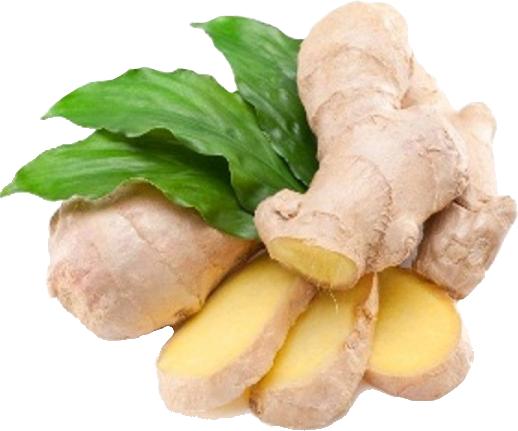

 |
****
-
*****
|
****
-
*****
-9/-10°C
Une plante herbacée vivace aux tiges souterraines gonflées. Il peut atteindre 30 à 100 cm de hauteur. La tige souterraine ou le rhizome se ramifie et est horizontal près d ... (traduction automatique)
→suite


Gingembre
Note alimentaire 
Note médicinale 

Une plante herbacée vivace aux tiges souterraines gonflées. Il peut atteindre 30 à 100 cm de hauteur. La tige souterraine ou le rhizome se ramifie et est horizontal près de la surface du sol. Il mesure... (traduction automatique) →suite
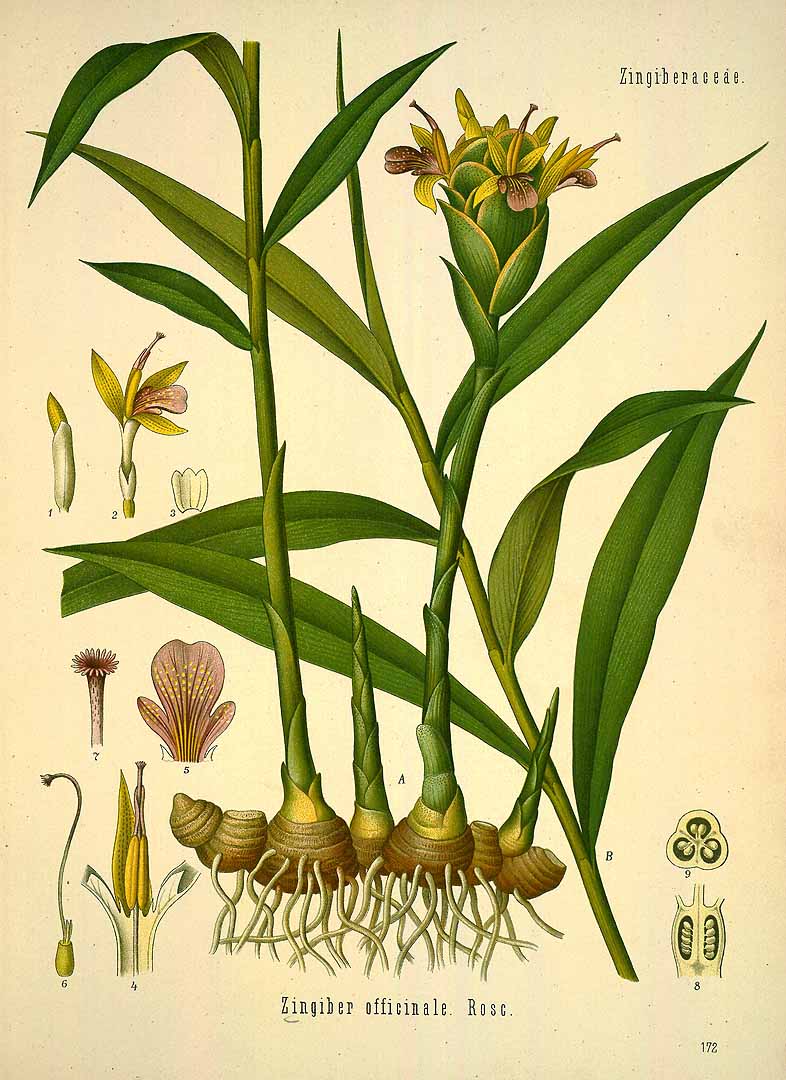
Zingiber officinale
Classification
- Classique : en haut de l'écran, sous le coeur.
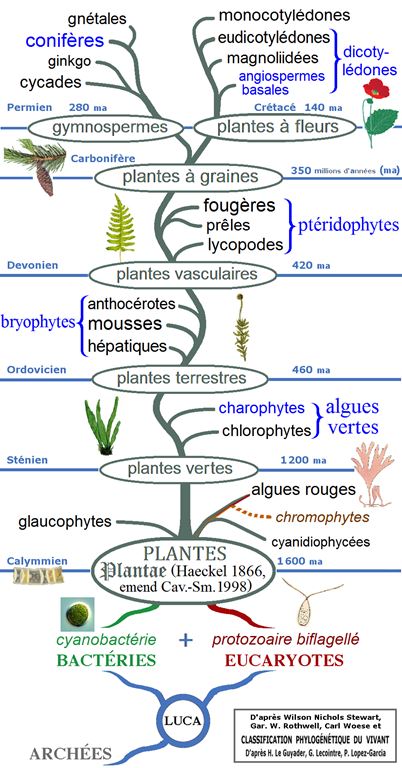
- Phylogénétique :
- Clade 4 : Angiospermes ;
- Clade 3 : Monocotylédones ;
- Clade 2 : Commelinidées ;
- Ordre APN : Zingiberales ;
- Famille APN : Zingiberaceae ;
À droite, cet arbre phylogénétique des plantes montre les principaux clades et groupes traditionnels (monophylétiques en noir et paraphylétiques en bleu).
Dénominations
- Nom botanique : Zingiber officinale Roscoe (1807)
- Synonymes français : gingembre officinale
- Synonymes : Amomum angustifolium Salisb, Amomum zingiber L, Zingiber aromaticum Noronha, Zingiber cholmondeleyi (F. M. Bailey) K. Schum, Zingiber missionis Wall, Zingiber sichuanense Z.Y. Zhu et al, Zingiber zingiber (L.) H. Karst
- Noms anglais et locaux : ginger, jiang (cn transcrit), Ingwer (de), zenzero (it), shoga (jp romaji), saenggang (ko transcrit), gengibre (pt), jengibre (es), ingefära (sv)
Description et culture
Tableau récapitulatif
Parties comes-tibles Note comest. (1-5) Note medic. (1-5) (Zones de) Rusticité Besoins en 
Besoins en  (1-3)
(1-3)Périodes de semis et récoltes Graines au gramme Durée de viabilité Profon-deur semis Espace-ment plants Espace-ment lignes Durée germi-native Durée avant récolte -9/-10°C J F M A M J
J A S O N D
J F M A M J
J A S O N D
- dont infos de 0FPI ("FOOD PLANTS INTERNATIONAL", en anglais) :
Description :
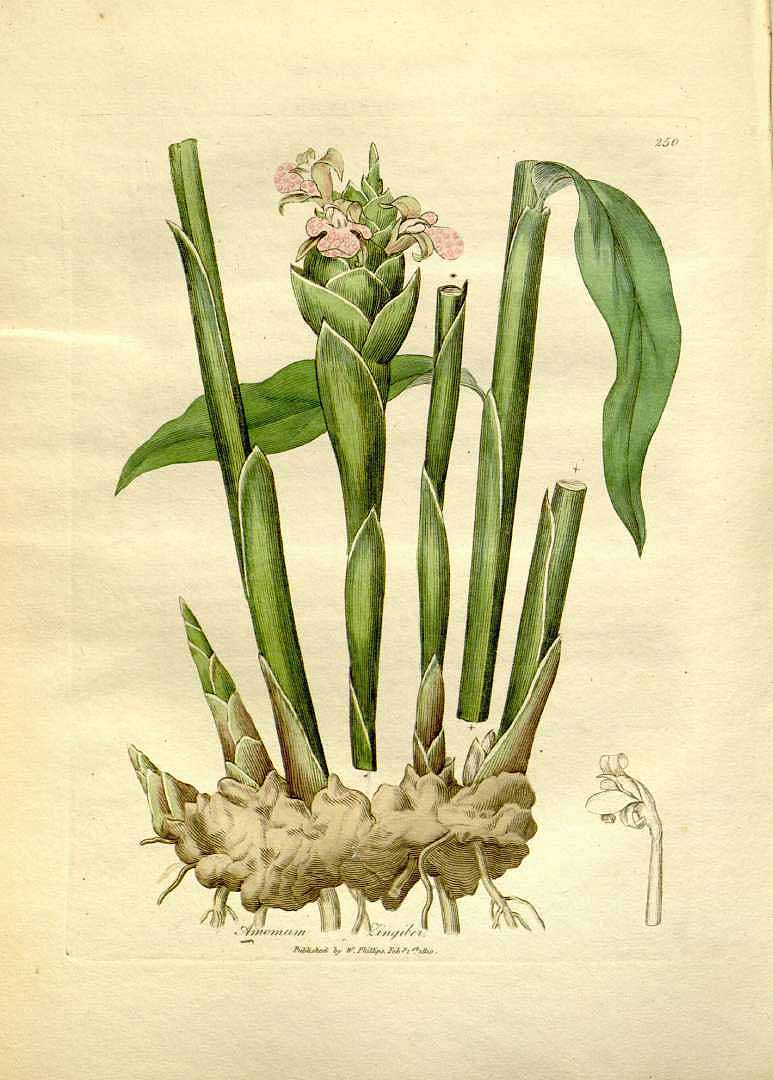
Une plante herbacée vivace aux tiges souterraines gonflées. Il peut atteindre 30 à 100 cm de hauteur. La tige souterraine ou le rhizome se ramifie et est horizontal près de la surface du sol. Il mesure environ 1,5 à 2,5 cm d'épaisseur. L'intérieur du rhizome est jaune et il est recouvert d'écailles formant un cercle autour de lui. Les feuilles sont longues (30 cm) et étroites (4 cm). Chaque pousse feuillue a généralement 8 à 12 feuilles en deux lignes verticales sur leurs côtés opposés. Le limbe se rétrécit uniformément jusqu'à l'extrémité de la feuille. La fleur est un cône de 6 cm de long sur une tige atteignant 30 cm de long. (Les fleurs ne sont pas produites dans tous les endroits.{{{0(+x) (traduction automatique).
Original : A perennial herb with swollen underground stems. It can grow 30-100 cm tall. The underground stem or rhizome branches and is horizontal near the soil surface. It is about 1.5-2.5 cm thick. Inside the rhizome is yellow and it is covered with scales forming a circle around it. The leaves are long (30 cm) and narrow (4 cm). Each leafy shoot usually has 8-12 leaves in two vertical lines on opposite sides of them. The leaf blade narrows evenly to the leaf tip. The flower is a cone 6 cm long on a stalk up to 30 cm long. (Flowers are not produced in all locations.){{{0(+x).
Production :
Il faut 12 mois pour mûrir. Il est récolté plusieurs fois. Les jeunes pousses sont coupées à environ 7,5 cm de hauteur{{{0(+x) (traduction automatique).
Original : It takes 12 months to mature. It is harvested several times. The young shoots are cut when about 7.5 cm high{{{0(+x).
Culture :
Une partie du rhizome est plantée à 5 à 7 cm sous la surface du sol. Parfois, une ombre légère est utilisée, mais elle peut être cultivée sans ombre{{{0(+x) (traduction automatique).
Original : A portion of the rhizome is planted 5-7 cm below the surface of the soil. Sometimes light shade is used but it can be grown without shade{{{0(+x).
 Consommation (rapports de comestibilité, parties utilisables et usages alimentaires correspondants)
Consommation (rapports de comestibilité, parties utilisables et usages alimentaires correspondants)Partie(s) comestible(s){{{0(+x) : rhizome, racine, feuilles, herbe, épice, légume{{{0(+x).
Utilisation(s)/usage(s){{{0(+x) culinaire(s) :
-le rhizome souterrain est consommé cru ou en salade ;
-les jeunes pousses sont épicées et peuvent être consommées ; ces jeunes pousses sont consommées comme légume ; elles sont également picklées ;
-le rhizome peut être séché et réduit en poudre ; ces vieilles racines sont utilisées comme épice ; elles sont conservées dans du sirop ;
-l'huile de gingembre est utilisée comme aromatisant ;
-le gingembre est utilisé pour les boissons{{{0(+x) ;
-le jus peut être utilisé pour faire cailler le lait (agent de coagulation/caillage /caille-lait substitut de présure) pour la préparation de fromage{{{~~244µ(dp*).
Partie testée :
racine moulue séchée{{{0(+x) (traduction automatique). Original : Root- dried ground{{{0(+x)| Taux d'humidité (%) | Énergie (kj) | Énergie (kcal) | Protéines (g) |
|---|---|---|---|
| 4.7 | 1452 | 347 | 347 9.1 |
| Pro- vitamines A (µg) |
Vitamines C (mg) | Fer (mg) | Zinc (mg) |
| 15 | 7.0 | 1452 11.5 | 4.7 |
 Risques et précautions à prendre
Risques et précautions à prendrenéant, inconnus ou indéterminés.
Usages médicinaux
La racine de gingembre est largement utilisée dans les traitements à base de plantes orientales. En Ayurveda, elle est connue comme la médecine universelle et elle est un ingrédient d'environ la moitié de toutes les prescriptions de la médecine ayurvédique et chinoise[238]. La racine est riche en huiles volatiles, gingérols et shogaols[238]. Les shogaols ne sont produits que lorsque la racine est séchée, en tant que substance de décomposition des gingérols[238]. Ils sont deux fois plus piquants que les gingérols et la racine séchée est donc normalement utilisée de différentes manières que la racine fraîche[238]. La racine est une herbe douce, piquante, aromatique et réchauffante qui est expectorante ; augmente la transpiration ; améliore la digestion et la fonction hépatique ; contrôle les nausées, les vomissements et la toux ; stimule la circulation ; détend les spasmes ; et soulage la douleur[238]. La racine est utilisée en interne dans le traitement de toutes les formes de nausées, y compris le mal du matin et le mal des transports[238]. On l'utilise pour traiter l'indigestion, les coliques, les frissons abdominaux, le rhume, la toux, la grippe et les problèmes circulatoires périphériques[238]. En usage externe, la racine est utilisée pour traiter les douleurs spasmodiques, les rhumatismes, les lumbagos, les crampes menstruelles et les entorses[238]{{{5(+)
Galerie(s)
Par Maria Brooklyn, via x
✖

Par Köhler, F.E., Köhler?s Medizinal Pflanzen (1883-1914) Med.-Pfl., via plantillustrations
✖

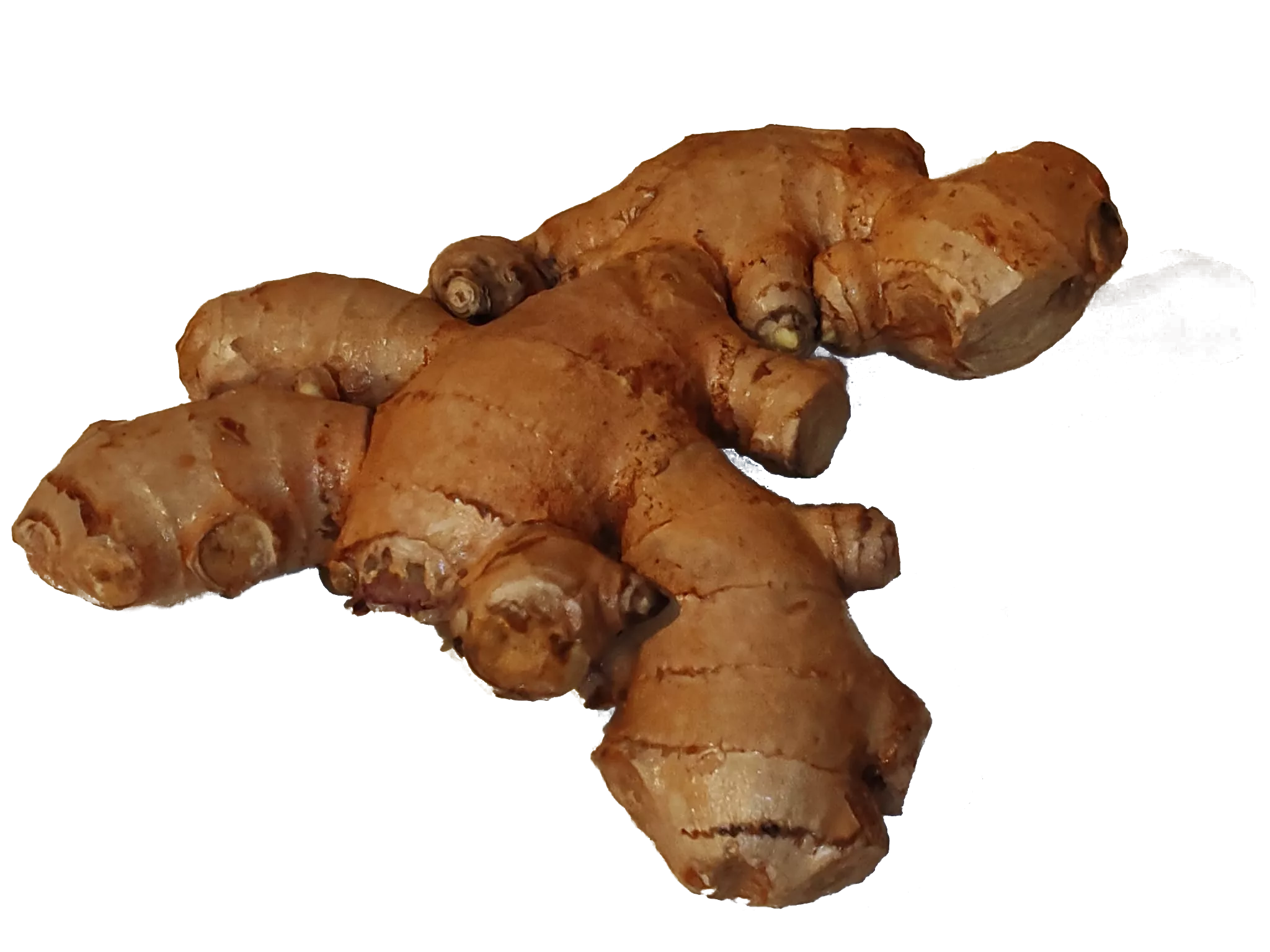
Par Patrick Le Ménahèze (travail personnel légué au domaine public), via x
✖
( ! ) Warning: Undefined array key 3 in C:\wamp64\www\lepotager-demesreves\inc\gal_fiches.php on line 52
✖
Autres infos
dont infos de 0FPI ("FOOD PLANTS INTERNATIONAL", en anglais) :
Statut :
C'est un légume cultivé commercialement. Commun dans la plupart des régions de Papouasie-Nouvelle-Guinée et consommé en quantité comme légume et comme épice{{{0(+x) (traduction automatique).
Original : It is a commercially cultivated vegetable. Common in most areas of Papua New Guinea and eaten in quantity as a vegetable and as a spice{{{0(+x).
Distribution :
C'est une plante tropicale. Il est principalement cultivé du niveau de la mer jusqu'à 1900 m d'altitude sous les tropiques, mais poussera dans des endroits plus élevés. Il a besoin d'un sol fertile et meuble. Il fait mieux avec beaucoup d'humus. Il nécessite une pluviométrie de 1500 mm ou plus par an. Il fait mieux là où il y a une courte saison sèche et une bonne température chaude. Il ne supporte pas l'engorgement. Au Népal, il atteint environ 2500 m d'altitude. Il convient aux zones de rusticité 9-12. Au Sichuan et au Yunnan{{{0(+x) (traduction automatique).
Original : It is a tropical plant. It is mainly grown from sea level up to 1900 m altitude in the tropics but will grow at higher places. It needs a loose fertile soil. It does best with plenty of humus. It requires a rainfall of 1500 mm or more per year. It does best where there is a short dry season and a good hot temperature. It cannot stand water-logging. In Nepal it grows to about 2500 m altitude. It suits hardiness zones 9-12. In Sichuan and Yunnan{{{0(+x).
Localisation :
Afrique, Andaman Is., Angola, Antigua-et-Barbuda, Asie, Australie, Bangladesh, Bhoutan, Bolivie, Brésil, Burkina Faso, Cambodge, Afrique centrale, Amérique centrale, Chine, République démocratique du Congo, Îles Cook, Costa Rica, Cuba, Afrique de l'Est , Timor oriental, Équateur, Éthiopie, Fidji, FSM, Grenade, Guam, Guinée, Guinée, Guinée-Bissau, Guyane, Hawaï, Haïti, Himalaya, Honduras, Inde, Indochine, Indonésie, Jamaïque, Japon, Kenya, Kiribati, Laos, Madagascar, Malaisie, Malawi, Marquises, Maurice, Mozambique, Myanmar, Nauru, Népal, Nicaragua, Nigéria, Nord-est de l'Inde, Pacifique, Papouasie-Nouvelle-Guinée, PNG, Pérou, Philippines, Pohnpei, Réunion, Samoa, Sao Tomé-et-Principe, Asie du Sud-Est, Sénégal, Sikkim, Îles Salomon, Amérique du Sud, Sri Lanka, Sainte-Lucie, Taïwan, Thaïlande, Timor-Leste, Tuvalu, Ouganda, USA, Vanuatu, Vietnam, Afrique de l'Ouest, Zimbabwe{{{0(+x) (traduction automatique).
Original : Africa, Andaman Is., Angola, Antigua and Barbuda, Asia, Australia, Bangladesh, Bhutan, Bolivia, Brazil, Burkina Faso, Cambodia, Central Africa, Central America, China, Congo DR, Cook Islands, Costa Rica, Cuba, East Africa, East Timor, Ecuador, Ethiopia, Fiji, FSM, Grenada, Guam, Guinea, Guinée, Guinea-Bissau, Guyana, Hawaii, Haiti, Himalayas, Honduras, India, Indochina, Indonesia, Jamaica, Japan, Kenya, Kiribati, Laos, Madagascar, Malaysia, Malawi, Marquesas, Mauritius, Mozambique, Myanmar, Nauru, Nepal, Nicaragua, Nigeria, Northeastern India, Pacific, Papua New Guinea, PNG, Peru, Philippines, Pohnpei, Reunion, Samoa, Sao Tome and Principe, SE Asia, Senegal, Sikkim, Solomon Islands, South America, Sri Lanka, St Lucia, Taiwan, Thailand, Timor-Leste, Tuvalu, Uganda, USA, Vanuatu, Vietnam, West Africa, Zimbabwe{{{0(+x).
Notes :
Il existe environ 100 à 150 espèces de Zingiber{{{0(+x) (traduction automatique).
Original : There are about 100-150 Zingiber species{{{0(+x).
Rusticité (résistance face au froid/gel, climat)
-9/-10°C
Liens, sources et/ou références
Liens :
"Ginger milk curd" WIKIPEDIA, en anglais) ;Sources et/ou références :
bibliographie (liste des sources et/ou références de l'encyclopédie)
dont classification : IPNI ("International Plant Names Index", en anglais) ; TPL ("The Plant List", en anglais) ; Kew (POWO - "Plant Of the World Online", "Royal Botanical Garden", en anglais) ;
dont livres et bases de données : 5PFAF ("Plants For A Future", en anglais) ; 0FPI ("FOOD PLANTS INTERNATIONAL", en anglais), 244Dictionaire oeconomique (livre, par Noel Chomel, Richard Bradley) ; 87Le Truffaut du Potager (collectif, éditions Larousse, 2010) / détails du livre ; Plantes médicinales - mode d'emploi (de Olivier Escuder, éditions Ulmer, 2007) / détails du livre
dont bibliographie/références de 5PFAF ("Plants For A Future", en anglais)
- [238] Encyclopaedia of Herbs and their Uses, Bown D., 1995, Dorling Kindersley, London, ISBN 0-7513-020-31 (Un livre très bien présenté et instructif sur les herbes du monde entier. Beaucoup de choses pour le lecteur occasionnel et l'étudiant avide d'apprendre. Un seul regret est la façon particulière d'avoir deux rubriques distinctes pour chaque plante.{{{5(x)) ;
Si parmis ces dernières (entre crochets) vous ne trouvez pas une ou plusieurs référence(s) utilisée(s) par PFAF ("Plants For A Future"), voici la liste complète (en anglais)
dont bibliographie/références de 0FPI ("FOOD PLANTS INTERNATIONAL", en anglais) :
Ali, A. M. S., 2005, Homegardens in Smallholder Farming Systems: Examples from Bangladesh. Human Ecology, Vol. 33, No. 2 pp. 245-270 Ambasta, S.P. (Ed.), 2000, The Useful Plants of India. CSIR India. p 701 Anderson, E. F., 1993, Plants and people of the Golden Triangle. Dioscorides Press. p 224 Bennett, B. C., 1990, Useful Plants of Amazonian Ecuador. US Agency for International Development. Fifth Progress Report. New York Botanical Gardens. p 40 Bianchini, F., Corbetta, F., and Pistoia, M., 1975, Fruits of the Earth. Cassell. p 212 Bodkin, F., 1991, Encyclopedia Botanica. Cornstalk publishing, p 1036 Bodner, C. C. and Gereau, R. E., 1988, A Contribution to Bontoc Ethnobotany. Economic Botany, 43(2): 307-369 Borrell, O.W., 1989, An Annotated Checklist of the Flora of Kairiru Island, New Guinea. Marcellin College, Victoria Australia. p 43 Bremness, L., 1994, Herbs. Collins Eyewitness Handbooks. Harper Collins. p 227 Burkill, H. M., 1985, The useful plants of west tropical Africa, Vol. 5. Kew. Burkill, I.H., 1966, A Dictionary of the Economic Products of the Malay Peninsula. Ministry of Agriculture and Cooperatives, Kuala Lumpur, Malaysia. Vol 2 (I-Z) p 2338 Burnie, G & Fenton-Smith, J., 1999, A Grower's Guide to Herbs. Murdoch Books. p 37 Cheifetz, A., (ed), 1999, 500 popular vegetables, herbs, fruits and nuts for Australian Gardeners. Random House p 163 Chin, H. F., 1999, Malaysian Vegetables in Colour. Tropical Press. p 82 Cobley, L.S. (rev. Steele, W.M.) 2nd Ed., 1976, An Introduction to the Botany of Tropical Crops. Longmans. p 230 Coe, F. G. and Anderson, G. J., 1999, Ethnobotany of the Sumu (Ulwa) of Southeastern Nicaragua and Comparisons with Miskitu Plant Lore. Economic Botany Vol. 53. No. 4. pp. 363-386 Cundall, P., (ed.), 2004, Gardening Australia: flora: the gardener's bible. ABC Books. p 1496 Dahlen, M., 1995, A Cook's Guide to Chinese Vegetables. Odyssey Guides. p 17, 112 Esperanca, M. J., 1988. Surviving in the wild. A glance at the wild plants and their uses. Vol. 1. p 382 Facciola, S., 1998, Cornucopia 2: a Source Book of Edible Plants. Kampong Publications, p 248 Foo, J.T.S.(ed), 1996, A Guide to Common Vegetables. Singapore Science Foundation. p 154 French, B.R., 1986, Food Plants of Papua New Guinea, A Compendium. Asia Pacific Science Foundation p 99 French, B.R., 2010, Food Plants of Solomon Islands. A Compendium. Food Plants International Inc. p 160 Goode, P., 1989, Edible Plants of Uganda. FAO p 26, 30 Hani Medicine of Xishuangbanna, 1999, p 183 Hedrick, U.P., 1919, (Ed.), Sturtevant's edible plants of the world. p 704 Hemphill, I, 2002, Spice Notes Macmillan. p 195 Heywood, V.H., Brummitt, R.K., Culham, A., and Seberg, O., 2007, Flowering Plant Families of the World. Royal Botanical Gardens, Kew. p 408 Hibbert, M., 2002, The Aussie Plant Finder 2002, Florilegium. p 311 Hutton, W., 1997, Tropical Herbs and Spices of Indonesia. Periplus. p 36 Hu, Shiu-ying, 2005, Food Plants of China. The Chinese University Press. p 329 Jacquat, C., 1990, Plants from the Markets of Thailand. D.K. Book House p 118 Japanese International Research Centre for Agricultural Science www.jircas.affrc.go.jp/project/value_addition/Vegetables Kapelle, M., et al, 2000, Useful plants within a Campesino Community in a Costa Rican Montane Cloud Forest. Mountain Research and Development, 20(2): 162-171 Kays, S. J., and Dias, J. C. S., 1995, Common Names of Commercially Cultivated Vegetables of the World in 15 languages. Economic Botany, Vol. 49, No. 2, pp. 115-152 Kiple, K.F. & Ornelas, K.C., (eds), 2000, The Cambridge World History of Food. CUP p 433, 1778 Kybal, J., 1980, Herbs and Spices, A Hamlyn Colour Guide, Hamlyn Sydney p 206 Larkcom, J., 1991, Oriental Vegetables, John Murray, London, p 127 Larsen, K., Ibrahim, H., Khaw, S.H., & Saw, L.G., 1999, Gingers of Peninsula Malaysia and Singapore. Natural History Publications (Borneo). p 7 Lazarides, M. & Hince, B., 1993, Handbook of Economic Plants of Australia, CSIRO. p 251 Lembaga Biologi Nasional, 1977, Ubi-Ubian, Balai Pustaka, Jakarta. p 40 Macmillan, H.F. (Revised Barlow, H.S., et al), 1991, Tropical Planting and Gardening. Sixth edition. Malayan Nature Society. Kuala Lumpur. p 380 Manandhar, N.P., 2002, Plants and People of Nepal. Timber Press. Portland, Oregon. p 486 Martin, F.W. & Ruberte, R.M., 1979, Edible Leaves of the Tropics. Antillian College Press, Mayaguez, Puerto Rico. p 43, 225 Mertz, O., Lykke, A. M., and Reenberg, A., 2001, Importance and Seasonality of Vegetable Consumption and Marketing in Burkina Faso. Economic Botany, 55(2):276-289 Molla, A., Ethiopian Plant Names. https://www.ethiopic.com/aplants.htm Mulherin, J., 1994, Spices and natural flavourings. Tiger Books, London. p 52 Norrington, L., & Campbell, C., 2001, Tropical Food Gardens. Bloomings Books. p 64 Omawale, 1973, Guyana's edible plants. Guyana University, Georgetown p 67 Owen, S., 1993, Indonesian Food and Cookery, INDIRA reprints. p 57 Peekel, P.G., 1984, (Translation E.E.Henty), Flora of the Bismarck Archipelago for Naturalists, Division of Botany, Lae, PNG. p 100, 99 Phon, P., 2000, Plants used in Cambodia. © Pauline Dy Phon, Phnom Penh, Cambodia. p 644 Purseglove, J.W., 1972, Tropical Crops. Monocotyledons. Longmans p 533 Rashid, H. E., 1977, Geography of Bangladesh. Westview. p 278 Smith, A.C., 1979, Flora Vitiensis Nova, Lawaii, Kuai, Hawaii, Volume 1 p 194 Smith, P.M., 1979, Ginger, in Simmonds, N.W., (ed), Crop Plant Evolution. Longmans. London. p 324 Solomon, C., 2001, Encyclopedia of Asian Food. New Holland. p 169 Staples, G.W. and Herbst, D.R., 2005, A tropical Garden Flora. Bishop Museum Press, Honolulu, Hawaii. p 768 (Drawing) Terra, G.J.A., 1973, Tropical Vegetables. Communication 54e Royal Tropical Institute, Amsterdam, p 83 Trans. Linn. Soc. London 8:348. 1807 Tredgold, M.H., 1986, Food Plants of Zimbabwe. Mambo Press. p 61 van Wyk, B., 2005, Food Plants of the World. An illustrated guide. Timber press. p 389 Vickery, M.L. and Vickery, B., 1979, Plant Products of Tropical Africa, Macmillan. p 87 Walter, A. & Lebot, V., 2007, Gardens of Oceania. ACIAR Monograph No. 122. p 296 Williams, C.N., Chew, W.Y., and Rajaratnam, J.A., 1989, Tree and Field Crops of the Wetter Regions of the Tropics. Longman, p 227 Woodward, P., 2000, Asian Herbs and Vegetables. Hyland House. p 135 Wu Delin, Larsen, K., Zingiberaceae. Flora of China. Zuchowski W., 2007, Tropical Plants of Costa Rica. A Zona Tropical Publication, Comstock Publishing. p 208
Recherche de/pour :
- "Zingiber officinale" sur Google (pages et
images) ;
GRIN ("Germplasm Resources Information Network", en anglais) ;
TROPICOS (en anglais) ;
Tela Botanica ;
Pl@ntNet ;
Pl@ntUse ;
"Useful Tropical Plants" (en anglais) ou
"Useful Temperate Plants" (en anglais) ;
- "Gingembre" sur Google (pages, images et recettes) ;
- "Zingiber officinale" sur Google (pages et
images) ;
GRIN ("Germplasm Resources Information Network", en anglais) ;
TROPICOS (en anglais) ;
Tela Botanica ;
Pl@ntNet ;
Pl@ntUse ;
"Useful Tropical Plants" (en anglais) ou
"Useful Temperate Plants" (en anglais) ;
Espèces du même genre (Zingiber)
28 taxons
- Zingiber bradleyanum Craib
- Zingiber cernuum Dalzell
- Zingiber chrysostachys Ridl.
- Zingiber corallinum Hance
- Zingiber densissimum S.Q.Tong & Y.M.Xia
- Zingiber fragile S.Q.Tong
- Zingiber gramineum Noronha ex Blume
- Zingiber griffithii Baker
- Zingiber kawagoii
- Zingiber kelabitianum Theilade & H.Chr.
- Zingiber longipedunculatum Ridl.
- Zingiber mioga (Thunb.) Roscoe (Mioga)
- Zingiber montanum (J. Koenig) Link ex A. Dietr. (Bangle)
- Zingiber neotruncatum T.L.Wu, K.Larsen & Turland
- Zingiber odoriferum Blume
- Zingiber oligophyllum K.Schum.
- Zingiber orbiculatum S.Q.Tong
- Zingiber ottensii Valeton
- Zingiber roseum
- Zingiber rubens Roxb. (Gingembre du bengale)
- Zingiber smilesianum Craib
- Zingiber spectabile Griff.
- Zingiber squarrosum Wight
- Zingiber striolatum Diels
- Zingiber tuanjuum Z.Y.Zhu
- Zingiber wightianum Thwaites
- Zingiber zerumbet (L.) Roscoe ex Sm. (Gingembre sauvage)
Espèces de la même famille (Zingiberaceae)
255 taxons
- Aframome blanc violacée (tp*)
- Alpinie pourprée
- Bangle
- Banjang
- Cardamome
- Cardamome brune
- Cardamome de Java
- Cardamome du cameroun
- Cardamome médicinale
- Cardamome naine
- Cardamome noire
- Curcuma
- Curcuma blanc
- Galanga
- Gingembre coquille
- Gingembre d'ornement
- Gingembre du bengale
- Gingembre mangue
- Gingembre papillon
- Gingembre sauvage
- Hédychie de Gardner
- Hédychie écarlate
- Kencur
- Korarima
- Korarima des singes
- Krachaï
- Longoza
- Maniguette
- Mbongo
- Mioga
- Munong
- Petit galanga
- Zédoaire
- Achasma loroglossum
- Aframomum albiflorum Lock
- Aframomum alboviolaceum (Ridl.) K.Schum. (Aframome blanc violacée (tp*))
- Aframomum angustifolium (Sonn.) K. Schum. (Longoza)
- Aframomum cereum
- Aframomum citratum (C.Pereira) K.Schum. (Mbongo)
- Aframomum corrorima (C. Pereira) P. C. M. Jansen (Korarima)
- Aframomum daniellii (Hook.f.) K.Schum. (Cardamome du cameroun)
- Aframomum elliotii
- Aframomum exscapum (Sims) Hepper (Maniguette)
- Aframomum giganteum
- Aframomum laurentii
- Aframomum letestuanum Gagnep.
- Aframomum longiscapum
- Aframomum luteoalbum
- Aframomum mala
- Aframomum melegueta (Rosc.) K. Schum. (Maniguette)
- Aframomum polyanthum
- Aframomum pruinosum Gagnep.
- Aframomum rostratum K.Schum.
- Aframomum strobilaceum (Sm.) Hepper (Maniguette)
- Aframomum subsericeum
- Aframomum sulcatum
- Aframomum thonneri De Wild.
- Aframomum verrucosum Lock
- Aframomum zambesiacum (Baker) K.Schum. (Korarima des singes)
- Alpinia aquatica
- Alpinia arundelliana
- Alpinia athroantha Valeton
- Alpinia beamanii R.M.Sm.
- Alpinia blepharocalyx K.Schum.
- Alpinia caerulea (R.Br.) Benth. (Gingembre d'ornement)
- Alpinia calcarata
- Alpinia capitellata Jack
- Alpinia chinensis
- Alpinia conchigera Griff.
- Alpinia coriandriodora D.Fang
- Alpinia elegans
- Alpinia emaculata S.Q.Tong
- Alpinia galanga (L.) Willd. (Galanga)
- Alpinia glabra Ridl.
- Alpinia globosa
- Alpinia hainanensis K.Schum.
- Alpinia japonica
- Alpinia javanica Blume
- Alpinia kawakamii Hayata
- Alpinia kusshakuensis Hayata
- Alpinia kwangsiensis T.L.Wu & S.J.Chen
- Alpinia latilabris Ridl.
- Alpinia ligulata K.Schum.
- ...







 donne accès au menu
  - encyclopédies des plantes alimentaires ;
 - page de recherche - reconnaissance (identification) de plantes ;
 - page du calendrier lunaire et son générateur (au format PDF et JPG) ;
 - tableau récapitulatif ;
 - générateur de potées (soupes), avec estimation des apports nutrionnels et du coût;
 - générateur de codes QR ;
 - page des archives avec de nombreux documents sur différents thèmes complémentaires comme la botanique, les légumes,
les champignons, la cuisine, le bien-être ainsi que différents MOOC mais également des liens vers les archives de l'association ;
- page des archives avec de nombreux documents sur différents thèmes complémentaires comme la botanique, les légumes,
les champignons, la cuisine, le bien-être ainsi que différents MOOC mais également des liens vers les archives de l'association ;

 pour le fruit (et/ou les graines, la pulpe, etc...),
 pour les fleurs (et/ou pétales, calice...),
 pour les feuilles (et/ou la tige, les pousses...),
 pour les racines,
 pour le tronc (et/ou l'écorce, la sève...), et enfin
 pour les champignons,
puis les notes alimentaires et médicinales (de 1 à 5 étoiles), la rusticité (résistance au froid/gel)
et pour finir un résumé.
pour les champignons,
puis les notes alimentaires et médicinales (de 1 à 5 étoiles), la rusticité (résistance au froid/gel)
et pour finir un résumé. menant ici 🙂
 ,
,  et
et





 ,
,


 Encyclopédie(s)
 Recherche-Reconnaissance
 Tableau récapitulatif
 Codes QR
 Archives
 Calendrier(s) lunaire(s)
  Potées
 Re-naturation/naturalisation
 Affichettes, herbiers &
co.
Affichettes, herbiers &
co. menu
menu galerie


 (en bas à droite).
 (en bas à gauche).
