Prunellier
(Prunus spinosa)


 |
***
-
**
|
***
-
**
-28°C
Un grand arbuste. Il peut devenir un petit arbre. Il ne mesure souvent que 4 m de haut. Il développe des drageons. Il perd ses feuilles pendant l'hiver. C'est épineux. Les f ... (traduction automatique)
→suite


Prunellier
Note alimentaire 
Note médicinale 
Note autre usage 

Un grand arbuste. Il peut devenir un petit arbre. Il ne mesure souvent que 4 m de haut. Il développe des drageons. Il perd ses feuilles pendant l'hiver. C'est épineux. Les feuilles sont petites et altern... (traduction automatique) →suite
Prunus spinosa
Classification
- Classique : en haut de l'écran, sous le coeur.
- Phylogénétique :
- Clade 4 : Angiospermes ;
- Clade 3 : Dicotylédones_vraies ;
- Clade 2 : Rosidées ;
- Clade 1 : Fabidées ;
- Ordre APN : Rosales ;
- Famille APN : Rosaceae ;
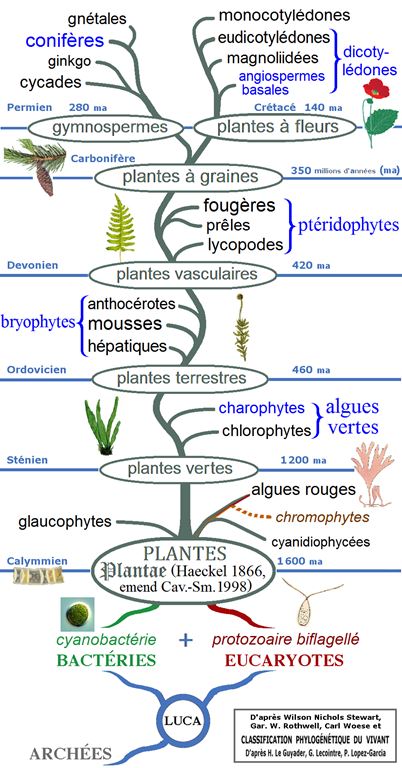
À droite, cet arbre phylogénétique des plantes montre les principaux clades et groupes traditionnels (monophylétiques en noir et paraphylétiques en bleu).
Dénominations
- Nom botanique : Prunus spinosa L. (1753)
- Synonymes français : épine noire, buisson noir, épinette, belossay, créquier, fourdinier, mère-du-bois (mère du bois), pelossier, prunellier commun, prunier épineux, prunier sauvage, cravichon, prunier, prunelle {fruit}
- Nom breton : irin {fruit}
- Noms anglais et locaux : blackthorn, sloe, plum, hei ci li (cn transcrit), gewöhnliche (de), Schlehdorn (de), Schlehe (de), Schwarzdorn (de), prugnolo (it), spino nero (it), abrunheiro (pt), ciruelo silvestre (es), endrino (es), espino negro (es), slån (sv)
Description et culture
Tableau récapitulatif
Parties comes-tibles Note comest. (1-5) Note medic. (1-5) (Zones de) Rusticité Besoins en 
Besoins en  (1-3)
(1-3)Périodes de semis et récoltes Graines au gramme Durée de viabilité Profon-deur semis Espace-ment plants Espace-ment lignes Durée germi-native Durée avant récolte
-28°C J F M A M J
J A S O N D
J F M A M J
J A S O N D
Types de feuillage :
Caduque
- dont infos de 0FPI ("FOOD PLANTS INTERNATIONAL", en anglais) :
Description :
Un grand arbuste. Il peut devenir un petit arbre. Il ne mesure souvent que 4 m de haut. Il développe des drageons. Il perd ses feuilles pendant l'hiver. C'est épineux. Les feuilles sont petites et alternes. Ils sont ternes sur le dessus et poilus en dessous. Les fleurs ont 5 pétales et des anthères à pointe rouge. Les fleurs sont blanches. Ils apparaissent avant les feuilles. Les fruits sont bleu-noir. Ils sont de la taille d'une baie{{{0(+x) (traduction automatique).
Original : A large shrub. It can grow to a small tree. It is often only 4 m high. It develops suckers. It loses its leaves during the winter. It is thorny. The leaves are small and alternate. They are dull above and hairy underneath. Flowers have 5 petals and red tipped anthers. The flowers are white. They appear before the leaves. The fruit are blue-black. They are berry sized{{{0(+x).
Culture :
Plantes disséminées par drageons. Les plantes peuvent être cultivées par graines{{{0(+x) (traduction automatique).
Original : Plants spread by suckers. Plants can be grown by seeds{{{0(+x).
 Consommation (rapports de comestibilité, parties utilisables et usages alimentaires correspondants)
Consommation (rapports de comestibilité, parties utilisables et usages alimentaires correspondants)fleur1 (confites (sucre)1 ou aromatisantes (desserts, tisaness)1), fruit (prunelles ; fraîches (confites1) ou blets (crus1 ou sirop (purée)1) et feuille (jeunes et/ou tendres ; fraîches ou séchées ; tisanes1, aromatisantes1) comestibles.
Partie testée :
fruit{{{0(+x) (traduction automatique). Original : Fruit{{{0(+x)| Taux d'humidité (%) | Énergie (kj) | Énergie (kcal) | Protéines (g) |
|---|---|---|---|
| / | 196 | 47 | 0.8 |
| Pro- vitamines A (µg) |
Vitamines C (mg) | Fer (mg) | Zinc (mg) |
| 0 | 0 | 0 | 0 |
Risques et précautions à prendre
Risques et précautions à prendreATTENTION : bien qu'aucune mention spécifique n'ait été vue pour cette espèce, il appartient à un genre où la plupart, sinon tous les membres du genre produisent du cyanure d'hydrogène, un poison qui donne aux amandes leur saveur caractéristique. Cette toxine se trouve principalement dans les feuilles et les graines et se reconnait facilement par son goût amer. Il est généralement présent en quantité trop faible pour faire du mal, mais toute graine ou fruit trop amer ne doit pas être consommé. En petites quantités, le cyanure d'hydrogène a été montré stimuler la respiration et améliorer la digestion, il est également prétendu être bénéfique dans le traitement du cancer. Au-delà, cependant, il peut provoquer une insuffisance respiratoire et même la mort{{{5(+x).
Galerie(s)
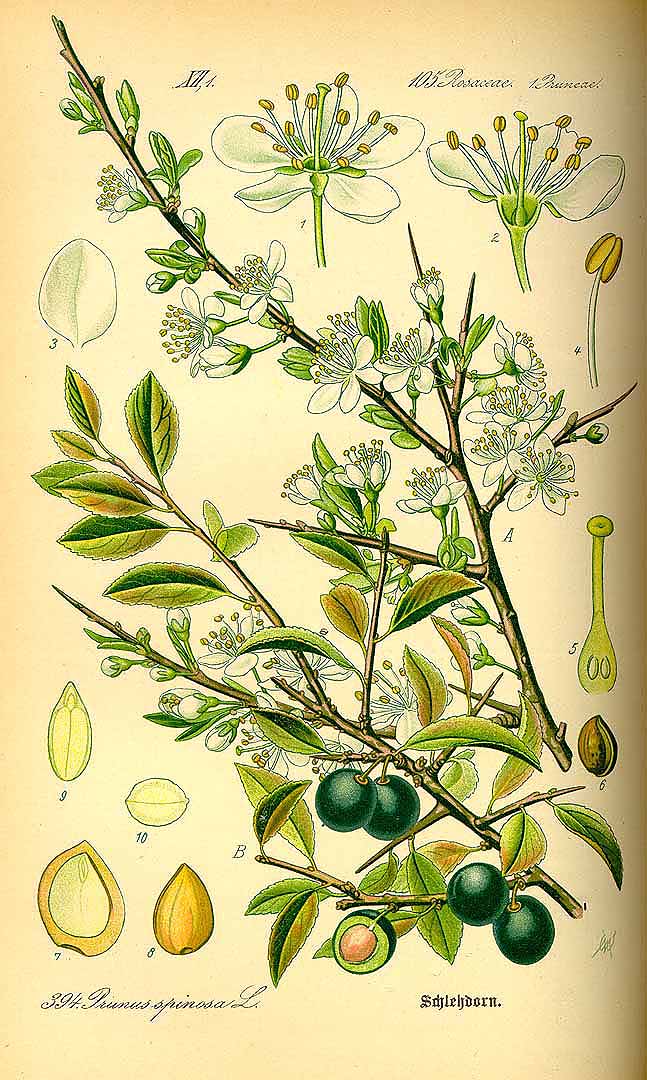
Par Thomé, O.W., Flora von Deutschland Österreich und der Schweiz (1886-1889) Fl. Deutschl. vol. 3 (1885), via plantillustrations
✖

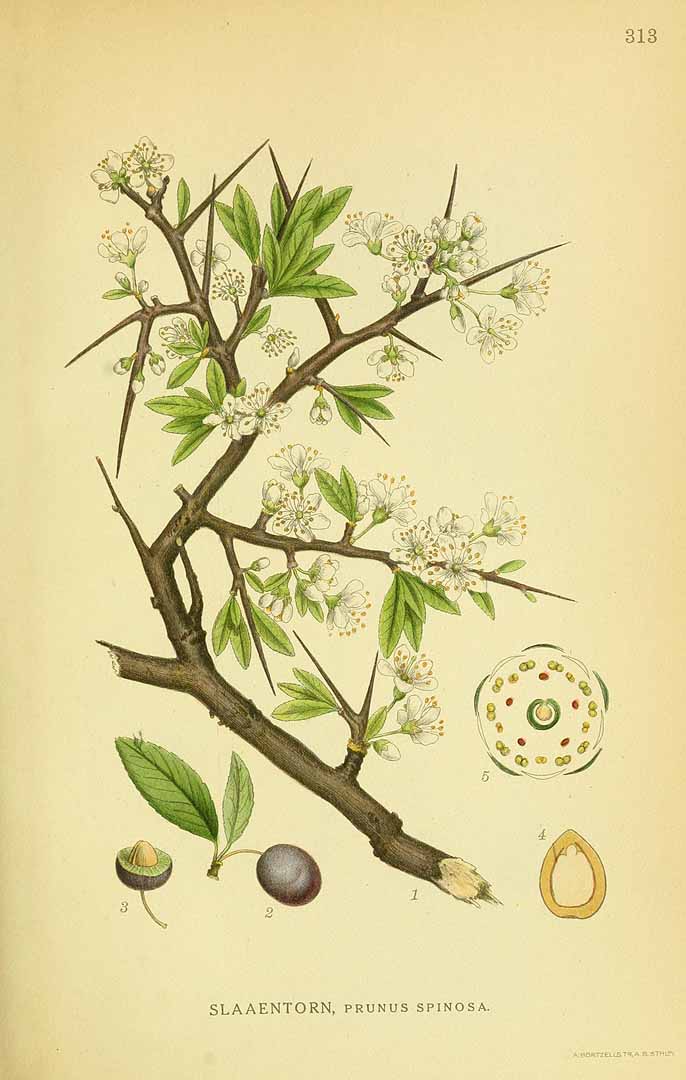
Par Lindman, C.A.M., Bilder ur Nordens Flora Bilder Nordens Fl. vol. 2 (1922), via plantillustrations
✖

Autres infos
dont infos de 0FPI ("FOOD PLANTS INTERNATIONAL", en anglais) :
Statut :
Les fruits sont surtout consommés par les enfants. Ils sont fournis aux restaurants{{{0(+x) (traduction automatique).
Original : The fruit are especially eaten by children. They are supplied to restaurants{{{0(+x).
Distribution :
C'est une plante tempérée. Il pousse en lisière de broussailles et en haies. Il convient aux zones de rusticité 4-10. Herbier de Tasmanie{{{0(+x) (traduction automatique).
Original : It is a temperate plant. It grows on the edges of scrub woodland and in hedges. It suits hardiness zones 4-10. Tasmania Herbarium{{{0(+x).
Localisation :
Afrique, Albanie, Arménie, Asie, Australie, Autriche, Azerbaïdjan, Balkans, Biélorussie, Belgique, Bosnie, Grande-Bretagne, Bulgarie, Caucase, Chine, Croatie, République tchèque, Danemark, Estonie, Europe, Finlande, France, Géorgie, Allemagne, Grèce , Hongrie, Iran, Irlande, Italie, Lettonie, Lituanie, Macédoine, Méditerranée, Moldavie, Pays-Bas, Afrique du Nord, Amérique du Nord, Norvège, Pologne, Portugal, Roumanie, Russie, Scandinavie, Slovaquie, Slovénie, Espagne, Suède, Suisse, Tasmanie , Tunisie, Turquie, Ukraine, USA, Yougoslavie{{{0(+x) (traduction automatique).
Original : Africa, Albania, Armenia, Asia, Australia, Austria, Azerbaijan, Balkans, Belarus, Belgium, Bosnia, Britain, Bulgaria, Caucasus, China, Croatia, Czech Republic, Denmark, Estonia, Europe, Finland, France, Georgia, Germany, Greece, Hungary, Iran, Ireland, Italy, Latvia, Lithuania, Macedonia, Mediterranean, Moldova, Netherlands, North Africa, North America, Norway, Poland, Portugal, Romania, Russia, Scandinavia, Slovakia, Slovenia, Spain, Sweden, Switzerland, Tasmania, Tunisia, Turkey, Ukraine, USA, Yugoslavia{{{0(+x).
Notes :
Il existe environ 200 espèces de Prunus{{{0(+x) (traduction automatique).
Original : There are about 200 Prunus species{{{0(+x).
Rusticité (résistance face au froid/gel, climat)
-28°C
Arôme et/ou texture
acide et astringent (fruits crus) très apréciable (fruits préparés)1
Liens, sources et/ou références
Liens :
/ ;Sources et/ou références :
bibliographie (liste des sources et/ou références de l'encyclopédie)
dont classification : IPNI ("International Plant Names Index", en anglais) ; TPL ("The Plant List", en anglais) ; Kew (POWO - "Plant Of the World Online", "Royal Botanical Garden", en anglais) ; Tela Botanica ;
dont livres et bases de données : 5PFAF ("Plants For A Future", en anglais) ; 1Plantes sauvages comestibles (livre pages 68 et 69, par S.G. Fleischhauer, J. Guthmann et R. Spiegelberger) ; 32Herbier gourmand (de Marc Veyrat et François Couplan, éditions Hachette, 1997) / détails du livre ; 1Plantes sauvages comestibles (de S.G. Fleischhauer, J. Guthmann et R. Spiegelberger, éditions Ulmer, 2012) / détails du livre ; 87Le Truffaut du Potager (collectif, éditions Larousse, 2010) / détails du livre
dont bibliographie/références de 0FPI ("FOOD PLANTS INTERNATIONAL", en anglais) :
Abbet, C., et al, 2014, Ethnobotanical survey on wild alpine food plants in Lower and Central Valais (Switzerland). Journal of Ethnopharmacology 151 (2014) 624–634 ; Blamey, M and Grey-Wilson, C., 2005, Wild flowers of the Mediterranean. A & C Black London. p 77 ; Bodkin, F., 1991, Encyclopedia Botanica. Cornstalk publishing, p 842 ; BOUQUET, ; Bremness, L., 1994, Herbs. Collins Eyewitness Handbooks. Harper Collins. p 77 ; Brickell, C. (Ed.), 1999, The Royal Horticultural Society A-Z Encyclopedia of Garden Plants. Convent Garden Books. p 839 ; Bussman, R. W. et al, 2017, Ethnobotany of Samtskhe-Javakheti, Sakartvelo (Republic of Georgia), Caucasus. Indian Journal of Traditional Knowledge Vol. 16(1) pp 7-24 ; Cerne, M., 1992, Wild Plants from Slovenia used as Vegetables. Acta Horticulturae 318 ; Ciocarlan, N. & Ghendov, V., 2015, Ethnobotanical and Ecological Studies of Wild Edible Plants from Bugeac Steppe, Republic of Moldova. Journal of EcoAgriTourism. Cailta terra Vol. 11(2): ; Cundall, P., (ed.), 2004, Gardening Australia: flora: the gardener's bible. ABC Books. p 1099 ; Denes, A., et al, 2012, Wild plants used for food by Hungarian ethnic groups living in the Carpathian Basin. Acta Societatis Botanicorum Poloniae 81 (4): 381-396 ; Dolina, K. & Luczaj, L., 2014, Wild food plants used on the Dubrovnik coast (south-eastern Croatia) Acta Soc Bot Pol 83(3):175–181 ; Dzhangaliev, A. D., et al, 2003, The Wild Fruit and Nut Plants of Kazakhstan, Horticultural Reviews, Vol. 29. pp 305-371 ; Egea, I., et al., 2010, Six Edible Wild fruits as potential Antioxidant Additives or Nutritional Supplements. Plant Foods for Human Nutrition. 65:121-129 ; Ertug, F, Yenen Bitkiler. Resimli Türkiye Florası -I- Flora of Turkey - Ethnobotany supplement ; Esperanca, M. J., 1988. Surviving in the wild. A glance at the wild plants and their uses. Vol. 2. p 225 ; Facciola, S., 1998, Cornucopia 2: a Source Book of Edible Plants. Kampong Publications, p 204 ; Flora of China. Vol. 9, p 402 ; Flowerdew, B., 2000, Complete Fruit Book. Kyle Cathie Ltd., London. p 34, 184 ; Girones-Vilaplana, A., et al, 2012, New Beverages of Lemon Juice Enriched with the Exotic Berries Maqui, Acai, and Blackthorn: Bioactive Components and in Vitro Biological Properties. Journal of Agricultural and Food Chemistry. 60:6571-6580 ; Glowinski, L., 1999, The Complete Book of Fruit Growing in Australia. Lothian. p 58 ; Gonzalez, J. A., et al, 2011, The consumption of wild and semi-domesticated edible plants in the Arribes del Duero (Salamanca-Zamora, Spain): an ananalysis of traditional knowledge. Genetic Resources and Crop Evolution 58:991-1006 ; Gunes, S. et al, 2018, Survey of wild food plants for human consumption in Karaisali (Adana-Turkey). Indian Journal of Traditional Knowledge. Vol. 17(2), April 2018, pp 290-298 ; Harris, E & J., 1983, Field Guide to the Trees and Shrubs of Britain. Reader's Digest. p 57 ; Hedrick, U.P., 1919, (Ed.), Sturtevant's edible plants of the world. p 529 ; Hibbert, M., 2002, The Aussie Plant Finder 2002, Florilegium. p 242 ; http://en.hortipedia.com ; http://nordicfood lab/org/blog/2102/9/wild-edible-plants-an-overview ; http://www.botanic-gardens-ljubljana.com/en/plants ; Irving, M., 2009, The Forager Handbook, A Guide to the Edible Plants of Britain. Ebury Press p 274 ; Kargioglu, M. et al, 2010, Traditional Uses of Wild Plants in the Middle Aegean Region. Human Ecology 38:429-450 ; Kermath, B. M., et al, 2014, Food Plants in the Americas: A survey of the domesticated, cultivated and wild plants used for Human food in North, Central and South America and the Caribbean. On line draft. p 715 ; Kiple, K.F. & Ornelas, K.C., (eds), 2000, The Cambridge World History of Food. CUP p 1853 ; Kremer, B.P., 1995, Shrubs in the Wild and in Gardens. Barrons. p 151 ; Lentini, F. and Venza, F., 2007, Wild food plants of popular use in Sicily. J Ethnobiol Ethnomedicine. 3: 15 ; Lord, E.E., & Willis, J.H., 1999, Shrubs and Trees for Australian gardens. Lothian. p 68 ; Luczaj, L., 2012, Ethnobotanical review of wild edible plants of Slovakia. Acta Societatis Botanicorum Poloniae 81(4):245-255 ; Luczaj, L. et al, 2012, Wild food plant use in 21st century Europe: the disappearance of old traditions and the search for new cuisines involving wild edibles. Acta Soc Bot Pol 81(4):359–370 ; Åukasz Åuczaj and Wojciech M SzymaÅ„ski, 2007, Wild vascular plants gathered for consumption in the Polish countryside: a review. J Ethnobiol Ethnomedicine. 3: 17 ; Luczaj, L. et al, 2013, Wild food plants used in the villages of the Lake Vrana Nature Park (northern Dalmatia, Croatia). Acta Societatis Botanicorum Poloniae, 82(4): 275-281 ; Luczaj, L., et al, 2015, Wild food plants and fungi used by Ukrainians in the western part of the Maramureş region in Romania. Acta Soc Bot Pol 84(3):339–346 ; Mabey, R., 1973, Food for Free. A Guide to the edible wild plants of Britain, Collins. p 169 ; Maghradze, D. et al, 2012, Minor and Underutilized Fruits in Georgia and Their Wild Relatives. In Acta Horticulturae Number 948 p 41-47 ; Michael, P., 2007, Edible Wild Plants and Herbs. Grub Street. London. p 28 ; Morton, ; Nedelcheva A., 2013, An ethnobotanical study of wild edible plants in Bulgaria. EurAsian Journal of BioSciences 7, 77-94 ; Özdemir, E. and Kültür, S., 2017, Wild Edible Plants of Savaştepe District (Balıkesir, Turkey), Marmara Pharm J 21/3: 578-589 ; Pardo-de-Santayana, M., et al, 2005, The gathering and consumption of wild edible plants in the Campoo (Cantabria, Spain). International Journal of Food Sciences and Nutrition. 56(7): 529-542 ; Pieroni, A., 1999, Gathered wild food plants in the Upper Valley of the Serchio River (Garfagnana), Central Italy. Economic Botany 53(3) pp 327-341 ; Plants for a Future, The Field, Penpol, Lostwithiel, Cornwall, PL22 0NG, UK. http://www.scs.leeds.ac.uk/pfaf/ ; Postman, J. D., et al, 2012, Recent NPGS Coordinated Expeditions in the Trans-Caucasus Region to Collect Wild Relatives of Temperate Fruit and Nut Crops. In Acta Horticulturae Number 948 p 191-198 ; Redzic, S. J., 2006, Wild Edible Plants and their Traditional Use in the Human Nutrition in Bosnia-Herzegovina. Ecology of Food and Nutrition, 45:189-232 ; Redzic, S., 2010, Use of Wild and Semi-Wild Edible Plants in Nutrition and Survival of People in 1430 Days of Siege of Sarajevo during the War in Bosnia and Herzegovina (1992–1995). Coll. Antropol 34 (2010) 2:551-570 ; Rigat, M et al, 2009, Ethnobotany of Food Plants in the High River Ter Valley (Pyrenees, catalonia, Iberian Peninsula): Non-Crop Food Vascular Plants and Crop Food Plants with medicinal Properties. Ecology of Food and Nutrition, 48:303-327 ; Ruiz-Rodriguez, B. M., et al, 2014, Wild blackthorn (Prunus spinosa L.) and hawthorn (Crataegus monogyna Jacq.) fruits as valuable sources of antioxidants. Fruits, Vol. 69, p.61-73 ; Ryan, S., 2008, Dicksonia. Rare Plants Manual. Hyland House. p 49 ; Sansanelli, S., et al, 2014, Wild food plants traditionall consumed in the area of Bologna (Emilia Romagna region, Italy). Journal of Ethnobiology and Ethnomedicine 10:69 ; Sfikas, G., 1984, Trees and shrubs of Greece. Efstathiadis Group. Athens. p 70 ; Signorini, M. A., et al, 2009, Plants and traditional knowledge: An ethnobotanical investigation on Monte Ortobene (Nuoro, Sardinia). Journal or Ethnobiology and Ethnomedicine, 5:6 ; Simkova, K. et al, 2014, Ethnobotanical review of wild edible plants used in the Czech Republic. Journal of Applied Botany and Food Quality 88, 49-67 ; Sp. pl. 1:475. 1753 ; Svanberg, I., 2012, The use of wild plants as food in pre-industrial Sweden. Acta Societatis Botanicorum Poloniae 81(4): 317-327 ; Tanaka, ; Tasmanian Herbarium Vascular Plants list p 51 ; Tardio, J., et al, Ethnobotanical review of wild edible plants in Spain. Botanical J. Linnean Soc. 152 (2006), 27-71 ; van Wyk, B., 2005, Food Plants of the World. An illustrated guide. Timber press. p 311 ; www.efloras.org Flora of China Volume 9
Recherche de/pour :
- "Prunus spinosa" sur Google (pages et
images) ;
GRIN ("Germplasm Resources Information Network", en anglais) ;
TROPICOS (en anglais) ;
Pl@ntNet ;
Pl@ntUse ;
"Useful Tropical Plants" (en anglais) ou
"Useful Temperate Plants" (en anglais) ;
- "Prunellier" sur Google (pages, images et recettes) ;
- "Prunus spinosa" sur Google (pages et
images) ;
GRIN ("Germplasm Resources Information Network", en anglais) ;
TROPICOS (en anglais) ;
Pl@ntNet ;
Pl@ntUse ;
"Useful Tropical Plants" (en anglais) ou
"Useful Temperate Plants" (en anglais) ;
Espèces du même genre (Prunus)
174 taxons
- Abricot prune
- Abricotier
- Abricotier du japon
- Amandier
- Amandier nain
- Amandier-nain trilobé
- Cerisier d'hiver
- Cerisier de Desfontaines
- Cerisier de Lannes
- Cerisier de Sainte-Lucie
- Cerisier de virginie
- Cerisier des steppes en boule
- Cerisier du Japon
- Cerisier intermédiaire
- Cerisier noir
- Cerisier prostré
- Cerisier yoshino
- Griottier
- Laurière des Açores
- Laurière officinale du Caucase
- Merisier
- Merisier à grappes
- Microcerisier du Japon
- Pêcher
- Prunellier à gros fruits
- Prunier
- Prunier américain
- Prunier chicachas
- Prunier cocomille
- Prunier d'Afrique
- Prunier de Briançon
- Prunier japonais
- Prunier myrobalan
- Prunier noir
- Ragouminier
- Prunus afghana Cardot
- Prunus africana (Hook.f.) Kalkman (Prunier d'Afrique)
- Prunus alabamensis C.Mohr
- Prunus alleghaniensis Porter
- Prunus amareno
- Prunus americana Marshall (Prunier américain)
- Prunus andersonii A.Gray
- Prunus angustifolia Marshall (Prunier chicachas)
- Prunus apetala
- Prunus arabica
- Prunus armeniaca L. (Abricotier)
- Prunus avium (L.) L. (Merisier)
- Prunus barbata Koehne
- Prunus besseriana
- Prunus besseyi L.H.Bailey
- Prunus bifrons Fritsch
- Prunus bokhariensis Royle ex C.K.Schneid.
- Prunus bracteopadus Koehne
- Prunus brigantina Vill. (Prunier de Briançon)
- Prunus bucharica
- Prunus buergeriana Miq.
- Prunus campanulata Maxim.
- Prunus canescens Bois
- Prunus capollin Zucc.
- Prunus capsica
- Prunus carmesina H.Hara
- Prunus caroliniana
- Prunus cerasifera Ehrh. (Prunier myrobalan)
- Prunus cerasifera x Prunus salicina
- Prunus cerasoides Koidz.
- Prunus cerasus L. (Griottier)
- Prunus cocomilia Ten. (Prunier cocomille)
- Prunus consociiflora C.K.Schneid.
- Prunus cornuta
- Prunus cortapico Kerber ex Koehne
- Prunus davidiana
- Prunus dawyckensis
- Prunus demissa
- Prunus depressa Pursh
- Prunus dielsiana
- Prunus divaricata Ledeb.
- Prunus domestica L. (Prunier)
- Prunus dulcis (Mill.) DAWebb (Amandier)
- Prunus edentata Hand.-Mazz.
- Prunus emarginata W.H.Brewer & S.Watson
- Prunus fasciculata
- Prunus fenzliana Fritsch
- Prunus ferganensis
- Prunus fruticans
- Prunus fruticosa Pall. (Cerisier des steppes en boule)
- ...
Espèces de la même famille (Rosaceae)
1223 taxons
- Abricot prune
- Abricotier
- Abricotier du japon
- Aigremoine eupatoire
- Alchémille à folioles soudées
- Alchémille brillante
- Alchémille commune
- Alchémille des champs
- Alchémille fendue
- Alchémille glabre
- Alchémille hybride
- Alchémille molle
- Alisier
- Alisier de Mougeot
- Alisier de suède
- Alouchier
- Amandier
- Amandier nain
- Amandier-nain trilobé
- Amélanchier à feuilles d'aulne
- Amélanchier à feuilles ovales
- Amélanchier à grappes
- Amélanchier de lamarck
- Amélanchier du canada
- Amélanchier glabre
- Aronie à fruits noirs
- Aronie pourpre
- Aronie rouge
- Aubépine
- Aubépine à feuilles de tanaisie
- Aubépine d'Orient
- Aubépine de Lavallée
- Aubépine du Kansas
- Aubépine du lac Champlain
- Aubépine du Sinaï
- Aubépine noire
- Aubépine orientale
- Aubépine russe
- Aubépine subsoyeuse
- Aubépine succulente
- Azerole
- Barbe-de-bouc
- Benoîte à fruits variables
- Benoîte à grandes feuilles
- Benoîte aquatique
- Benoîte commune ou benoite commune
- Benoîte des montagnes
- Buisson ardent
- Cenellier de l'est
- Cenellier de l'ouest
- Acaena anserinifolia (Forst. & Forst.f.) Druce
- Agrimonia coreana Nakai
- Agrimonia eupatoria L. (Aigremoine eupatoire)
- Agrimonia odorata Mill.
- Agrimonia pilosa Kitam.
- Alchemilla alpina L. (Satinée)
- Alchemilla conjuncta Bab. (Alchémille à folioles soudées)
- Alchemilla fissa Hornem. (Alchémille fendue)
- Alchemilla glabra Buser (Alchémille glabre)
- Alchemilla hybrida Brgger (Alchémille hybride)
- Alchemilla mollis (Alchémille molle)
- Alchemilla plicatula Gand.
- Alchemilla splendens Christ (Alchémille brillante)
- Alchemilla vulgaris L. (Alchémille commune)
- Alchemilla xanthoclora
- Amelanchier alnifolia (Nutt.) Nutt. ex M. Roem. (Amélanchier à feuilles d'aulne)
- Amelanchier amabilis Wiegand
- Amelanchier arborea
- Amelanchier asiatica
- Amelanchier bartramiana
- Amelanchier basalticola Piper
- Amelanchier canadensis (L.) Medik. (Amélanchier du canada)
- Amelanchier confusa
- Amelanchier cretica
- Amelanchier cusickii Fernald
- Amelanchier humilis Wiegand
- Amelanchier huroensis
- Amelanchier interior E.L.Nielsen
- Amelanchier intermedia Blanch.
- Amelanchier laevis Wiegand (Amélanchier glabre)
- Amelanchier lamarckii F. G. Schroed. (Amélanchier de lamarck)
- Amelanchier oblongifolia Wiegand
- Amelanchier obovalis
- Amelanchier obovata Knowlt.
- Amelanchier ovalis Medik. (Amélanchier à feuilles ovales)
- Amelanchier pallida Greene
- Amelanchier parviflora Douglas ex Hook.
- Amelanchier pumila
- Amelanchier sanguinea Decne.
- Amelanchier spicata Decne. (Amélanchier à grappes)
- Amelanchier stolonifera Wiegand
- Amelanchier utahensis Koehne
- Amelanchier weigandii
- Amelanchier x grandiflora Rehder
- Amelanchier x grandiflora
- Amelasorbus jackii
- Amygdalus andersonii
- Amygdalus communis L.
- Amygdalus graeca Lindl.
- Amygdalus lycioides Spach
- ...
Par Lindman, C.A.M., Bilder ur Nordens Flora Bilder Nordens Fl. vol. 2 (1922), via plantillustrations







 donne accès au menu
  - encyclopédies des plantes alimentaires ;
 - page de recherche - reconnaissance (identification) de plantes ;
 - page du calendrier lunaire et son générateur (au format PDF et JPG) ;
 - tableau récapitulatif ;
 - générateur de potées (soupes), avec estimation des apports nutrionnels et du coût;
 - générateur de codes QR ;
 - page des archives avec de nombreux documents sur différents thèmes complémentaires comme la botanique, les légumes,
les champignons, la cuisine, le bien-être ainsi que différents MOOC mais également des liens vers les archives de l'association ;
- page des archives avec de nombreux documents sur différents thèmes complémentaires comme la botanique, les légumes,
les champignons, la cuisine, le bien-être ainsi que différents MOOC mais également des liens vers les archives de l'association ;

 pour le fruit (et/ou les graines, la pulpe, etc...),
 pour les fleurs (et/ou pétales, calice...),
 pour les feuilles (et/ou la tige, les pousses...),
 pour les racines,
 pour le tronc (et/ou l'écorce, la sève...), et enfin
 pour les champignons,
puis les notes alimentaires et médicinales (de 1 à 5 étoiles), la rusticité (résistance au froid/gel)
et pour finir un résumé.
pour les champignons,
puis les notes alimentaires et médicinales (de 1 à 5 étoiles), la rusticité (résistance au froid/gel)
et pour finir un résumé. menant ici 🙂
 ,
,  et
et





 ,
,


 Encyclopédie(s)
 Recherche-Reconnaissance
 Tableau récapitulatif
 Codes QR
 Archives
 Calendrier(s) lunaire(s)
  Potées
 Re-naturation/naturalisation
 Affichettes, herbiers &
co.
Affichettes, herbiers &
co. menu
menu galerie


 (en bas à droite).
 (en bas à gauche).
