Malaka
(Phyllanthus emblica)


 |
***
-
*****
|
***
-
*****
Un petit arbre à feuilles caduques. Il atteint une hauteur de 2 à 20 m. Le tronc est courbé et a de nombreuses branches. Les branches se répandent. L'écorce est brun gris ... (traduction automatique)
→suite


Malaka
Note alimentaire 
Note médicinale 

Un petit arbre à feuilles caduques. Il atteint une hauteur de 2 à 20 m. Le tronc est courbé et a de nombreuses branches. Les branches se répandent. L'écorce est brun grisâtre et se décolle en flocon... (traduction automatique) →suite
Phyllanthus emblica
Classification
- Classique : en haut de l'écran, sous le coeur.
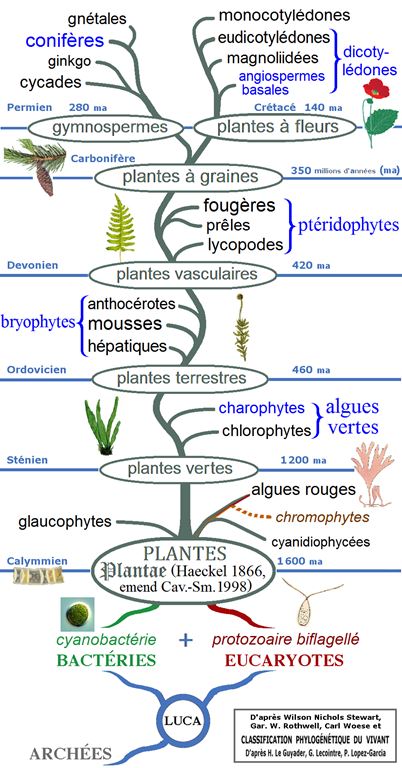
- Phylogénétique :
- Clade 4 : Angiospermes ;
- Clade 3 : Dicotylédones_vraies ;
- Clade 2 : Rosidées ;
- Clade 1 : Fabidées ;
- Ordre APN : Malpighiales ;
- Famille APN : Phyllanthaceae ;
À droite, cet arbre phylogénétique des plantes montre les principaux clades et groupes traditionnels (monophylétiques en noir et paraphylétiques en bleu).
Dénominations
- Nom botanique : Phyllanthus emblica L. (1753)
- Synonymes français : melaka, groseiller népalais ou indien
- Synonymes : Emblica officinalis Gaertn. 1790 ;
- Noms anglais et locaux : emblic, myrobalan
Description et culture
Tableau récapitulatif
Parties comes-tibles Note comest. (1-5) Note medic. (1-5) (Zones de) Rusticité Besoins en 
Besoins en  (1-3)
(1-3)Périodes de semis et récoltes Graines au gramme Durée de viabilité Profon-deur semis Espace-ment plants Espace-ment lignes Durée germi-native Durée avant récolte J F M A M J
J A S O N D
J F M A M J
J A S O N D53
Nombre de graines au gramme :
53
- dont infos de 0FPI ("FOOD PLANTS INTERNATIONAL", en anglais) :
Description :
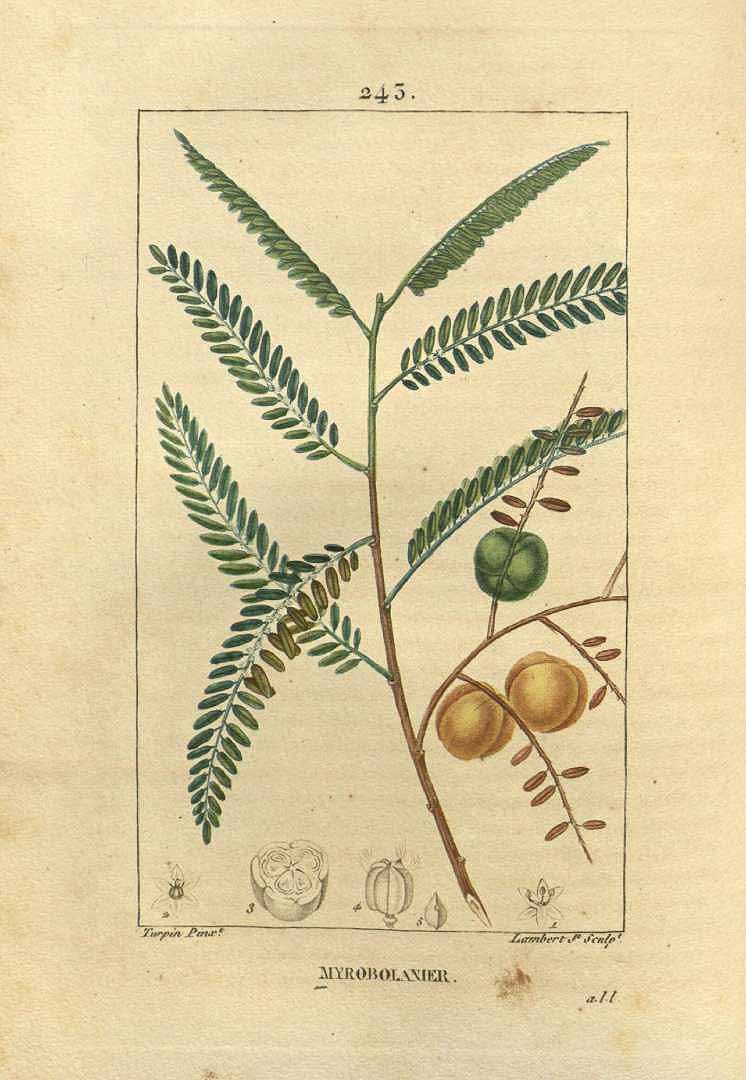
Un petit arbre à feuilles caduques. Il atteint une hauteur de 2 à 20 m. Le tronc est courbé et a de nombreuses branches. Les branches se répandent. L'écorce est brun grisâtre et se décolle en flocons. Les feuilles sont vert pâle et plumeuses. Les nouvelles feuilles sont rosâtres. Les feuilles ont de courtes tiges. Les feuilles mesurent 1 à 1,5 cm de longueur sur 0,2 à 0,3 cm de largeur. Les feuilles sont disposées sur des branches minces pour ressembler à des feuilles composées plumeuses. Ils sont comme des feuilles de tamarin. Les fleurs mâles et femelles se produisent sur différents arbres. Les fleurs sont petites et jaunes. Ils sont densément regroupés sur les branches. Les fruits sont petits et jaunes à verts. Ils mesurent 2 cm de diamètre et sont comestibles. Ils ont 6-8 lignes pâles le long d'eux. Ils sont charnus et comestibles. Ils sont aigres. Certains types améliorés ont des fruits de 8 à 9 cm de diamètre. Les graines sont à 3 faces{{{0(+x) (traduction automatique).
Original : A small deciduous tree. It grows 2-20 m tall. The trunk is bent and has many branches. The branches are spreading. The bark is greyish-brown and peels off in flakes. The leaves are pale green and feathery. New leaves are pinkish. The leaves have short stalks. The leaves are 1-1.5 cm long by 0.2-0.3 cm wide. The leaves are arranged on slender branches to appear like feathery compound leaves. They are like tamarind leaves. Male and female flowers occur on different trees. The flowers are small and yellow. They are densely clustered on the branches. The fruit are small and yellow to green. They are 2 cm across and edible. They have 6-8 faint lines along them. They are fleshy and edible. They are sour. Some improved kinds have fruit 8-9 cm across. The seeds are 3 sided{{{0(+x).
Production :
La croissance précoce est rapide. Certains arbres bourgeons produisent des fruits après 3 ans. Les semis prennent 7 à 8 ans. Les meilleurs rendements sont obtenus après 10 à 12 ans et les arbres peuvent continuer à porter pendant 70 à 75 ans. En Inde, les fruits sont disponibles d'octobre à décembre. Un fruit pèse 30 à 50 g{{{0(+x) (traduction automatique).
Original : Early growth is fast. Some budded trees produce fruit after 3 years. Seedling trees take 7-8 years. Best yields are produced after 10-12 years and trees can keep bearing for 70-75 years. In India fruit are available October to December. A fruit weighs 30-50 g{{{0(+x).
Culture :
Les plantes sont cultivées à partir de graines. Il est préférable de les cultiver en utilisant un bourgeonnement en anneau ou une greffe de placage. Les arbres peuvent être taillés pour former 4 à 6 branches à partir d'un même tronc. Ils peuvent être cultivés à partir de boutures, de greffage ou par stratification à l'air{{{0(+x) (traduction automatique).
Original : Plants are grown from seed. They are best grown using ring budding or veneer grafting. Trees can be pruned to form 4-6 branches from one trunk. They can be grown from cuttings, grafting or by air layering{{{0(+x).
 Consommation (rapports de comestibilité, parties utilisables et usages alimentaires correspondants)
Consommation (rapports de comestibilité, parties utilisables et usages alimentaires correspondants)Partie(s) comestible(s){{{0(+x) : graines, fruit, feuilles, pétales de fleur{{{0(+x)µ.
Utilisation(s)/usage(s)µ{{{0(+x) culinaire(s) :
-les fruits sont cuits et utilisée dans les conserves ; les fruits sont acides et peuvent être consommés frais ou utilisés pour l'aromatisation ; ils sont également utilisés comme assaisonnement dans les aliments cuits ; ils sont picklés et transformés en confitures, gelées, conserves, tartes et autres aliments ; les copeaux de fruits secs sont assaisonnés avec des graines de cumin, du sel et du yaourt et consommés ;
-graines et feuilles vertes sont comestibles{{{0(+x) ; feuilles cuites (ex. : comme potherbe) ? (qp*).
Partie testée :
fruit{{{0(+x) (traduction automatique). Original : Fruit{{{0(+x)| Taux d'humidité (%) | Énergie (kj) | Énergie (kcal) | Protéines (g) |
|---|---|---|---|
| 78.4 | 281 | 67 | 0.6 |
| Pro- vitamines A (µg) |
Vitamines C (mg) | Fer (mg) | Zinc (mg) |
| 0 | 316 | 0.9 | 0.5 |
 Risques et précautions à prendre
Risques et précautions à prendrenéant, inconnus ou indéterminés.
Usages médicinaux
L'emblic est d'une grande importance dans la médecine traditionnelle asiatique, non seulement comme antiscorbutique, mais aussi dans le traitement de diverses affections, notamment celles associées aux organes digestifs. En Thaïlande, les fruits de l'emblic sont traditionnellement utilisés comme expectorant, antipyrétique, diurétique, antidiarrhéique et antiscorbutique[306]. Bon nombre de ces utilisations traditionnelles ont été confirmées par des recherches sur les principes actifs des plantes et leurs propriétés. Les fruits, l'écorce et les feuilles sont riches en tannin[299]. La pulpe séchée des fruits non mûrs contient 18 à 35 % de tannin ; la teneur des fruits mûrs est beaucoup plus faible. L'écorce de la tige sèche contient 8 à 20 % de tannin. L'écorce des rameaux est généralement plus riche, contenant 12 à 24 % de tannin sur la base du poids sec. Les feuilles peuvent produire 22 à 28 % de tannin[299]. Les tannins du fruit appartiennent au groupe des gallotanins et des ellagitanins, donnant par hydrolyse de grandes quantités d'acide gallique, de petites quantités d'acide ellagique et de glucose[299]. Le tannin de l'écorce appartient au groupe des proanthocyanidines, donnant par hydrolyse de la (+)leucodelphinidine[299]. Le fruit est une source extrêmement riche d'acide ascorbique, 100 g de jus en contenant 600 à 1 300 mg, parfois même plus[299]. Le tannin du fruit empêche ou retarde l'oxydation de la vitamine, de sorte que les fruits peuvent être conservés en solution saline ou sous forme de poudre sèche tout en conservant leur valeur antiscorbutique[299]. Les principes tannoïdes sont de puissants inhibiteurs de l'aldose réductase et peuvent être efficaces dans la gestion des complications diabétiques, notamment la cataracte[299]. Les fruits sont une riche source de pectine[299]. De nombreuses applications médicinales des fruits peuvent être attribuées à la présence d'acide ascorbique et à l'action astringente des tannins, mais les fruits contiennent également d'autres composés actifs. Des extraits de fruits ont montré des activités antioxydantes et antitumorales dans des tests in vitro et sur des animaux. Ils ont également montré des propriétés hypocholestérolémiantes, antitussives, anti-ulcéreuses et hépatoprotectrices et ont montré une puissante activité inhibitrice sur la transcriptase inverse du VIH ; pour cette dernière activité, la putranjivaïne A était le composé le plus actif isolé[299]. La phyllembline a également été isolée des fruits ; elle potentialise l'action de l'adrénaline, a une légère action dépressive sur le système nerveux central et a des propriétés spasmolytiques[299]. Des extraits de feuilles ont montré une activité inhibitrice sur les leucocytes et les plaquettes humaines, ce qui confirme au moins en partie leurs propriétés anti-inflammatoires et antipyrétiques[299]. Les fruits ont des activités diurétiques, laxatives et purgatives et présentent également des propriétés molluscicides et antimicrobiennes. Ingrédient principal de diverses formules toniques ayurvédiques[301], le fruit est administré afin d'atténuer les effets du vieillissement et de restaurer les organes[254]. Les fruits acides sont l'un des ingrédients du « triphala », un tonique laxatif rajeunissant ayurvédique à base de cette espèce ainsi que des fruits de Terminalia bellirica et de Terminalia chebula[238].Le jus du fruit est également donné afin de renforcer le pancréas des diabétiques, ainsi que dans le traitement des problèmes oculaires, des douleurs articulaires, de la diarrhée et de la dysenterie[254]{{{5(+)
Galerie(s)
Par Chaumeton, F.P., Flore médicale (1828-1832) Fl. Med. vol. 5 (1831) t. 243, via plantillustrations
✖

Par Blackwell, E., Herbarium Blackwellianum (1747-1773) Herb. Blackwell. vol. 4 (1760) t. 400, via plantillustrations
✖

Autres infos
dont infos de 0FPI ("FOOD PLANTS INTERNATIONAL", en anglais) :
Statut :
Les fruits sont vendus sur les marchés. Les fruits sont surtout consommés par les enfants. C'est un fruit mineur important de la zone aride{{{0(+x) (traduction automatique).
Original : The fruit are sold in markets. The fruit are eaten especially by children. It is an important arid zone minor fruit{{{0(+x).
Distribution :
Une plante tropicale. Il convient aux basses terres tropicales chaudes et humides. Il est originaire d'Asie tropicale. Il pousse dans la savane aride et buissonnante. Il pousse de 10-20 m à 1400-1500 m d'altitude. Il pousse souvent sur des sols pauvres et peu profonds. Il est léger et tolérant à la sécheresse. Il peut tolérer les incendies de forêt. Ils sont communs dans les forêts tropicales de feuillus en Inde. Cela convient aux régions subtropicales. Il a besoin de températures chaudes au moment de la formation des boutons floraux. Les périodes de sécheresse pendant la fructification font tomber les fruits. Il peut tolérer des températures basses et élevées une fois établi. Il peut tolérer les sols avec un pH 6-10. Certaines variétés peuvent tolérer les sols salins. Dans XTBG Yunnan. Au Sichuan{{{0(+x) (traduction automatique).
Original : A tropical plant. It suits the hot humid tropical lowlands. It is native to tropical Asia. It grows in arid bushy savannah. It grows from 10-20 m to 1400-1500 m altitude. It often grows on poor shallow soils. It is light demanding and drought tolerant. It can tolerate forest fires. They are common in tropical deciduous forest in India. It suits the subtropics. It needs warm temperatures at time of flower bud formation. Dry times during fruiting cause fruit to drop. It can tolerate low and high temperatures once established. It can tolerate soils with a pH 6-10. Some varieties can tolerate saline soils. In XTBG Yunnan. In Sichuan{{{0(+x).
Localisation :
Afrique, Andamans, Asie, Australie, Bangladesh, Bhoutan, Brésil, Cambodge, Amérique centrale, Chine, Cuba, Afrique de l'Est, Fidji, Hawaï, Himalaya, Inde, Indochine, Indonésie *, Iran, Laos, Malaisie *, Maldives, Myanmar, Népal, Inde du Nord-Est, Inde du Nord-Ouest, Pacifique, Pakistan, Philippines, Porto Rico, Asie du Sud-Est, Sikkim, Amérique du Sud, Sri Lanka, Taiwan, Thaïlande, Tibet, USA, Vietnam{{{0(+x) (traduction automatique).
Original : Africa, Andamans, Asia, Australia, Bangladesh, Bhutan, Brazil, Cambodia, Central America, China, Cuba, East Africa, Fiji, Hawaii, Himalayas, India, Indochina, Indonesia*, Iran, Laos, Malaysia*, Maldives, Myanmar, Nepal, Northeastern India, NW India, Pacific, Pakistan, Philippines, Puerto Rico, SE Asia, Sikkim, South America, Sri Lanka, Taiwan, Thailand, Tibet, USA, Vietnam{{{0(+x).
Notes :
Il existe environ 750 espèces de Phyllanthus. Ils sont principalement sous les tropiques. Le fruit est riche en vitamine C. Il a des propriétés anticancéreuses. Il a été utilisé pour réduire les dommages causés par l'arsenic{{{0(+x) (traduction automatique).
Original : There are about 750 Phyllanthus species. They are mostly in the tropics. The fruit are high in Vitamin C. It has anticancer properties. It has been used to reduce arsenic damage{{{0(+x).
Liens, sources et/ou références
Liens :
/ ;Sources et/ou références :
bibliographie (liste des sources et/ou références de l'encyclopédie)
dont classification : IPNI ("International Plant Names Index", en anglais) ; TPL ("The Plant List", en anglais) ; Kew (POWO - "Plant Of the World Online", "Royal Botanical Garden", en anglais) ;
dont livres et bases de données : 5PFAF ("Plants For A Future", en anglais) ; 0FPI ("FOOD PLANTS INTERNATIONAL", en anglais) ;
dont bibliographie/références de 5PFAF ("Plants For A Future", en anglais)
- [238] Encyclopaedia of Herbs and their Uses, Bown D., 1995, Dorling Kindersley, London, ISBN 0-7513-020-31 (Un livre très bien présenté et instructif sur les herbes du monde entier. Beaucoup de choses pour le lecteur occasionnel et l'étudiant avide d'apprendre. Un seul regret est la façon particulière d'avoir deux rubriques distinctes pour chaque plante.{{{5(x)) ;
- [254] The Encyclopedia of Medicinal Plants, Chevallier A., 1996, Dorling Kindersley, London, ISBN 9-780751-303148 (Un excellent guide sur plus de 500 des herbes médicinales les plus connues du monde entier.{{{5(x)) ;
- [299] Protabase - Plant Resources of Tropical Africa, http://www.prota.org (Une excellente base de données en ligne contenant des informations détaillées sur plus de 3 200 espèces de plantes utiles d'Afrique){{{5(x)) ;
- [301] Cornucopia II, Facciola S., 1998, Kampong Publications, California, ISBN 0-9628087-2-5 (La deuxième édition d'un excellent guide sur les utilisations comestibles des plantes, bien qu'elle ne donne aucun détail de la culture, etc.{{{5(x)) ;
Si parmis ces dernières (entre crochets) vous ne trouvez pas une ou plusieurs référence(s) utilisée(s) par PFAF ("Plants For A Future"), voici la liste complète (en anglais)
dont bibliographie/références de 0FPI ("FOOD PLANTS INTERNATIONAL", en anglais) :
Ambasta, S.P. (Ed.), 2000, The Useful Plants of India. CSIR India. p 195 (As Emblica officinalis) Anderson, E. F., 1993, Plants and people of the Golden Triangle. Dioscorides Press. p 218 Aryal, K. P. et al, 2009, Uncultivated Plants and Livehood Support - A case study from the Chepang people of Nepal. Ethnobotany Research and Applications. 7:409-422 Bajracharya, D., 1980, Nutritive Values of Nepalese Edible Wild Fruits. Z. Lebensm. Unters. Forsch. 171: 363-366 Barwick, M., 2004, Tropical and Subtropical Trees. A Worldwide Encyclopedic Guide. Thames and Hudson p 318 Bodkin, F., 1991, Encyclopedia Botanica. Cornstalk publishing, p 789 Bole, P.V., & Yaghani, Y., 1985, Field Guide to the Common Trees of India. OUP p 43 (As Emblica officinalis) Coronel, R.E., 1982, Fruit Collections in the Philippines. IBPGR Newsletter p 9 (As Emblica officinalis) Coronel, R.E., 1982, Fruit Collections in the Philippines. IBPGR Newsletter p 10 Davis, S.D., Heywood, V.H., & Hamilton, A.C. (eds), 1994, Centres of plant Diversity. WWF. Vol 1 or 2. p 125 Davis, S.D., Heywood, V.H., & Hamilton, A.C. (eds), 1994, Centres of plant Diversity. WWF. Vol 1 or 2. p 112 (As Emblica officinalis) Delang, C. O., 2007, Ecological Succession of Usable Plants in an Eleven-Year Fallow Cycle in North Lao P.D.R., Ethnobotany Research and Applications. Vol. 5:331-350 Dhyani, S.K., & Sharma, R.V., 1987, Exploration of Socio-economic plant resources of Vyasi Valley in Tehri Garwhal. J. Econ. Tax. Bot. Vol. 9 No. 2 pp 299-310 (As Emblica officinalis) Facciola, S., 1998, Cornucopia 2: a Source Book of Edible Plants. Kampong Publications, p 100 (As Emblica officinalis) Flora of Pakistan. www.eFloras.org Flowerdew, B., 2000, Complete Fruit Book. Kyle Cathie Ltd., London. p 245 (As Emblica officinalis) Food Composition Tables for use in East Asia FAO https://www.fao.org/infoods/directory No. 858 Fu, Yongneng, et al, 2003, Relocating Plants from Swidden Fallows to Gardens in Southwestern China. Economic Botany, 57(3): 389-402 Forest Inventory and Planning Institute, 1996, Vietnam Forest Trees. Agriculture Publishing House p 243 Ghimeray, A. K., Lamsal, K., et al, 2010, Wild edible angiospermic plants of the Illam Hills (Eastern Nepal) and their mode of use by local community. Korean J. Pl. Taxon. 40(1) (As Emblica officinalis) Ghorbani, A., et al, 2012, A comparison of the wild food plant use knowledge of ethnic minorities in Naban River Watershed Nature Reserve, Yunnan, SW China. Journal of Ethnobiology and Ethnomedicine; 8:17 Hani Medicine of Xishuangbanna, 1999, p 147 Hearne, D.A., & Rance, S.J., 1975, Trees for Darwin and Northern Australia. AGPS, Canberra p 94, Pl 27 Hedrick, U.P., 1919, (Ed.), Sturtevant's edible plants of the world. p 489 Hu, Shiu-ying, 2005, Food Plants of China. The Chinese University Press. p 512 Jacquat, C., 1990, Plants from the Markets of Thailand. D.K. Book House p 77 Jansen, P.C.M., 2005. Phyllanthus emblica L. [Internet] Record from Protabase. Jansen, P.C.M. & Cardon, D. (Editors). PROTA (Plant Resources of Tropical Africa), Wageningen, Netherlands. {{{ https://database.prota.org/search.htm>. Accessed 21 October 200919 October 2009. Jardin, C., 1970, List of Foods Used In Africa, FAO Nutrition Information Document Series No 2.p 154 Jin, Chen et al, 1999, Ethnobotanical studies on Wild Edible Fruits in Southern Yunnan: Folk Names: Nutritional Value and Uses. Economic Botany 53(1) pp 2-14 Johnson, N., 2002, Environmental Change in northern Thailand: Impact on Wild Edible Plant Availability. Ecology of Food and Nutrition, 41: 5, 373-399 Ju, Y., et al, 2013, Eating from the wild: diversity of wild edible plants used by Tibetans in Shangri-la region, Yunnan, China, Journal of Ethnobiology and Ethno medicine 9:28 Kintzios, S. E., 2006, Terrestrial Plant-Derived Anticancer Agents and Plant Species Used in Anticancer research. Critical Reviews in Plant Sciences. 25: pp 79-113 (Also as Emblica officinalis) Krishen P., 2006, Trees of Delhi, A Field Guide. DK Books. p 184 Lalfakzuala, R., 2007, Ethnobotanical usages of plants in western Mizoram. Indian Journal of Traditional Knowledge. Vol 6(3) pp 480-493 (As Emblica officinalis) Lorenzi, H., Bacher, L., Lacerda, M. & Sartori, S., 2006, Brazilian Fruits & Cultivated Exotics. Sao Paulo, Instituto Plantarum de Estuados da Flora Ltda. p 475 Lyle, S., 2006, Discovering fruit and nuts. Land Links. p 320 Macmillan, H.F. (Revised Barlow, H.S., et al) 1991, Tropical Planting and Gardening. Sixth edition. Malayan Nature Society. Kuala Lumpur. p 305 Maheshwari, J.K., & Singh, J.P., 1984, Contribution to the Ethnobotany of Bhoxa Tribe of Bijnor and Pauri Garhwal Districts, U.P. J. Econ. Tax. Bot. Vol.5. No.2 pp 253- (As Emblica officinalis) Maikhuri, R, K, and Gangwar, A. K., 1993, Ethnobiological Notes on the Khasi and Garo Tribes of Meghalaya, Northeast India, Economic Botany, Vol. 47, No. 4, pp. 345-357 Manandhar, N.P., 2002, Plants and People of Nepal. Timber Press. Portland, Oregon. p 359 Manju, S., and Sundriyal, R. C., 2001, Wild Edible Plants of the Sikkim Himalaya: Nutritive Values of Selected Species. Economic Botany 55(3): 377-390 (As Emblica officinalis) Martin, F.W. & Ruberte, R.M., 1979, Edible Leaves of the Tropics. Antillian College Press, Mayaguez, Puerto Rico. p 57, 192 Martin, F. W., et al, 1987, Perennial Edible Fruits of the Tropics. USDA Handbook 642 p 27 Martin, M.A., 1971, Introduction L'Ethnobotanique du Cambodge. Centre National de la Recherche Scientifique. Paris. Menninger, E.A., 1977, Edible Nuts of the World. Horticultural Books. Florida p 52 Morton, J. F., 1987, Fruits of Warm Climates. Wipf & Stock Publishers p 211 Mot So Rau Dai an Duoc O Vietnam. Wild edible Vegetables. Ha Noi 1994, p 224 Ochse, J.J. et al, 1931, Vegetables of the Dutch East Indies. Asher reprint. p 286 Patiri, B. & Borah, A., 2007, Wild Edible Plants of Assam. Geethaki Publishers. p 129 Pfoze, N. L., et al, 2012, Assessment of Local Dependency on Selected Wild Edible Plants and fruits from Senapati district, Manipur, Northeast India. Ethnobotany Research & Applications 10:357-367 (As Emblica officinalis) Pfoze, N. L., et al, 2012, Survey and assessment of floral diversity on wild edible plants from Senapati district of Manipur, Northeast India. Journal of Biodiversity and Environmental Sciences. 1(6):50-52 (As Emblica officinalis) Phon, P., 2000, Plants used in Cambodia. © Pauline Dy Phon, Phnom Penh, Cambodia. p 497 Premi, B. R., Sethi, V., Saxena, D. B., 1998, Studies on identification of white specks in cured aonla (Emblica officinalis Gaertn.) fruits. Food Chemistry 61(1/2): 9-11 (As Emblica officinalis) PROSEA Purseglove, J.W., 1968, Tropical Crops Dicotyledons, Longmans. p 139 Rashid, H. E., 1977, Geography of Bangladesh. Westview. p 348 (As Phullanthus emblica) Rashid, A., Anand, V.K. & Serwar, J., 2008, Less Known Wild Plants Used by the Gujjar Tribe of District Rajouri, Jammu and Kashmir State. International Journal of Botany 4(2):219-244 (As Emblica officinalis) Recher, P, 2001, Fruit Spirit Botanical Gardens Plant Index. www.nrg.com.au/~recher/ seedlist.html p 3 (As Phyllanthus emblica) Sahni, K.C., 2000, The Book of Indian Trees. Bombay Natural History Society. Oxford. p 146 (As Emblica officinalis) Sarma, H., et al, 2010, Updated Estimates of Wild Edible and Threatened Plants of Assam: A Meta-analysis. International Journal of Botany 6(4): 414-423 Sasi, R. & Rajendran, A., 2012, Diversity of Wild Fruits in Nilgiri Hills of the Southern Western Ghats - Ethnobotanical Aspects. IJABPT, 3(1) p 82-87 Saw, L.G., LaFrankie, J. V. Kochummen, K. M., Yap S. K., 1991, Fruit Trees in a Malaysian Rain Forest. Economic Botany, Vol. 45, No. 1, pp. 120-136 Sawian, J. T., et al, 2007, Wild edible plants of Meghalaya, North-east India. Natural Product Radiance Vol. 6(5): p 416 (As Emblica officinalis) Shah, G.L. et al, 1981, An account of the Ethnobotany of Saurashtra in Gujarat State (India). J. Econ. Tax. Bot. Vol 2 pp 173-182 (As Emblica officinalis) Sharma, B.D., & Lakshminarasimhan, P., 1986, Ethnobotanical Studies on the Tribals of Nasik District (Maharashtra). J. Econ. Tax. Bot. Vol. 8 No. 2 pp 439-446 (As Emblica officinalis) Sharma, B.B., 2005, Growing fruits and vegetables. Publications Division. Ministry of Information and broadcasting. India. p 7 (As Emblica officinalis) Singh, H.B., Arora R.K.,1978, Wild edible Plants of India. Indian Council of Agricultural Research, New Delhi. p 59, 76 Singh, V. and Singh, P., 1981, Edible Wild Plants of Eastern Rajasthan. J. Econ. Tax. Bot. Vol 2 pp 197-207 Slik, F., www.asianplant.net Smith, A.C., 1981, Flora Vitiensis Nova, Lawaii, Kuai, Hawaii, Volume 2 p 462 Sp. pl. 2:982. 1753 Srivastava, R. C., 2010, Traditional knowledge of Nyishi (Daffla) tribe of Arunachal Pradesh. Indian Journal of Traditional Knowledge. 9(1):26-37 (As Emblica officinalis) Staples, G.W. and Herbst, D.R., 2005, A tropical Garden Flora. Bishop Museum Press, Honolulu, Hawaii. p 294 Swaminathan, M.S., and Kochnar, S.L., 2007, An Atlas of major Flowering Trees in India. Macmillan. p 234 (As Emblica officinalis) Terra, G.J.A., 1973, Tropical Vegetables. Communication 54e Royal Tropical Institute, Amsterdam, p 67 Tewari, D.N., 1994, Important Plants of India. International Book Distributors, India. p 21 (As Emblica officinalis) Thitiprasert, W., et al, 2007, Country report on the State of Plant Genetic Resources for Food and Agriculture in Thailand (1997-2004). FAO p 95 USDA, ARS, National Genetic Resources Program. Germplasm Resources Information Network - (GRIN). [Online Database] National Germplasm Resources Laboratory, Beltsville, Maryland. Available: www.ars-grin.gov/cgi-bin/npgs/html/econ.pl (10 April 2000) Van Sam, H. et al, 2008, Uses and Conservation of Plant Species in a National Park. A case study of Ben En, Vietnam. Economic Botany 62:574-593 van Wyk, B., 2005, Food Plants of the World. An illustrated guide. Timber press. p 292 Wickens, G.E., 1995, Edible Nuts. FAO Non-wood forest products. FAO, Rome. p 122 www.nationalherbarium.nl/thaueuph/ Flora of Thailand.
Recherche de/pour :
- "Phyllanthus emblica" sur Google (pages et
images) ;
GRIN ("Germplasm Resources Information Network", en anglais) ;
TROPICOS (en anglais) ;
Tela Botanica ;
Pl@ntNet ;
Pl@ntUse ;
"Useful Tropical Plants" (en anglais) ou
"Useful Temperate Plants" (en anglais) ;
- "Malaka" sur Google (pages, images et recettes) ;
- "Phyllanthus emblica" sur Google (pages et
images) ;
GRIN ("Germplasm Resources Information Network", en anglais) ;
TROPICOS (en anglais) ;
Tela Botanica ;
Pl@ntNet ;
Pl@ntUse ;
"Useful Tropical Plants" (en anglais) ou
"Useful Temperate Plants" (en anglais) ;
Espèces du même genre (Phyllanthus)
26 taxons
- Phyllanthus acidus (L.) Skeels (Girembellier)
- Phyllanthus acuminatus Vahl
- Phyllanthus adenodiscus Mll.Arg.
- Phyllanthus amarus Schumach. & Thonn. (Phyllanthe amer)
- Phyllanthus boehmii Pax
- Phyllanthus casticum P.Willemet
- Phyllanthus chacoensis Morong
- Phyllanthus engleri Pax
- Phyllanthus fraternus G.L.Webster
- Phyllanthus gomphocarpus Hook.f.
- Phyllanthus heyneanus Mll.Arg.
- Phyllanthus indofischeri Bennet
- Phyllanthus limmuensis Cufod.
- Phyllanthus maderaspatensis Forssk. (Phyllanthe de Madras)
- Phyllanthus muellerianus
- Phyllanthus myrtaceus Sond.
- Phyllanthus niruri L. (Phyllanthe niruri)
- Phyllanthus oxyphyllus Mll.Arg.
- Phyllanthus parvifolius Steud.
- Phyllanthus pectinatus Hook.f.
- Phyllanthus polyanthus Pax
- Phyllanthus reticulatus Poir.
- Phyllanthus salviifolius Kunth
- Phyllanthus urinaria L.
Espèces de la même famille (Euphorbiaceae)
598 taxons
- Acalyphe d'Inde
- Acalyphe géante
- Acalyphe hérissée
- Acalyphe lancéolée
- Andrachne faux-téléphium
- Antidesme de Madagascar
- Bancoulier
- Bignay
- Buah
- Buisson de Noël
- Cerise de la rivière herbert (dp*)
- Chaya
- Chrozophore
- Dentelaire du Cap
- Engkumi
- Épurge
- Euphorbe
- Euphorbe à feuilles de thym
- Euphorbe âcre
- Euphorbe couchée
- Euphorbe de Heyne
- Euphorbe de Nice
- Euphorbe de Robb
- Euphorbe dentée
- Euphorbe des garrigues
- Euphorbe des jardiniers
- Euphorbe des moissons
- Euphorbe des sables
- Euphorbe faux Cyprès
- Euphorbe fluette de Merino
- Euphorbe prostrée
- Euphorbe réveille-matin
- Girembellier
- Hévéa du Brésil
- Inchi
- Katuk
- Lampaong
- Lang khae{{{69
- Manioc
- Médecinier béni
- Médicinier à feuilles de cotonnier
- Médicinier multifide
- Mercuriale des montagnes
- Mercuriale tomenteuse
- Noyer africain (tp* de "african nut tree")
- Pédilanthe tithymaloïde
- Phyllanthe amer
- Phyllanthe de Madras
- Phyllanthe niruri
- Raisin birmane
- Acalypha amentacea Roxb.
- Acalypha australis L.
- Acalypha bipartita Muell. Arg.
- Acalypha boehmeroides
- Acalypha cardiophylla Merr.
- Acalypha caturus Blume
- Acalypha ciliata Forssk.
- Acalypha fruticosa Forssk.
- Acalypha glabrata Thunb.
- Acalypha glandulifolia Buchinger & Meisn. ex C.Krauss
- Acalypha grandis Benth. (Acalyphe géante)
- Acalypha hispida Burm.f. (Acalyphe hérissée)
- Acalypha indica (L.) Vell. (Acalyphe d'Inde)
- Acalypha lanceolata Willd. (Acalyphe lancéolée)
- Acalypha malabarica Mll.Arg.
- Acalypha matsudai Hayata
- Acalypha nemora
- Acalypha nemorosa
- Acalypha nemorum F.Muell. ex Müll.Arg.
- Acalypha ornata Hochst. ex A Rich.
- Acalypha paniculata Miq.
- Acalypha peduncularis Pax
- Acalypha plicata Griseb.
- Acalypha racemosa Wall. ex F.W.Andrews
- Acalypha rivularis Seem.
- Acalypha segetalis Mull. Arg.
- Acalypha siamensis Oliver ex Gage
- Acalypha spiciflorum
- Acalypha stricta Poepp.
- Acalypha suirenbiensis Yamam.
- Acalypha volkensii Pax
- Acalypha wilkesiana Mull. Arg.
- Actephila excelsa (Dalzell) Mll.Arg.
- Adelia barbinervis Cham. & Schltdl.
- Alchornea cordifolia (Schumach. & Thonn.) Müll.Arg. (Buisson de Noël)
- Alchornea floribunda Mll.Arg.
- Alchornea scandens
- Alchornea triplinervia
- Aleurites cordatus
- Aleurites fordii Hemsl.
- Aleurites moluccanus (L.) Willd. (Bancoulier)
- Aleurites rockinghamensis
- Andrachne telephioides L. (Andrachne faux-téléphium)
- Antidesma acidum Retz.
- Antidesma alexiteria Gaertn.
- Antidesma Bunius (L.) Spreng. (Bignay)
- Antidesma celebicum Miq.
- Antidesma coriaceum Tul.
- Antidesma dallachyanum Baill. (Cerise de la rivière herbert (dp*))
- Antidesma edule Merr.
- ...
Par Blackwell, E., Herbarium Blackwellianum (1747-1773) Herb. Blackwell. vol. 4 (1760) t. 400, via plantillustrations







 donne accès au menu
  - encyclopédies des plantes alimentaires ;
 - page de recherche - reconnaissance (identification) de plantes ;
 - page du calendrier lunaire et son générateur (au format PDF et JPG) ;
 - tableau récapitulatif ;
 - générateur de potées (soupes), avec estimation des apports nutrionnels et du coût;
 - générateur de codes QR ;
 - page des archives avec de nombreux documents sur différents thèmes complémentaires comme la botanique, les légumes,
les champignons, la cuisine, le bien-être ainsi que différents MOOC mais également des liens vers les archives de l'association ;
- page des archives avec de nombreux documents sur différents thèmes complémentaires comme la botanique, les légumes,
les champignons, la cuisine, le bien-être ainsi que différents MOOC mais également des liens vers les archives de l'association ;

 pour le fruit (et/ou les graines, la pulpe, etc...),
 pour les fleurs (et/ou pétales, calice...),
 pour les feuilles (et/ou la tige, les pousses...),
 pour les racines,
 pour le tronc (et/ou l'écorce, la sève...), et enfin
 pour les champignons,
puis les notes alimentaires et médicinales (de 1 à 5 étoiles), la rusticité (résistance au froid/gel)
et pour finir un résumé.
pour les champignons,
puis les notes alimentaires et médicinales (de 1 à 5 étoiles), la rusticité (résistance au froid/gel)
et pour finir un résumé. menant ici 🙂
 ,
,  et
et





 ,
,


 Encyclopédie(s)
 Recherche-Reconnaissance
 Tableau récapitulatif
 Codes QR
 Archives
 Calendrier(s) lunaire(s)
  Potées
 Re-naturation/naturalisation
 Affichettes, herbiers &
co.
Affichettes, herbiers &
co. menu
menu galerie


 (en bas à droite).
 (en bas à gauche).
