Phyllanthe amer
(Phyllanthus amarus)
Pas d'illustration
pour le moment 😕


Une herbe annuelle. Il pousse de 10 à 40 cm de haut. Il repose presque sur le sol. Il est ligneux près de la base. Les feuilles sont dans une seule plaine. Les fleurs penden ... (traduction automatique)
→suite


Phyllanthe amer

Une herbe annuelle. Il pousse de 10 à 40 cm de haut. Il repose presque sur le sol. Il est ligneux près de la base. Les feuilles sont dans une seule plaine. Les fleurs pendent d'un côté de la branche. L... (traduction automatique) →suite
Pas d'illustration
pour le moment 😕
Pas d'illustration
pour le moment 😕
Phyllanthus amarus
Classification
- Classique : en haut de l'écran, sous le coeur.
- Phylogénétique :
- Clade 4 : Angiospermes ;
- Clade 3 : Dicotylédones_vraies ;
- Clade 2 : Rosidées ;
- Clade 1 : Fabidées ;
- Ordre APN : Malpighiales ;
- Famille APN : Phyllanthaceae ;
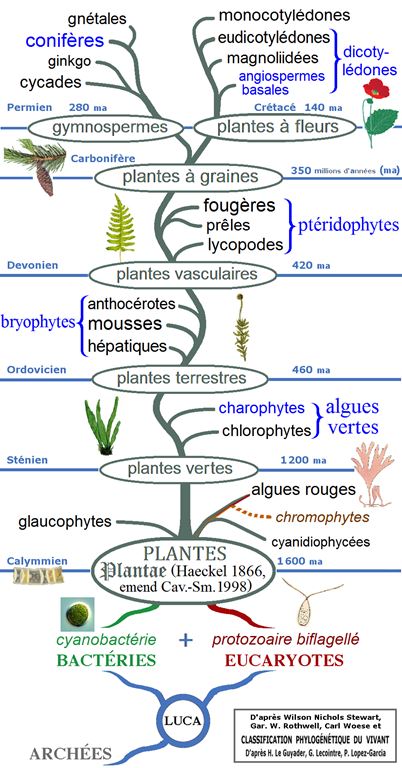
À droite, cet arbre phylogénétique des plantes montre les principaux clades et groupes traditionnels (monophylétiques en noir et paraphylétiques en bleu).
Dénominations
- Nom botanique : Phyllanthus amarus Schumach. & Thonn.
- Synonymes : Phyllanthus niruri auct. non L, Phyllanthus niruri var. genuinus Muell. Arg
- Noms anglais et locaux : Fly roost
Description et culture
Tableau récapitulatif
Parties comes-tibles Note comest. (1-5) Note medic. (1-5) (Zones de) Rusticité Besoins en 
Besoins en  (1-3)
(1-3)Périodes de semis et récoltes Graines au gramme Durée de viabilité Profon-deur semis Espace-ment plants Espace-ment lignes Durée germi-native Durée avant récolte J F M A M J
J A S O N D
J F M A M J
J A S O N D
- dont infos de 0FPI ("FOOD PLANTS INTERNATIONAL", en anglais) :
Description :
Une herbe annuelle. Il pousse de 10 à 40 cm de haut. Il repose presque sur le sol. Il est ligneux près de la base. Les feuilles sont dans une seule plaine. Les fleurs pendent d'un côté de la branche. Les fleurs sont séparément mâles et femelles. Le fruit est rond et aplati. Il se divise en trois. Les graines ont des côtes{{{0(+x) (traduction automatique).
Original : An annual herb. It grows 10-40 cm high. It almost lies along the ground. It is woody near the base. The leaves are in one plain. The flowers hang from one side of the branch. Flowers are separately male and female. The fruit is round and flattened. It splits into three. The seeds have ribs{{{0(+x).
Production :
En République centrafricaine, on plante des fruits en mars{{{0(+x) (traduction automatique).
Original : In Central African Republic plants fruit in March{{{0(+x).
 Consommation (rapports de comestibilité, parties utilisables et usages alimentaires correspondants)
Consommation (rapports de comestibilité, parties utilisables et usages alimentaires correspondants)Parties comestibles :
fruits, feuilles{{{0(+x) (traduction automatique). Original : Fruit, Leaves{{{0(+x).Partie testée :
/ Risques et précautions à prendre
Risques et précautions à prendrenéant, inconnus ou indéterminés.
Autres infos
dont infos de 0FPI ("FOOD PLANTS INTERNATIONAL", en anglais) :
Statut :
Fruits consommés surtout par les enfants{{{0(+x) (traduction automatique).
Original : Fruit eaten especially by children{{{0(+x).
Distribution :
Une plante tropicale. Il pousse dans des endroits ensoleillés. Aux Fidji, il pousse près du niveau de la mer et jusqu'à 50 m d'altitude. Il pousse dans les rizières inondées. Dans le sud de la Chine, il pousse entre 100 et 600 m d'altitude. Au Yunnan{{{0(+x) (traduction automatique).
Original : A tropical plant. It grows in sunny places. In Fiji it grows near sea level and up to 50 m altitude. It grows in flooded rice fields. In southern China it grows between 100-600 m above sea level. In Yunnan{{{0(+x).
Localisation :
Afrique, Samoa américaines, Asie, Australie, Bénin, Burkina Faso, Cambodge, Afrique centrale, République centrafricaine, RCA, Chine, Chuuk, RD Congo, République dominicaine, Afrique de l'Est, Timor oriental, Fidji, FSM, Ghana, Guinée, Guinée, Guinée © e, Guinée-Bissau, Haïti, Himalaya, Inde, Indochine, Kiribati, Laos, Madagascar, Maldives, Marquises, Îles Marshall, Micronésie, Mozambique, Népal, Pacifique, Pakistan, Palau, Philippines, Sao Tomé-et-Principe, Asie du Sud-Est, Sierra Leone, Sainte-Lucie, Taiwan, Thaïlande, Timor-Leste, Togo, Tuvalu, Afrique de l'Ouest, Antilles{{{0(+x) (traduction automatique).
Original : Africa, American Samoa, Asia, Australia, Benin, Burkina Faso, Cambodia, Central Africa, Central African Republic, CAR, China, Chuuk, Congo DR, Dominican Republic, East Africa, East Timor, Fiji, FSM, Ghana, Guinea, Guinée, Guinea-Bissau, Haiti, Himalayas, India, Indochina, Kiribati, Laos, Madagascar, Maldives, Marquesas, Marshall Islands, Micronesia, Mozambique, Nepal, Pacific, Pakistan, Palau, Philippines, Sao Tome and Principe, SE Asia, Sierra Leone, St Lucia, Taiwan, Thailand, Timor-Leste, Togo, Tuvalu, West Africa, West Indies{{{0(+x).
Notes :
Il existe environ 750 espèces de Phyllanthus. Ils sont principalement sous les tropiques. Il est utilisé comme médicament pour stimuler la production de lait. Il a des propriétés anticancéreuses{{{0(+x) (traduction automatique).
Original : There are about 750 Phyllanthus species. They are mostly in the tropics. It is used as a medicine to stimulate milk production. It has anticancer properties{{{0(+x).
Liens, sources et/ou références
Liens :
/ ;Sources et/ou références :
bibliographie (liste des sources et/ou références de l'encyclopédie)
dont classification : IPNI ("International Plant Names Index", en anglais) ; Kew (POWO - "Plant Of the World Online", "Royal Botanical Garden", en anglais) ;
dont livres et bases de données : 0FPI ("FOOD PLANTS INTERNATIONAL", en anglais) ;
dont bibliographie/références de 0FPI ("FOOD PLANTS INTERNATIONAL", en anglais) :
Achigan-Dako, E, et al (Eds), 2009, Catalogue of Traditional Vegetables in Benin. International Foundation for Science. ; Batawila, K., et al, 2007, Diversite et gestion des legumes de cueillete au Togo. African Journal of Food, Agriculture, Nutrition and Development 7( 3& 4): 65 ; Bonou, A., et al, 2013, Valeur economique des Produits Forestiers Non Ligneux (PFNL) au Benin. Editions Universitaires Europeennes p 97 ; Cowie, I, 2006, A Survey of Flora and vegetation of the proposed Jaco-Tutuala-Lore National Park. Timor-Lests (East Timor) www.territorystories.nt/gov.au p 47 ; Dansi, A., et al, 2008, Traditional leafy vegetables and their use in the Benin Republic. Genet Resour Crop Evol (2008) 55:1239–1256 ; Dansi, A., et al, 2009, Traditional leafy vegetables in Benin: folk nomenclature, species under threat and domestication. Acta Bot. Gallica 156(2), 183-199 ; Franklin, J., Keppel, G., & Whistler, W., 2008, The vegetation and flora of Lakeba, Nayau and Aiwa Islands, Central Lau Group, Fiji. Micronesica 40(1/2): 169–225, 2008 ; Hussey, B.M.J., Keighery, G.J., Cousens, R.D., Dodd, J., Lloyd, S.G., 1997, Western Weeds. A guide to the weeds of Western Australia. Plant Protection Society of Western Australia. p 146 ; Jackes, B.R., 2001, Plants of the Tropics. Rainforest to Heath. An Identification Guide. James Cook University. p 53 ; Jiwajinda, S., et al, 2002, Suppressive Effects of Edible Thai Plants on Superoxide and Nitric Oxide Generation. Asian Pacific Journal of Cancer Prevention, Vol 3, 2002 ; Kintzios, S. E., 2006, Terrestrial Plant-Derived Anticancer Agents and Plant Species Used in Anticancer research. Critical Reviews in Plant Sciences. 25: pp 79-113 ; Latham, P & Mbuta, A., 2017, Useful Plants of Central Province, Democratic Republic of Congo. Volume 2. Salvation Army p 102 ; Manandhar, N.P., 2002, Plants and People of Nepal. Timber Press. Portland, Oregon. p 359 ; Pandy, R. K. & Saini, S. K., 2007, Edible plants of tropical forests among tribal communities of Madhya Pradesh. Indian Journal of Traditional Knowledge. 6(1), pp 185-190 ; Phon, P., 2000, Plants used in Cambodia. © Pauline Dy Phon, Phnom Penh, Cambodia. p 497 ; Plants of Haiti Smithsonian Institute http://botany.si.edu/antilles/West Indies ; C. F. Schumacher, Beskr. Guin. pl. 421. 1827 ; Sujanapal, P., & Sankaran, K. V., 2016, Common Plants of Maldives. FAO & Kerala FRI, p 205 ; Thaman, R. R., 1987, Plants of Kiribati: A listing and analysis of vernacular names. Atoll Research Bulletin No. 296 ; Thaman, R. R, 2016, The flora of Tuvalu. Atoll Research Bulletin No. 611. Smithsonian Institute p 84
Recherche de/pour :
- "Phyllanthus amarus" sur Google (pages et
images) ;
TPL ("The Plant List", en anglais) ;
GRIN ("Germplasm Resources Information Network", en anglais) ;
TROPICOS (en anglais) ;
Tela Botanica ;
Pl@ntNet ;
Pl@ntUse ;
"Plants For A Future" (en anglais) ;
"Useful Tropical Plants" (en anglais) ou
"Useful Temperate Plants" (en anglais) ;
- "Phyllanthe amer" sur Google (pages, images et recettes) ;
- "Phyllanthus amarus" sur Google (pages et
images) ;
TPL ("The Plant List", en anglais) ;
GRIN ("Germplasm Resources Information Network", en anglais) ;
TROPICOS (en anglais) ;
Tela Botanica ;
Pl@ntNet ;
Pl@ntUse ;
"Plants For A Future" (en anglais) ;
"Useful Tropical Plants" (en anglais) ou
"Useful Temperate Plants" (en anglais) ;
Espèces du même genre (Phyllanthus)
26 taxons
- Phyllanthus acidus (L.) Skeels (Girembellier)
- Phyllanthus acuminatus Vahl
- Phyllanthus adenodiscus Mll.Arg.
- Phyllanthus boehmii Pax
- Phyllanthus casticum P.Willemet
- Phyllanthus chacoensis Morong
- Phyllanthus emblica L. (Malaka)
- Phyllanthus engleri Pax
- Phyllanthus fraternus G.L.Webster
- Phyllanthus gomphocarpus Hook.f.
- Phyllanthus heyneanus Mll.Arg.
- Phyllanthus indofischeri Bennet
- Phyllanthus limmuensis Cufod.
- Phyllanthus maderaspatensis Forssk. (Phyllanthe de Madras)
- Phyllanthus muellerianus
- Phyllanthus myrtaceus Sond.
- Phyllanthus niruri L. (Phyllanthe niruri)
- Phyllanthus oxyphyllus Mll.Arg.
- Phyllanthus parvifolius Steud.
- Phyllanthus pectinatus Hook.f.
- Phyllanthus polyanthus Pax
- Phyllanthus reticulatus Poir.
- Phyllanthus salviifolius Kunth
- Phyllanthus urinaria L.
Espèces de la même famille (Euphorbiaceae)
598 taxons
- Acalyphe d'Inde
- Acalyphe géante
- Acalyphe hérissée
- Acalyphe lancéolée
- Andrachne faux-téléphium
- Antidesme de Madagascar
- Bancoulier
- Bignay
- Buah
- Buisson de Noël
- Cerise de la rivière herbert (dp*)
- Chaya
- Chrozophore
- Dentelaire du Cap
- Engkumi
- Épurge
- Euphorbe
- Euphorbe à feuilles de thym
- Euphorbe âcre
- Euphorbe couchée
- Euphorbe de Heyne
- Euphorbe de Nice
- Euphorbe de Robb
- Euphorbe dentée
- Euphorbe des garrigues
- Euphorbe des jardiniers
- Euphorbe des moissons
- Euphorbe des sables
- Euphorbe faux Cyprès
- Euphorbe fluette de Merino
- Euphorbe prostrée
- Euphorbe réveille-matin
- Girembellier
- Hévéa du Brésil
- Inchi
- Katuk
- Lampaong
- Lang khae{{{69
- Malaka
- Manioc
- Médecinier béni
- Médicinier à feuilles de cotonnier
- Médicinier multifide
- Mercuriale des montagnes
- Mercuriale tomenteuse
- Noyer africain (tp* de "african nut tree")
- Pédilanthe tithymaloïde
- Phyllanthe de Madras
- Phyllanthe niruri
- Raisin birmane
- Acalypha amentacea Roxb.
- Acalypha australis L.
- Acalypha bipartita Muell. Arg.
- Acalypha boehmeroides
- Acalypha cardiophylla Merr.
- Acalypha caturus Blume
- Acalypha ciliata Forssk.
- Acalypha fruticosa Forssk.
- Acalypha glabrata Thunb.
- Acalypha glandulifolia Buchinger & Meisn. ex C.Krauss
- Acalypha grandis Benth. (Acalyphe géante)
- Acalypha hispida Burm.f. (Acalyphe hérissée)
- Acalypha indica (L.) Vell. (Acalyphe d'Inde)
- Acalypha lanceolata Willd. (Acalyphe lancéolée)
- Acalypha malabarica Mll.Arg.
- Acalypha matsudai Hayata
- Acalypha nemora
- Acalypha nemorosa
- Acalypha nemorum F.Muell. ex Müll.Arg.
- Acalypha ornata Hochst. ex A Rich.
- Acalypha paniculata Miq.
- Acalypha peduncularis Pax
- Acalypha plicata Griseb.
- Acalypha racemosa Wall. ex F.W.Andrews
- Acalypha rivularis Seem.
- Acalypha segetalis Mull. Arg.
- Acalypha siamensis Oliver ex Gage
- Acalypha spiciflorum
- Acalypha stricta Poepp.
- Acalypha suirenbiensis Yamam.
- Acalypha volkensii Pax
- Acalypha wilkesiana Mull. Arg.
- Actephila excelsa (Dalzell) Mll.Arg.
- Adelia barbinervis Cham. & Schltdl.
- Alchornea cordifolia (Schumach. & Thonn.) Müll.Arg. (Buisson de Noël)
- Alchornea floribunda Mll.Arg.
- Alchornea scandens
- Alchornea triplinervia
- Aleurites cordatus
- Aleurites fordii Hemsl.
- Aleurites moluccanus (L.) Willd. (Bancoulier)
- Aleurites rockinghamensis
- Andrachne telephioides L. (Andrachne faux-téléphium)
- Antidesma acidum Retz.
- Antidesma alexiteria Gaertn.
- Antidesma Bunius (L.) Spreng. (Bignay)
- Antidesma celebicum Miq.
- Antidesma coriaceum Tul.
- Antidesma dallachyanum Baill. (Cerise de la rivière herbert (dp*))
- Antidesma edule Merr.
- ...







 donne accès au menu
  - encyclopédies des plantes alimentaires ;
 - page de recherche - reconnaissance (identification) de plantes ;
 - page du calendrier lunaire et son générateur (au format PDF et JPG) ;
 - tableau récapitulatif ;
 - générateur de potées (soupes), avec estimation des apports nutrionnels et du coût;
 - générateur de codes QR ;
 - page des archives avec de nombreux documents sur différents thèmes complémentaires comme la botanique, les légumes,
les champignons, la cuisine, le bien-être ainsi que différents MOOC mais également des liens vers les archives de l'association ;
- page des archives avec de nombreux documents sur différents thèmes complémentaires comme la botanique, les légumes,
les champignons, la cuisine, le bien-être ainsi que différents MOOC mais également des liens vers les archives de l'association ;

 pour le fruit (et/ou les graines, la pulpe, etc...),
 pour les fleurs (et/ou pétales, calice...),
 pour les feuilles (et/ou la tige, les pousses...),
 pour les racines,
 pour le tronc (et/ou l'écorce, la sève...), et enfin
 pour les champignons,
puis les notes alimentaires et médicinales (de 1 à 5 étoiles), la rusticité (résistance au froid/gel)
et pour finir un résumé.
pour les champignons,
puis les notes alimentaires et médicinales (de 1 à 5 étoiles), la rusticité (résistance au froid/gel)
et pour finir un résumé. menant ici 🙂
 ,
,  et
et





 ,
,


 Encyclopédie(s)
 Recherche-Reconnaissance
 Tableau récapitulatif
 Codes QR
 Archives
 Calendrier(s) lunaire(s)
  Potées
 Re-naturation/naturalisation
 Affichettes, herbiers &
co.
Affichettes, herbiers &
co. menu
menu galerie


 (en bas à droite).
 (en bas à gauche).
