Bignay
(Antidesma Bunius)
 |
****
|
****
-2,5/-3°C
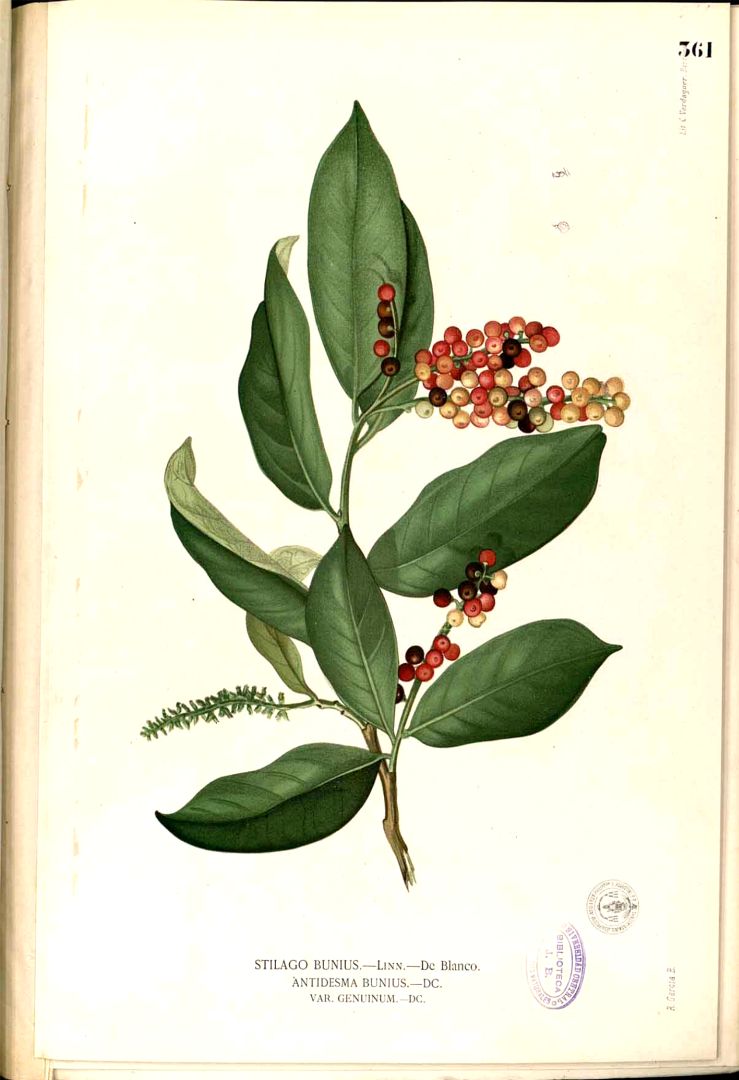
Un petit arbre touffu. Il mesure souvent 3 à 6 m de haut. Il peut atteindre 15 à 30 mètres de haut. Les feuilles ont tendance à être longues, étroites et brillantes. Ils ... (traduction automatique)
→suite


Bignay
Note alimentaire 

Un petit arbre touffu. Il mesure souvent 3 à 6 m de haut. Il peut atteindre 15 à 30 mètres de haut. Les feuilles ont tendance à être longues, étroites et brillantes. Ils sont vert foncé. Ils sont po... (traduction automatique) →suite
Pas d'autre illustration
pour le moment 😕
Antidesma Bunius
Classification
- Classique : en haut de l'écran, sous le coeur.
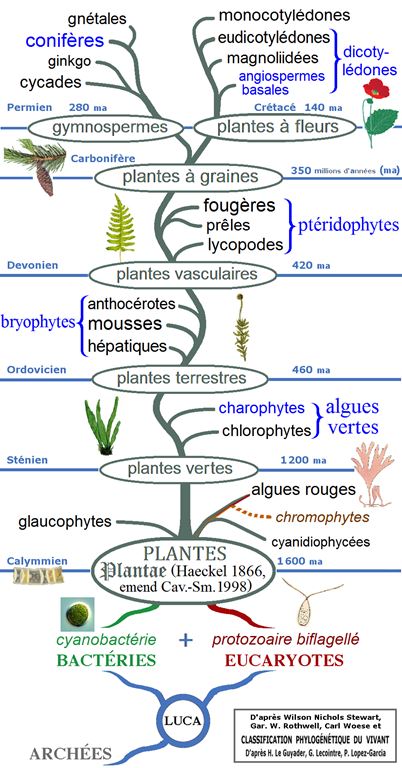
- Phylogénétique :
- Clade 4 : Angiospermes ;
- Clade 3 : Dicotylédones_vraies ;
- Clade 2 : Rosidées ;
- Clade 1 : Fabidées ;
- Ordre APN : Malpighiales ;
- Famille APN : Phyllanthaceae ;
À droite, cet arbre phylogénétique des plantes montre les principaux clades et groupes traditionnels (monophylétiques en noir et paraphylétiques en bleu).
Dénominations
- Nom botanique : Antidesma Bunius (L.) Spreng. (1824)
- Synonymes français : buni, bugnay ou bignai, arbre à cassis, arbre salamandre, antidesme
- Synonymes : Antidesma andamanicum Hook.f. 1887 ;
Dont basionyme : Stilago bunius L. 1767 ; - Noms anglais et locaux : bignay, bignay China-laurel bignay China laurel), Chinese-laurel (Chinese laurel), currant-tree, Herbert River-cherry, Queensland-cherry, salamander-tree, wild cherry, buni, wu yue cha (ch transcrir), salamanderboom (nl), lorbeerblättriger Flachsbaum (de), Salamanderbaum (de), bignai (es)
Description et culture
Tableau récapitulatif
Parties comes-tibles Note comest. (1-5) Note medic. (1-5) (Zones de) Rusticité Besoins en 
Besoins en  (1-3)
(1-3)Périodes de semis et récoltes Graines au gramme Durée de viabilité Profon-deur semis Espace-ment plants Espace-ment lignes Durée germi-native Durée avant récolte -2,5/-3°C J F M A M J
J A S O N D
J F M A M J
J A S O N D30
Nombre de graines au gramme :
30
- dont infos de 0FPI ("FOOD PLANTS INTERNATIONAL", en anglais) :
Description :
Un petit arbre touffu. Il mesure souvent 3 à 6 m de haut. Il peut atteindre 15 à 30 mètres de haut. Les feuilles ont tendance à être longues, étroites et brillantes. Ils sont vert foncé. Ils sont pointus à la pointe et plus arrondis à la base. Les feuilles mesurent 10 à 15 cm de long sur 5 à 7 cm de large. Les fleurs mâles et femelles sont séparées, sur des arbres séparés. Les fleurs femelles produisant des fruits se trouvent aux extrémités des branches. Un épi de baies noires rougeâtre foncé est produit. Les baies mesurent environ 1 cm de diamètre et ont une graine à l'intérieur. Ils pendent dans un grand cluster. Il y en a 20 à 50 dans un cluster{{{0(+x) (traduction automatique).
Original : A small bushy tree. It is often 3-6 m tall. It can be up to 15-30 metres high. The leaves tend to be long and narrow and shiny. They are dark green. They are pointed at the tip and more rounded at the base. The leaves are 10-15 cm long by 5-7 cm wide. The male and female flowers are separate, on separate trees. Female flowers producing fruit are on the ends of branches. A spike of dark reddish black berries is produced. The berries are about 1 cm across and have one seed inside. They hang in a large cluster. There are 20-50 in a cluster{{{0(+x).
Production :
Les semis des arbres donnent des fruits 4-5 ans après la plantation. La saison de fructification dure quelques mois. En Inde, les plantes fleurissent et fructifient d'avril à août{{{0(+x) (traduction automatique).
Original : Seedling trees fruit 4-5 years after planting. The fruiting season lasts a couple of months. In India plants flower and fruit April to August{{{0(+x).
Culture :
Il pousse à partir de graines. Ceux-ci peuvent être plantés, mais les arbres poussent également naturellement à partir de graines. Les arbres peuvent être produits par bourgeonnement, greffage ou boutures. La superposition aérienne peut également être utilisée. L'espacement doit être d'environ 12 à 14 mètres entre les arbres. Certains arbres mâles doivent être présents pour la pollinisation croisée. Lorsque les arbres femelles produisent des fruits sans arbres mâles, les graines de ces fruits ne germent normalement pas{{{0(+x) (traduction automatique).
Original : It grows from seeds. These can be planted, but trees also grow naturally from seed. Trees can be produced by budding, grafting or from cuttings. Aerial layering can also be used. Spacing should be about 12 to 14 metres between trees. Some male trees need to be present for cross pollination. When female trees produce fruit without male trees, the seed from these fruit normally will not germinate{{{0(+x).
 Consommation (rapports de comestibilité, parties utilisables et usages alimentaires correspondants)
Consommation (rapports de comestibilité, parties utilisables et usages alimentaires correspondants)Fruit (fruits mûrs{{{27(+x) [nourriture/aliment{{{2(+)(dp*) {confitures27(+x)} et base boissons/breuvages{{{2(+)(dp*) {sirops27(+x)}]) comestible.
Détails :
Fruits consommés localement{{{27(+x).
Partie testée :
fruit {{{0(+x) (traduction automatique). Original : Fruit {{{0(+x)| Taux d'humidité (%) | Énergie (kj) | Énergie (kcal) | Protéines (g) |
|---|---|---|---|
| 81.7 | 281 | 67 | 0.7 |
| Pro- vitamines A (µg) |
Vitamines C (mg) | Fer (mg) | Zinc (mg) |
| 31 | 69 | 0.9 | 0 |
 Risques et précautions à prendre
Risques et précautions à prendrecf. consommation
Galerie(s)
Petite histoire-géo
Aire d'origine : Asie (tempérée et tropicale), Australie et Pacifique{{{2(+x). :: Plus de détails et d'infos (dont zone(s) de cullture) : voir GRIN ("2").
Autres infos
dont infos de 0FPI ("FOOD PLANTS INTERNATIONAL", en anglais) :
Statut :
C'est une plante alimentaire cultivée. Les fruits sont vendus sur les marchés. Ceci dans seulement un fruit comestible mineur des zones tropicales de plaine. Il est important en Indonésie et occasionnel en Papouasie-Nouvelle-Guinée. Les fruits sont surtout consommés par les enfants{{{0(+x) (traduction automatique).
Original : It is a cultivated food plant. The fruit are sold in markets. This in only a minor edible fruit of lowland tropical areas. It is important in Indonesia and occasional in Papua New Guinea. The fruit are especially eaten by children{{{0(+x).
Distribution :
Une plante tropicale. Il peut probablement pousser jusqu'à 1000 m d'altitude sous les tropiques. En Indonésie, il pousse entre 50 et 1 400 m au-dessus du niveau de la mer. Il peut supporter un gel léger. Ils peuvent pousser sur une variété de sols. Ils sont communs et largement distribués dans les endroits ouverts et la forêt secondaire à travers les Philippines. Il peut tolérer le sel. Il convient aux basses terres tropicales humides. Il convient aux zones de rusticité 10-12. Dans XTBG Yunnan{{{0(+x) (traduction automatique).
Original : A tropical plant. It can probably grow up to 1000 m altitude in the tropics. In Indonesia it grows between 50-1,400 m above sea level. It can stand light frost. They can grow on a variety of soils. They are common and widely distributed in open places and secondary forest throughout the Philippines. It can tolerate salt. It suits the humid tropical lowlands. It suits hardiness zones 10-12. In XTBG Yunnan{{{0(+x).
Localisation :
Asie, Australie, Bhoutan, Brésil, Cambodge, Chine, Cuba, Hawaï, Himalaya, Inde, Indochine, Indonésie, Laos, Malaisie, Myanmar, Népal, Nord-est de l'Inde, Pacifique, Papouasie-Nouvelle-Guinée, PNG, Philippines, Asie du Sud-Est, Sikkim, Singapour, Iles Salomon, Amérique du Sud, Sri Lanka, Thaïlande, Tibet, USA, Vietnam{{{0(+x) (traduction automatique).
Original : Asia, Australia, Bhutan, Brazil, Cambodia, China, Cuba, Hawaii, Himalayas, India, Indochina, Indonesia, Laos, Malaysia, Myanmar, Nepal, Northeastern India, Pacific, Papua New Guinea, PNG, Philippines, SE Asia, Sikkim, Singapore, Solomon Islands, South America, Sri Lanka, Thailand, Tibet, USA, Vietnam{{{0(+x).
Notes :
Il existe environ 100 à 170 espèces d'Antidesma{{{0(+x) (traduction automatique).
Original : There are about 100-170 Antidesma species{{{0(+x).
Rusticité (résistance face au froid/gel, climat)
-2,5/-3°C
Liens, sources et/ou références
Liens :
/ ;Sources et/ou références :
bibliographie (liste des sources et/ou références de l'encyclopédie)
dont classification : IPNI ("International Plant Names Index", en anglais) ; TPL ("The Plant List", en anglais) ; 2GRIN ("Germplasm Resources Information Network", en anglais) ; Kew (POWO - "Plant Of the World Online", "Royal Botanical Garden", en anglais) ;
dont livres et bases de données : 5PFAF ("Plants For A Future", en anglais) ; 27Dictionnaire des plantes comestibles (livre, page 29, par Louis Bubenicek) ;
Warning: Undefined variable $prex in /home/waso5761/public_html/inc/fiches.php on line 2607
dont bibliographie/références de 0FPI ("FOOD PLANTS INTERNATIONAL", en anglais) :
REFERENCES Antidesma bunius ; Airy Shaw, 1972, Kew Bulletin 26(2) p 353 ; Alegado, A. M. & De Guzman, R. B., 2014, Indigenous food crops of the Aetas tribe in the Philippines and their traditional methods of food preparation. in Promotion of Underutilized Indigenous Food Resources for Food Security and Nutrition in Asia and Pacific. FAO. Bangkok p 160 ; Ambasta S.P. (Ed.), 2000, The Useful Plants of India. CSIR India. p 45 ; Anon , 1921, Philipp. Agric Rev. 14 p 243 ; Arora, R. K., 2014, Diversity in Underutilized Plant Species - An Asia-Pacific Perspective. Bioversity International. p 57 ; Ashton, M. S., et al 1997, A Field Guide to the Common Trees and Shrubs of Sri Lanka. WHT Publications Ltd. p 193 ; Bailey, F M., 1902, Rep British New Guinea p 3 ; Barwick, M., 2004, Tropical and Subtropical Trees. A Worldwide Encyclopedic Guide. Thames and Hudson p 28 ; Bircher, A. G. & Bircher, W. H., 2000, Encyclopedia of Fruit Trees and Edible Flowering Plants in Egypt and the Subtropics. AUC Press. p 34 ; Black, A A 1870, Treasures Botany 1:75 ; Bodner, C. C. and Gereau, R. E., 1988, A Contribution to Bontoc Ethnobotany. Economic Botany, 43(2): 307-369 ; Brown, W.H., 1920, Wild Food Plants of the Philippines. Bureau of Forestry Bulletin No. 21 Manila. p 80 ; Brown, 1951, Useful Plants of the Philippines p 296 ; 1977, Buah Buahan, Lembaga Biologi Nasional p 26 ; Burkill, I H, 1935, A Dictionary of the Economic Products of the Malay Peninsula p 185 ; Chakraborty, S. & Chaturbedi, H. P., 2014, Some Wild Edible Fruits of Tripura- A Survey. Indian Journal of Applied research. (4) 9 ; Cherikoff V. & Isaacs, J., The Bush Food Handbook. How to gather, grow, process and cook Australian Wild Foods. Ti Tree Press, Australia p 144, 198 ; Chua-Barcelo, R. T., 2014, Ethnobotanical survey of edible wild fruits in Benguet, Cordillera administrative region, the Philippines. Asian Pac. J. Trop. Biomed. 4(Suppl. 1):S525-S538 ; Cook, A A., 1975, Diseases of Tropical; and Subtropical fruits and nuts. Hafner ; Cooper W & Cooper W T, 1994, Fruits of the Rain Forest. RD Press p 34 ; Cooper, W. and Cooper, W., 2004, Fruits of the Australian Tropical Rainforest. Nokomis Editions, Victoria, Australia. p 172 ; Corner, Wayside Trees of Malaya p 231 ; Coronel, R.E., 1982, Fruit Collections in the Philippines. IBPGR Newsletter p 6 ; Cribb, A.B. & J.W., 1976, Wild Food in Australia, Fontana. p 22 ; Cundall, P., (ed.), 2004, Gardening Australia: flora: the gardener's bible. ABC Books. p 161 ; Darley, J.J., 1993, Know and Enjoy Tropical Fruit. P & S Publishers. p 119 ; Delang, C. O., 2007, Ecological Succession of Usable Plants in an Eleven-Year Fallow Cycle in North Lao P.D.R., Ethnobotany Research and Applications. Vol. 5:331-350 ; Dobriyal, M. J. R. & Dobriyal, R., 2014, Non Wood Forest Produce an Option for Ethnic Food and Nutritional Security in India. Int. J. of Usuf. Mngt. 15(1):17-37 ; Elliot, W.R., & Jones, D.L., 1982, Encyclopedia of Australian Plants suitable for cultivation. Vol 2. Lothian. p 208 ; Facciola, S., 1998, Cornucopia 2: a Source Book of Edible Plants. Kampong Publications, p 240 ; Flora of China. www.eFloras.org ; French, B., 1986, Food Plants of Papua New Guinea, Asia Pacific Science Foundation p 290 ; Hazarika, T. K., et al, 2012, Studies on wild fruits of Mizoram, India used as ethno-medicines. Genetic Resources and Crop Evolution. Published on line 03 February, 2012 ; Hedricks U.P. (ed) 1919, Sturtevantâ's Edible Plants of the World. Dover p 60 ; Heyne, K., 1927, Nutt. Plant. Ned. Ind. p 915 ; Hibbert, M., 2002, The Aussie Plant Finder 2002, Florilegium. p 30 ; Hill, M. & Hallam, D., (eds), 1997, Na Hang Nature Reserve, Tat Ke Sector. Site description and conservation evaluation. Hanoi. p 77 ; Hooker, Flora of British India Vol V p 357 ; Hu, Shiu-ying, 2005, Food Plants of China. The Chinese University Press. p 509 ; INFOODS:FAO/INFOODS Databases ; Jackes, B.R., 2001, Plants of the Tropics. Rainforest to Heath. An Identification Guide. James Cook University. p 51 ; Jeeva, S., 2009, Horticultural potential of wild edible fruits used by the Khasi tribes of Meghalaya. Journal or Horticulture and Forestry Vol. 1(9) pp. 182-192 ; Jones D, L, 1986, Ornamental Rainforest Plants in Australia, Reed Books, p 180, 340 ; Kalshoven, L.G.E., 1951, De Plagen van de Cultuur Gewassen in Indonesie. p 1026 ; Kiple, K.F. & Ornelas, K.C., (eds), 2000, The Cambridge World History of Food. CUP p 1732 ; Lazarides, M. & Hince, B., 1993, Handbook of Economic Plants of Australia, CSIRO. p 22 ; Lembaga Biologi Nasional, 1977, Buah-Buahan, Balai Pustaka, Jakarta. p 26 ; Leon, J. 1968, Fundamentos Botanicos de los Cultiuvos Tropicales. p 350 ; Llamas, K.A., 2003, Tropical Flowering Plants. Timber Press. p 187 ; Lorenzi, H., Bacher, L., Lacerda, M. & Sartori, S., 2006, Brazilian Fruits & Cultivated Exotics. Sao Paulo, Instituto Plantarum de Estuados da Flora Ltda. p 410 ; Macmillan, H.F. (Revised Barlow, H.S., et al) 1991, Tropical Planting and Gardening. Sixth edition. Malayan Nature Society. Kuala Lumpur. p 291 ; Maranon, J., 1935, Nutritive mineral value of Philippine food plants. Philipp. J Sci. 53:317-358. ; Martin, F.W. & Ruberte, R.M., 1979, Edible Leaves of the Tropics. Antillian College Press, Mayaguez, Puerto Rico. p 55, 179, 191 ; Martin, F. W., et al, 1987, Perennial Edible Fruits of the Tropics. USDA Handbook 642 p 25 ; Monsalud, M.R., Tongacan, A.L., Lopez, F.R., & Lagrimas, M.Q., 1966, Edible Wild Plants in Philippine Forests. Philippine Journal of Science. p 465 ; Morton, J. F., 1987, Fruits of Warm Climates. Wipf & Stock Publishers p 210 ; Neal, C.M., 1965, In Gardens of Hawaii. Bishop Museum Press. ; Nicholson, N & H., 1994, Australian Rainforest Plants 4, Terania Rainforest Publishing. NSW. p 9 ; Ochse, J.J. et al, 1931, Vegetables of the Dutch East Indies. Asher reprint. p 262 ; Ochse,J.J., Dijkman,M.J., Soule, M.J.& Wehlburg,C., 1961, Tropical and Subtropical Agriculture. P 599 ; Patiri, B. & Borah, A., 2007, Wild Edible Plants of Assam. Geethaki Publishers. p 124 ; Pegu, R., et al, 2013, Ethnobotanical study of Wild Edible Plants in Poba Reserved Forest, Assam, India. Research Journal of Agriculture and Forestry Sciences 1(3):1-10 ; Polinag, M. A., 2003, Food from the Wilderness. Department of Environment and Natural Resources. Laguna. ; PROSEA (Plant Resources of South East Asia) handbook, Volume 2, 1991, Edible fruits and nut. p 78 ; PROSEA handbook Volume 13 Spices. p 274 ; Purseglove, J.W., 1968, Tropical Crops Dicotyledons, Longmans. p 139 ; Queensland Forest Service, 1991, Trees and Shrubs. Department of Primary Industries. p 62 ; Rajapaksha, U., 1998, Traditional Food Plants in Sri Lanka. HARTI, Sri Lanka. p 206 ; Ramakrishnan, T.S., & Sundaram, N.V., 1952, A new rust on Antidesma in India. Trans. Brit. Mycol. Soc. 35:26-28 ; Recher, P, 2001, Fruit Spirit Botanical Gardens Plant Index. www.nrg.com.au/~recher/ seedlist.html p 1 ; Rumf. 17, Herbarium Amboinense 3, 170, p 204. ; Sarma, H., et al, 2010, Updated Estimates of Wild Edible and Threatened Plants of Assam: A Meta-analysis. International Journal of Botany 6(4): 414-423 ; Savita, et al, 2006, Studies on wild edible plants of ethnic people in east Sikkim. Asian J. of Bio Sci. (2006) Vol. 1 No. 2 : 117-125 ; Sawian, J. T., et al, 2007, Wild edible plants of Meghalaya, North-east India. Natural Product Radiance Vol. 6(5): p 413 ; Seidemann J., 2005, World Spice Plants. Economic Usage, Botany, Taxonomy. Springer. p 45 ; Singh, H.B., Arora R.K.,1978, Wild edible Plants of India. Indian Council of Agricultural Research, New Delhi. p17, 49 ; Sukarya, D. G., (Ed.) 2013, 3,500 Plant Species of the Botanic Gardens of Indonesia. LIPI p 128 ; Syst. veg. 1:826. 1824 ; Tanaka,T., 1976, Tanaka's Cyclopedia of Edible Plants of the World. Keigaku Publishing, Tokyo. p 50 ; Tate, D., 1999, Tropical Fruit. Archipelago Press. Singapore. p 24 ; Terra, G.J.A., 1973, Tropical Vegetables. Communication 54e Royal Tropical Institute, Amsterdam, p 25 ; Townsend, K., 1994, Across the Top. Gardening with Australian Plants in the tropics. Society for Growing Australian Plants, Townsville Branch Inc. p 83 ; USDA, ARS, National Genetic Resources Program. Germplasm Resources Information Network - (GRIN). [Online Database] National Germplasm Resources Laboratory, Beltsville, Maryland. Available: www.ars-grin.gov/cgi-bin/npgs/html/econ.pl (10 April 2000) ; Uphof, J.C.Th.,1968, Dictionary of Economic Plants 591pp Cramer p ; Walter, A. & Sam C., 2002, Fruits of Oceania. ACIAR Monograph No. 85. Canberra. p 278 ; 1948 Wealth of India p 84 ; Wight, R., 1963, Icones Plantarum Indiae Orientalis Vol 3 Pl 819. ; Williams, K.A.W., 1999, Native Plants of Queensland Volume 4. Keith A.W. Williams North Ipswich, Australia. p 54 ; www.worldagroforestrycentre.org/treedb/ ; Flora of Thailand. www.nationalherbarium.nl/thaueuph/ ; www.pngplants.org
Recherche de/pour :
- "Antidesma Bunius" sur Google (pages et
images) ;
TROPICOS (en anglais) ;
Tela Botanica ;
Pl@ntNet ;
Pl@ntUse ;
"Useful Tropical Plants" (en anglais) ou
"Useful Temperate Plants" (en anglais) ;
- "Bignay" sur Google (pages, images et recettes) ;
- "Antidesma Bunius" sur Google (pages et
images) ;
TROPICOS (en anglais) ;
Tela Botanica ;
Pl@ntNet ;
Pl@ntUse ;
"Useful Tropical Plants" (en anglais) ou
"Useful Temperate Plants" (en anglais) ;
Espèces du même genre (Antidesma)
35 taxons
- Antidesma acidum Retz.
- Antidesma alexiteria Gaertn.
- Antidesma celebicum Miq.
- Antidesma coriaceum Tul.
- Antidesma dallachyanum Baill. (Cerise de la rivière herbert (dp*))
- Antidesma edule Merr.
- Antidesma erostre F.Muell.
- Antidesma excavatum Miq.
- Antidesma fordii Hemsl.
- Antidesma ghaesembilla Gaertn.
- Antidesma hainanense Merr.
- Antidesma japonicum Siebold & Zucc.
- Antidesma khasianum Hook.f.
- Antidesma laciniatum Mll.Arg.
- Antidesma maclurei Merr.
- Antidesma madagascariense Lam. (Antidesme de Madagascar)
- Antidesma membranaceum Mll.Arg.
- Antidesma montanum Thwaites
- Antidesma parvifolium F.Muell.
- Antidesma platyphyllum H.Mann
- Antidesma pleuricum Tul.
- Antidesma puncticulatum Miq.
- Antidesma rec
- Antidesma rufescens Tul.
- Antidesma sinuatum Benth.
- Antidesma sootepense Craib
- Antidesma spatulifolium Airy Shaw
- Antidesma stipulare Blume
- Antidesma tetrandum
- Antidesma tomentosum Miq.
- Antidesma velutinosum Blume
- Antidesma velutinum Tul.
- Antidesma venosum E.Mey. ex Tul. (Tassle berry)
- Antidesma vogelianum Mll.Arg.
Espèces de la même famille (Euphorbiaceae)
598 taxons
- Acalyphe d'Inde
- Acalyphe géante
- Acalyphe hérissée
- Acalyphe lancéolée
- Andrachne faux-téléphium
- Antidesme de Madagascar
- Bancoulier
- Buah
- Buisson de Noël
- Cerise de la rivière herbert (dp*)
- Chaya
- Chrozophore
- Dentelaire du Cap
- Engkumi
- Épurge
- Euphorbe
- Euphorbe à feuilles de thym
- Euphorbe âcre
- Euphorbe couchée
- Euphorbe de Heyne
- Euphorbe de Nice
- Euphorbe de Robb
- Euphorbe dentée
- Euphorbe des garrigues
- Euphorbe des jardiniers
- Euphorbe des moissons
- Euphorbe des sables
- Euphorbe faux Cyprès
- Euphorbe fluette de Merino
- Euphorbe prostrée
- Euphorbe réveille-matin
- Girembellier
- Hévéa du Brésil
- Inchi
- Katuk
- Lampaong
- Lang khae{{{69
- Malaka
- Manioc
- Médecinier béni
- Médicinier à feuilles de cotonnier
- Médicinier multifide
- Mercuriale des montagnes
- Mercuriale tomenteuse
- Noyer africain (tp* de "african nut tree")
- Pédilanthe tithymaloïde
- Phyllanthe amer
- Phyllanthe de Madras
- Phyllanthe niruri
- Raisin birmane
- Acalypha amentacea Roxb.
- Acalypha australis L.
- Acalypha bipartita Muell. Arg.
- Acalypha boehmeroides
- Acalypha cardiophylla Merr.
- Acalypha caturus Blume
- Acalypha ciliata Forssk.
- Acalypha fruticosa Forssk.
- Acalypha glabrata Thunb.
- Acalypha glandulifolia Buchinger & Meisn. ex C.Krauss
- Acalypha grandis Benth. (Acalyphe géante)
- Acalypha hispida Burm.f. (Acalyphe hérissée)
- Acalypha indica (L.) Vell. (Acalyphe d'Inde)
- Acalypha lanceolata Willd. (Acalyphe lancéolée)
- Acalypha malabarica Mll.Arg.
- Acalypha matsudai Hayata
- Acalypha nemora
- Acalypha nemorosa
- Acalypha nemorum F.Muell. ex Müll.Arg.
- Acalypha ornata Hochst. ex A Rich.
- Acalypha paniculata Miq.
- Acalypha peduncularis Pax
- Acalypha plicata Griseb.
- Acalypha racemosa Wall. ex F.W.Andrews
- Acalypha rivularis Seem.
- Acalypha segetalis Mull. Arg.
- Acalypha siamensis Oliver ex Gage
- Acalypha spiciflorum
- Acalypha stricta Poepp.
- Acalypha suirenbiensis Yamam.
- Acalypha volkensii Pax
- Acalypha wilkesiana Mull. Arg.
- Actephila excelsa (Dalzell) Mll.Arg.
- Adelia barbinervis Cham. & Schltdl.
- Alchornea cordifolia (Schumach. & Thonn.) Müll.Arg. (Buisson de Noël)
- Alchornea floribunda Mll.Arg.
- Alchornea scandens
- Alchornea triplinervia
- Aleurites cordatus
- Aleurites fordii Hemsl.
- Aleurites moluccanus (L.) Willd. (Bancoulier)
- Aleurites rockinghamensis
- Andrachne telephioides L. (Andrachne faux-téléphium)
- Antidesma acidum Retz.
- Antidesma alexiteria Gaertn.
- Antidesma celebicum Miq.
- Antidesma coriaceum Tul.
- Antidesma dallachyanum Baill. (Cerise de la rivière herbert (dp*))
- Antidesma edule Merr.
- Antidesma erostre F.Muell.
- ...







 donne accès au menu
  - encyclopédies des plantes alimentaires ;
 - page de recherche - reconnaissance (identification) de plantes ;
 - page du calendrier lunaire et son générateur (au format PDF et JPG) ;
 - tableau récapitulatif ;
 - générateur de potées (soupes), avec estimation des apports nutrionnels et du coût;
 - générateur de codes QR ;
 - page des archives avec de nombreux documents sur différents thèmes complémentaires comme la botanique, les légumes,
les champignons, la cuisine, le bien-être ainsi que différents MOOC mais également des liens vers les archives de l'association ;
- page des archives avec de nombreux documents sur différents thèmes complémentaires comme la botanique, les légumes,
les champignons, la cuisine, le bien-être ainsi que différents MOOC mais également des liens vers les archives de l'association ;

 pour le fruit (et/ou les graines, la pulpe, etc...),
 pour les fleurs (et/ou pétales, calice...),
 pour les feuilles (et/ou la tige, les pousses...),
 pour les racines,
 pour le tronc (et/ou l'écorce, la sève...), et enfin
 pour les champignons,
puis les notes alimentaires et médicinales (de 1 à 5 étoiles), la rusticité (résistance au froid/gel)
et pour finir un résumé.
pour les champignons,
puis les notes alimentaires et médicinales (de 1 à 5 étoiles), la rusticité (résistance au froid/gel)
et pour finir un résumé. menant ici 🙂
 ,
,  et
et





 ,
,


 Encyclopédie(s)
 Recherche-Reconnaissance
 Tableau récapitulatif
 Codes QR
 Archives
 Calendrier(s) lunaire(s)
  Potées
 Re-naturation/naturalisation
 Affichettes, herbiers &
co.
Affichettes, herbiers &
co. menu
menu galerie


 (en bas à droite).
 (en bas à gauche).
