Acrocomia aculeata
 |
***
-
*
|
***
-
*
Un seul palmier à tige. Il est épineux sur le tronc. Il atteint 12 m de haut. Le tronc est épais et gris. Il mesure 30 cm de diamètre. Les feuilles sont comme des plumes. ... (traduction automatique)
→suite


Acrocomia aculeata
Note alimentaire 
Note médicinale 

Un seul palmier à tige. Il est épineux sur le tronc. Il atteint 12 m de haut. Le tronc est épais et gris. Il mesure 30 cm de diamètre. Les feuilles sont comme des plumes. Ils mesurent 1 à 2 m de long.... (traduction automatique) →suite

Classification
- Classique : en haut de l'écran, sous le coeur.
- Phylogénétique :
- Clade 4 : Angiospermes ;
- Clade 3 : Monocotylédones ;
- Clade 2 : Commelinidées ;
- Ordre APN : Arecales ;
- Famille APN : Arecaceae ;
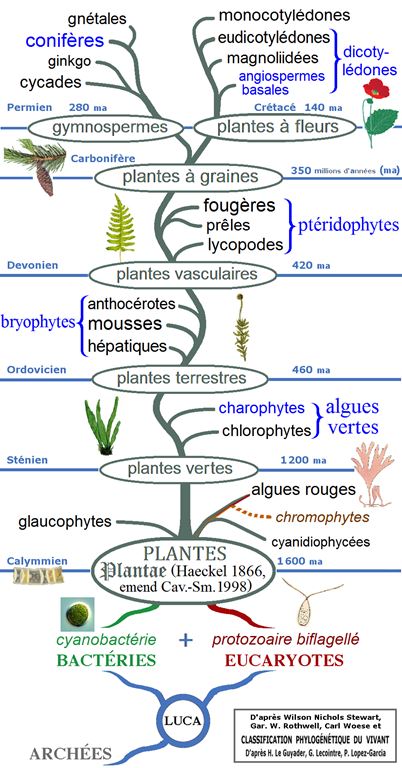
À droite, cet arbre phylogénétique des plantes montre les principaux clades et groupes traditionnels (monophylétiques en noir et paraphylétiques en bleu).
Dénominations
- Nom botanique : Acrocomia aculeata (Jacq.) Lodd. ex Mart.
- Synonymes : Acrocomia antiguana L.H.Bailey, Acrocomia antioquiensis Pusada-Arango, Acrocomia belizensis L.H.Bailey, Acrocomia christopherensis L.H.Bailey, Acrocomia chunta Covas & Ragonese, Acrocomia erioacantha Barb. Rodr, Acrocomia fusiformis (Sw.) Sweet, Acrocomia glaucophylla Drude, Acrocomia grenadana L.H.Bailey, Acrocomia hospes L.H.Bailey, Acrocomia ierensis L.H.Bailey, Acrocomia intumescens Drude, Acrocomia karukerana L.H.Bailey, Acrocomia lasiospatha Mart, Acrocomia media O. F. Cook, Acrocomia mexicana Karw. ex Mart, Acrocomia microcarpa Barb. Rodr, Acrocomia mokayayba Barb. Rodr, Acrocomia odorata Barb. Rodr, Acrocomia panamensis L.H.Bailey, Acrocomia pilosa Leon, Acrocomia quisqueyana L.H.Bailey, Acrocomia sclerocarpa Mart, Acrocomia spinosa (Mill.) H. E. Moore, Acrocomia subinermis Leon ex L.H.Bailey, Acrocomia totai Mart, Acrocomia ulei Dammer, Acrocomia viegasii L.H.Bailey, Acrocomia vinifera Oerst, Acrocomia wallaceana Becc, Bactris globosa Gaertn, Bactris pavoniana Mart, Cocos aculeatus Jacq, Cocos fusiformis Sw, Euterpe aculeata (Willd.) Spreng, Palma spinosa Mill
- Noms anglais et locaux : Gru-Gru Palm, Macaw palm
Description et culture
Tableau récapitulatif
Parties comes-tibles Note comest. (1-5) Note medic. (1-5) (Zones de) Rusticité Besoins en 
Besoins en  (1-3)
(1-3)Périodes de semis et récoltes Graines au gramme Durée de viabilité Profon-deur semis Espace-ment plants Espace-ment lignes Durée germi-native Durée avant récolte J F M A M J
J A S O N D
J F M A M J
J A S O N D
- dont infos de 0FPI ("FOOD PLANTS INTERNATIONAL", en anglais) :
Description :
Un seul palmier à tige. Il est épineux sur le tronc. Il atteint 12 m de haut. Le tronc est épais et gris. Il mesure 30 cm de diamètre. Les feuilles sont comme des plumes. Ils mesurent 1 à 2 m de long. Les frondes sont vert foncé mais plus pâles en dessous à cause des poils blanchâtres. Ils ont des épines. La tige fleurie mesure environ 1,5 m de long. La bractée est laineuse et forme une gaine. Les fleurs sont jaunes. Les plantes individuelles peuvent produire des graines fertiles. Les fruits sont ronds et mesurent 5 cm de diamètre. Ils sont jaune verdâtre. La chair est fine et ferme. C'est orange. La peau se fend à maturité{{{0(+x) (traduction automatique).
Original : A single stemmed palm. It is spiny on the trunk. It grows 12 m tall. The trunk is stout and grey. It is 30 cm across. The leaves are feather like. They are 1-2 m long. The fronds are dark green but paler underneath due to whitish hairs. They have spines. The flowering stalk is about 1.5 m long. The bract is woolly and forms a sheath. The flowers are yellow. Single plants can produce fertile seed. The fruit are round and 5 cm across. They are greenish yellow. The flesh is thin and firm. It is orange. The skin splits when fully ripe{{{0(+x).
Production :
Les semis poussent rapidement et des épines apparaissent rapidement. L'amande contient 58% de matières grasses{{{0(+x) (traduction automatique).
Original : Seedlings grow quickly and spines soon appear. The kernel contains 58% fat{{{0(+x).
Culture :
Les plantes peuvent être cultivées à partir de graines. Les graines sont difficiles à germer et cela est amélioré en les trempant dans de l'eau chaude ou en fissurant le tégument de la graine. Des graines fraîches doivent être plantées. Les graines peuvent mettre 1 an à germer{{{0(+x) (traduction automatique).
Original : Plants can be grown from seed. Seed are difficult to germinate and this is improved by soaking in warm water or cracking the seed coat. Fresh seed should be planted. Seeds may take 1 year to sprout{{{0(+x).
 Consommation (rapports de comestibilité, parties utilisables et usages alimentaires correspondants)
Consommation (rapports de comestibilité, parties utilisables et usages alimentaires correspondants)Parties comestibles :
cerneaux, sève, fruits, noix, graines, chou, jeunes feuilles, coeur de palmier, huile{{{0(+x) (traduction automatique). Original : Kernels, Sap, Fruit, Nuts, Seeds, Cabbage, Young leaves, Palm heart, Oil{{{0(+x).Détails :
La sève est utilisée pour le vin de palme.Les grains du fruit sont consommés crus. Ils ont une pulpe de noix de coco. Le chou de palme est mangé. La coque ou la pulpe externe est comestible. Les grains contiennent de l'huile de cuisson{{{0(+x) (traduction automatique).
Original : The sap is used for palm wine.The kernels of the fruit are eaten raw. They have a coconut-like pulp. The palm cabbage is eaten. The outer husk or pulp is edible. The kernels contain cooking oil{{{0(+x).
Partie testée :
graine{{{0(+x) (traduction automatique). Original : Seed{{{0(+x) Risques et précautions à prendre
Risques et précautions à prendrenéant, inconnus ou indéterminés.
Galerie(s)
Par Denisse, E., Flore d?Amérique (1843-1846) Fl. Amérique, via plantillustrations
✖

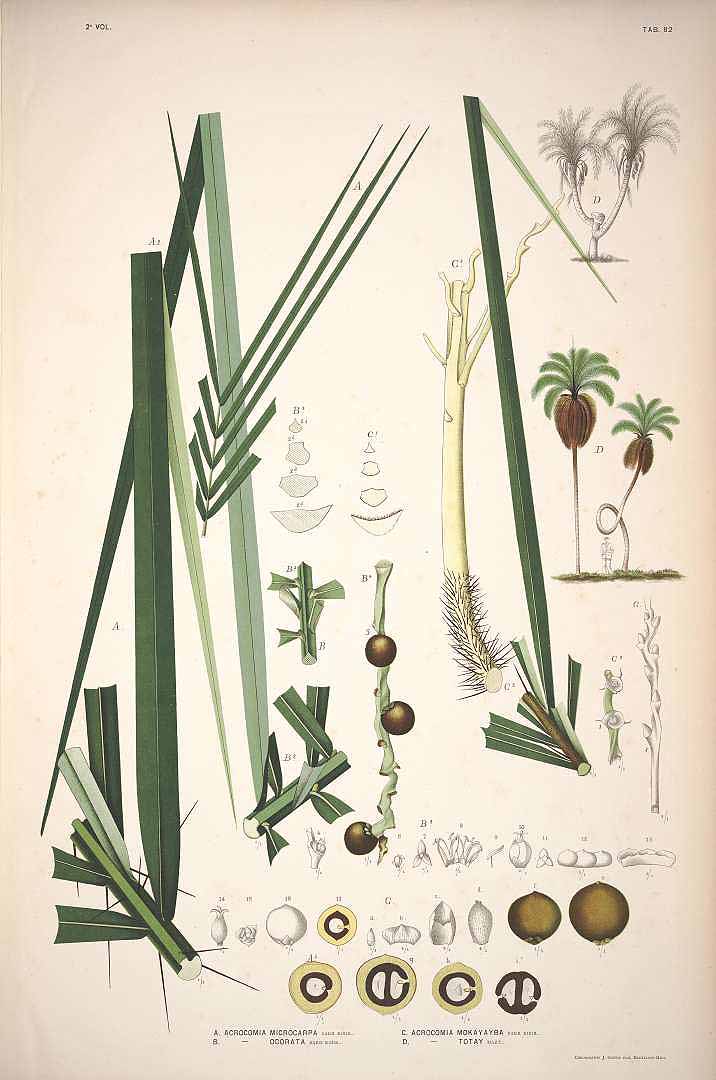
Par Rodrigues, J. Barbosa, Sertum palmarum brasiliensium (1903) Sert. Palm. Bras. vol. 2 (1903), via plantillustrations
✖


Par Martius, C.F.P. von, Historia Naturalis Palmarum (1823-1853) Hist. Nat. Palm. vol. 2 (1839), via plantillustrations
✖
Autres infos
dont infos de 0FPI ("FOOD PLANTS INTERNATIONAL", en anglais) :
Statut :
Il est cultivé pour son fruit. Les fruits sont surtout consommés par les enfants{{{0(+x) (traduction automatique).
Original : It is cultivated for its fruit. The fruit are especially eaten by children{{{0(+x).
Distribution :
Une plante tropicale. Il a besoin d'un sol bien drainé et d'un bon soleil. Il pousse dans la savane et la forêt ouverte, généralement à basse altitude. En Bolivie, il atteint 900 m d'altitude. En Argentine, il pousse entre 100 et 200 m au-dessus du niveau de la mer. Il convient aux zones de rusticité 10-12{{{0(+x) (traduction automatique).
Original : A tropical plant. It needs well drained soil and good sun. It grows in savannah and open woodland, usually at low altitude. In Bolivia it grows to 900 m altitude. In Argentina it grows between 100-200 m above sea level. It suits hardiness zones 10-12{{{0(+x).
Localisation :
Afrique, Amazonie, Antigua-et-Barbuda, Argentine, Australie, Belize, Bolivie, Brésil, Caraïbes, Amérique centrale, Colombie, Costa Rica, Cuba, Dominique, Afrique de l'Est, El Salvador, Guyane française, Grenade, Guatemala, Guyanes, Guyane, Haïti , Honduras, Jamaïque, Martinique, Mexique, Myanmar, Amérique du Nord, Pacifique, Panama, Paraguay, Philippines, Porto Rico, Asie du Sud-Est, Amérique du Sud, Saint-Kitts-et-Nevis, Sainte-Lucie, Saint-Vincent-et-les Grenadines, Suriname, Tanzanie , Trinité-et-Tobago, Venezuela, Antilles{{{0(+x) (traduction automatique).
Original : Africa, Amazon, Antigua and Barbuda, Argentina, Australia, Belize, Bolivia, Brazil, Caribbean, Central America, Colombia, Costa Rica, Cuba, Dominica, East Africa, El Salvador, French Guiana, Grenada, Guatemala, Guianas, Guyana, Haiti, Honduras, Jamaica, Martinique, Mexico, Myanmar, North America, Pacific, Panama, Paraguay, Philippines, Puerto Rico, SE Asia, South America, St. Kitts and Nevis, St. Lucia, St. Vincent and Grenadines, Suriname, Tanzania, Trinidad and Tobago, Venezuela, West Indies{{{0(+x).
Notes :
Il existe 2 espèces d'Acrocomia. C'est une espèce très variable et peut être une ou 26 espèces. Il a des propriétés antihypovitaminose A{{{0(+x) (traduction automatique).
Original : There are 2 Acrocomia species. This is a very variable species and may be one or 26 species. It has antihypovitaminosis A properties{{{0(+x).
Liens, sources et/ou références
Liens :
/ ;Sources et/ou références :
bibliographie (liste des sources et/ou références de l'encyclopédie)
dont livres et bases de données : 5PFAF ("Plants For A Future", en anglais) ; 0FPI ("FOOD PLANTS INTERNATIONAL", en anglais) ;
dont bibliographie/références de 0FPI ("FOOD PLANTS INTERNATIONAL", en anglais) :
Balick, M.J. and Beck, H.T., (Ed.), 1990, Useful palms of the World. A Synoptic Bibliography. Colombia p 50 (As Acrocomia vinifera), 58 (As Acrocomia vinifera), 73 (As Acrocomia totai), 113 (As Acrocomia totai), 163 (As Acrocomia sclerocarpa), 208 (As Acrocomia sclerocarpa), 295, 387 (As Acrocomia totai), 388 (As Acrocomia totai), 394 (As Acrocomia mexicana), 429 (As Acrocomia sclerocarpa), 556 (As Acrocomia mexicana), 561 (As Acrocomia antioquensis, Acrocomia ierensis and Acrocomia totai), 562 (As Acrocomia sclerocarpa), 598, 647, 658 (As Acrocomia belizensis, Acrocomia mexicana and Acrocomia vinifera), 659, ; Biocyclopedia Edible Plant Species biocyclopedia.org (As Acrocomia lasiospatha and others) ; Bircher, A. G. & Bircher, W. H., 2000, Encyclopedia of Fruit Trees and Edible Flowering Plants in Egypt and the Subtropics. AUC Press. p 7 (As Acrocomia antiquioensis and others) ; Blomberry, A. & Rodd, T., 1982, Palms. An informative practical guide. Angus & Robertson. p 43 (As Acrocomia media and Acrocomia totai) ; Bortolotto, I. M., et al, 2015, Knowledge and use of wild edible plants in rural communities along Paraguay River, Pantanal, Brazil. Journal or Ethnobiology and Ethnomedicine. 11:46 ; Bortolotto, I. M., et al, 2018, Lista preliminar das plantas alimenticias nativas de Mato Grosso do Sul, Brasil. Iheringia, Serie Botanica, Porto Alegre, 73 (supl.):101-116 ; Burkill, I.H., 1966, A Dictionary of the Economic Products of the Malay Peninsula. Ministry of Agriculture and Cooperatives, Kuala Lumpur, Malaysia. Vol 1 (A-H) p 39 (As Acrocomia sclerocarpa) ; Chizmar Fernandez, C., et al, 2009, Plantas comestibles de Centroamerica. Instituto de Biodiversidad, Costa Rica. p 66 ; Etherington, K., & Imwold, D., (Eds), 2001, Botanica's Trees & Shrubs. The illustrated A-Z of over 8500 trees and shrubs. Random House, Australia. p 75 ; Etkin, N.L. (Ed.), 1994, Eating on the Wild Side, Univ. of Arizona. p 135 (As Acrocomia sclerocarpa) ; Facciola, S., 1998, Cornucopia 2: a Source Book of Edible Plants. Kampong Publications, p 26 (Also as Acrocomia mexicana and Acrocomia sclerocarpa and Acrocomia totai) ; Fagg, C. W. et al, 2015, Useful Brazilian plants listed in the manuscripts and publications of the Scottish medic and naturalist George Gardner (1812–1849). Journal of Ethnopharmacology 161 (2015) 18–29 ; Gibbons, M., 2003, A pocket guide to Palms. Chartwell Books. p 29 ; Grandtner, M. M., 2008, World Dictionary of Trees. Wood and Forest Science Department. Laval University, Quebec, Qc Canada. (Internet database http://www.WDT.QC.ca) ; Grandtner, M. M. & Chevrette, J.,2013, Dictionary of Trees, Volume 2: South America: Nomenclature, Taxonomy and Ecology. Academic Press p 11 ; Haynes, J., & McLaughlin, J., 2000, Edible palms and Their Uses. University of Florida Fact sheet MCDE-00-50-1 p 2 ; Hedrick, U.P., 1919, (Ed.), Sturtevant's edible plants of the world. p 24 (As Acrocomia lasiospatha, Acrocomia mexicana, Acrocomia sclerocarpa) ; Heindorf, C., 2011, Analysis of the Agrobiodiversity of Home Gardens in the Tropical Regions of Mexico. M.Sc. thesis. Cologne University of Applied Sciences. (As Acrocomia mexicana) ; Henderson, A., Galeano, G and Bernal, R., 1995, Field Guide to the Palms of the Americas. Princeton. p 166 ; Hist. nat. palm. 3:286. 1845 ; INFOODS:FAO/INFOODS Databases (Also as Acrocomia mokayayba) ; Jamaica: A country report to the FAO International Technical Conference on Plant Genetic Resources for Food and Culture. 2008 (As Acrocomia spinosa) ; James, A., 2009, Notes on the Uses of Dominica's Native Palms. Palms, Vol. 53(2): p 62 ; Janick, J. & Paul, R. E. (Eds.), 2008, The Encyclopedia of Fruit & Nuts. CABI p 83 ; Johnson, D.V., 1998, Tropical palms. Non-wood Forest products 10. FAO Rome. p 90 ; Jones, D.L., 1994, Palms throughout the World. Smithtonian Institution, Washington. p 55, 56, 58 ; Jones, D.L., 2000, Palms of Australia 3rd edition. Reed/New Holland. p 112 ; Jones, D.L., 2000, Palms of Australia 3rd edition. Reed/New Holland. p 112 (As Acrocomia media) ; Kermath, B. M., et al, 2014, Food Plants in the Americas: A survey of the domesticated, cultivated and wild plants used for Human food in North, Central and South America and the Caribbean. On line draft. p 19 ; Kiple, K.F. & Ornelas, K.C., (eds), 2000, The Cambridge World History of Food. CUP p 1805 ; Kujawska, M. & Luczaj, L., 2015, Wild Edible Plants Used by the Polish Community in Misiones, Argentina. Human Ecology 43:855-869 ; Lentz, D. L., 1986, Ethnobotany of the Jicaque of Honduras. Economic Botany 40(2):210-219 (As Acrocomia mexicana) ; Lentz, D. L., 1993, Medicinal and Other Economic Plants of the Paya of Honduras. Economic Botany, Vol. 47, No. 4, pp. 358-370 (As Acrocomia mexicana) ; Leticia, Z., et al, 2015, Do Socioeconomic characteristics explain the knowledge and use of native food plants in semiarid environments in Northeastern Brazil? Journal of Arid Environments 115:53-61 ; Lorenzi, H., 2002, Brazilian Trees. A Guide to the Identification and Cultivation of Brazilian Native Trees. Vol. 01 Nova Odessa, SP, Instituto Plantarum p 288 ; Lorenzi, H., Bacher, L., Lacerda, M. & Sartori, S., 2006, Brazilian Fruits & Cultivated Exotics. Sao Paulo, Instituto Plantarum de Estuados da Flora Ltda. p 62 ; Marcia, M. J., et al, 2011, Palm Uses in Northwestern South America: A Quantitative Review. Bot. Rev. (2011) 77:462-570 ; Martin, F.W. & Ruberte, R.M., 1979, Edible Leaves of the Tropics. Antillian College Press, Mayaguez, Puerto Rico. p 96, 209 (As Acrocomia sclerocarpa) ; Menninger, E.A., 1977, Edible Nuts of the World. Horticultural Books. Florida p 124 (As Acrocomia media) ; Menninger, E.A., 1977, Edible Nuts of the World. Horticultural Books. Florida p 124 (Also as Acrocomia totai) ; Miguel, E., et al, 1989, A checklist of the cultivated plants of Cuba. Kulturpflanze 37. 1989, 211-357 ; Mutchnick, P. A. and McCarthy, B. C., 1997, An Ethnobotanical Analysis of the Tree Species Common to the Subtropical Moist Forests of the Peten, Guatemala. Economic Botany, Vol. 51, No. 2, pp. 158-183 (As Acrocomia mexicana) ; NYBG herbarium "edible" ; Oliviera V. B., et al, 2012, Native foods from Brazilian biodiversity as a source of bioactive compounds. Food Research International 48 (2012) 170-179 ; Plants of Haiti Smithsonian Institute http://botany.si.edu ; Riffle, R.L. & Craft, P., 2003, An Encyclopedia of Cultivated Palms. Timber Press. p 21, 22, 243 ; Rodriguez-Amaya, D. B., 1999, Carotenoides y Prepracion de Alimentos. University Estadual de Campinas, Brasil, Ph.D. thesis. p 25 (As Acrocomia makayayba) ; Scarpa, G. F., 2009, Wild food plants used by the indigenous peoples of South American Gran Chaco: A general synopsis and intercultural comparison. Journal of Applied Botany and Food Quality 83:90-101 ; Schmedia-Hirschmann, G., 1994, Plants resources Used by the Ayoreo of the Paraguayan Chaco. Economic Botany Vol. 48. No. 3. pp. 252-258 ; Standley, P. & Steyermark, J., 1958, Flora of Guatemala. Fieldiana: Botany, Volume 24 part 1 p 347 (As Acrocomia mexicana) ; TodaFruta.com.br (As Acrocomia totai) ; Turreira-Garcia, N., et al, 2015, Wild edible plant knowledge, distribution and transmission: a case study of the Achi Mayans of Guatemala. Journal of Ethnobiology and Ethnomedicine. 11:52 ; USDA, ARS, National Genetic Resources Program. Germplasm Resources Information Network - (GRIN). [Online Database] National Germplasm Resources Laboratory, Beltsville, Maryland. Available: www.ars-grin.gov/cgi-bin/npgs/html/econ.pl (10 April 2000) ; Usher, G., 1974, A Dictionary of Plants Used by Man. Constable. p 19 (As Acrocomia mexicana and Acrocomia totai) ; Vasquez, Roberto Ch. & Coimbra, German S., 1996, Frutas Silvestres Comestibles de Santa Cruz. p 152 ; Vazquez-Garcia. V., 2008, Gender, ethnicity, and economic status in plant management: Uncultivated edible plants among the Nahuas and Popolucas of veracruz, Mexico. Agriculture and Human Values 25: 65-77 (As Acrocomia mexicana) ; Villachica, H., (Ed.), 1996, Frutales Y hortalizas promisorios de la Amazonia. FAO, Lima. p 261 (As Acrocomia totai) ; Wickens, G.E., 1995, Edible Nuts. FAO Non-wood forest products. FAO, Rome. p161 (Also as Acrocomia totai) ; Zambrana, P, et al, 2017, Traditional knowledge hiding in plain sight – twenty-first century ethnobotany of theChácobo in Beni, Bolivia. Journal of Ethnobiology and Ethnomedicine (2017) 13:57 ; Zuchowski W., 2007, Tropical Plants of Costa Rica. A Zona Tropical Publication, Comstock Publishing. p 380
Recherche de/pour :
- "Acrocomia aculeata" sur Google (pages et
images) ;
IPNI ("International Plant Names Index", en anglais) ;
TPL ("The Plant List", en anglais) ;
GRIN ("Germplasm Resources Information Network", en anglais) ;
TROPICOS (en anglais) ;
Tela Botanica ;
Pl@ntNet ;
Pl@ntUse ;
"Useful Tropical Plants" (en anglais) ou
"Useful Temperate Plants" (en anglais) ;
- "Acrocomia aculeata" sur Google (pages et
images) ;
IPNI ("International Plant Names Index", en anglais) ;
TPL ("The Plant List", en anglais) ;
GRIN ("Germplasm Resources Information Network", en anglais) ;
TROPICOS (en anglais) ;
Tela Botanica ;
Pl@ntNet ;
Pl@ntUse ;
"Useful Tropical Plants" (en anglais) ou
"Useful Temperate Plants" (en anglais) ;
Espèces de la même famille (Arecaceae)
781 taxons
- Acanthophénix chevelu
- Bismarckie noble
- Borasse d'Éthiopie
- Butia argentin
- Cocotier
- Cocotier du chili
- Cocotier plumeux
- Dattier
- Dattier du Sénégal
- Dypsis de Madagascar
- Forest acai
- Palmier à bétel
- Palmier à huile d'afrique
- Palmier à huile d'amérique
- Palmier à sucre
- Palmier à vin
- Palmier açaï
- Palmier bleu du mexique
- Palmier butia pourpre
- Palmier chanvre
- Palmier de guadeloupe
- Palmier de juçara
- Palmier de palmyre
- Palmier du Brésil
- Palmier du mexique
- Palmier ébouriffé
- Palmier eleiodoxa
- Palmier jucum
- Palmier jupon
- Palmier laineux
- Palmier maraja
- Palmier nain
- Palmier pêche
- Palmier piassava
- Palmier tucuma
- Palmier-dattier
- Palmier-dattier des canaries
- Palmier-dattier des falaises
- Palmier-dattier nain
- Palmier-dattier sauvage
- Palmier-éventail d'Australie
- Palmier-éventail de Chine
- Palmiste blanc
- Palmiste rouge
- Phénix de Loureiro
- Pritchardie du Pacifique
- Pseudophénix de Sargent
- Sabal des Bermudes
- Sabal palmetto
- Sagouier farineux
- Acanthophoenix crinita (Acanthophénix chevelu)
- Acanthophoenix rubra (Bory) H. Wendl. (Palmiste rouge)
- Acoelorrhaphe wrightii (Griseb. & H.Wendl.) H.Wendl. ex Becc.
- Acrocomia crispa
- Acrocomia media O.F.Cook
- Actinorhytis calapparia
- Adonidia merrillii
- Aiphanes deltoidea Burret
- Aiphanes eggersii Burret
- Aiphanes gelatinosa H.E.Moore
- Aiphanes grandis Borchs. & Balslev
- Aiphanes hirsuta Burret
- Aiphanes horrida (Jacq.) Burret (Palmier ébouriffé)
- Aiphanes lindeniana
- Aiphanes linearis Burret
- Aiphanes macroloba Burret
- Aiphanes minima
- Aiphanes ulei
- Aiphanes verrucosa Borchs. & Balslev
- Aiphanes weberbaueri Burret
- Allagoptera arenaria
- Allagoptera brevicalyx M.Moraes
- Allagoptera campestris
- Allagoptera caudescens
- Allagoptera leucocalyx
- Allagoptera maritimum
- Ammandra decasperma O.F.Cook
- Aphandra natalia
- Archontophoenix alexandrae
- Archontophoenix cunninghamiana
- Areca caliso Becc.
- Areca catechu L. (Palmier à bétel)
- Areca concinna Thwaites
- Areca glandiformis Lam.
- Areca hutchinsoniana Becc.
- Areca ipot Becc.
- Areca jobiensis Becc.
- Areca macrocalyx Zipp. ex Blume
- Areca macrocarpa Becc.
- Areca montana Ridl.
- Areca novohibernica
- Areca parens Becc.
- Areca triandra Roxb. ex Buch.-Ham.
- Areca vestiaria Giseke
- Areca whitfordii Becc.
- Arenga australasica
- Arenga brevipes Becc.
- Arenga engleri Becc.
- Arenga listeri Becc.
- Arenga microcarpa Becc.
- ...
Par Rodrigues, J. Barbosa, Sertum palmarum brasiliensium (1903) Sert. Palm. Bras. vol. 2 (1903), via plantillustrations







 donne accès au menu
  - encyclopédies des plantes alimentaires ;
 - page de recherche - reconnaissance (identification) de plantes ;
 - page du calendrier lunaire et son générateur (au format PDF et JPG) ;
 - tableau récapitulatif ;
 - générateur de potées (soupes), avec estimation des apports nutrionnels et du coût;
 - générateur de codes QR ;
 - page des archives avec de nombreux documents sur différents thèmes complémentaires comme la botanique, les légumes,
les champignons, la cuisine, le bien-être ainsi que différents MOOC mais également des liens vers les archives de l'association ;
- page des archives avec de nombreux documents sur différents thèmes complémentaires comme la botanique, les légumes,
les champignons, la cuisine, le bien-être ainsi que différents MOOC mais également des liens vers les archives de l'association ;

 pour le fruit (et/ou les graines, la pulpe, etc...),
 pour les fleurs (et/ou pétales, calice...),
 pour les feuilles (et/ou la tige, les pousses...),
 pour les racines,
 pour le tronc (et/ou l'écorce, la sève...), et enfin
 pour les champignons,
puis les notes alimentaires et médicinales (de 1 à 5 étoiles), la rusticité (résistance au froid/gel)
et pour finir un résumé.
pour les champignons,
puis les notes alimentaires et médicinales (de 1 à 5 étoiles), la rusticité (résistance au froid/gel)
et pour finir un résumé. menant ici 🙂
 ,
,  et
et





 ,
,


 Encyclopédie(s)
 Recherche-Reconnaissance
 Tableau récapitulatif
 Codes QR
 Archives
 Calendrier(s) lunaire(s)
  Potées
 Re-naturation/naturalisation
 Affichettes, herbiers &
co.
Affichettes, herbiers &
co. menu
menu galerie


 (en bas à droite).
 (en bas à gauche).
