Cocotier
(Cocos nucifera)
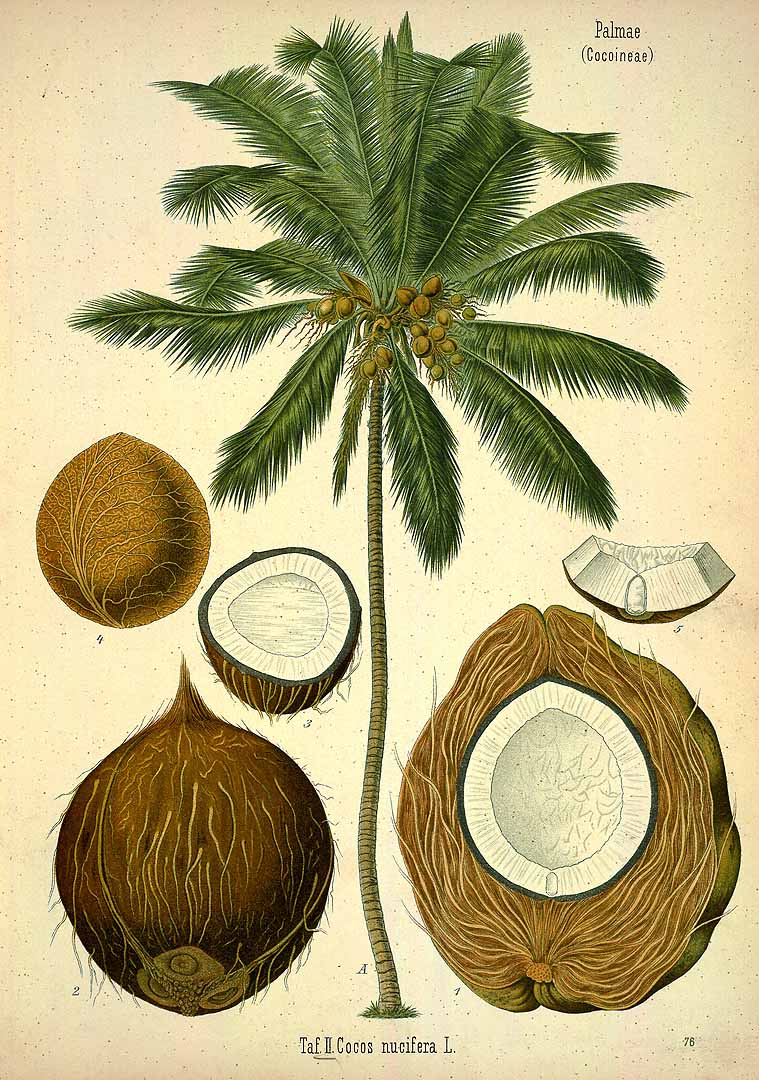

 |
*****
|
*****
10/4 (zone 10b à 11) et jusqu'à -1/-3°C avec de très fortes brûlures de gel selon awkelleys.com
Un palmier avec un tronc non ramifié. Le tronc a des cicatrices foliaires en forme d'anneau. À la base, il est gonflé et entouré d'une masse de racines. Ils atteignent env ... (traduction automatique)
→suite


Cocotier
Note alimentaire 

Un palmier avec un tronc non ramifié. Le tronc a des cicatrices foliaires en forme d'anneau. À la base, il est gonflé et entouré d'une masse de racines. Ils atteignent environ 25 m de haut. Des variét... (traduction automatique) →suite
Pas d'autre illustration
pour le moment 😕
Cocos nucifera
Classification
- Classique : en haut de l'écran, sous le coeur.
- Phylogénétique :
- Clade 4 : Angiospermes ;
- Clade 3 : Monocotylédones ;
- Clade 2 : Commelinidées ;
- Ordre APN : Arecales ;
- Famille APN : Arecaceae ;
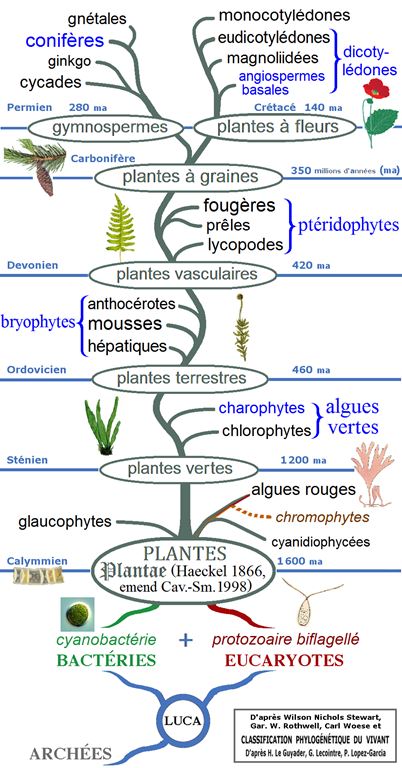
À droite, cet arbre phylogénétique des plantes montre les principaux clades et groupes traditionnels (monophylétiques en noir et paraphylétiques en bleu).
Dénominations
- Nom botanique : Cocos nucifera L. (1753)
- Synonymes français : cocotier cultivé
- Nom breton : kraoñ-kokoz
- Synonymes : Palma cocos Miller
- Noms anglais et locaux : coconut, coconut palm, copra, Kokosnuß (de), Kokospalme (de), khopar (in), coqueiro (pt), coco-da-bahia (pt,br), coco-da-praia (pt,br), coqueiro-da-bahia (pt,br), coqueiro-da-praia (pt,br), cocotero (es), mnazi (sw), kokospalm (sv)
Description et culture
Tableau récapitulatif
Parties comes-tibles Note comest. (1-5) Note medic. (1-5) (Zones de) Rusticité Besoins en 
Besoins en  (1-3)
(1-3)Périodes de semis et récoltes Graines au gramme Durée de viabilité Profon-deur semis Espace-ment plants Espace-ment lignes Durée germi-native Durée avant récolte 10/4 (zone 10b à 11) et jusqu'à -1/-3°C avec de très fortes brûlures de gel selon awkelleys.com J F M A M J
J A S O N D
J F M A M J
J A S O N D
- dont infos de 0FPI ("FOOD PLANTS INTERNATIONAL", en anglais) :
Description :
Un palmier avec un tronc non ramifié. Le tronc a des cicatrices foliaires en forme d'anneau. À la base, il est gonflé et entouré d'une masse de racines. Ils atteignent environ 25 m de haut. Des variétés naines ont été produites. Les frondes mesurent 2 à 6 m de long. Ils sont divisés le long de la tige en folioles en forme de sangle. Les folioles mesurent 60 à 90 cm de long. Ils sont étroits et effilés. Des grappes de gros fruits se développent sous les frondes. Les fleurs mâles et femelles sont séparées sur une seule tige. Les fleurs femelles sont près de la base. Les fleurs sont de couleur crème. Les fleurs sont couvertes de bractées en forme de bateau. Environ 10 à 12 fruits / tige est une bonne récolte. Les feuilles mesurent jusqu'à 5 m de long. Les fruits peuvent mesurer 25 cm de diamètre. Les fruits sont fibreux. La coque dure à l'intérieur est remplie de lait de coco et de la couche de coprah blanc{{{0(+x) (traduction automatique).
Original : A palm with an unbranched trunk. The trunk has ring-like leaf scars along it. At the base it is swollen and surrounded by a mass of roots. They grow to about 25 m tall. Dwarf varieties have been produced. The fronds are 2-6 m long. They are divided along the stalk into strap shaped leaflets. The leaflets are 60-90 cm long. They are narrow and tapering. Clusters of large fruit develop beneath the fronds. Male and female flowers are separate on the one stalk. Female flowers are near the base. Flowers are cream. The flowers are covered by boat shaped bracts. About 10-12 fruit/stalk is a good crop. Leaves are up to 5 m long. Fruit can be 25 cm across. The fruit are fibrous. The hard shell inside is filled with coconut milk and the white copra layer{{{0(+x).
Production :
Les noix à germination précoce donnent une production précoce sur le terrain. Ils peuvent commencer la production après 6-8 ans. Les meilleurs rendements sont souvent produits entre 12 et 60 ans. Les arbres peuvent vivre 100 ans. Les palmiers peuvent produire 15 à 100 noix par an. Les fruits mettent environ 1 an à mûrir. Taper sur la tige de la fleur peut donner 1 kg de sève / jour pendant 6 mois. Pour les cœurs de palmier, les plantes sont placées à un espacement étroit d'environ 2 m et sont prêtes à être récoltées dans 2 ans{{{0(+x) (traduction automatique).
Original : Early germinating nuts, give early production in the field. They can commence production after 6-8 years. The best yields are often produced between 12 and 60 years of age. Trees can live for 100 years. Palms can produce 15-100 nuts per year. Fruit take about 1 year to be mature. Tapping the flower stalk can give 1 kg sap/day for 6 months.For palm hearts plants are put at a close spacing of about 2 m and are ready to harvest in 2 years{{{0(+x).
Culture :
Les graines doivent être sélectionnées à partir de palmiers à roulement régulier qui produisent plus de 80 noix par an. Les noix sélectionnées sont germées dans une pépinière, puis plantées. Les graines qui n'ont pas germé dans les 3 mois sont généralement rejetées. Les semis sont prêts pour la transplantation lorsqu'ils ont 3-4 feuilles (environ 1 an). L'écrou doit être planté dans un trou de 0,6 x 0,6 m. Un espacement d'environ 7 à 8 m convient. Les températures doivent être supérieures à 15 ° C pour que les noix germent{{{0(+x) (traduction automatique).
Original : Seeds should be selected from regular bearing palms that produce more than 80 nuts per year. Selected nuts are sprouted in a nursery, then planted out. Seeds that have not germinated within 3 months are usually rejected. Seedlings are ready for transplanting when they have 3-4 leaves (about 1 year). The nut should be planted in a hole 0.6 x 0.6 m. A spacing of about 7-8 m is suitable. Temperatures need to be above 15°C for nuts to germinate{{{0(+x).
 Consommation (rapports de comestibilité, parties utilisables et usages alimentaires correspondants)
Consommation (rapports de comestibilité, parties utilisables et usages alimentaires correspondants)Fruit (graines {chair et lait}{{{27(+x) crues [nourriture/aliment{{{(dp*) {confiserie27(+x)} et base boissons/breuvages{{{(dp*) : liqueur27(+x)]) et tronc (coeur(dp*) (jeunes pousses{{{27(+x)) [nourriture/aliment{{{(dp*) : légume0(+x)]) comestibles27(+x).
Détails :
Plante d'importance considérable ; cultivée dans tous les sites favorables du monde ; objet d'un important commerce international{{{27(+x). noix, sève, chou, lait de coco, pomme, coeur de palmier{{{0(+x) ; la noix est également utilisée pour son lait végétal (lait de coco){{{(dp*).
Partie testée :
chair séchée{{{0(+x) (traduction automatique). Original : flesh dried{{{0(+x)| Taux d'humidité (%) | Énergie (kj) | Énergie (kcal) | Protéines (g) |
|---|---|---|---|
| 12.2 | 2429 | 581 | 6.6 |
| Pro- vitamines A (µg) |
Vitamines C (mg) | Fer (mg) | Zinc (mg) |
| 0 | 0 | 0 | 0 |
 Risques et précautions à prendre
Risques et précautions à prendrenéant, inconnus ou indéterminés.
Autres infos
dont infos de 0FPI ("FOOD PLANTS INTERNATIONAL", en anglais) :
Statut :
Une collation et un complément courants et populaires dans toutes les régions côtières de Papouasie-Nouvelle-Guinée et dans tous les endroits côtiers tropicaux{{{0(+x) (traduction automatique).
Original : A common and popular snack food and supplement in all coastal areas of Papua New Guinea and all tropical coastal places{{{0(+x).
Distribution :
Une plante tropicale. Principalement dans les zones côtières mais parfois jusqu'à 1000 m sous les tropiques. Aux Fidji, les cocotiers fructifient rarement au-dessus de 400 m d'altitude. Les températures de 27 ° -32 ° C sont les meilleures avec une plage quotidienne de 5 à 7 ° C. Ils ont besoin d'une température minimale de plus de 18 ° C pour porter leurs fruits. Ils ont besoin de plus de 1000 mm de pluie / an de préférence de 1500 mm. Les sols doivent être bien drainés. Cela nécessite beaucoup de soleil. La lumière du soleil de 1 800 heures par an donne une bonne croissance. Il est tolérant au sel. Il peut tolérer les sols avec un pH compris entre 5 et 8. Au Népal, les plantes atteignent 500 m d'altitude. Les noix de coco sont normalement confinées à moins de 26 ° de l'équateur. Il convient aux zones de rusticité 12. Au Yunnan{{{0(+x) (traduction automatique).
Original : A tropical plant. Mainly in coastal areas but occasionally up to 1000 m in the tropics. In Fiji coconut palms rarely fruit above 400 m altitude. Temperatures of 27°-32°C are best with a daily range of 5-7°C. They need a minimum temperature of over 18°C to bear fruit. They need over 1000 mm of rain/year preferably 1500 mm. Soils need to be well drained. It requires plenty of sunlight. Sunlight of 1,800 hours per year gives good growth. It is salt tolerant. It can tolerate soils with pH between 5-8. In Nepal plants grow to 500 m altitude. Coconuts are normally confined to within 26° of the equator. It suits hardiness zones 12. In Yunnan{{{0(+x).
Localisation :
Afrique, Amazonie, Samoa américaines, Andamans, Antigua-et-Barbuda, Argentine, Asie, Australie, Bangladesh, Barbade, Belize, Bénin, Bermudes, Bolivie, Brésil, Brunei, Burkina Faso, Cambodge, Cameroun, Caraïbes, Iles Caroline, Afrique centrale, Amérique centrale, Tchad, Chili, Chine, Chuuk, île Cocos, Colombie, RD Congo, îles Cook, Costa Rica, Côte d'Ivoire, Cuba, Dominique, République dominicaine, Afrique de l'Est, Timor oriental, île de Pâques, Équateur, Fidji, Guyane française, Polynésie française, FSM, Gambie, Ghana, Grenade, Guam, Guyanes, Guinée, Guinée, Guyane, Haïti, Hawaï, Himalaya, Inde, Indochine, Indonésie, Côte d'Ivoire, Jamaïque, Kenya, Kiribati, Laos , Liberia, Madagascar, Malawi, Malaisie, Maldives, Mali, Mariannes, Marquises, Iles Marshall, Mauritanie, Maurice, Mayotte, Mexique, Micronésie, Mozambique, Myanmar, Nauru, Népal, Nouvelle Calédonie,Nicaragua, Niger, Nigéria, Nuie, Amérique du Nord, Inde du Nord-Est, Pacifique *, Pakistan, Palau, Papouasie-Nouvelle-Guinée, PNG, Paraguay, Pérou, Philippines, Pohnpei, Rotuma, Samoa, Sao Tomé-et-Principe, Asie du Sud-Est, Sénégal, Seychelles , Sierra Leone, Singapour, Îles Salomon, Somalie, Afrique du Sud, Afrique australe, Amérique du Sud, Sri Lanka, Sainte-Hélène, Saint-Kitts-et-Nevis, Sainte-Lucie, Saint-Vincent-et-les Grenadines, Suriname, Tahiti, Taïwan, Tanzanie, Thaïlande , Timor-Leste, Tobago, Togo, Tokelau, Tonga, Trinidad, Turks & Caicos, Tuvalu, Uganda, USA, Uruguay, Vanuatu, Venezuela, Vietnam, Wallis & Futuna, West Indies, Yap, Zambia, Zimbabwe,Seychelles, Sierra Leone, Singapour, Îles Salomon, Somalie, Afrique du Sud, Afrique australe, Amérique du Sud, Sri Lanka, Sainte-Hélène, Saint-Kitts-et-Nevis, Sainte-Lucie, Saint-Vincent-et-les Grenadines, Suriname, Tahiti, Taïwan, Tanzanie, Thaïlande, Timor-Leste, Tobago, Togo, Tokelau, Tonga, Trinidad, Turks & Caicos, Tuvalu, Uganda, USA, Uruguay, Vanuatu, Venezuela, Vietnam, Wallis & Futuna, West Indies, Yap, Zambia, Zimbabwe,Seychelles, Sierra Leone, Singapour, Îles Salomon, Somalie, Afrique du Sud, Afrique australe, Amérique du Sud, Sri Lanka, Sainte-Hélène, Saint-Kitts-et-Nevis, Sainte-Lucie, Saint-Vincent-et-les Grenadines, Suriname, Tahiti, Taïwan, Tanzanie, Thaïlande, Timor-Leste, Tobago, Togo, Tokelau, Tonga, Trinidad, Turks & Caicos, Tuvalu, Uganda, USA, Uruguay, Vanuatu, Venezuela, Vietnam, Wallis & Futuna, West Indies, Yap, Zambia, Zimbabwe,Zambie, Zimbabwe,Zambie, Zimbabwe{{{0(+x) (traduction automatique).
Original : Africa, Amazon, American Samoa, Andamans, Antigua and Barbuda, Argentina, Asia, Australia, Bangladesh, Barbados, Belize, Benin, Bermuda, Bolivia, Brazil, Brunei, Burkina Faso, Cambodia, Cameroon, Caribbean, Caroline Islands, Central Africa, Central America, Chad, Chile, China, Chuuk, Cocos Island, Colombia, Congo DR, Cook Islands, Costa Rica, Côte d'Ivoire, Cuba, Dominica, Dominican Republic, East Africa, East Timor, Easter Island, Ecuador, Fiji, French Guiana, French Polynesia, FSM, Gambia, Ghana, Grenada, Guam, Guianas, Guinea, Guinée, Guyana, Haiti, Hawaii, Himalayas, India, Indochina, Indonesia, Ivory Coast, Jamaica, Kenya, Kiribati, Laos, Liberia, Madagascar, Malawi, Malaysia, Maldives, Mali, Marianas, Marquesas, Marshall Islands, Mauritania, Mauritius, Mayotte, Mexico, Micronesia, Mozambique, Myanmar, Nauru, Nepal, New Caledonia, Nicaragua, Niger, Nigeria, Nuie, North America, Northeastern India, Pacific*, Pakistan, Palau, Papua New Guinea, PNG, Paraguay, Peru, Philippines, Pohnpei, Rotuma, Samoa, Sao Tome and Principe, SE Asia, Senegal, Seychelles, Sierra Leone, Singapore, Solomon Islands, Somalia, South Africa, Southern Africa, South America, Sri Lanka, St Helena, St. Kitts and Nevis, St Lucia, St. Vincent and Grenadines, Suriname, Tahiti, Taiwan, Tanzania, Thailand, Timor-Leste, Tobago, Togo, Tokelau, Tonga, Trinidad, Turks & Caicos, Tuvalu, Uganda, USA, Uruguay, Vanuatu, Venezuela, Vietnam, Wallis & Futuna, West Africa, West Indies, Yap, Zambia, Zimbabwe{{{0(+x).
Notes :
Il n'y a plus qu'une seule espèce de Cocos{{{0(+x) (traduction automatique).
Original : There is now only one Cocos species{{{0(+x).
Rusticité (résistance face au froid/gel, climat)
10/4 (zone 10b à 11) et jusqu'à -1/-3°C avec de très fortes brûlures de gel selon awkelleys.com
Liens, sources et/ou références
Liens :
/ ;Sources et/ou références :
bibliographie (liste des sources et/ou références de l'encyclopédie)
dont classification : IPNI ("International Plant Names Index", en anglais) ; TPL ("The Plant List", en anglais) ; Kew (POWO - "Plant Of the World Online", "Royal Botanical Garden", en anglais) ; Tela Botanica ;
dont livres et bases de données : 5PFAF ("Plants For A Future", en anglais) ; 0FPI ("FOOD PLANTS INTERNATIONAL", en anglais), 27Dictionnaire des plantes comestibles (livre, page 93 [Coccoloba uvifera (L.) Jacq.], par Louis Bubenicek) ; 87Le Truffaut du Potager (collectif, éditions Larousse, 2010) / détails du livre
dont bibliographie/références de 0FPI ("FOOD PLANTS INTERNATIONAL", en anglais) :
Abbiw, D.K., 1990, Useful Plants of Ghana. West African uses of wild and cultivated plants. Intermediate Technology Publications and the Royal Botanic Gardens, Kew. p 41 Ali, A. M. S., 2005, Homegardens in Smallholder Farming Systems: Examples from Bangladesh. Human Ecology, Vol. 33, No. 2 pp. 245-270 Ambasta, S.P. (Ed.), 2000, The Useful Plants of India. CSIR India. p 134 Anderson, E. F., 1993, Plants and people of the Golden Triangle. Dioscorides Press. p 207 Awasthi, A.K., 1991, Ethnobotanical studies of the Negrito Islanders of Andaman Islands, India - The Great Andamanese. Economic Botany 45(2) pp274-280 Baker, W.J. and Dransfield, J., 2006, Field Guide to Palms of New Guinea. Kew p 64 Bianchini, F., Corbetta, F., and Pistoia, M., 1975, Fruits of the Earth. Cassell. p 230 Blomberry, A. & Rodd, T., 1982, Palms. An informative practical guide. Angus & Robertson. p 85 Bodkin, F., 1991, Encyclopedia Botanica. Cornstalk publishing, p 269 Bole, P.V., & Yaghani, Y., 1985, Field Guide to the Common Trees of India. OUP p 29 Bodner, C. C. and Gereau, R. E., 1988, A Contribution to Bontoc Ethnobotany. Economic Botany, 43(2): 307-369 Bremness, L., 1994, Herbs. Collins Eyewitness Handbooks. Harper Collins. p 49 Brickell, C. (Ed.), 1999, The Royal Horticultural Society A-Z Encyclopedia of Garden Plants. Convent Garden Books. p 284 Burkill, H. M., 1985, The useful plants of west tropical Africa, Vol. 4. Kew. Burkill, I.H., 1966, A Dictionary of the Economic Products of the Malay Peninsula. Ministry of Agriculture and Cooperatives, Kuala Lumpur, Malaysia. Vol 1 (A-H) p 603 Chin, H.F., & Yong, H.S., 1996, Malaysian Fruits in Colour. Tropical press, Kuala Lumpur p 20 Clarke, W.C. & Thaman, R.R., 1993, Agroforestry in the Pacific Islands: Systems for sustainability. United Nations University Press. New York. p 231 Cobley, L.S. (rev. Steele, W.M.) 2nd Ed., 1976, An Introduction to the Botany of Tropical Crops. Longmans. p 306 Coe, F. G. and Anderson, G. J., 1999, Ethnobotany of the Sumu (Ulwa) of Southeastern Nicaragua and Comparisons with Miskitu Plant Lore. Economic Botany Vol. 53. No. 4. pp. 363-386 Cowie, I, 2006, A Survey of Flora and vegetation of the proposed Jaco-Tutuala-Lore National Park. Timor-Lests (East Timor) www.territorystories.nt/gov.au p 43 Cribb, A.B. & J.W., 1976, Wild Food in Australia, Fontana. p 26, 179 Cronin, L., 1989, The Concise Australian Flora. Reed. p 219 Cronin, L., 2000, Australian Palms, Ferns, Cycads and Pandans. Cronin Publications. p 44 Cundall, P., (ed.), 2004, Gardening Australia: flora: the gardener's bible. ABC Books. p 398 Darley, J.J., 1993, Know and Enjoy Tropical Fruit. P & S Publishers. p 81 Dharani, N., 2002, Field Guide to common Trees & Shrubs of East Africa. Struik. p 288 Ekman Herbarium records Haiti Elevitch, C.R.(ed.), 2006, Traditional Trees of the Pacific Islands: Their Culture, Environment and Use. Permanent Agriculture Resources, Holualoa, Hawaii. p 277 Elliot, W.R., & Jones, D.L., 1984, Encyclopedia of Australian Plants suitable for cultivation. Vol 3. Lothian. p 54 Etherington, K., & Imwold, D., (Eds), 2001, Botanica's Trees & Shrubs. The illustrated A-Z of over 8500 trees and shrubs. Random House, Australia. p 219 Facciola, S., 1998, Cornucopia 2: a Source Book of Edible Plants. Kampong Publications, p 27 Flora of Pakistan. www.eFloras.org Flowerdew, B., 2000, Complete Fruit Book. Kyle Cathie Ltd., London. p 206 Fowler, D. G., 2007, Zambian Plants: Their Vernacular Names and Uses. Kew. p 64 French, B.R., 1986, Food Plants of Papua New Guinea, A Compendium. Asia Pacific Science Foundation p 31 French, B.R., 2010, Food Plants of Solomon Islands. A Compendium. Food Plants International Inc. p 272 Gibbons, M., 2003, A pocket guide to Palms. Chartwell Books. p 87 Hearne, D.A., & Rance, S.J., 1975, Trees for Darwin and Northern Australia. AGPS, Canberra p 48 Hedrick, U.P., 1919, (Ed.), Sturtevant's edible plants of the world. p 207 Henderson, A., Galeano, G and Bernal, R., 1995, Field Guide to the Palms of the Americas. Princeton. p 139 Hiddins, L., 1999, Explore Wild Australia with the Bush Tucker Man. Penguin Books/ABC Books. p 136 Hu, Shiu-ying, 2005, Food Plants of China. The Chinese University Press. p 301 Huxley, A. (Ed.), 1977, The Encyclopedia of the Plant Kingdom. Chartweil Books. p 47, 165 Jacquat, C., 1990, Plants from the Markets of Thailand. D.K. Book House p 109 Jardin, C., 1970, List of Foods Used In Africa, FAO Nutrition Information Document Series No 2.p 33, 68 Johnson, D.V., 1998, Tropical palms. Non-wood Forest products 10. FAO Rome. p 127 Jones, D.L., 2000, Palms of Australia 3rd edition. Reed/New Holland. p 83 Katende, A.B., Birnie, A & Tengnas B., 1995, Useful Trees and Shrubs for Uganda. Identification, Propagation and Management for Agricultural and Pastoral Communities. Technical handbook No 10. Regional Soil Conservation Unit, Nairobi, Kenya. p 194 Kiple, K.F. & Ornelas, K.C., (eds), 2000, The Cambridge World History of Food. CUP p 1759 Kuo, W. H. J., (Ed.) Taiwan's Ethnobotanical Database (1900-2000), https://tk.agron.ntu.edu.tw/ethnobot/DB1.htm Lazarides, M. & Hince, B., 1993, Handbook of Economic Plants of Australia, CSIRO. p 62 Lepofsky, D., 1992, Arboriculture in the Mussau Islands, Bismarck Archipelago. Economic Botany, Vol 46, No. 2, pp. 192-211 Llamas, K.A., 2003, Tropical Flowering Plants. Timber Press. p 100 Lord, E.E., & Willis, J.H., 1999, Shrubs and Trees for Australian gardens. Lothian. p 94 Lorenzi, H., 2002, Brazilian Trees. A Guide to the Identification and Cultivation of Brazilian Native Trees. Vol. 01 Nova Odessa, SP, Instituto Plantarum p 293 Lorenzi, H., Bacher, L., Lacerda, M. & Sartori, S., 2006, Brazilian Fruits & Cultivated Exotics. Sao Paulo, Instituto Plantarum de Estuados da Flora Ltda. p 77 Manandhar, N.P., 2002, Plants and People of Nepal. Timber Press. Portland, Oregon. p 163 Martin, F.W. & Ruberte, R.M., 1979, Edible Leaves of the Tropics. Antillian College Press, Mayaguez, Puerto Rico. p 210 Martin, F. W., et al, 1987, Perennial Edible Fruits of the Tropics. USDA Handbook 642 p 47 Martin, M.A., 1971, Introduction L'Ethnobotanique du Cambodge. Centre National de la Recherche Scientifique. Paris. Massal, E. and Barrau, J., 1973, Food Plants of the South Sea Islands. SPC Technical Paper No 94. Nounea, New Caledonia. p 28-30 Menninger, E.A., 1977, Edible Nuts of the World. Horticultural Books. Florida p 131 Mulherin, J., 1994, Spices and natural flavourings. Tiger Books, London. p 113 Nathan, A., & Wong Y Chee, 1987, A Guide to Fruits and Seeds, Singapore Science Centre. p 26 Norrington, L., & Campbell, C., 2001, Tropical Food Gardens. Bloomings Books. p 100 Omawale, 1973, Guyana's edible plants. Guyana University, Georgetown p 15 Peekel, P.G., 1984, (Translation E.E.Henty), Flora of the Bismarck Archipelago for Naturalists, Division of Botany, Lae, PNG. p 65, 64 Phon, P., 2000, Plants used in Cambodia. © Pauline Dy Phon, Phnom Penh, Cambodia. p 165 Plants of Haiti Smithsonian Institute https://botany.si.edu Purseglove, J.W., 1972, Tropical Crops. Monocotyledons. Longmans p 440 Rashid, H. E., 1977, Geography of Bangladesh. Westview. p 328 Riffle, R.L. & Craft, P., 2003, An Encyclopedia of Cultivated Palms. Timber Press. p 310 Sahni, K.C., 2000, The Book of Indian Trees. Bombay Natural History Society. Oxford. p 185 Schuler, S., (Ed.), 1977, Simon & Schuster's Guide to Trees. Simon & Schuster. No. 51 Sharma, B.B., 2005, Growing fruits and vegetables. Publications Division. Ministry of Information and broadcasting. India. p 50 Solomon, C., 2001, Encyclopedia of Asian Food. New Holland. p 99 Sp. pl. 2:1188. 1753 Staples, G.W. and Herbst, D.R., 2005, A tropical Garden Flora. Bishop Museum Press, Honolulu, Hawaii. p 620 Swaminathan, M.S., and Kochnar, S.L., 2007, An Atlas of major Flowering Trees in India. Macmillan. p 278 Tankard, G., 1990, Tropical fruit. An Australian Guide to Growing and using exotic fruit. Viking p 107 Tate, D., 1999, Tropical Fruit. Archipelago Press. Singapore. p 50 Thaman, R.R., 1976, The Tongan Agricultural System, University of the South Pacific, Suva, Fiji. p 389 USDA, ARS, National Genetic Resources Program. Germplasm Resources Information Network - (GRIN). [Online Database] National Germplasm Resources Laboratory, Beltsville, Maryland. Available: www.ars-grin.gov/cgi-bin/npgs/html/econ.pl (10 April 2000) van der Vossen, H.A.M. & Chipungahelo, G.S.E., 2007. Cocos nucifera L. [Internet] Record from Protabase. van der Vossen, H.A.M. & Mkamilo, G.S. (Editors). PROTA (Plant Resources of Tropical Africa), Wageningen, Netherlands. < https://database.prota.org/search.htm>. Accessed 15 October 2009. van Wyk, B., 2005, Food Plants of the World. An illustrated guide. Timber press. p 146 van Wyk, Be, & Gericke, N., 2007, People's plants. A Guide to Useful Plants of Southern Africa. Briza. p 38 Vickery, M.L. and Vickery, B., 1979, Plant Products of Tropical Africa, Macmillan. p 28 Walter, A. & Lebot, V., 2007, Gardens of Oceania. ACIAR Monograph No. 122. p 137 Watling, D., 2005, Palms of the Fiji Islands. Environmental Consultants (Fiji) Ltd. p 150 Whistler, W. A., 1988, Ethnobotany of Tokelau: The Plants, Their Tokelau Names, and Their Uses. Economic Botany 42(2): 155-176 Whitehead, R.A., 1979, Coconut, in Simmonds, N.W., (ed), Crop Plant Evolution. Longmans. London. p 221 Wickens, G.E., 1995, Edible Nuts. FAO Non-wood forest products. FAO, Rome. p 39, 165 Williams, C.N., Chew, W.Y., and Rajaratnam, J.A., 1989, Tree and Field Crops of the Wetter Regions of the Tropics. Longman, p 188 Williamson, J., 2005, Useful Plants of Malawi. 3rd. Edition. Mdadzi Book Trust. p 72 www.worldagroforestrycentre.org/sea/products/afdbases/af/asp/SpeciesInfo.asp?SpID=545 Yuncker, T.G., 1959, Plants of Tonga, Bernice P. Bishop Museum, Hawaii, Bulletin 220. p 74 Zaldivar, M. E., et al, 2002, Species Diversity of Edible Plants Grown in Homegardens of Chibehan Amerindians from Costa Rica. Human Ecology, Vol. 30, No. 3, pp. 301-316 Zuchowski W., 2007, Tropical Plants of Costa Rica. A Zona Tropical Publication, Comstock Publishing. p 384
Recherche de/pour :
- "Cocos nucifera" sur Google (pages et
images) ;
GRIN ("Germplasm Resources Information Network", en anglais) ;
TROPICOS (en anglais) ;
Pl@ntNet ;
Pl@ntUse ;
"Useful Tropical Plants" (en anglais) ou
"Useful Temperate Plants" (en anglais) ;
- "Cocotier" sur Google (pages, images et recettes) ;
- "Cocos nucifera" sur Google (pages et
images) ;
GRIN ("Germplasm Resources Information Network", en anglais) ;
TROPICOS (en anglais) ;
Pl@ntNet ;
Pl@ntUse ;
"Useful Tropical Plants" (en anglais) ou
"Useful Temperate Plants" (en anglais) ;
Espèces de la même famille (Arecaceae)
781 taxons
- Acanthophénix chevelu
- Bismarckie noble
- Borasse d'Éthiopie
- Butia argentin
- Cocotier du chili
- Cocotier plumeux
- Dattier
- Dattier du Sénégal
- Dypsis de Madagascar
- Forest acai
- Palmier à bétel
- Palmier à huile d'afrique
- Palmier à huile d'amérique
- Palmier à sucre
- Palmier à vin
- Palmier açaï
- Palmier bleu du mexique
- Palmier butia pourpre
- Palmier chanvre
- Palmier de guadeloupe
- Palmier de juçara
- Palmier de palmyre
- Palmier du Brésil
- Palmier du mexique
- Palmier ébouriffé
- Palmier eleiodoxa
- Palmier jucum
- Palmier jupon
- Palmier laineux
- Palmier maraja
- Palmier nain
- Palmier pêche
- Palmier piassava
- Palmier tucuma
- Palmier-dattier
- Palmier-dattier des canaries
- Palmier-dattier des falaises
- Palmier-dattier nain
- Palmier-dattier sauvage
- Palmier-éventail d'Australie
- Palmier-éventail de Chine
- Palmiste blanc
- Palmiste rouge
- Phénix de Loureiro
- Pritchardie du Pacifique
- Pseudophénix de Sargent
- Sabal des Bermudes
- Sabal palmetto
- Sagouier farineux
- Salak
- Acanthophoenix crinita (Acanthophénix chevelu)
- Acanthophoenix rubra (Bory) H. Wendl. (Palmiste rouge)
- Acoelorrhaphe wrightii (Griseb. & H.Wendl.) H.Wendl. ex Becc.
- Acrocomia aculeata
- Acrocomia crispa
- Acrocomia media O.F.Cook
- Actinorhytis calapparia
- Adonidia merrillii
- Aiphanes deltoidea Burret
- Aiphanes eggersii Burret
- Aiphanes gelatinosa H.E.Moore
- Aiphanes grandis Borchs. & Balslev
- Aiphanes hirsuta Burret
- Aiphanes horrida (Jacq.) Burret (Palmier ébouriffé)
- Aiphanes lindeniana
- Aiphanes linearis Burret
- Aiphanes macroloba Burret
- Aiphanes minima
- Aiphanes ulei
- Aiphanes verrucosa Borchs. & Balslev
- Aiphanes weberbaueri Burret
- Allagoptera arenaria
- Allagoptera brevicalyx M.Moraes
- Allagoptera campestris
- Allagoptera caudescens
- Allagoptera leucocalyx
- Allagoptera maritimum
- Ammandra decasperma O.F.Cook
- Aphandra natalia
- Archontophoenix alexandrae
- Archontophoenix cunninghamiana
- Areca caliso Becc.
- Areca catechu L. (Palmier à bétel)
- Areca concinna Thwaites
- Areca glandiformis Lam.
- Areca hutchinsoniana Becc.
- Areca ipot Becc.
- Areca jobiensis Becc.
- Areca macrocalyx Zipp. ex Blume
- Areca macrocarpa Becc.
- Areca montana Ridl.
- Areca novohibernica
- Areca parens Becc.
- Areca triandra Roxb. ex Buch.-Ham.
- Areca vestiaria Giseke
- Areca whitfordii Becc.
- Arenga australasica
- Arenga brevipes Becc.
- Arenga engleri Becc.
- Arenga listeri Becc.
- ...







 donne accès au menu
  - encyclopédies des plantes alimentaires ;
 - page de recherche - reconnaissance (identification) de plantes ;
 - page du calendrier lunaire et son générateur (au format PDF et JPG) ;
 - tableau récapitulatif ;
 - générateur de potées (soupes), avec estimation des apports nutrionnels et du coût;
 - générateur de codes QR ;
 - page des archives avec de nombreux documents sur différents thèmes complémentaires comme la botanique, les légumes,
les champignons, la cuisine, le bien-être ainsi que différents MOOC mais également des liens vers les archives de l'association ;
- page des archives avec de nombreux documents sur différents thèmes complémentaires comme la botanique, les légumes,
les champignons, la cuisine, le bien-être ainsi que différents MOOC mais également des liens vers les archives de l'association ;

 pour le fruit (et/ou les graines, la pulpe, etc...),
 pour les fleurs (et/ou pétales, calice...),
 pour les feuilles (et/ou la tige, les pousses...),
 pour les racines,
 pour le tronc (et/ou l'écorce, la sève...), et enfin
 pour les champignons,
puis les notes alimentaires et médicinales (de 1 à 5 étoiles), la rusticité (résistance au froid/gel)
et pour finir un résumé.
pour les champignons,
puis les notes alimentaires et médicinales (de 1 à 5 étoiles), la rusticité (résistance au froid/gel)
et pour finir un résumé. menant ici 🙂
 ,
,  et
et





 ,
,


 Encyclopédie(s)
 Recherche-Reconnaissance
 Tableau récapitulatif
 Codes QR
 Archives
 Calendrier(s) lunaire(s)
  Potées
 Re-naturation/naturalisation
 Affichettes, herbiers &
co.
Affichettes, herbiers &
co. menu
menu galerie


 (en bas à droite).
 (en bas à gauche).
