Cordyline
(Cordyline australis)
Pas d'illustration
pour le moment 😕

 |
***
-
**
|
***
-
**
Un arbre à feuilles persistantes. Il atteint 7 à 10 m de haut. Il mesure 2-3 m de diamètre. Il a un petit tronc droit et de courtes branches robustes. Il peut avoir plusieu ... (traduction automatique)
→suite


Cordyline
Note alimentaire 
Note médicinale 
Note autre usage 

Un arbre à feuilles persistantes. Il atteint 7 à 10 m de haut. Il mesure 2-3 m de diamètre. Il a un petit tronc droit et de courtes branches robustes. Il peut avoir plusieurs branches vers le haut. Au s... (traduction automatique) →suite
Pas d'illustration
pour le moment 😕
Pas d'illustration
pour le moment 😕
Cordyline australis
Classification
- Classique : en haut de l'écran, sous le coeur.
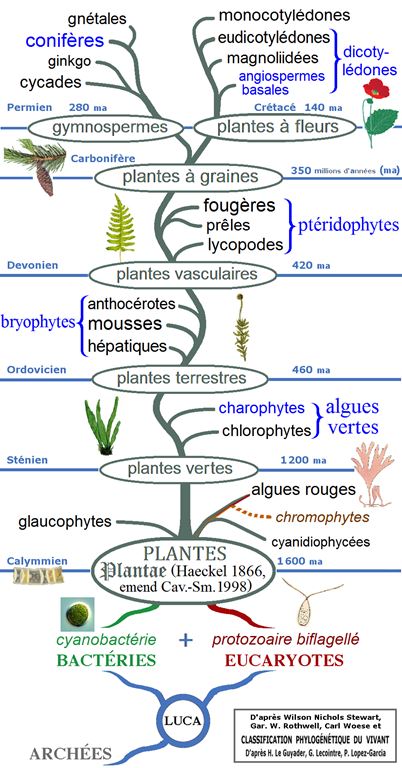
- Phylogénétique :
- Clade 4 : Angiospermes ;
- Clade 3 : Monocotylédones ;
- Ordre APN : Asparagales ;
- Famille APN : Asparagaceae ;
À droite, cet arbre phylogénétique des plantes montre les principaux clades et groupes traditionnels (monophylétiques en noir et paraphylétiques en bleu).
Dénominations
- Nom botanique : Cordyline australis (G. Forst.) Hook. f.
- Synonymes : Dracaena australis
- Noms anglais et locaux : Cabbage Tree
Description et culture
Tableau récapitulatif
Parties comes-tibles Note comest. (1-5) Note medic. (1-5) (Zones de) Rusticité Besoins en 
Besoins en  (1-3)
(1-3)Périodes de semis et récoltes Graines au gramme Durée de viabilité Profon-deur semis Espace-ment plants Espace-ment lignes Durée germi-native Durée avant récolte Zones de rusticité : 7, 8, 9, 10 J F M A M J
J A S O N D
J F M A M J
J A S O N D
Types de feuillage :
Persistant
- dont infos de 0FPI ("FOOD PLANTS INTERNATIONAL", en anglais) :
Description :
Un arbre à feuilles persistantes. Il atteint 7 à 10 m de haut. Il mesure 2-3 m de diamètre. Il a un petit tronc droit et de courtes branches robustes. Il peut avoir plusieurs branches vers le haut. Au sommet, il y a une grande masse dense de feuilles gris-vert en forme d'épée. Ils mesurent 1 m de long sur 5 cm de large. Ils se produisent dans les anneaux. Après 8 à 10 ans, ils produisent de grands panaches de fleurs blanc crème. Les fruits sont des baies blanches ou bleuâtres{{{0(+x) (traduction automatique).
Original : An evergreen tree. It grows 7-10 m high. It is 2-3 m across. It has a small upright trunk and short stout branches. It can have several branches towards the top. At the top there are a large dense mass of sword-like grey-green leaves. These are 1 m long by 5 cm wide. They occur in rings. After 8-10 years they produce large plumes of creamy white flowers. The fruit are white or bluish berries{{{0(+x).
Culture :
Ils peuvent être cultivés à partir de graines ou de boutures de tige{{{0(+x) (traduction automatique).
Original : They can be grown from seed or stem cuttings{{{0(+x).
 Consommation (rapports de comestibilité, parties utilisables et usages alimentaires correspondants)
Consommation (rapports de comestibilité, parties utilisables et usages alimentaires correspondants)Parties comestibles :
feuilles, racine, tige, rhizome{{{0(+x) (traduction automatique). Original : Leaves, Root, Stem, Rhizome{{{0(+x).Détails :
Les tiges ou rhizomes souterrains charnus et sucrés sont cuits à la vapeur ou cuits au four et mangés. Ils sont également brassés dans une boisson alcoolisée. Attention: l'alcool est une cause de cancer. La moelle centrale du tronc peut être cuite à la vapeur et mangée. Le noyau central ou la base des jeunes feuilles émergeant de la tige est coupé en dés et mangé cru ou cuit{{{0(+x) (traduction automatique).
Original : The sweet, fleshy underground stems or rhizomes are steamed or baked and eaten. They are also brewed into an alcoholic drink. Caution: Alcohol is a cause of cancer.The central pith of the trunk can be steamed and eaten.The central core or base of the young leaves emerging from the stem is diced and eaten raw or cooked{{{0(+x).
Partie testée :
/ Risques et précautions à prendre
Risques et précautions à prendrenéant, inconnus ou indéterminés.
Autres infos
dont infos de 0FPI ("FOOD PLANTS INTERNATIONAL", en anglais) :
Distribution :
C'est une plante tempérée chaude à subtropicale. Il est assez résistant au gel. Le mieux dans un sol riche et bien drainé. Il peut tolérer le brouillard salin. Il pousse dans les forêts, les marécages et sur les coteaux ouverts. Il convient aux zones de rusticité 8-11. Dans les jardins botaniques de Melbourne{{{0(+x) (traduction automatique).
Original : It is a warm temperate to subtropical plant. It is fairly frost hardy. The do best in rich, well drained soil. It can tolerate salt spray. It grows in forests, swamps and on open hillsides. It suits hardiness zones 8-11. In Melbourne Botanical Gardens{{{0(+x).
Localisation :
Asie, Australie, Grande-Bretagne, Malouines, Inde, Indonésie, Irlande, Nouvelle-Zélande *, Asie du Sud-Est, Slovénie, Tasmanie{{{0(+x) (traduction automatique).
Original : Asia, Australia, Britain, Falklands, India, Indonesia, Ireland, New Zealand*, SE Asia, Slovenia, Tasmania{{{0(+x).
Notes :
Il existe entre 15 et 20 espèces de Cordyline. Aussi mis dans la famille Laxmanniaceae{{{0(+x) (traduction automatique).
Original : There are 15-20 Cordyline species. Also put in the family Laxmanniaceae{{{0(+x).
Rusticité (résistance face au froid/gel, climat)
Zones de rusticité : 7, 8, 9, 10
Liens, sources et/ou références
Liens :
/ ;Sources et/ou références :
bibliographie (liste des sources et/ou références de l'encyclopédie)
dont livres et bases de données : 5PFAF ("Plants For A Future", en anglais) ; 0FPI ("FOOD PLANTS INTERNATIONAL", en anglais) ;
dont bibliographie/références de 0FPI ("FOOD PLANTS INTERNATIONAL", en anglais) :
Bodkin, F., 1991, Encyclopedia Botanica. Cornstalk publishing, p 280 ; Brickell, C. (Ed.), 1999, The Royal Horticultural Society A-Z Encyclopedia of Garden Plants. Convent Garden Books. p 295 ; Cambie, R. C. & Ferguson, L. R., 2003, Potential functional foods in the traditional Maori diet. Mutation Research/Fundamental and Molecular Mechanisms of Mutagenesis. Volumes 523–524, February–March 2003, Pages 109-117 ; Crowe, A., 1997, A Field Guide to the Native Edible Plants of New Zealand. Penguin. p 17 ; Cundall, P., (ed.), 2004, Gardening Australia: flora: the gardener's bible. ABC Books. p 412 ; Etherington, K., & Imwold, D., (Eds), 2001, Botanica's Trees & Shrubs. The illustrated A-Z of over 8500 trees and shrubs. Random House, Australia. p 225 ; Facciola, S., 1998, Cornucopia 2: a Source Book of Edible Plants. Kampong Publications, p 92 ; Hibbert, M., 2002, The Aussie Plant Finder 2002, Florilegium. p 73 ; Joyce, D., 1998, The Garden Plant Selector. Ryland, Peters and Small. p 109 ; Lavelle, M., 2008, Wild Flowers of Australia and Oceania. Southwater. p 88 ; Lim, T. K., 2015, Edible Medicinal and Non Medicinal Plants. Volume 9, Modified Stems, Roots, Bulbs. Springer p 28 ; Lord, E.E., & Willis, J.H., 1999, Shrubs and Trees for Australian gardens. Lothian. p 94 ; Matthews, J., 1987, New Zealand Native Plants for your Garden. Pacific Publishers, p 35 ; Morley, B. & Everard, B., 1970, Wild Flowers of the World. Ebury press. Plate 142 ; Perry, F., and Hay, R., 1982, Guide to Tropical and Subtropical Plants. Sun Books p 24 ; Plants for a Future database, The Field, Penpol, Lostwithiel, Cornwall, PL22 0NG, UK. http://www.scs.leeds.ac.uk/pfaf/ ; Prodr. fl. Norfolk. 29. 1833 (J. D. Hooker, Gard. Chron. 1860:792. 1860) ; Salmon, J.T., 1989, The Native Trees of New Zealand. Heinmann Reid p 348 ; Smith, N., Mori, S.A., et al, 2004, Flowering Plants of the Neotropics. Princeton. p 454 ; Stewart, K., 1984, Collins handguide to the Native Trees of New Zealand. Collins. p 28 ; Sukarya, D. G., (Ed.) 2013, 3,500 Plant Species of the Botanic Gardens of Indonesia. LIPI p 736 ; Tanaka, ; Tasmanian Herbarium Vascular Plants list p 59 ; Upson, R., & Lewis R., 2014, Updated Vascular Plant Checklist and Atlas for the Falkland Islands. Falklands Conservation and Kew.
Recherche de/pour :
- "Cordyline australis" sur Google (pages et
images) ;
IPNI ("International Plant Names Index", en anglais) ;
TPL ("The Plant List", en anglais) ;
GRIN ("Germplasm Resources Information Network", en anglais) ;
TROPICOS (en anglais) ;
Pl@ntNet ;
Pl@ntUse ;
"Useful Tropical Plants" (en anglais) ou
"Useful Temperate Plants" (en anglais) ;
- "Cordyline" sur Google (pages, images et recettes) ;
- "Cordyline australis" sur Google (pages et
images) ;
IPNI ("International Plant Names Index", en anglais) ;
TPL ("The Plant List", en anglais) ;
GRIN ("Germplasm Resources Information Network", en anglais) ;
TROPICOS (en anglais) ;
Pl@ntNet ;
Pl@ntUse ;
"Useful Tropical Plants" (en anglais) ou
"Useful Temperate Plants" (en anglais) ;
Espèces du même genre (Cordyline)
10 taxons
Espèces de la même famille (Liliaceae)
882 taxons
- Agave
- Agave de Gentry (tp* de "Agave gentryi")
- Agave à cou de cygne
- Agave à épine noire (tp* de "black-spined agave")
- Agave à fleur dorée (tp* de "Golden-flower agave")
- Agave à fleur double (tp* de "twin-flowered agave"
- Agave à fleurs en panache
- Agave à petite fleur (tp* de "small-flower agave")
- Agave à pulque
- Agave américain
- Agave araignée (tp* de "spider agave")
- Agave bleu
- Agave de Clark Mountain
- Agave de Felger (tp* de "Felger's agave")
- Agave de Franzosini
- Agave de Karwinski (tp* de "Karwinski´s agave")
- Agave de la reine Victoria
- Agave de McKelvey (tp* de "McKelvey's agave")
- Agave de Murphey (tp* de "Agave murpheyi")
- Agave de Palmer
- Agave de Parry
- Agave de Salm
- Agave de Schott
- Agave de Shaw
- Agave de Toumey
- Agave de Weber (tp* de "Weber's agave")
- Agave des caraïbes
- Agave du désert
- Agave du roi Ferdinand
- Agave filamenteux
- Alstromère dorée
- Alstromère splendide
- Aphyllante de Montpellier
- Asperge
- Asperge à feuilles fines
- Asperge blanche
- Asperge chinoise
- Asperge d'Éthiopie
- Asperge des sables maritimes
- Asperge horrible
- Asperge maritime
- Asperge sans feuille
- Asperge sauvage
- Asperge sétacée
- Barbe-de-serpens du Japon
- Bellevalia de Rome
- Camassie de cusick
- Camassie faux-scille
- Cantala (dp*)
- Daldinie concentrique
- Agave 'Blue Flame'
- Agave acicularis Trel.
- Agave acklinicola Trel.
- Agave aktites Gentry
- Agave albescens Trel.
- Agave albomarginata Gentry
- Agave albopilosa I.Cabral, Villarreal & A.E.Estrada
- Agave aloides Jacobi
- Agave americana L. (Agave américain)
- Agave americana subsp. protamericana x scabra
- Agave angustiarum Trel.
- Agave angustifolia Haw. (Agave des caraïbes)
- Agave anomala Trel.
- Agave antillarum Descourt.
- Agave applanata K. Koch
- Agave arcedianoensis Cházaro, O.M.Valencia & A.Vázquez
- Agave arubensis Hummelinck
- Agave asperrima Jacobi
- Agave atrovirens Karw. ex Salm-Dyck (Agave à pulque)
- Agave attenuata Salm-Dyck (Agave à cou de cygne)
- Agave aurea Brandegee
- Agave avellanidens Trel.
- Agave bahamana Trel.
- Agave banlan Perr.
- Agave baxteri Baker
- Agave beauleriana Jacobi
- Agave bernhardii Jacobi
- Agave boldinghiana Trel.
- Agave boscii (Hornem.) ined. (Agave à fleur double (tp* de "twin-flowered agave")
- Agave bovicornuta Gentry
- Agave braceana Trel.
- Agave bracteosa S.Watson ex Engelm. (Agave araignée (tp* de "spider agave"))
- Agave breedlovei Gentry
- Agave brevipetala Trel.
- Agave brevispina Trel.
- Agave brittoniana Trel.
- Agave cacozela Trel.
- Agave cajalbanensis A.Alvarez
- Agave calderonii Trel.
- Agave calodonta A.Berger
- Agave cantala (Haw.) Roxb. ex Salm-Dyck (Cantala (dp*))
- Agave cantala Roxb.
- Agave capensis Gentry (Mesquilito (dp*))
- Agave caribaeicola Trel.
- Agave cerulata Trel. (Mescal (dp*))
- Agave chazaroi A.Vazquez & O.M.Valencia
- Agave chiapensis Jacobi
- Agave chrysantha Peebles (Agave à fleur dorée (tp* de "Golden-flower agave"))
- Agave chrysoglossa I. M. Johnst.
- Agave cocui Trel.
- ...







 donne accès au menu
  - encyclopédies des plantes alimentaires ;
 - page de recherche - reconnaissance (identification) de plantes ;
 - page du calendrier lunaire et son générateur (au format PDF et JPG) ;
 - tableau récapitulatif ;
 - générateur de potées (soupes), avec estimation des apports nutrionnels et du coût;
 - générateur de codes QR ;
 - page des archives avec de nombreux documents sur différents thèmes complémentaires comme la botanique, les légumes,
les champignons, la cuisine, le bien-être ainsi que différents MOOC mais également des liens vers les archives de l'association ;
- page des archives avec de nombreux documents sur différents thèmes complémentaires comme la botanique, les légumes,
les champignons, la cuisine, le bien-être ainsi que différents MOOC mais également des liens vers les archives de l'association ;

 pour le fruit (et/ou les graines, la pulpe, etc...),
 pour les fleurs (et/ou pétales, calice...),
 pour les feuilles (et/ou la tige, les pousses...),
 pour les racines,
 pour le tronc (et/ou l'écorce, la sève...), et enfin
 pour les champignons,
puis les notes alimentaires et médicinales (de 1 à 5 étoiles), la rusticité (résistance au froid/gel)
et pour finir un résumé.
pour les champignons,
puis les notes alimentaires et médicinales (de 1 à 5 étoiles), la rusticité (résistance au froid/gel)
et pour finir un résumé. menant ici 🙂
 ,
,  et
et





 ,
,


 Encyclopédie(s)
 Recherche-Reconnaissance
 Tableau récapitulatif
 Codes QR
 Archives
 Calendrier(s) lunaire(s)
  Potées
 Re-naturation/naturalisation
 Affichettes, herbiers &
co.
Affichettes, herbiers &
co. menu
menu galerie


 (en bas à droite).
 (en bas à gauche).
