Ylang-ylang
(Cananga odorata)


 |
**
-
***
|
**
-
***
zone 11-12
Un arbre à feuilles persistantes. Il atteint 25 m de haut et 5 m de large. La tige est dressée et les branches pleurent. Les feuilles sont alternes et simples. Ils mesurent ... (traduction automatique)
→suite


Ylang-ylang
Note alimentaire 
Note médicinale 

Un arbre à feuilles persistantes. Il atteint 25 m de haut et 5 m de large. La tige est dressée et les branches pleurent. Les feuilles sont alternes et simples. Ils mesurent 20 cm de long et ont des bords... (traduction automatique) →suite
![Illustration Cananga odorata, Par Blanco M. (Flora de Filipinas, t. 221, 1875) [xxx], via plantillustrations](inc/images/illustrations/ylang_ylang.jpg)
Cananga odorata
Classification
- Classique : en haut de l'écran, sous le coeur.
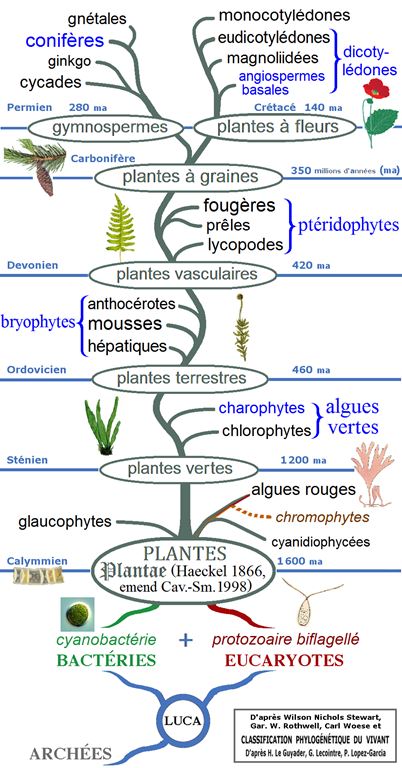
- Phylogénétique :
- Clade 4 : Angiospermes ;
- Clade 3 : Magnoliidées ;
- Ordre APN : Magnoliales ;
- Famille APN : Annonaceae ;
À droite, cet arbre phylogénétique des plantes montre les principaux clades et groupes traditionnels (monophylétiques en noir et paraphylétiques en bleu).
Dénominations
- Nom botanique : Cananga odorata (Lam.) Hook.f. & Thomson (1855)
- Synonymes français : annone asiatique, ilang-ilang
- Synonymes : Canangium odoratum (Lam.) Baill. ex King 1892 ;
Dont basionyme : Uvaria odorata Lam. 1785 ; - Noms anglais et locaux : Ylang-Ylang (de)
Description et culture
Tableau récapitulatif
Parties comes-tibles Note comest. (1-5) Note medic. (1-5) (Zones de) Rusticité Besoins en 
Besoins en  (1-3)
(1-3)Périodes de semis et récoltes Graines au gramme Durée de viabilité Profon-deur semis Espace-ment plants Espace-ment lignes Durée germi-native Durée avant récolte zone 11-12 J F M A M J
J A S O N D
J F M A M J
J A S O N D32
Nombre de graines au gramme :
32
- dont infos de 0FPI ("FOOD PLANTS INTERNATIONAL", en anglais) :
Description :
Un arbre à feuilles persistantes. Il atteint 25 m de haut et 5 m de large. La tige est dressée et les branches pleurent. Les feuilles sont alternes et simples. Ils mesurent 20 cm de long et ont des bords ondulés. Ils sont ovales et effilés. Les fleurs sont d'un vert vif. Ils mesurent 7,5 cm de long avec des pétales tordus, tombants et étroits. Ils ont une forte odeur. Les fleurs sont sur de courtes tiges et poussent à partir de vieux bois. Les fleurs se présentent en grappes à l'aisselle des feuilles. Le fruit est composé de 10 à 12 bourgeons de graines et ils sont noirs{{{0(+x) (traduction automatique).
Original : An evergreen tree. It grows to 25 m tall and spreads to 5 m wide. The stem is erect and the branches are weeping. The leaves are alternate and simple. They are 20 cm long and with wavy edges. They are oval and tapering. The flowers are bright green. They are 7.5 cm long with twisted, drooping, narrow petals. They have a strong smell. Flowers are on short stalks and grow from old wood. The flowers occur in clusters in the axils of leaves. The fruit is made up of 10-12 seed buds and they are black{{{0(+x).
Production :
Les plantes poussent rapidement. Ils peuvent croître de 5 m par an. L'arbre fleurit toute l'année. La première récolte de fleurs est récoltée lorsque les arbres ont entre 1,5 et 2 ans. Après cela, les fleurs sont cueillies deux fois par an. Les fleurs sont cueillies tôt le matin puis l'huile est extraite par distillation à la vapeur. Un arbre peut donner 20 à 100 kg de fleurs en un an{{{0(+x) (traduction automatique).
Original : Plants are fast growing. They can grow 5 m per year. The tree flowers all year round. The first crop of flowers are harvested when trees are 1.5-2 years old. After that, flowers are picked twice per year. The flowers are picked early in the morning then the oil is extracted by steam distillation. A tree can yield 20-100 kg of flowers in a year{{{0(+x).
Culture :
Les plantes sont cultivées à partir de graines. La graine doit être semée fraîche. Il est préférable de semer la graine dans le champ pour éviter d'endommager la longue racine pivotante. L'arbre est souvent taillé à 3 m de hauteur pour faciliter la récolte de l'huile. Les branches sont pliées vers le bas et fixées au sol. Les plantes peuvent également être cultivées à partir de boutures{{{0(+x) (traduction automatique).
Original : Plants are grown from seed. The seed must be sown fresh. It is best to sow the seed in the field to avoid damaging the long taproot. The tree is often pruned to 3 m height to make oil harvesting more easy. The branches are bent down and pegged to the ground. Plants can also be grown from cuttings{{{0(+x).
 Consommation (rapports de comestibilité, parties utilisables et usages alimentaires correspondants)
Consommation (rapports de comestibilité, parties utilisables et usages alimentaires correspondants)Fleur (extrait(dp*) fleurs {huile}{{{0(+x)) et fruit0(+x) (baies(dp*)) comestibles0(+x).
Partie testée :
fleurs - huile{{{0(+x) (traduction automatique). Original : Flowers - oil{{{0(+x) Risques et précautions à prendre
Risques et précautions à prendrenéant, inconnus ou indéterminés.
Galerie(s)
Par Blanco M. (Flora de Filipinas, t. 221, 1875) [xxx], via plantillustrations
✖

Par Prenn (travail personnel), via wikimedia
✖

Autres infos
dont infos de 0FPI ("FOOD PLANTS INTERNATIONAL", en anglais) :
Statut :
Un arôme alimentaire très mineur{{{0(+x) (traduction automatique).
Original : A very minor food flavouring{{{0(+x).
Distribution :
Une plante tropicale. Il pousse mieux dans un sol riche, humide et bien drainé. Il nécessite une position ensoleillée protégée. Il est sensible à la sécheresse et au gel. Les températures doivent être supérieures à 21 ° C pour que les graines poussent. Les arbres ont besoin de températures supérieures à 16 ° C. Il fait mieux dans les régions où la température moyenne annuelle est de 18 à 28 ° C. Il pousse dans la forêt tropicale. Il pousse dans les vallées humides en dessous de 800 m d'altitude. Au Costa Rica, il pousse jusqu'à 200 m d'altitude. En Colombie, il pousse entre 100 et 220 m au-dessus du niveau de la mer. Dans XTBG Yunnan. Chez MARDI. À Townsville Queens BG{{{0(+x) (traduction automatique).
Original : A tropical plant. It grows best in rich, moist, well drained soil. It requires a protected sunny position. It is drought and frost tender. Temperatures need to be above 21°C for seed to grow. Trees need temperatures above 16°C. It does best in regions with an annual average temperature of 18-28°C. It grows in rainforest. It grows in moist valleys below 800 m altitude. In Costa Rica it grows up to 200 m altitude. In Colombia it grows between 100-2,220 m above sea level. In XTBG Yunnan. At MARDI. In Townsville Queens BG{{{0(+x).
Localisation :
Afrique, Samoa américaines, Andamans, Angola, Asie *, Australie, Afrique centrale, Amérique centrale, Chine, Chuuk, Colombie, Comores, RD Congo, Cook Is., Costa Rica, République dominicaine, Afrique de l'Est, Timor oriental, Fidji, Français Polynésie, FSM, Guam, Haïti, Hawaï, Inde, Indochine, Indonésie, Kenya, Kosrae, Laos, Madagascar, Malaisie, Marquises, Micronésie, Mozambique, Myanmar, Nauru, Niue, Pacifique, Palau, Papouasie-Nouvelle-Guinée, PNG, Philippines, Puerto Rico, Samoa, Sao Tomé et Principe, Seychelles, Asie du Sud-Est, Îles Salomon, Amérique du Sud, Suriname, Tahiti, Taïwan, Tanzanie, Thaïlande, Timor-Leste, Tonga, États-Unis, Vanuatu, Vietnam, Wallis et Futuna, Antilles{{{0(+x) (traduction automatique).
Original : Africa, American Samoa, Andamans, Angola, Asia*, Australia, Central Africa, Central America, China, Chuuk, Colombia, Comoros, Congo DR, Cook Is., Costa Rica, Dominican Republic, East Africa, East Timor, Fiji, French Polynesia, FSM, Guam, Haiti, Hawaii, India, Indochina, Indonesia, Kenya, Kosrae, Laos, Madagascar, Malaysia, Marquesas, Micronesia, Mozambique, Myanmar, Nauru, Niue, Pacific, Palau, Papua New Guinea, PNG, Philippines, Puerto Rico, Samoa, Sao Tome and Principe, Seychelles, SE Asia, Solomon Islands, South America, Suriname, Tahiti, Taiwan, Tanzania, Thailand, Timor-Leste, Tonga, USA, Vanuatu, Vietnam, Wallis & Futuna, West Indies{{{0(+x).
Notes :
Probablement utilisé uniquement en médecine. L'arbre peut être envahissant à certains endroits. Il existe 2 espèces de Cananga. Il est cultivé à Hawaï pour le parfum{{{0(+x) (traduction automatique).
Original : Probably only used in medicine. The tree can be invasive in some locations. There are 2 Cananga species. It is grown in Hawaii for perfume{{{0(+x).
Rusticité (résistance face au froid/gel, climat)
zone 11-12
Liens, sources et/ou références
Liens :
Wikipedia ; "Botanical journeys, plant-guides" (en anglais) ; "Top Tropicals" (en anglais) ;Sources et/ou références :
bibliographie (liste des sources et/ou références de l'encyclopédie)
dont classification : TPL ("The Plant List", en anglais) ; GRIN ("Germplasm Resources Information Network", en anglais) ;
dont livres et bases de données : 5PFAF ("Plants For A Future", en anglais) ; 0FPI ("FOOD PLANTS INTERNATIONAL", en anglais) ;
dont bibliographie/références de 0FPI ("FOOD PLANTS INTERNATIONAL", en anglais) :
Ambasta S.P. (Ed.), 2000, The Useful Plants of India. CSIR India. p 99 ; Barwick, M., 2004, Tropical and Subtropical Trees. A Worldwide Encyclopedic Guide. Thames and Hudson p 88 ; Bircher, A. G. & Bircher, W. H., 2000, Encyclopedia of Fruit Trees and Edible Flowering Plants in Egypt and the Subtropics. AUC Press. p 78 ; Bodkin, F., 1991, Encyclopedia Botanica. Cornstalk publishing, p 209 ; Borrell, O.W., 1989, An Annotated Checklist of the Flora of Kairiru Island, New Guinea. Marcellin College, Victoria Australia. p 50, 175 ; Bremness, L., 1994, Herbs. Collins Eyewitness Handbooks. Harper Collins. p 40 ; Brown, D., 2002, The Royal Horticultural Society encyclopedia of Herbs and their uses. DK Books. p 151 ; Brickell, C. (Ed.), 1999, The Royal Horticultural Society A-Z Encyclopedia of Garden Plants. Convent Garden Books. p 224 ; Clarke, W.C. & Thaman, R.R.(Eds.), 1993, Agroforestry in the Pacific Islands: Systems for sustainability. United Nations University Press. New York. p 226 ; Cobley, L.S. (rev. Steele, W.M.) 2nd Ed., 1976, An Introduction to the Botany of Tropical Crops. Longmans. p 328 ; Cooper, W. and Cooper, W., 2004, Fruits of the Australian Tropical Rainforest. Nokomis Editions, Victoria, Australia. p 20 ; Elevitch, C.R.(ed.), 2006, Traditional Trees of the Pacific Islands: Their Culture, Environment and Use. Permanent Agriculture Resources, Holualoa, Hawaii. p 199 ; Elliot, W.R., & Jones, D.L., 1982, Encyclopedia of Australian Plants suitable for cultivation. Vol 2. Lothian. p 455 ; Engel, D.H., & Phummai, S., 2000, A Field Guide to Tropical Plants of Asia. Timber Press. p 55, 156 ; Facciola, S., 1998, Cornucopia 2: a Source Book of Edible Plants. Kampong Publications, p 14 ; Fl. ind. 1:130. 1855 ; Gardner, S., et al, 2000, A Field Guide to Forest Trees of Northern Thailand, Kobfai Publishing Project. p 41 ; Havel, J.J., 1975, Forest Botany, Volume 3 Part 2 Botanical taxonomy. Papua New Guinea Department of Forests, p 70 ; Hibbert, M., 2002, The Aussie Plant Finder 2002, Florilegium. p 59 ; Jackes, B.R., 2001, Plants of the Tropics. Rainforest to Heath. An Identification Guide. James Cook University. p 39 ; Jones D, L, 1986, Ornamental Rainforest Plants in Australia, Reed Books, p 203 ; Johns, R.J., 1976, Common Forest Trees of Papua New Guinea. Part 2 Angiospermae, Forestry College Bulolo, PNG p 40 ; Li Ping-Tao, Annonaceae, Flora China. ; Llamas, K.A., 2003, Tropical Flowering Plants. Timber Press. p 61 ; McMakin, P.D., 2000, Flowering Plants of Thailand. A Field Guide. White Lotus. p 6 ; Morley, B. & Everard, B., 1970, Wild Flowers of the World. Ebury press. Plate 110 ; Nicholson, N & H., 1994, Australian Rainforest Plants 4, Terania Rainforest Publishing. NSW. p 21 ; Peekel, P.G., 1984, (Translation E.E.Henty), Flora of the Bismarck Archipelago for Naturalists, Division of Botany, Lae, PNG. p 183, 182 ; Pham-Hoang Ho, 1999, An Illustrated Flora of Vietnam. Nha Xuat Ban Tre. p 263 ; Plants of Haiti Smithsonian Institute https://botany.si.edu ; Purseglove, J.W., 1968, Tropical Crops Dicotyledons, Longmans. p 626 ; Radke, P & A, Sankowsky, G & N., 1993, Growing Australian Tropical Plants. Frith & Frith, Australia. p 25 ; Smith, A.C., 1981, Flora Vitiensis Nova, Lawaii, Kuai, Hawaii, Volume 2 p 37 ; Staples, G.W. and Herbst, D.R., 2005, A tropical Garden Flora. Bishop Museum Press, Honolulu, Hawaii. p 111 ; Swaminathan, M.S., and Kochnar, S.L., 2007, An Atlas of Major Flowering Trees in India. Macmillan. p 29 ; Townsend, K., 1994, Across the Top. Gardening with Australian Plants in the tropics. Society for Growing Australian Plants, Townsville Branch Inc. p 117 ; Whistler, W.A., 2004, Rainforest Trees of Samoa. Isle Botanica Honolulu, Hawaii. p 22 ; Williams, C.N., Chew, W.Y., and Rajaratnam, J.A., 1989, Tree and Field Crops of the Wetter Regions of the Tropics. Longman, p 233 ; Williams, K.A.W., 1999, Native Plants of Queensland Volume 4. Keith A.W. Williams North Ipswich, Australia. p 92 ; Zuchowski W., 2007, Tropical Plants of Costa Rica. A Zona Tropical Publication, Comstock Publishing. p 113 ; Young, J., (Ed.), 2001, Botanica's Pocket Trees and Shrubs. Random House. p 193 ; Yuncker, T.G., 1959, Plants of Tonga, Bernice P. Bishop Museum, Hawaii, Bulletin 220. p 113
Recherche de/pour :
- "Cananga odorata" sur Google (pages et
images) ;
IPNI ("International Plant Names Index", en anglais) ;
TROPICOS (en anglais) ;
Tela Botanica ;
Pl@ntNet ;
Pl@ntUse ;
"Useful Tropical Plants" (en anglais) ou
"Useful Temperate Plants" (en anglais) ;
- "Ylang-ylang" sur Google (pages, images et recettes) ;
- "Cananga odorata" sur Google (pages et
images) ;
IPNI ("International Plant Names Index", en anglais) ;
TROPICOS (en anglais) ;
Tela Botanica ;
Pl@ntNet ;
Pl@ntUse ;
"Useful Tropical Plants" (en anglais) ou
"Useful Temperate Plants" (en anglais) ;
Espèces de la même famille (Annonaceae)
355 taxons
- Annone à peau dure
- Annone blanche
- Annone des marais
- Annone du sénégal
- Anonilla
- Araticum
- Araticum-cagao
- Artabotrys à six pétales
- Asiminier
- Asiminier à longues feuilles (tp* de "Asimina longifolia)
- Asiminier à petites fleurs (tp* de "Asimina parvif
- Atemoya
- Atier
- Attier
- Attier des plages (tp* de "beach sugar apple")
- Chérimolier
- Coeur de boeuf
- Coeur de boeuf nain (tp* de "bush custard apple")
- Corossolier
- Corossolier bâtard
- Cuyaba
- Ebom69
- Guanabana de monte
- Kepel
- Muscadier du gabon
- Petit corrossol
- Pindaiba
- Pinha
- Poivre de Guinée
- Rollinia
- Alphonsea elliptica Hook.f. & Thomson
- Alphonsea glabrifolia Craib
- Alphonsea hainanensis Merr. & Chun
- Alphonsea javanica Scheff.
- Alphonsea lutea
- Alphonsea maingayi Hook.f. & Thomson
- Alphonsea mollis Dunn
- Alphonsea ventricosa
- Anaxagorea javanica Blume
- Annickia kummeriae
- Annona acuminata Saff.
- Annona acutiflora Mart.
- Annona amazonica R.E.Fr.
- Annona ambotay Aubl.
- Annona aurantiaca Barb.Rodr. (Coeur de boeuf nain (tp* de "bush custard apple"))
- Annona boliviana
- Annona bullata A.Rich.
- Annona cacans Warm.
- Annona calcarata
- Annona centrantha
- Annona cercocarpa Saff.
- Annona cherimola Mill. (Chérimolier)
- Annona cherimola x Annona squamosa
- Annona cherimolioides Triana & Planch.
- Annona conica Ruiz & Pav. ex G.Don
- Annona cordifolia
- Annona coriacea Mart. (Araticum-cagao)
- Annona cornifolia A.St.-Hil. (Cuyaba)
- Annona crassiflora Mart. (Araticum)
- Annona cuspidata
- Annona densicoma Mart.
- Annona dioica A.St.-Hil.
- Annona dolichopetala
- Annona echinata Dunal
- Annona edulis
- Annona emarginata
- Annona exalbida Vell.
- Annona excellens R.E.Fr.
- Annona exsucca DC.
- Annona foetida Mart.
- Annona fosteri
- Annona glabra L. (Annone des marais)
- Annona glauca Schumach. & Thonn.
- Annona globiflora Schltdl.
- Annona hayesii Saff.
- Annona helosioides
- Annona herzogii
- Annona holosericea Saff.
- Annona hypoglauca Mart.
- Annona impressivenia Saff. ex R.E.Fr.
- ...







 donne accès au menu
  - encyclopédies des plantes alimentaires ;
 - page de recherche - reconnaissance (identification) de plantes ;
 - page du calendrier lunaire et son générateur (au format PDF et JPG) ;
 - tableau récapitulatif ;
 - générateur de potées (soupes), avec estimation des apports nutrionnels et du coût;
 - générateur de codes QR ;
 - page des archives avec de nombreux documents sur différents thèmes complémentaires comme la botanique, les légumes,
les champignons, la cuisine, le bien-être ainsi que différents MOOC mais également des liens vers les archives de l'association ;
- page des archives avec de nombreux documents sur différents thèmes complémentaires comme la botanique, les légumes,
les champignons, la cuisine, le bien-être ainsi que différents MOOC mais également des liens vers les archives de l'association ;

 pour le fruit (et/ou les graines, la pulpe, etc...),
 pour les fleurs (et/ou pétales, calice...),
 pour les feuilles (et/ou la tige, les pousses...),
 pour les racines,
 pour le tronc (et/ou l'écorce, la sève...), et enfin
 pour les champignons,
puis les notes alimentaires et médicinales (de 1 à 5 étoiles), la rusticité (résistance au froid/gel)
et pour finir un résumé.
pour les champignons,
puis les notes alimentaires et médicinales (de 1 à 5 étoiles), la rusticité (résistance au froid/gel)
et pour finir un résumé. menant ici 🙂
 ,
,  et
et





 ,
,


 Encyclopédie(s)
 Recherche-Reconnaissance
 Tableau récapitulatif
 Codes QR
 Archives
 Calendrier(s) lunaire(s)
  Potées
 Re-naturation/naturalisation
 Affichettes, herbiers &
co.
Affichettes, herbiers &
co. menu
menu galerie


 (en bas à droite).
 (en bas à gauche).
