Coeur de boeuf
(Annona reticulata)

 |
***
|
***
0/-3/-3,5/-4
Un petit arbre atteignant 7,5 m de haut. Il a plusieurs branches près de la base. Les arbres perdent leurs feuilles à certaines périodes de l'année. Les nouvelles pousses ... (traduction automatique)
→suite


Coeur de boeuf
Note alimentaire 

Un petit arbre atteignant 7,5 m de haut. Il a plusieurs branches près de la base. Les arbres perdent leurs feuilles à certaines périodes de l'année. Les nouvelles pousses ont de courts poils bruns mais... (traduction automatique) →suite
![Illustration Annona reticulata, Par Descourtilz, M.E., Flore [pittoresque et] médicale des Antilles (1821-1829) Fl. Méd. Antilles vol. 2 (1822), via plantillustrations](inc/images/illustrations/coeur_boeuf.jpg)
Annona reticulata
Classification
- Classique : en haut de l'écran, sous le coeur.
- Phylogénétique :
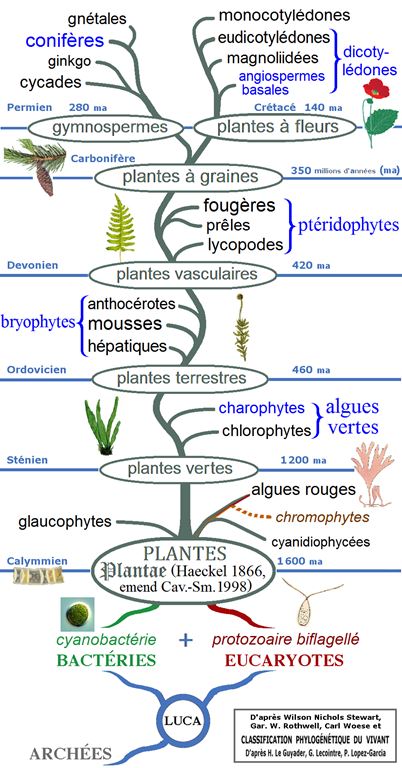
- Clade 4 : Angiospermes ;
- Clade 3 : Magnoliidées ;
- Ordre APN : Magnoliales ;
- Famille APN : Annonaceae ;
À droite, cet arbre phylogénétique des plantes montre les principaux clades et groupes traditionnels (monophylétiques en noir et paraphylétiques en bleu).
Dénominations
- Nom botanique : Annona reticulata L. (1753)
- Synonymes français : annone réticulée (ou anone réticulée), cachiman, corossol reticulé, corossolier réticulé, annone coeur de boeuf (ou anone coeur de boeuf), cachimantier, corossol sauvage, corossolier sauvage
- Synonymes : Annona excelsa Kunth 1821 ;
Dont basionyme : x ; - Noms anglais et locaux : custard apple, bullock's-heart (bullock's heart), ox-heart, Netzannone (de), Ochsenherz (de), anoneira(pt), coraçao-de-boi (pt), biriba (pt,br), fruta-de-condessa (pt,br), fruta-do-conde (pt,br), anona corazon (es,local), anonillo (es), corazon de buey (es), mamán (es), nätannona (sv), araticum (br), coraçao de koi (br), anoda (si), ramphala (in), ramsita (local), anona colorado (mx)
Description et culture
Tableau récapitulatif
Parties comes-tibles Note comest. (1-5) Note medic. (1-5) (Zones de) Rusticité Besoins en 
Besoins en  (1-3)
(1-3)Périodes de semis et récoltes Graines au gramme Durée de viabilité Profon-deur semis Espace-ment plants Espace-ment lignes Durée germi-native Durée avant récolte
0/-3/-3,5/-4 J F M A M J
J A S O N D
J F M A M J
J A S O N D
- dont infos de 0FPI ("FOOD PLANTS INTERNATIONAL", en anglais) :
Description :
Un petit arbre atteignant 7,5 m de haut. Il a plusieurs branches près de la base. Les arbres perdent leurs feuilles à certaines périodes de l'année. Les nouvelles pousses ont de courts poils bruns mais le bois plus ancien est lisse et brillant. Les feuilles sont longues et en forme de lance avec de courtes tiges. Autour du bord de la feuille se trouve un bord clair. Les feuilles sentent lorsqu'elles sont écrasées. Les fleurs sont jaune verdâtre. Ils se produisent en groupes où les feuilles rejoignent la tige. Les fleurs apparaissent sur la nouvelle croissance du bois. Les fruits sont de couleur brun rougeâtre et mesurent 10 à 12 cm de diamètre. Il y a un fin motif hexagonal sur le fruit. À l'intérieur, il y a de grosses graines brunes. Les fruits sont comestibles mais les graines ne sont pas consommées{{{0(+x) (traduction automatique).
Original : A small tree up to 7.5 m tall. It has several branches near the base. Trees loose their leaves at some times of the year. New shoots have short brown hairs but older wood is smooth and shiny. The leaves are long and spear shaped with short leaf stalks. Around the edge of the leaf is a clear edge. The leaves smell when crushed. Flowers are greenish yellow. They occur in groups where the leaves join the stalk. Flowers occur on new wood growth. The fruit are reddish brown in colour and 10-12 cm across. There is a fine hexagonal pattern over the fruit. Inside there are large brown seeds. The fruit are edible but the seeds are not eaten{{{0(+x).
Production :
Les arbres commencent à fructifier à 3-5 ans. La nouaison est souvent améliorée par pollinisation manuelle. Les fruits mûrissent en environ 200 jours. Les fruits peuvent varier de 0,25 à 2,25 kg chacun. Le fruit contient 13% de sucre. La production de fruits est saisonnière. Un arbre peut porter de 100 à 150 fruits en une saison. La saison est normalement de décembre à mars{{{0(+x) (traduction automatique).
Original : Trees begin fruiting at 3-5 years. Fruit setting is often improved by hand pollination. Fruit mature in about 200 days. Fruit can vary from 0.25 to 2.25 kg each. The fruit has 13% sugar. Fruit production is seasonal. A tree may bear 100-150 fruit in a season. The season is normally Dec. to March{{{0(+x).
Culture :
Les plantes sont normalement cultivées à partir de graines. Les semis varient un peu. Les semis sont faciles à transplanter. Un espacement de 4 à 7 m convient. De meilleurs types peuvent être cultivés en utilisant le bourgeonnement ou le greffage{{{0(+x) (traduction automatique).
Original : Plants are normally grown from seeds. Seedling trees vary quite a bit. Seedlings are easy to transplant. A spacing of 4-7 m is suitable. Better kinds can be grown using budding or grafting{{{0(+x).
 Consommation (rapports de comestibilité, parties utilisables et usages alimentaires correspondants)
Consommation (rapports de comestibilité, parties utilisables et usages alimentaires correspondants)Fruit2(+),27(+x) (pulpe/chair mûre{{{(dp*) crue27(+x) [nourriture/aliment{{{2(+) et base boissons/breuvages{{{2(dp*)]) comestible.(1*)
Partie testée :
fruit{{{0(+x) (traduction automatique). Original : Fruit{{{0(+x)| Taux d'humidité (%) | Énergie (kj) | Énergie (kcal) | Protéines (g) |
|---|---|---|---|
| 66.4 | 462 | 111 | 2.06 |
| Pro- vitamines A (µg) |
Vitamines C (mg) | Fer (mg) | Zinc (mg) |
| 10 | 50 | 0.5 | 0 |
Risques et précautions à prendre
Risques et précautions à prendre(1*) Les graines, comme celles de toutes les espèces du genre Annona, sont toxiques et il faut prendre soin de les retirer de la pulpe avant qu'elle ne soit mécaniquement mélangée (mixée){{{67.
Galerie(s)
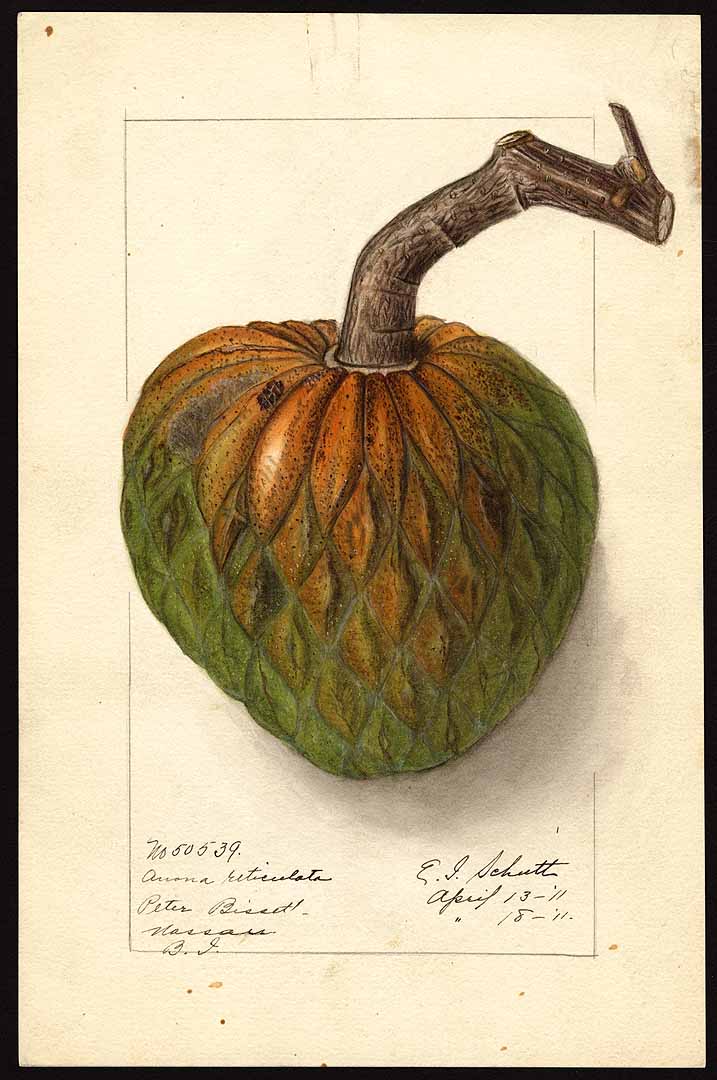
Par Descourtilz, M.E., Flore [pittoresque et] médicale des Antilles (1821-1829) Fl. Méd. Antilles vol. 2 (1822), via plantillustrations
✖

Par USDA Pomological Watercolor Collection (1872-1948), via plantillustrations
✖

Petite histoire-géo
Aire d'origine : Amérique centrale (probablement){{{2(+x). :: Plus de détails et d'infos (dont zone(s) de cullture) : voir GRIN ("2").
Autres infos
dont infos de 0FPI ("FOOD PLANTS INTERNATIONAL", en anglais) :
Statut :
C'est un arbre fruitier cultivé. Fréquemment vu sur l'île de Manus et dans certaines autres zones côtières de Papouasie-Nouvelle-Guinée{{{0(+x) (traduction automatique).
Original : It is a cultivated fruit tree. Commonly seen on Manus Island and in some other coastal areas in Papua New Guinea{{{0(+x).
Distribution :
Une plante tropicale. Il se produit dans les basses terres tropicales et pousse jusqu'à au moins 1200 m d'altitude. En Colombie, il pousse entre 500 et 1 900 m d'altitude. Il peut pousser sur des sols plus pauvres avec différents niveaux d'acidité. Il ne supporte pas l'engorgement. Il convient aux climats humides. Il est moins adapté aux climats secs. Il peut pousser dans des endroits arides. Au Népal, il atteint 900 m d'altitude. Il convient aux zones de rusticité 10-12. Au Yunnan. Dans les jardins botaniques de Brisbane{{{0(+x) (traduction automatique).
Original : A tropical plant. It occurs in the tropical lowlands and grows up to at least 1200 m altitude. In Colombia it grows between 500-1,900 m above sea level. It can grow on poorer soils with different levels of acidity. It cannot stand water-logging. It suits humid climates. It is less suited to dry climates. It can grow in arid places. In Nepal it grows to 900 m altitude. It suits hardiness zones 10-12. In Yunnan. In Brisbane Botanical Gardens{{{0(+x).
Localisation :
Afrique, Amazonie, Andamans, Angola, Antilles, Asie, Australie, Bahamas, Bangladesh, Belize, Bolivie, Brésil, Cambodge, Cameroun, Afrique centrale, Amérique centrale *, Chine, Colombie, Îles Cook, Costa Rica, Cuba, République dominicaine, Afrique de l'Est, Timor oriental, Équateur, Fidji, Gabon, Grenade, Guam, Guatemala, Guyana, Haïti, Hawaï, Himalaya, Honduras, Inde, Indochine, Indonésie, Jamaïque, Kenya, Laos, Madagascar, Malawi, Malaisie, Maldives, Marquises, Marshall Is., Martinique, Mexique, Mozambique, Myanmar, Nauru, Népal, Amérique du Nord, Inde du Nord-Est, Pacifique, Pakistan, Palau, Panama, Papouasie-Nouvelle-Guinée, PNG, Pérou, Philippines, Porto Rico, Sao Tomé-et-Principe, Asie du Sud-Est , Îles Salomon, Amérique du Sud, Sri Lanka, Saint-Vincent-et-Grenadines, Suriname, Taïwan, Tanzanie, Timor-Leste, Thaïlande, Tonga, Ouganda, USA, Vanuatu, Venezuela, Vietnam, Afrique de l'Ouest,Antilles, Zambie, Zimbabwe{{{0(+x) (traduction automatique).
Original : Africa, Amazon, Andamans, Angola, Antilles, Asia, Australia, Bahamas, Bangladesh, Belize, Bolivia, Brazil, Cambodia, Cameroon, Central Africa, Central America*, China, Colombia, Cook Islands, Costa Rica, Cuba, Dominican Republic, East Africa, East Timor, Ecuador, Fiji, Gabon, Grenada, Guam, Guatemala, Guyana, Haiti, Hawaii, Himalayas, Honduras, India, Indochina, Indonesia, Jamaica, Kenya, Laos, Madagascar, Malawi, Malaysia, Maldives, Marquesas, Marshall Is., Martinique, Mexico, Mozambique, Myanmar, Nauru, Nepal, North America, Northeastern India, Pacific, Pakistan, Palau, Panama, Papua New Guinea, PNG, Peru, Philippines, Puerto Rico, Sao Tome and Principe, SE Asia, Solomon Islands, South America, Sri Lanka, St. Vincent and Grenadines, Suriname, Taiwan, Tanzania, Timor-Leste, Thailand, Tonga, Uganda, USA, Vanuatu, Venezuela, Vietnam, West Africa, West Indies, Zambia, Zimbabwe{{{0(+x).
Notes :
Il existe environ 100 à 150 espèces d'Annona. Il a des propriétés anticancéreuses{{{0(+x) (traduction automatique).
Original : There are about 100-150 Annona species. It has anticancer properties{{{0(+x).
Rusticité (résistance face au froid/gel, climat)
0/-3/-3,5/-4
Où trouver des graines et/ou des plants de qualité ?

Liens, sources et/ou références
Liens :
/ ;Sources et/ou références :
bibliographie (liste des sources et/ou références de l'encyclopédie)
dont classification : IPNI ("International Plant Names Index", en anglais) ; TPL ("The Plant List", en anglais) ; 2GRIN ("Germplasm Resources Information Network", en anglais) ; Kew (POWO - "Plant Of the World Online", "Royal Botanical Garden", en anglais) ;
dont livres et bases de données : 5PFAF ("Plants For A Future", en anglais) ; 27Dictionnaire des plantes comestibles (livre, page 27, par Louis Bubenicek) ; 87Le Truffaut du Potager (collectif, éditions Larousse, 2010) / détails du livre
dont bibliographie/références de 0FPI ("FOOD PLANTS INTERNATIONAL", en anglais) :
Bullockâ's heart references ; Ajesh, T. P., et al, 2012, Ethnobotanical Documentation of Wild Edible Fruits used by Muthuvan Tribes of Idukki, Kerala-India. International Journal of Pharma and Bio Sciences 3(3): 479-487 ; Ambasta S.P. (Ed.), 2000, The Useful Plants of India. CSIR India. p 43 ; Anderson, E. F., 1993, Plants and people of the Golden Triangle. Dioscorides Press. p 202 ; Ashton, M. S., et al 1997, A Field Guide to the Common Trees and Shrubs of Sri Lanka. WHT Publications Ltd. p 100 ; Bandyopadhyay, S. et al, 2009, Wild edible plants of Koch Bihar district, West Bengal. Natural Products Radiance 8(1) 64-72 ; Bandyopadhyay, S., et al, 2012, A Census of Wild Edible Plants from Howrah District, West Bengal, India. Proceedings of UGC sponsored National Seminar 2012 ; Banerjee, A., et al, 2013, Ethnobotanical Documentation of Some Wild Edible Plants in Bankura District, West Bengal, India. The Journal of Ethnobiology and Traditional Medicine. Photon 120 (2013) 585-590 ; Barwick, M., 2004, Tropical and Subtropical Trees. A Worldwide Encyclopedic Guide. Thames and Hudson p 27 ; Bircher, A. G. & Bircher, W. H., 2000, Encyclopedia of Fruit Trees and Edible Flowering Plants in Egypt and the Subtropics. AUC Press. p 31 ; Bodkin, F., 1991, Encyclopedia Botanica. Cornstalk publishing, p 86 ; Bourret, D., 1981, Bonnes-Plantes de Nouvelle-Caledonie et des Loyaute. ORSTOM. p 38 ; Brahma, S., et al, 2013, Wild edible fruits of Kokrajhar district of Assam, North-East India, Asian Journal of Plant Science and Research 3(6):95-100 ; Brouk, B., 1975, Plants Consumed by Man. Academic Press, London. p 170 ; Brown, 1951, Useful Plants of the Philippines. ; Burkill, H. M., 1985, The useful plants of west tropical Africa, Vol. 1. Kew. ; Burkill, I. H., 1935, A Dictionary of the Economic Products of the Malay Peninsula. p 168 ; Casas, A., et al, 1996, Plant Management Among the Nahua and the Mixtec in the Balsas River Basin, Mexico: An Ethnobotanical Approach to the Study of Plant Domestication. Human Ecology, Vol. 24, No. 4 pp. 455-478 ; Chakraborty, S. & Chaturbedi, H. P., 2014, Some Wild Edible Fruits of Tripura- A Survey. Indian Journal of Applied research. (4) 9 ; Chin, H.F., & Yong, H.S., 1996, Malaysian Fruits in Colour. Tropical press, Kuala Lumpur p 57 ; Chizmar Fernandez, C., et al, 2009, Plantas comestibles de Centroamerica. Instituto de Biodiversidad, Costa Rica. p 38 ; Chowdery, T., et al, 2014, Wild edible plants of Uttar Dinajpur District, West Bengal. Life Science Leaflets. 47:pp 20-36 http://lifesciencesleaflets.ning.com ; Chowdhury, M. & Mukherjee, R., 2012, Wild Edible Plants Consumed by Local Communities of Maldah of West Bengal, India. Indian J.Sci.Res.3(2) : 163-170 ; Cooper, W. and Cooper, W., 2004, Fruits of the Australian Tropical Rainforest. Nokomis Editions, Victoria, Australia. p 19 ; Coronel, R.E., 1982, Fruit Collections in the Philippines. IBPGR Newsletter p 6 ; Darley, J.J., 1993, Know and Enjoy Tropical Fruit. P & S Publishers. p 2 ; Das, S. and De, B., 2013, Evaluation of Angiotension I-Converting Enzyme (ACE) inhibitory potential of some underutilized indigenous fruits of West Bengal using an in vitro model. Fruits, Vol. 68:499-506 ; Das, T. & Das, A. K., 2005, Inventorying plant biodiversity in homegardens: A case study in Barak Valley, Assam, North East India. CURRENT SCIENCE, VOL. 89, NO. 1, 10 JULY 2005 ; Datar, M. N. & Upadhye, A. S., 2015, Forest foods of Northern Western Ghats: Mode of Consumption, Nutrition, and Availability. Asian Agri-History Vol. 19, No. 4, 2015 (293–316) ; Dobriyal, M. J. R. & Dobriyal, R., 2014, Non Wood Forest Produce an Option for Ethnic Food and Nutritional Security in India. Int. J. of Usuf. Mngt. 15(1):17-37 ; Etherington, K., & Imwold, D., (Eds), 2001, Botanica's Trees & Shrubs. The illustrated A-Z of over 8500 trees and shrubs. Random House, Australia. p 96 ; Facciola, S., 1998, Cornucopia 2: a Source Book of Edible Plants. Kampong Publications, p 12 ; Flowerdew, B., 2000, Complete Fruit Book. Kyle Cathie Ltd., London. p 157 ; French, B., 1986, Food Plants of Papua New Guinea, Asia Pacific Science Foundation p 213 ; French, B.R., 2010, Food Plants of Solomon Islands. A Compendium. Food Plants International Inc. p 212 ; Garner, R.J., and Chaudhri, S.A., (Ed.) 1976, The Propagation of Tropical fruit Trees. FAO/CAB. p 223. 239 ; Grandtner, M. M. & Chevrette, J., 2013, Dictionary of Trees, Volume 2: South America: Nomenclature, Taxonomy and Ecology. Academic Press p 39 ; Goode, P., 1989, Edible Plants of Uganda. FAO p 27 ; Hedrick, U.P., 1919, (Ed.), Sturtevant's edible plants of the world. p 58 ; Hermandez Bermejo, J.E., and Leon, J. (Eds.), 1994, Neglected Crops. 1492 from a different perspective. FAO Plant Production and Protection Series No 26. FAO, Rome. p14, 89 ; Hibbert, M., 2002, The Aussie Plant Finder 2002, Florilegium. p 29 ; Jadhav, R., et al, 2015, Forest Foods of Northern Western Ghats: Mode of Consumption, Nutrition and Availability. Asian Agri-History Vol. 19, No. 4: 293-317 ; Jardin, C., 1970, List of Foods Used In Africa, FAO Nutrition Information Document Series No 2.p 120 ; Johns, L. & Stevenson, V., 1979, The Complete Book of Fruit. Angus & Robertson. p 122 ; Kintzios, S. E., 2006, Terrestrial Plant-Derived Anticancer Agents and Plant Species Used in Anticancer research Critical Reviews in Plant Sciences. 25: pp 79-113 ; Kiple, K.F. & Ornelas, K.C., (eds), 2000, The Cambridge World History of Food. CUP p 1890 ; Kumar, S. A., Manus, D. & Mallika, M., 2018, Impact of non-timber forest products on Forest and in Livelihood Economy of the People of Adjoining Areas of Jalpaiguri Forest Division, West Bengal, India. Int. J. of Life Sciences, 2018; 6 (2):365-385 ; Lazarides, M. & Hince, B., 1993, Handbook of Economic Plants of Australia, CSIRO. p 21 ; Leon, J., 1968, Fundamentos Botanicos de los Cultivos tropicales. p ; Lorenzi, H., Bacher, L., Lacerda, M. & Sartori, S., 2006, Brazilian Fruits & Cultivated Exotics. Sao Paulo, Instituto Plantarum de Estuados da Flora Ltda. p 360 ; Macmillan, H.F. (Revised Barlow, H.S., et al) 1991, Tropical Planting and Gardening. Sixth edition. Malayan Nature Society. Kuala Lumpur. p 291 ; Maisch, 1885, Amer. Journ. Pharm. 57 p339 ; Manandhar, N.P., 2002, Plants and People of Nepal. Timber Press. Portland, Oregon. p 91 ; Martin, F. W., et al, 1987, Perennial Edible Fruits of the Tropics. USDA Handbook 642 p 17 (Also as Annona lutescens) ; McMakin, P.D., 2000, Flowering Plants of Thailand. A Field Guide. White Lotus. p 104 ; Miguel, E., et al, 1989, A checklist of the cultivated plants of Cuba. Kulturpflanze 37. 1989, 211-357 (Also as Annona lutescens) ; Milsum, 1919, Bull. 29. Dep. Agric. F.M.S. p 52 ; Morton, J. F., 1987, Fruits of Warm Climates. Wipf & Stock Publishers p 80 ; Murillo-A, J., 2001, Annonaceae of Colombia. Biota Colombiana 2(1): 49-51 ; NYBG Herbarium "edible" ; Ochse. J.J. 1927, Indische Vruchten ; Ochse, J.J., 1930, Fruits and Fruit Culture in the Dutch East Indies. p ; Ochse, J.J., Dijkman, M.J., Soule, M.J. & Wehlburg,C., 1961, Tropical and Subtropical Agriculture. p ; Omawale, 1973, Guyana's edible plants. Guyana University, Georgetown p 15 ; Paczkowska, G. & Chapman, A.R., 2000, The Western Australian Flora. A Descriptive Catalogue. Western Australian Herbarium. p 145 ; Peekel, P.G., 1984, (Translation E.E.Henty), Flora of the Bismarck Archipelago for Naturalists, Division of Botany, Lae, PNG. p 183 ; Perry, F., and Hay, R., 1982, Guide to Tropical and Subtropical Plants. Sun Books p 10 ; Peters, C. R., O'Brien, E. M., and Drummond, R.B., 1992, Edible Wild plants of Sub-saharan Africa. Kew. p 54 ; Pham-Hoang Ho, 1999, An Illustrated Flora of Vietnam. Nha Xuat Ban Tre. p 244 ; Phon, P., 2000, Plants used in Cambodia. © Pauline Dy Phon, Phnom Penh, Cambodia. p 39 ; Plants of Haiti Smithsonian Institute http://botany.si.edu ; Poponoe, W., 1920, Manual of Tropical and Subtropical fruits. Macmillan. p 186-188 ; Rajapaksha, U., 1998, Traditional Food Plants in Sri Lanka. HARTI, Sri Lanka. p 59 ; Raponda-Walker, A & Sillans, R., 1961, Les Plantes Utiles du Gabon. Editions Paul Lechevalier, Paris. p 63 ; Rashid, H. E., 1977, Geography of Bangladesh. Westview. p 343 ; Ramachandran, V.S. and Nair, V.J., 1981, Ethnobotanical studies in Cannanore District, Kerala State (India). J Econ. Tax. Bot. Vol 2 pp 65-72 ; Reddy, B. M., 2012, Wild edible plants of Chandrapur district, Maharashtra, India. Indian Journal of Natural Products and Resources. 3(1) pp 110-117 ; Royal Botanic Gardens, Kew (1999). Survey of Economic Plants for Arid and Semi-Arid Lands (SEPASAL) database. Published on the Internet; http://www.rbgkew.org.uk/ceb/sepasal/internet [Accessed 28th March 2011] ; Safford, W.E., 1905, Useful Plants of Guam. Contrib. US Nat. Herb., 9, 184. ; Sharma, B.B., 2005, Growing fruits and vegetables. Publications Division. Ministry of Information and broadcasting. India. p 4 ; Smith, A.C., 1981, Flora Vitiensis Nova, Lawaii, Kuai, Hawaii, Volume 2 p 40 ; Solomon, C., 2001, Encyclopedia of Asian Food. New Holland. p 116 ; Sp. pl. 1:537. 1753 ; Sujanapal, P., & Sankaran, K. V., 2016, Common Plants of Maldives. FAO & Kerala FRI, p 36 ; Swaminathan, M.S., and Kochnar, S.L., 2007, An Atlas of Major Flowering Trees in India. Macmillan. p 27 ; Tabuti, J. R. S., 2012, Important Woody Plant Species, their Management and Conservation Status in Balawoli Sub-country, Uganda. Ethnobotany Research & Applications 10:269-286 ; Tankard, G., 1990, Tropical fruit. An Australian Guide to Growing and using exotic fruit. Viking p 111 ; Tate, D., 1999, Tropical Fruit. Archipelago Press. Singapore. p 20 ; Thaman, R.R., 1976, The Tongan Agricultural System, University of the South Pacific, Suva, Fiji. p 381 ; Turreira-Garcia, N., et al, 2015, Wild edible plant knowledge, distribution and transmission: a case study of the Achi Mayans of Guatemala. Journal of Ethnobiology and Ethnomedicine. 11:52 ; van Roosmalen, M.G.M., 1985, Fruits of the Guianan Flora. Utrecht Univ. & Wageningen Univ. p 8 ; Vasquez, R. and Gentry, A. H., 1989, Use and Misuse of Forest-harvested Fruits in the Iquitos Area. Conservation Biology 3(4): 350f ; Vivien, J., & Faure, J.J., 1996, Fruitiers Sauvages d'Afrique. Especes du Cameroun. CTA p 51 ; Vock, N.T., 1978, Diplodia rot of Custard apples. in A handbook of plant diseases in colour. Vol 1 Queensland DPI. ; Walter, A. & Lebot, V., 2007, Gardens of Oceania. ACIAR Monograph No. 122. p 114 ; Williams, C.N., Chew, W.Y., and Rajaratnam, J.A., 1989, Tree and Field Crops of the Wetter Regions of the Tropics. Longman, p 120 ; Williamson, J., 2005, Useful Plants of Malawi. 3rd. Edition. Mdadzi Book Trust. p 25 ; Wong, K. C., 1995, Collection and Evaluation of Under-Utilized Tropical and Subtropical Fruit Tree Genetic Resources in Malaysia. JIRCAS International Symposium Series No. 3: 27-38 ; www.worldagroforestrycentre.org/treedb/ ; Yuncker, T.G., 1959, Plants of Tonga, Bernice P. Bishop Museum, Hawaii, Bulletin 220. p 116
Recherche de/pour :
- "Annona reticulata" sur Google (pages et
images) ;
TROPICOS (en anglais) ;
Tela Botanica ;
Pl@ntNet ;
Pl@ntUse ;
"Useful Tropical Plants" (en anglais) ou
"Useful Temperate Plants" (en anglais) ;
- "Coeur de boeuf" sur Google (pages, images et recettes) ;
- "Annona reticulata" sur Google (pages et
images) ;
TROPICOS (en anglais) ;
Tela Botanica ;
Pl@ntNet ;
Pl@ntUse ;
"Useful Tropical Plants" (en anglais) ou
"Useful Temperate Plants" (en anglais) ;
Espèces du même genre (Annona)
89 taxons
- Annone à peau dure
- Annone blanche
- Annone des marais
- Annone du sénégal
- Anonilla
- Araticum
- Araticum-cagao
- Atemoya
- Atier
- Attier
- Attier des plages (tp* de "beach sugar apple")
- Chérimolier
- Coeur de boeuf nain (tp* de "bush custard apple")
- Corossolier
- Corossolier bâtard
- Cuyaba
- Petit corrossol
- Annona acuminata Saff.
- Annona acutiflora Mart.
- Annona amazonica R.E.Fr.
- Annona ambotay Aubl.
- Annona aurantiaca Barb.Rodr. (Coeur de boeuf nain (tp* de "bush custard apple"))
- Annona boliviana
- Annona bullata A.Rich.
- Annona cacans Warm.
- Annona calcarata
- Annona centrantha
- Annona cercocarpa Saff.
- Annona cherimola Mill. (Chérimolier)
- Annona cherimola x Annona squamosa
- Annona cherimolioides Triana & Planch.
- Annona conica Ruiz & Pav. ex G.Don
- Annona cordifolia
- Annona coriacea Mart. (Araticum-cagao)
- Annona cornifolia A.St.-Hil. (Cuyaba)
- Annona crassiflora Mart. (Araticum)
- Annona cuspidata
- Annona densicoma Mart.
- Annona dioica A.St.-Hil.
- Annona dolichopetala
- Annona echinata Dunal
- Annona edulis
- Annona emarginata
- Annona exalbida Vell.
- Annona excellens R.E.Fr.
- Annona exsucca DC.
- Annona foetida Mart.
- Annona fosteri
- Annona glabra L. (Annone des marais)
- Annona glauca Schumach. & Thonn.
- Annona globiflora Schltdl.
- Annona hayesii Saff.
- Annona helosioides
- Annona herzogii
- Annona holosericea Saff.
- Annona hypoglauca Mart.
- Annona impressivenia Saff. ex R.E.Fr.
- Annona jahnii Saff.
- Annona jamaicensis Sprague
- Annona jucunda
- Annona leptopetala
- Annona liebmanniana Baill.
- Annona longiflora S.Watson
- Annona longipes Saff.
- Annona macroprophyllata Donn.Sm. (Annone blanche)
- Annona mammifera
- Annona maritima
- ...
Espèces de la même famille (Annonaceae)
355 taxons
- Annone à peau dure
- Annone blanche
- Annone des marais
- Annone du sénégal
- Anonilla
- Araticum
- Araticum-cagao
- Artabotrys à six pétales
- Asiminier
- Asiminier à longues feuilles (tp* de "Asimina longifolia)
- Asiminier à petites fleurs (tp* de "Asimina parvif
- Atemoya
- Atier
- Attier
- Attier des plages (tp* de "beach sugar apple")
- Chérimolier
- Coeur de boeuf nain (tp* de "bush custard apple")
- Corossolier
- Corossolier bâtard
- Cuyaba
- Ebom69
- Guanabana de monte
- Kepel
- Muscadier du gabon
- Petit corrossol
- Pindaiba
- Pinha
- Poivre de Guinée
- Rollinia
- Ylang-ylang
- Alphonsea elliptica Hook.f. & Thomson
- Alphonsea glabrifolia Craib
- Alphonsea hainanensis Merr. & Chun
- Alphonsea javanica Scheff.
- Alphonsea lutea
- Alphonsea maingayi Hook.f. & Thomson
- Alphonsea mollis Dunn
- Alphonsea ventricosa
- Anaxagorea javanica Blume
- Annickia kummeriae
- Annona acuminata Saff.
- Annona acutiflora Mart.
- Annona amazonica R.E.Fr.
- Annona ambotay Aubl.
- Annona aurantiaca Barb.Rodr. (Coeur de boeuf nain (tp* de "bush custard apple"))
- Annona boliviana
- Annona bullata A.Rich.
- Annona cacans Warm.
- Annona calcarata
- Annona centrantha
- Annona cercocarpa Saff.
- Annona cherimola Mill. (Chérimolier)
- Annona cherimola x Annona squamosa
- Annona cherimolioides Triana & Planch.
- Annona conica Ruiz & Pav. ex G.Don
- Annona cordifolia
- Annona coriacea Mart. (Araticum-cagao)
- Annona cornifolia A.St.-Hil. (Cuyaba)
- Annona crassiflora Mart. (Araticum)
- Annona cuspidata
- Annona densicoma Mart.
- Annona dioica A.St.-Hil.
- Annona dolichopetala
- Annona echinata Dunal
- Annona edulis
- Annona emarginata
- Annona exalbida Vell.
- Annona excellens R.E.Fr.
- Annona exsucca DC.
- Annona foetida Mart.
- Annona fosteri
- Annona glabra L. (Annone des marais)
- Annona glauca Schumach. & Thonn.
- Annona globiflora Schltdl.
- Annona hayesii Saff.
- Annona helosioides
- Annona herzogii
- Annona holosericea Saff.
- Annona hypoglauca Mart.
- Annona impressivenia Saff. ex R.E.Fr.
- ...







 donne accès au menu
  - encyclopédies des plantes alimentaires ;
 - page de recherche - reconnaissance (identification) de plantes ;
 - page du calendrier lunaire et son générateur (au format PDF et JPG) ;
 - tableau récapitulatif ;
 - générateur de potées (soupes), avec estimation des apports nutrionnels et du coût;
 - générateur de codes QR ;
 - page des archives avec de nombreux documents sur différents thèmes complémentaires comme la botanique, les légumes,
les champignons, la cuisine, le bien-être ainsi que différents MOOC mais également des liens vers les archives de l'association ;
- page des archives avec de nombreux documents sur différents thèmes complémentaires comme la botanique, les légumes,
les champignons, la cuisine, le bien-être ainsi que différents MOOC mais également des liens vers les archives de l'association ;

 pour le fruit (et/ou les graines, la pulpe, etc...),
 pour les fleurs (et/ou pétales, calice...),
 pour les feuilles (et/ou la tige, les pousses...),
 pour les racines,
 pour le tronc (et/ou l'écorce, la sève...), et enfin
 pour les champignons,
puis les notes alimentaires et médicinales (de 1 à 5 étoiles), la rusticité (résistance au froid/gel)
et pour finir un résumé.
pour les champignons,
puis les notes alimentaires et médicinales (de 1 à 5 étoiles), la rusticité (résistance au froid/gel)
et pour finir un résumé. menant ici 🙂
 ,
,  et
et





 ,
,


 Encyclopédie(s)
 Recherche-Reconnaissance
 Tableau récapitulatif
 Codes QR
 Archives
 Calendrier(s) lunaire(s)
  Potées
 Re-naturation/naturalisation
 Affichettes, herbiers &
co.
Affichettes, herbiers &
co. menu
menu galerie


 (en bas à droite).
 (en bas à gauche).
