Basilic sauvage africain
(Ocimum canum)
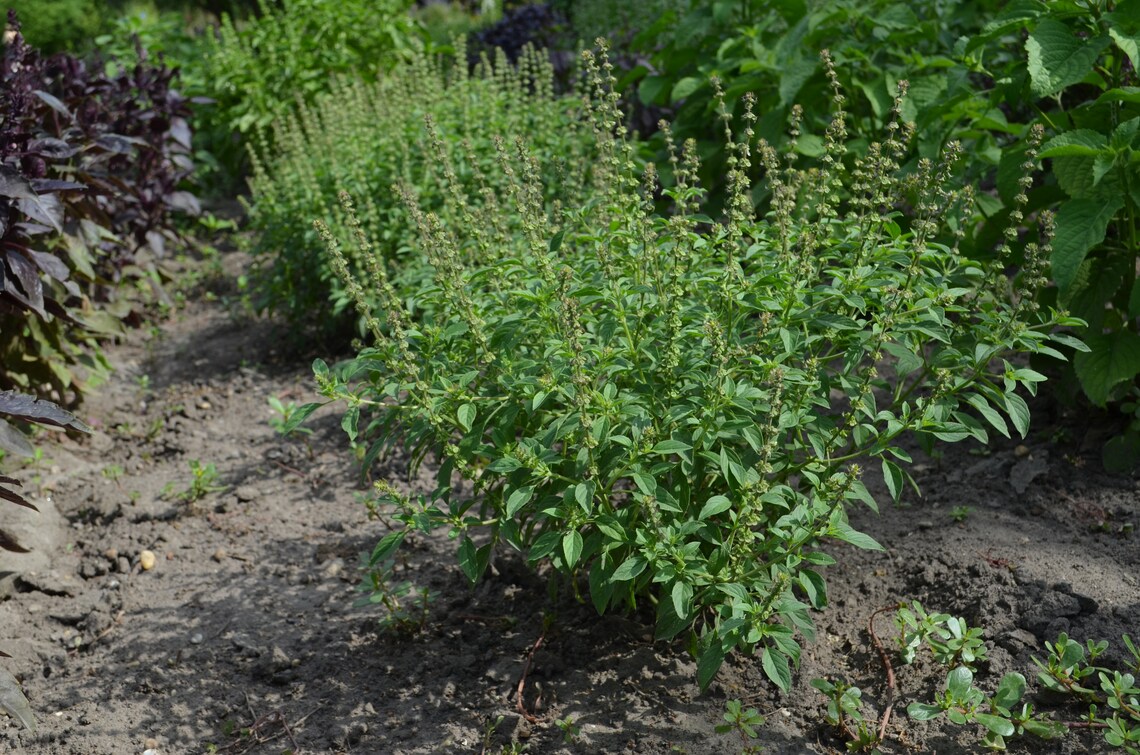

Une herbe. Elle pousse à partir de graines chaque année. Les plantes mesurent entre 30 et 50 cm de hauteur. La tige est à quatre côtés et ramifiée. Les feuilles sont sim ... (traduction automatique)
→suite


Basilic sauvage africain

Une herbe. Elle pousse à partir de graines chaque année. Les plantes mesurent entre 30 et 50 cm de hauteur. La tige est à quatre côtés et ramifiée. Les feuilles sont simples et opposées. Chacun est ... (traduction automatique) →suite
Pas d'autre illustration
pour le moment 😕
Ocimum canum
Classification
- Classique : en haut de l'écran, sous le coeur.
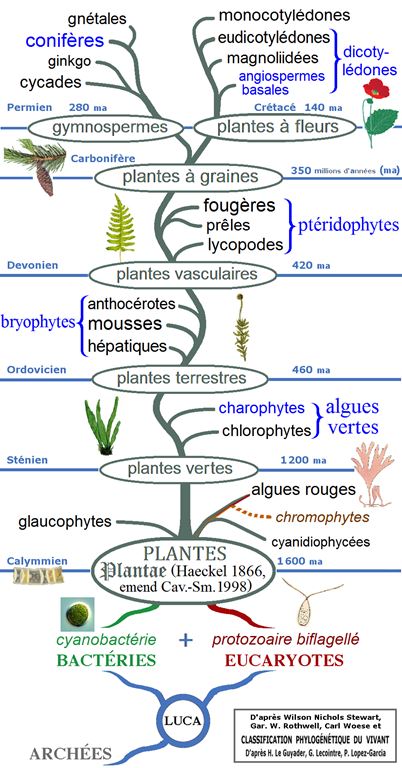
- Phylogénétique :
- Clade 4 : Angiospermes ;
- Clade 3 : Dicotylédones_vraies ;
- Clade 2 : Astéridées ;
- Clade 1 : Lamiidées ;
- Ordre APN : Lamiales ;
- Famille APN : Lamiaceae ;
À droite, cet arbre phylogénétique des plantes montre les principaux clades et groupes traditionnels (monophylétiques en noir et paraphylétiques en bleu).
Dénominations
- Nom botanique : Ocimum canum Sims (1824)
- Synonymes : See Ocimum americanu
- Noms anglais et locaux : wild african basil, hoary basil, Thai basil
Description et culture
Tableau récapitulatif
Parties comes-tibles Note comest. (1-5) Note medic. (1-5) (Zones de) Rusticité Besoins en 
Besoins en  (1-3)
(1-3)Périodes de semis et récoltes Graines au gramme Durée de viabilité Profon-deur semis Espace-ment plants Espace-ment lignes Durée germi-native Durée avant récolte J F M A M J
J A S O N D
J F M A M J
J A S O N D350
Nombre de graines au gramme :
350
- dont infos de 0FPI ("FOOD PLANTS INTERNATIONAL", en anglais) :
Description :
Une herbe. Elle pousse à partir de graines chaque année. Les plantes mesurent entre 30 et 50 cm de hauteur. La tige est à quatre côtés et ramifiée. Les feuilles sont simples et opposées. Chacun est perpendiculaire à celui du dessus et du dessous. Ils mesurent 2,5 à 5 cm de long sur 9 à 25 mm de large. La tige des feuilles mesure de 5 à 22 mm de long. Le groupe de fleurs est aux extrémités des branches. Ils mesurent jusqu'à 13,5 cm de long. Les fruits mesurent 4,5-5,5 mm de long. Les petites noix sont ovales et presque triangulaires. Ils mesurent 1,5 mm de long sur 1 mm de large{{{0(+x) (traduction automatique).
Original : A herb. It grows from seed each year. Plants are 30-50 cm high. The stem is four sided and branched. The leaves are simple and opposite. Each one is at right angles to the one above and below it. They are 2.5-5 cm long by 9-25 mm wide. The leaf stalk is 5-22 mm long. The flower group is at the ends of branches. They are up to 13.5 cm long. The fruit are 4.5-5.5 mm long. The small nuts are oval and almost triangular. They are 1.5 mm long by 1 mm wide{{{0(+x).
 Consommation (rapports de comestibilité, parties utilisables et usages alimentaires correspondants)
Consommation (rapports de comestibilité, parties utilisables et usages alimentaires correspondants)Synonyme d'Ocimum americanum L. selon GRIN et TPL{{{(rp*).
Partie testée :
feuilles{{{0(+x) (traduction automatique). Original : Leaves{{{0(+x)| Taux d'humidité (%) | Énergie (kj) | Énergie (kcal) | Protéines (g) |
|---|---|---|---|
| 87.4 | 167 | 40 | 3.4 |
| Pro- vitamines A (µg) |
Vitamines C (mg) | Fer (mg) | Zinc (mg) |
| 0 | 0 | 2.0 | 0 |
 Risques et précautions à prendre
Risques et précautions à prendrenéant, inconnus ou indéterminés.
Autres infos
dont infos de 0FPI ("FOOD PLANTS INTERNATIONAL", en anglais) :
Statut :
C'est un légume cultivé commercialement. Il est vendu sur les marchés{{{0(+x) (traduction automatique).
Original : It is a commercially cultivated vegetable. It is sold in markets{{{0(+x).
Distribution :
Une plante tropicale. Il a tendance à se développer dans les zones où les précipitations sont inférieures à 1000 mm par an{{{0(+x) (traduction automatique).
Original : A tropical plant. It tends to grow in areas with a rainfall less than 1000 mm per year{{{0(+x).
Localisation :
Afrique, Asie, Bénin, Botswana, Cuba, Afrique de l'Est, Inde, Indochine, Indonésie, Malawi, Nord-est de l'Inde, Papouasie-Nouvelle-Guinée, PNG, Rwanda, Asie du Sud-Est, Afrique du Sud, Afrique australe, Sri Lanka, Thaïlande, Togo, Afrique de l'Ouest , Zambie{{{0(+x) (traduction automatique).
Original : Africa, Asia, Benin, Botswana, Cuba, East Africa, India, Indochina, Indonesia, Malawi, Northeastern India, Papua New Guinea, PNG, Rwanda, SE Asia, South Africa, Southern Africa, Sri Lanka, Thailand, Togo, West Africa, Zambia{{{0(+x).
Notes :
Il existe entre 100 et 150 espèces d'Ocimum. Il est utilisé comme médicament. Probablement maintenant Ocimum americanum{{{0(+x) (traduction automatique).
Original : There are between 100 and 150 Ocimum species. It is used as a medicine. Probably now Ocimum americanum{{{0(+x).
Liens, sources et/ou références
Liens :
/ ;Sources et/ou références :
bibliographie (liste des sources et/ou références de l'encyclopédie)
dont classification : IPNI ("International Plant Names Index", en anglais) ; Kew (POWO - "Plant Of the World Online", "Royal Botanical Garden", en anglais) ;
dont livres et bases de données : 0FPI ("FOOD PLANTS INTERNATIONAL", en anglais) ;
dont bibliographie/références de 0FPI ("FOOD PLANTS INTERNATIONAL", en anglais) :
Achigan-Dako, E, et al (Eds), 2009, Catalogue of Traditional Vegetables in Benin. International Foundation for Science. ; Anderson, E. F., 1993, Plants and people of the Golden Triangle. Dioscorides Press. p 216 ; Batawila, K., et al, 2007, Diversite et gestion des legumes de cueillete au Togo. African Journal of Food, Agriculture, Nutrition and Development 7( 3& 4): 66 ; Bot. Mag. 51: t. 2452. 1824 ; Burkill, I.H., 1966, A Dictionary of the Economic Products of the Malay Peninsula. Ministry of Agriculture and Cooperatives, Kuala Lumpur, Malaysia. Vol 2 (I-Z) p 1600 ; Facciola, S., 1998, Cornucopia 2: a Source Book of Edible Plants. Kampong Publications, p 131 ; Fowler, D. G., 2007, Zambian Plants: Their Vernacular Names and Uses. Kew. p 43 ; Fox, F. W. & Young, M. E. N., 1982, Food from the Veld. Delta Books. p 247 ; GAMMIE, ; Jacquat, C., 1990, Plants from the Markets of Thailand. D.K. Book House p 99 ; Kays, S. J., and Dias, J. C. S., 1995, Common Names of Commercially Cultivated Vegetables of the World in 15 languages. Economic Botany, Vol. 49, No. 2, pp. 115-152 ; Martin, F.W. & Ruberte, R.M., 1979, Edible Leaves of the Tropics. Antillian College Press, Mayaguez, Puerto Rico. p 99, 196 ; Miguel, E., et al, 1989, A checklist of the cultivated plants of Cuba. Kulturpflanze 37. 1989, 211-357 ; Ochse, J.J. et al, 1931, Vegetables of the Dutch East Indies. Asher reprint. p 355 ; Peters, C. R., O'Brien, E. M., and Drummond, R.B., 1992, Edible Wild plants of Sub-saharan Africa. Kew. p 118 ; Purseglove, J.W., 1968, Tropical Crops Dicotyledons, Longmans. p 636 ; Roodt, V., 1998, Common Wild Flowers of the Okavango Delta. Medicinal Uses and Nutritional value. The Shell Field Guide Series: Part 2. Shell Botswana. p 101 ; SHANKARNARAYAN & SAXENA, ; Singh, P.K., Singh, N.I., and Singh, L.J., 1988, Ethnobotanical Studies on Wild Edible Plants in the Markets of Manipur - 2. J. Econ. Tax. Bot. Vol. 12 No. 1 pp 113-119 ; Solomon, C., 2001, Encyclopedia of Asian Food. New Holland. p 24, 25 ; Terra, G.J.A., 1973, Tropical Vegetables. Communication 54e Royal Tropical Institute, Amsterdam, p 64 ; Thokchom, R., et al, 2016, Documentation and assessment of wild medicinal and edible flowers of valley districts of Manipur. International Journal of Research in Applied, Natural and Social Sciences. 4(11):13-20 ; van Wyk, B., 2005, Food Plants of the World. An illustrated guide. Timber press. p 265 ; Vernon, R., 1983, Field Guide to Important Arable Weeds of Zambia. Dept of Agriculture, Chilanga, Zambia. p 62 ; Williamson, J., 2005, Useful Plants of Malawi. 3rd. Edition. Mdadzi Book Trust. p 176 ; Wossa, S. W. et al, 2008, Volatile Chemical Constituents of three Ocimum species (Lamiaceae) from Papua New Guinea. The South Pacific Journal of Natural Science 26, 2008, 25-
Recherche de/pour :
- "Ocimum canum" sur Google (pages et
images) ;
TPL ("The Plant List", en anglais) ;
GRIN ("Germplasm Resources Information Network", en anglais) ;
TROPICOS (en anglais) ;
Tela Botanica ;
Pl@ntNet ;
Pl@ntUse ;
"Plants For A Future" (en anglais) ;
"Useful Tropical Plants" (en anglais) ou
"Useful Temperate Plants" (en anglais) ;
- "Basilic sauvage africain" sur Google (pages, images et recettes) ;
- "Ocimum canum" sur Google (pages et
images) ;
TPL ("The Plant List", en anglais) ;
GRIN ("Germplasm Resources Information Network", en anglais) ;
TROPICOS (en anglais) ;
Tela Botanica ;
Pl@ntNet ;
Pl@ntUse ;
"Plants For A Future" (en anglais) ;
"Useful Tropical Plants" (en anglais) ou
"Useful Temperate Plants" (en anglais) ;
Espèces du même genre (Ocimum)
18 taxons
- Basilic
- Basilic à petites feuilles
- Basilic camphre
- Basilic péruvien
- Basilic piment
- Basilic pubescent
- Basilic sacré
- Basilic suave a feuilles lisses
- Ocimum americanum L. (Basilic pubescent)
- Ocimum angustifolium Benth.
- Ocimum arborescens Bojer ex Benth.
- Ocimum basilicum L. (Basilic)
- Ocimum campechianum Mill. (Basilic péruvien)
- Ocimum carnosum (Spreng.) Link & Otto ex Benth. (Basilic piment)
- Ocimum forskolei
- Ocimum grandiflorum Blume
- Ocimum gratissimum L. (Basilic suave a feuilles lisses)
- Ocimum kilimandscharicum Baker ex Gürke (Basilic camphre)
- Ocimum lamiifolium Hochst. ex Benth.
- Ocimum micranthum Willd.
- Ocimum minimum L. (Basilic à petites feuilles)
- Ocimum obovatum E.Mey. ex Benth.
- Ocimum ovatum Willd. ex Benth.
- Ocimum tenuiflorum L. (Basilic sacré)
- Ocimum x africanum
Espèces de la même famille (Lamiaceae)
982 taxons
- Agastache à feuilles d'ortie
- Agastache à fleurs pâles
- Agastache argentée
- Agastache dorée
- Agastache géante jaune
- Agastache géante pourpre
- Agastache lavande
- Agastache mexicaine
- Agastache rupestre
- Agripaume
- Agripaume de Sibérie
- Agripaume du Japon
- Anis hysope
- Arbre aux bonbons
- Arbre du clergé
- Arbuste aux bonbons du Japon
- Ballote
- Basilic
- Basilic à épis nombreux
- Basilic à petites feuilles
- Basilic camphre
- Basilic péruvien
- Basilic piment
- Basilic pubescent
- Basilic sacré
- Basilic suave a feuilles lisses
- Baume de gilead
- Baume vietnamien
- Bétoine
- Brunelle
- Brunelle commune
- Bugle pyramidal
- Bugle rampante
- Calament
- Calament à feuilles de menthe
- Calament à grandes fleurs
- Calament des Alpes
- Cataire
- Cataire de sibérie
- Cataire géante (tp* de "giant catmint")
- Cataleptique de Virginie
- Chan
- Chia
- Clérodendron d'Inde
- Clérodendron de Chine
- Clérodendron de Wallich
- Clérodendron paniculé
- Clinopode commun
- Coleus à feuilles rondes
- Crapaudine espacée
- Achyrospermum wallichianum (Benth.) Benth. ex Hook.f.
- Acinos alpinus
- Acinos arvensis
- Acinos rotundifolius Friv. ex Walp.
- Aegiphila alba Moldenke
- Aegiphila bogotensis
- Aegiphila brachiata Schltdl. & Cham.
- Aegiphila martinicensis Jacq.
- Aegiphila verticillata Vell.
- Aeollanthus frutescens
- Aeollanthus pubescens Benth.
- Aeollanthus suaveolens Mart. ex Spreng.
- Agastache aurantiaca (A.Gray) Lint & Epling (Agastache dorée)
- Agastache breviflora (A.Gray) Epling
- Agastache cana (Hook.) Wooton & Standl. (Agastache argentée)
- Agastache foeniculum (Pursh) Kuntze (Anis hysope)
- Agastache mexicana (Kunth) Lint & Epling (Agastache mexicaine)
- Agastache neomexicana (Agastache lavande)
- Agastache nepetoides (L.) Kuntze (Agastache géante jaune)
- Agastache pallida (Lindl.) Cory
- Agastache pallidiflora (A. Heller) Rydb. (Agastache à fleurs pâles)
- Agastache rugosa (Fisch. & C. A. Mey.) Kuntze (Menthe-réglisse coréenne)
- Agastache rupestris (Greene) Standl. (Agastache rupestre)
- Agastache scrophulariifolia (Willd.) Kuntze (Agastache géante pourpre)
- Agastache urticifolia (Benth.) Kuntze (Agastache à feuilles d'ortie)
- Agastache wrightii
- Ajuga graecorum
- Ajuga integrifolia Buch.-Ham. ex D.Don
- Ajuga macrosperma Wall. ex Benth.
- Ajuga pyramidalis L. (Bugle pyramidal)
- Ajuga reptans L. (Bugle rampante)
- Alvesia rosmarinifolia Welw.
- Anisochilus carnosus
- Anisochilus siamensis Ridl.
- Anisomeles indica
- Ballota nigra L. (Ballote)
- Ballota rotundifolia K.Koch
- Basilicum polystachyon (Basilic à épis nombreux)
- Blephilia ciliata (L.) Benth.
- Blephilia hirsuta (Pursh) Benth.
- Bystropogon canariensis (L.) L'Hér. (Menthe des Canaries)
- Calamintha incana
- Calamintha nepeta Willk.
- Calamintha sylvatica Bromf.
- Callicarpa acuminata Roxb.
- Callicarpa americana L. (Arbre aux bonbons)
- Callicarpa arborea Miq. ex C.B.Clarke
- Callicarpa erioclona Schauer
- Callicarpa japonica Thunb. (Arbuste aux bonbons du Japon )
- Callicarpa kochiana Makino
- ...







 donne accès au menu
  - encyclopédies des plantes alimentaires ;
 - page de recherche - reconnaissance (identification) de plantes ;
 - page du calendrier lunaire et son générateur (au format PDF et JPG) ;
 - tableau récapitulatif ;
 - générateur de potées (soupes), avec estimation des apports nutrionnels et du coût;
 - générateur de codes QR ;
 - page des archives avec de nombreux documents sur différents thèmes complémentaires comme la botanique, les légumes,
les champignons, la cuisine, le bien-être ainsi que différents MOOC mais également des liens vers les archives de l'association ;
- page des archives avec de nombreux documents sur différents thèmes complémentaires comme la botanique, les légumes,
les champignons, la cuisine, le bien-être ainsi que différents MOOC mais également des liens vers les archives de l'association ;

 pour le fruit (et/ou les graines, la pulpe, etc...),
 pour les fleurs (et/ou pétales, calice...),
 pour les feuilles (et/ou la tige, les pousses...),
 pour les racines,
 pour le tronc (et/ou l'écorce, la sève...), et enfin
 pour les champignons,
puis les notes alimentaires et médicinales (de 1 à 5 étoiles), la rusticité (résistance au froid/gel)
et pour finir un résumé.
pour les champignons,
puis les notes alimentaires et médicinales (de 1 à 5 étoiles), la rusticité (résistance au froid/gel)
et pour finir un résumé. menant ici 🙂
 ,
,  et
et





 ,
,


 Encyclopédie(s)
 Recherche-Reconnaissance
 Tableau récapitulatif
 Codes QR
 Archives
 Calendrier(s) lunaire(s)
  Potées
 Re-naturation/naturalisation
 Affichettes, herbiers &
co.
Affichettes, herbiers &
co. menu
menu galerie


 (en bas à droite).
 (en bas à gauche).
