Coeur (menu général)
Vita > Plantae > Magnoliophyta > Magnoliopsida > Solanales >
Solanaceae > Solanum > Solanum nigrum - idu : 38184
! Nouveau site ici ! Recherche simple
Flèche gauche Fiche précédente | AVI. O | Fiche suivante Flèche droite
! Nouveau site ici !
Vita > Plantae > Magnoliophyta > Magnoliopsida > Solanales > Solanaceae > Solanum
AVI. O

  ↗
↗
Explications de "AVI.O" :

le A, qui pointe vers le haut, permet de remonter,
le V, qui pointe vers le bas, permet de descendre,
le I permet de dérouler toute la page
(les différentes catégories)
et le O amène ici,
où vous pouvez revenir à l'origine,
en cliquant n'importe où 🙂


À suivre !


Note alimentaire  

MiamMiam     |    

   Note médicinale  

SosSos

Flèche gauche  aléatoire  Flèche droite

Accueil Rafraichir AVI.O


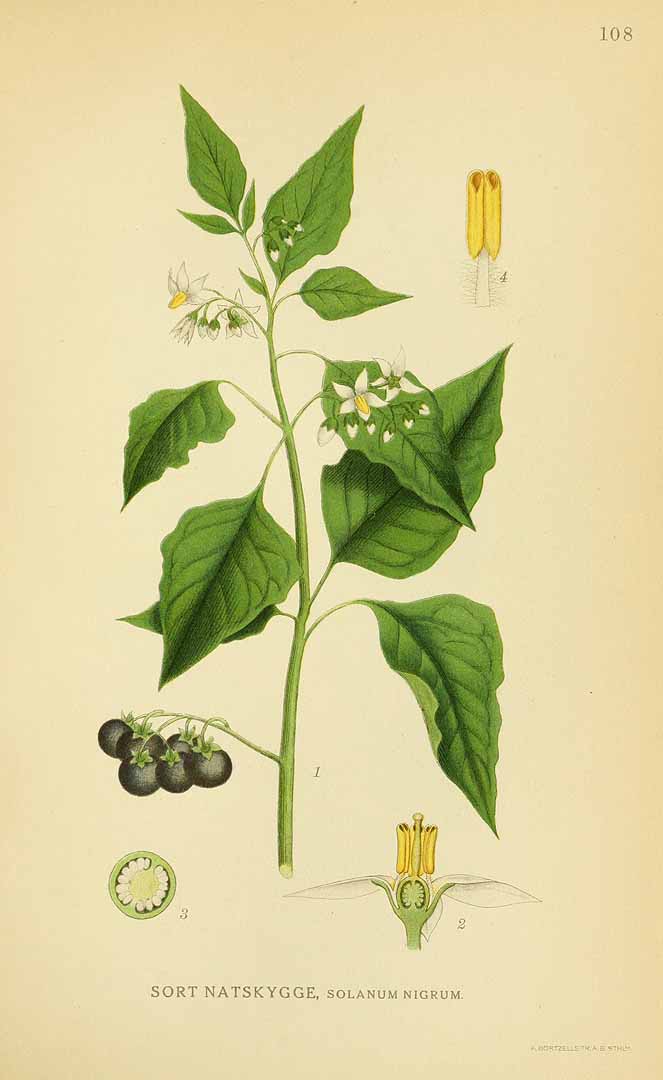
Illustration Solanum nigrum, Par Lindman, C.A.M., Bilder ur Nordens Flora Bilder Nordens Fl. vol. 1 (1922), via plantillustrations
      Illustration Solanum nigrum, Par Lindman, C.A.M., Bilder ur Nordens Flora Bilder Nordens Fl. vol. 1 (1922), via plantillustrations  - Fermer      

Par Lindman, C.A.M., Bilder ur Nordens Flora Bilder Nordens Fl. vol. 1 (1922), via plantillustrations


✖


  • Détails

    :

      ✖

      MORELLE NOIRE

      Solanum nigrum L.

      Famille des Solanées.


      Synonymes : M. de Pile de France, M. commune, Brède, Crève-chien, Herbe aux magiciens, Morette, Raisin de loup.

      Noms étrangers : Nightshade, Black nightshade (en), Yerbesserter Nachtschatten Spinat (de), Erba mora (it), Yerba mora (es).


      Annuelle. — Indigène ou naturalisée. — La morelle noire est une plante spontanée très connue et généralement regardée comme mauvaise herbe, qui croît surtout au voisinage des habitations et dans les endroits cultivés. Elle a une tige dressée, ramifiée, s’élevant de 0m,40 à 0m,80, avec des feuilles simples, larges, ovales, souvent ondulées sur les bords ; fleurs blanches, étoilées, réunies en petits bouquets axillaires et faisant place à des baies sphériques, de la grosseur d’un pois, noires ou rarement jaune ambré, contenant une pulpe verdâtre entremêlée de graines lenticulaires très petites, d’un jaune pâle. Un gramme de ces graines en contient environ 800, et le litre pèse 600 grammes ; leur durée germinative est de cinq années.

      La race de morelle qui est cultivée à l’île de France sous le nom de Brède ne diffère aucunement par ses caractères botaniques de notre morelle noire commune ; elle se distingue seulement en ce qu’elle est plus vigoureuse et plus grande dans toutes ses parties.

      Culture. — La morelle noire se sème en place au mois d’avril, en planches, ou mieux en rayons espacés de 0m,30 à 0m,40. Elle ne demande aucun soin après la levée et l’éclaircissage, et résiste parfaitement aux sécheresses. Cependant les feuilles sont plus tendres et plus abondantes si l’on donne au besoin à la plante quelques bons arrosements.

      Usage. — Cette plante reste chez nous sans emploi, mais dans les pays chauds on en consomme quelquefois les feuilles en guise d’épinards, et, bien qu’appartenant à la famille des solanées, ce légume ne parait avoir aucun fâcheux effetµ{{{75(+x)µ.


  • Dénominations

    :

      ✖

    • Nom botanique :

      Solanum nigrum L. (1753)

    • Synonymes français

      :

      tue-chien [Solanum nigrum et subsp. nigrum], raisin de loup, chichiquelite, morelle vert jaune [Solanum nigrum et subsp. nigrum], morelle commune, morelle des jardins, morelle à fruits noirs, morelle noire [subsp. nigrum], brède bleue [var. nodiflorum], brède malgache [var. nodiflorum], morelle de Schultes [subsp. schultesii], calalou, brède morelle, brède monsieur, brède martin

    • Synonymes

      :

      Solanum guineense sensu Lam non Linne, Solanum incertum Dun, Solanum opacum A. Braun & Bouche, Solanum rubrum Mill, Solanum schultesii Opiz, See also Solanum intrusum

    • Noms anglais et locaux

      :

      black nightshade, blackberry nightshade, common nightshade, poisonberry, blackberried nightshade, enab el-deeb (ar), schwarzer Nachtschatten (de), erva-moura (pt), pimenta-de-galinha (pt,br), hierba mora (es), nattskatta (sv) ;


  • Description et culture

    :

      ✖

    • Description détaillée

      :

      MORELLE NOIRE

      Solanum nigrum L.

      Famille des Solanées.


      Synonymes : M. de Pile de France, M. commune, Brède, Crève-chien, Herbe aux magiciens, Morette, Raisin de loup.

      Noms étrangers : Nightshade, Black nightshade (en), Yerbesserter Nachtschatten Spinat (de), Erba mora (it), Yerba mora (es).


      Annuelle. — Indigène ou naturalisée. — La morelle noire est une plante spontanée très connue et généralement regardée comme mauvaise herbe, qui croît surtout au voisinage des habitations et dans les endroits cultivés. Elle a une tige dressée, ramifiée, s’élevant de 0m,40 à 0m,80, avec des feuilles simples, larges, ovales, souvent ondulées sur les bords ; fleurs blanches, étoilées, réunies en petits bouquets axillaires et faisant place à des baies sphériques, de la grosseur d’un pois, noires ou rarement jaune ambré, contenant une pulpe verdâtre entremêlée de graines lenticulaires très petites, d’un jaune pâle. Un gramme de ces graines en contient environ 800, et le litre pèse 600 grammes ; leur durée germinative est de cinq années.

      La race de morelle qui est cultivée à l’île de France sous le nom de Brède ne diffère aucunement par ses caractères botaniques de notre morelle noire commune ; elle se distingue seulement en ce qu’elle est plus vigoureuse et plus grande dans toutes ses parties.

      Culture. — La morelle noire se sème en place au mois d’avril, en planches, ou mieux en rayons espacés de 0m,30 à 0m,40. Elle ne demande aucun soin après la levée et l’éclaircissage, et résiste parfaitement aux sécheresses. Cependant les feuilles sont plus tendres et plus abondantes si l’on donne au besoin à la plante quelques bons arrosements.

      Usage. — Cette plante reste chez nous sans emploi, mais dans les pays chauds on en consomme quelquefois les feuilles en guise d’épinards, et, bien qu’appartenant à la famille des solanées, ce légume ne parait avoir aucun fâcheux effetµ{{{75(+x)µ.

    • Nombre de graines au gramme

      : 800


    • dont infos de "FOOD PLANTS INTERNATIONAL" :


      • Description

        :

        Une herbe lisse et ramifiée dressée. Il pousse environ 60-100 cm de haut. Les tiges sont vertes et 3 coudées. Les feuilles sont pointues aux deux extrémités. Les feuilles mesurent 1,3 à 9 cm de long sur 0,5 à 6 cm de large. Ils sont oblongs et effilés jusqu'à la pointe. Ils peuvent avoir des lobes ondulés. L'anneau intérieur des pétales est blanc et mesure environ 8 mm de diamètre. Les fruits sont noirs, lisses et ronds. Ils pendent vers le bas.

        Certaines personnes affirment qu'il s'agit peut-être maintenant de Solanum americanum{{{0(+x) (traduction automatique).

        Original : An erect branched smooth herb. It grows about 60-100 cm high. The stems are green and 3 angled. Leaves are pointed at both ends. The leaves are 1.3-9 cm long by 0.5-6 cm wide. They are oblong and taper to the tip. They can have wavy lobes. The inner ring of petals are white and about 8 mm across. The fruit are black, smooth and round. They hang downwards. Some people claim it is possibly now Solanum americanum{{{0(+x).

      • Production

        :

        Les graines germent environ une semaine après la plantation. Les feuilles peuvent être récoltées après environ 8 à 10 semaines en coupant les 5 derniers cm de chaque branche. Des rendements élevés peuvent être obtenus. 5-8 récoltes sur 6-8 semaines sont possibles. Solanum nigrum pousse rapidement, a une production élevée de graines et une viabilité élevée des graines. Cela lui donne une compétitivité en tant qu'espèce adventice, mais cela signifie également que c'est l'un des premiers légumes verts comestibles récoltés dans un nouveau jardin{{{0(+x) (traduction automatique).

        Original : Seeds germinate about a week after planting. Leaves can be harvested after about 8-10 weeks by cutting off the last 5 cm of each branch. High yields can be obtained. 5-8 harvests over 6-8 weeks are possible.Solanum nigrum grows rapidly, has high seed production and high viability of seed. This gives it a competitiveness as a weedy species but also means it is one of the first harvested edible greens from a new garden{{{0(+x).

      • Culture

        :

        Il est cultivé à partir de graines. Dans les régions tropicales des hautes terres, il est presque toujours auto-semé ou encouragé en brûlant les prairies, mais ensuite désherbé et récolté comme une composante normale du jardin. Dans les zones côtières, les graines sont semées à la volée. De bons rendements peuvent être obtenus avec des niveaux de fertilité modérés. Un espacement de 40 cm x 40 cm convient. La garniture encourage la ramification. Il peut être cultivé à partir de boutures. Les plantes sont également cultivées en pépinière et en repiquage{{{0(+x) (traduction automatique).

        Original : It is grown from seed. In the tropical highlands areas it is almost always self sown or encouraged by burning grassland but then weeded and harvested as a normal component of the garden. In coastal areas seeds are sown by broadcasting. Good yields can be obtained under moderate fertility levels. A spacing of 40 cm x 40 cm is suitable. Topping encourages branching. It can be grown from cuttings.Plants are also grown in nurseries and transplanting{{{0(+x).


  • Miam

    Consommation

    (rapports de comestibilité, parties utilisables et usages alimentaires correspondants) :

      ✖

    Partie(s) comestible(s)µ{{{0(+x)µ : fruit, feuilles, légumeµ{{{0(+x)µ.
    Utilisation(s)/usage(s)µ{{{0(+x)
    µ culinaires :
    -les fruitsµ{{{0(+x),2(+)µ mûrs sont cuits et mangés ; ils sont également utilisés pour la soupe ; ils peuvent être cuits ou transformés en tartes, confitures, conserves, desserts, sauces, pâtisseries et une relish épicée ;
    -les feuilles et les jeunes pousses sont consommées cuitesµ{{{0(+x)µ (ex. : comme potherbe, brèdeµ{{{(dp*)µ) ; les feuilles récoltées peuvent être stockées pendant 2-3 joursµ{{{0(+x)µ.(1*)


    Partie testée

    : feuilles{{{0(+x) (traduction automatique).

    Original : Leaves{{{0(+x)

    Taux d'humidité Énergie (kj) Énergie (kcal) Protéines (g)
    87 160 38 4.3

    Pro-
    vitamines A (µg)
    Vitamines C (mg) Fer (mg) Zinc (mg)
    70 20 1.0 /


  • Précautions

    Risques et précautions à prendre

    :

      ✖

    (1*)ATTENTIONµ0(+x)µ : les fruits peuvent contenir de la solanine (alcaloïde), probablement quand ils sont immaturesµ{{{0(+x)µ.


  • Autres infos

    :

      ✖

    on distingue plusieurs variétés de morelle : brèdes gros grains et brèdes ti grainsµ{{{Wikiµ.


    dont infos de "FOOD PLANTS INTERNATIONAL" :

    • Statut

      :

      C'est un légume cultivé commercialement. C'est une plante alimentaire importante dans tous les tropiques. Légume vert couramment utilisé dans la plupart des régions de Papouasie-Nouvelle-Guinée. Il pousse principalement à l'état sauvage dans les hautes terres et est cultivé sur la côte. Les feuilles sont vendues sur les marchés locaux. Les fruits mûrs sont consommés par les enfants{{{0(+x) (traduction automatique).

      Original : It is a commercially cultivated vegetable. It is a significant food plant throughout the tropics. A commonly used green vegetable in most areas of Papua New Guinea. It mostly grows wild in the highlands and is cultivated on the coast. Leaves are sold in local markets. The ripe fruit are eaten by children{{{0(+x).

    • Distribution

      :

      C'est une plante de climat tempéré et tropical. Ils se produisent dans des décharges à basse et moyenne altitude dans tout le pays. Il pousse du niveau de la mer jusqu'à des altitudes élevées telles que 2700 m sous les tropiques. Il arrive souvent de se semer après les incendies. Il est cultivé dans la plupart des pays tropicaux comme légume à feuilles vertes. Il se produit entre 600 et 3000 m dans le sud de la Chine. Au Népal, il atteint environ 2900 m d'altitude. Il peut pousser dans les régions où les précipitations annuelles sont inférieures à 500 mm. Il peut pousser dans des endroits arides. Herbier de Tasmanie. Au Sichuan et au Yunnan{{{0(+x) (traduction automatique).

      Original : It is a temperate and tropical climate plant. They occur in waste places at low and medium altitudes throughout the country. It grows from sea level up to high altitudes such as 2700 m in the tropics. It often comes up self sown after fires. It is grown in most tropical countries as a green leafy vegetable. It occurs between 600-3000 m in southern China. In Nepal it grows to about 2900 m altitude. It can grow in areas with an annual rainfall below 500 mm. It can grow in arid places. Tasmania Herbarium. In Sichuan and Yunnan{{{0(+x).

    • Localisation

      :

      Afghanistan, Afrique, Angola, Asie, Australie, Autriche, Îles Baléares, Balkans, Bangladesh, Belgique, Belize, Bénin, Bhoutan, Bolivie, Bosnie, Botswana, Grande-Bretagne, Bulgarie, Burkina Faso, Burundi, Cambodge, Cameroun, Afrique centrale, Afrique centrale Amérique, Tchad, Chili, Chine, Colombie, RD Congo, Corse, Costa Rica, Crète, Chypre, République tchèque, Danemark, Afrique de l'Est, Timor oriental, Île de Pâques, Équateur, Égypte, El Salvador, Eswatini, Éthiopie, Europe, Fidji , Finlande, France, Allemagne, Ghana, Grande-Bretagne, Grèce, Guatemala, Guinée, Guinée, Guinée-Bissau, Himalaya, Hongrie, Inde, Indochine, Indonésie, Irak, Irlande, Israël, Italie, Japon, Kenya, Corée, Koweït, Laos, Lesotho, Libye, Macédoine, Madagascar, Malawi, Malaisie, Mali, Mauritanie, Maurice, Méditerranée, Mexique, Mongolie, Maroc, Mozambique, Myanmar, Namibie, Népal, Nouvelle-Calédonie, Nouvelle-Zélande,Niger, Nigéria, Afrique du Nord, Inde du Nord-Est, Norvège, Amérique du Nord, Inde du Nord-Est, Inde du Nord-Ouest, Oman, Pacifique, Pakistan, Papouasie-Nouvelle-Guinée, PNG, Philippines, Pologne, Portugal, Qatar, Roumanie, Russie, Rwanda, Sao Tomé et Principe, Sardaigne, Arabie Saoudite, Scandinavie, Asie du Sud-Est, Sénégal, Sicile, Sierra Leone, Sikkim, Slovaquie, Socotra, Îles Salomon, Somalie, Afrique du Sud, Afrique australe, Amérique du Sud, Soudan du Sud, Espagne, Sri Lanka, Soudan, Swaziland Afrique de l'Ouest, Suède, Suisse, Syrie, Taiwan, Tanzanie, Tasmanie, Thaïlande, Pays-Bas, Tibet, Timor-Leste, Tonga, Tunisie, Turquie, Ouganda, Emirats Arabes Unis, Vanuatu, Vietnam, Yémen, Yougoslavie , Zambie, Zimbabwe,Pologne, Portugal, Qatar, Roumanie, Russie, Rwanda, Sao Tomé-et-Principe, Sardaigne, Arabie saoudite, Scandinavie, Asie du Sud-Est, Sénégal, Sicile, Sierra Leone, Sikkim, Slovaquie, Socotra, Îles Salomon, Somalie, Afrique du Sud, Afrique australe , Amérique du Sud, Soudan du Sud, Espagne, Sri Lanka, Soudan, Swaziland, Suède, Suisse, Syrie, Taïwan, Tanzanie, Tasmanie, Thaïlande, Pays-Bas, Tibet, Timor-Leste, Tonga, Tunisie, Turquie, Ouganda, Emirats Arabes Unis , EAU, USA, Vanuatu, Vietnam, Afrique de l'Ouest, Yémen, Yougoslavie, Zambie, Zimbabwe,Pologne, Portugal, Qatar, Roumanie, Russie, Rwanda, Sao Tomé-et-Principe, Sardaigne, Arabie saoudite, Scandinavie, Asie du Sud-Est, Sénégal, Sicile, Sierra Leone, Sikkim, Slovaquie, Socotra, Îles Salomon, Somalie, Afrique du Sud, Afrique australe , Amérique du Sud, Soudan du Sud, Espagne, Sri Lanka, Soudan, Swaziland, Suède, Suisse, Syrie, Taïwan, Tanzanie, Tasmanie, Thaïlande, Pays-Bas, Tibet, Timor-Leste, Tonga, Tunisie, Turquie, Ouganda, Emirats Arabes Unis , EAU, USA, Vanuatu, Vietnam, Afrique de l'Ouest, Yémen, Yougoslavie, Zambie, Zimbabwe,Taiwan, Tanzanie, Tasmanie, Thaïlande, Pays-Bas, Tibet, Timor-Leste, Tonga, Tunisie, Turquie, Ouganda, Emirats Arabes Unis, Emirats Arabes Unis, USA, Vanuatu, Vietnam, Afrique de l'Ouest, Yémen, Yougoslavie, Zambie, Zimbabwe,Taiwan, Tanzanie, Tasmanie, Thaïlande, Pays-Bas, Tibet, Timor-Leste, Tonga, Tunisie, Turquie, Ouganda, Emirats Arabes Unis, Emirats Arabes Unis, USA, Vanuatu, Vietnam, Afrique de l'Ouest, Yémen, Yougoslavie, Zambie, Zimbabwe{{{0(+x) (traduction automatique).

      Original : Afghanistan, Africa, Angola, Asia, Australia, Austria, Balearic Islands, Balkans, Bangladesh, Belgium, Belize, Benin, Bhutan, Bolivia, Bosnia, Botswana, Britain, Bulgaria, Burkina Faso, Burundi, Cambodia, Cameroon, Central Africa, Central America, Chad, Chile, China, Colombia, Congo DR, Corsica, Costa Rica, Crete, Cyprus, Czech Republic, Denmark, East Africa, East Timor, Easter Island, Ecuador, Egypt, El Salvador, Eswatini, Ethiopia, Europe, Fiji, Finland, France, Germany, Ghana, Great Britain, Greece, Guatemala, Guinea, Guinée, Guinea-Bissau, Himalayas, Hungary, India, Indochina, Indonesia, Iraq, Ireland, Israel, Italy, Japan, Kenya, Korea, Kuwait, Laos, Lesotho, Libya, Macedonia, Madagascar, Malawi, Malaysia, Mali, Mauritania, Mauritius, Mediterranean, Mexico, Mongolia, Morocco, Mozambique, Myanmar, Namibia, Nepal, New Caledonia, New Zealand, Niger, Nigeria, North Africa, Northeastern India, Norway, North America, Northeastern India, NW India, Oman, Pacific, Pakistan, Papua New Guinea, PNG, Philippines, Poland, Portugal, Qatar, Romania, Russia, Rwanda, Sao Tome and Principe, Sardinia, Saudi Arabia, Scandinavia, SE Asia, Senegal, Sicily, Sierra Leone, Sikkim, Slovakia, Socotra, Solomon Islands, Somalia, South Africa, Southern Africa, South America, South Sudan, Spain, Sri Lanka, Sudan, Swaziland, Sweden, Switzerland, Syria, Taiwan, Tanzania, Tasmania, Thailand, The Netherlands, Tibet, Timor-Leste, Tonga, Tunisia, Turkey, Uganda, United Arab Emirates, UAE, USA, Vanuatu, Vietnam, West Africa, Yemen, Yugoslavia, Zambia, Zimbabwe{{{0(+x).

    • Notes

      :

      Il existe environ 1400 espèces de Solanum. Démo Composition chimique (fruit, échantillon chinois): Protéine = 2,51%. Lipides = 0,56%. Glucides = 5,66%. Cendres 1,19%. Les feuilles peuvent contenir un élément toxique. Les graines peuvent être supérieures à la moyenne pour les plantes angiospermeuses dans les acides aminés Alanine, Phénylalanine et Threonine. Dans la liste des plantes, il a ceci comme synonyme de Solanum americanum. Il est riche en proVitamine A{{{0(+x) (traduction automatique).

      Original : There are about 1400 Solanum species. Demo Chemical composition (fruit, Chinese sample): Protein = 2.51%. Fat = 0.56%. Carbohydrate = 5.66%. Ash 1.19%. Leaves may contain a toxic element. Seeds may be above-average for angiospermous plants in the amino acids Alanine, Phenylalanine, and Threonine. In The Plant List it has this as a synonym of Solanum americanum. It is high in proVitamin A{{{0(+x).


  • Liens, sources et/ou références


      ✖

    • Sources et/ou références :

      Tela Botanica ; INPI ; "Eat The Weeds and other things, too" (en anglais) ; Éco-logique : le blog de François Dumas ; Wikipedia ; Wikipedia (en anglais) ; Wikipedia (en anglais) ; 5"Plants For A Future" (en anglais) ;

      dont classification :
      "The Plant List" (en anglais) ; 2"GRIN" (en anglais) ; Kew (POWO - "Plant Of the World Online", "Royal Botanical Garden", en anglais) ;

      dont livres et bases de données : 0"Food Plants International" (en anglais), 76Le Potager d'un curieux - histoire, culture et usages de 250 plantes comestibles peu connues ou inconnues (livre, page 410, par A. Paillieux et D. Bois) ;

      76Le potager d'un curieux - histoire, culture et usages de 250 plantes comestibles, peu connues ou inconnue (par Auguste Pailleux et Désiré Bois, 3ème édition de 1899) / détails du livre

      dont biographie/références de "FOOD PLANTS INTERNATIONAL" :

      Abbiw, D.K., 1990, Useful Plants of Ghana. West African uses of wild and cultivated plants. Intermediate Technology Publications and the Royal Botanic Gardens, Kew. p 41 Acipa, A. et al, 2013, Nutritional Profile of some Selected Food Plants of Otwal and Ngai Counties, Oyam District, Northern Uganda. African Journal or Food, Agriculture, Nutrition and Development. 13(2) Addis, G., et al, 2005, Ethnobotanical Study of Edible Wild Plants in Some Selected Districts of Ethiopia. Human Ecology, Vol. 33, No. 1, pp. 83-118 Agea, J. G., et al 2011, Wild and Semi-wild Food Plants of Bunyoro-Kitara Kingdom of Uganda: etc. Environmental Research Journal 5(2) 74-86 Ambasta, S.P. (Ed.), 2000, The Useful Plants of India. CSIR India. p 581 Anderson, E. F., 1993, Plants and people of the Golden Triangle. Dioscorides Press. p 221 Asfaw, Z. and Tadesse, M., 2001, Prospects for Sustainable Use and Development of Wild Food Plants in Ethiopia. Economic Botany, Vol. 55, No. 1, pp. 47-62 Barrau, J., 1976, Subsistence Agriculture in Polynesia and Micronesia. Bernice P. Bishop Museu, Bulletin 223 Honolulu Hawaii. Kraus reprint. p 59 Beckstrom-Sternberg, Stephen M., and James A. Duke. "The Foodplant Database." https://probe.nalusda.gov:8300/cgi-bin/browse/foodplantdb.(ACEDB version 4.0 - data version July 1994) Bindon, P., 1996, Useful Bush Plants. Western Australian Museum. p 233 Blamey, M and Grey-Wilson, C., 2005, Wild flowers of the Mediterranean. A & C Black London. p 405 Bodkin, F., 1991, Encyclopedia Botanica. Cornstalk publishing, p 934 Bodner, C. C. and Gereau, R. E., 1988, A Contribution to Bontoc Ethnobotany. Economic Botany, 43(2): 307-369 Bremness, L., 1994, Herbs. Collins Eyewitness Handbooks. Harper Collins. p 270 Burkill, I.H., 1966, A Dictionary of the Economic Products of the Malay Peninsula. Ministry of Agriculture and Cooperatives, Kuala Lumpur, Malaysia. Vol 2 (I-Z) p 2082 Cherikoff V. & Isaacs, J., The Bush Food Handbook. How to gather, grow, process and cook Australian Wild Foods. Ti Tree Press, Australia p 120, 191, 196 Cooper, W. and Cooper, W., 2004, Fruits of the Australian Tropical Rainforest. Nokomis Editions, Victoria, Australia. p 522 Crowe, A., 1997, A Field Guide to the Native Edible Plants of New Zealand. Penguin. p 72 Cribb, A.B. & J.W., 1976, Wild Food in Australia, Fontana. p 74 Dashorst, G.R.M., and Jessop, J.P., 1998, Plants of the Adelaide Plains & Hills. Botanic Gardens of Adelaide and State Herbarium. p 128 Diaz-Betancourt, M., et al, 2001, Weeds as a future source for human consumption. (On Plants For A Future website) Dogan, Y. et al, 2013, Wild Edible Plants sold in the Local Markets of Izmir, Turkey. Pak. J. Bot. 45(S1): 177-184 Dutta, U., 2012, Wild Vegetables collected by the local communities from the Churang reserve if BTDm Assam. International Journal of Science and Advanced Technology. Vol. 2(4) p 124 Edmonds, Jennifer M. and James A. Chweya. 1997. Black nightshades. Solanum nigrum L. and related species. Promoting the conservation and use of underutilized and neglected crops. 15. Institute of Plant Genetics and Crop Plant Research, Gatersleben/International Plant Genetic Resources Institute, Rome, Italy. Epenhuijsen C.W. van., 1974, Growing Native vegetables in Nigeria. FAO Rome, p 86 Ertug, F., 2004, Wild Edible Plants of the Bodrum Area. (Mugla, Turkey). Turk. J. Bot. 28 (2004): 161-174 Ethiopia: Famine Food Field Guide. https://www.africa.upenn.edu/faminefood/category2.htm Facciola, S., 1998, Cornucopia 2: a Source Book of Edible Plants. Kampong Publications, p 237 Flora of Australia Volume 49, Oceanic Islands 1, Australian Government Publishing Service, Canberra. (1994) p 299 Flora of Pakistan. www.eFloras.org Food Composition Tables for the Near East. https://www/fao.org/docrep No. 441 Fowler, D. G., 2007, Zambian Plants: Their Vernacular Names and Uses. Kew. p 61 French, B.R., 1986, Food Plants of Papua New Guinea, A Compendium. Asia Pacific Science Foundation p 60 French, B.R., 2010, Food Plants of Solomon Islands. A Compendium. Food Plants International Inc. p 73 GAMMIE; Gangwar, A. K. & Ramakrishnan, P. S., 1990, Ethnobotanical Notes on Some Tribes of Arunachal Pradesh, Northeastern India. Economic Botany, Vol. 44, No. 1 pp. 94-105 Gbile, Z. O. and Adesina, S. K., 1988, Nigerian Solanum Species of Economic Importance. Annals of the Missouri Botanical Garden, Vol. 75, No. 3. p 864 Godfrey, J. et al, 2013, Harvesting, preparation and preservation of commonly consumed wild and semi-wild food plants in Bunyoro-Kitara Kingdom, Uganda. Int. J. Med. Arom. Plants. Vol.3 No.2 pp 262-282 Goode, P., 1989, Edible Plants of Uganda. FAO p 26 Goode, P., 1989, Edible Plants of Uganda. FAO p 39 Grubben, G. J. H. and Denton, O. A. (eds), 2004, Plant Resources of Tropical Africa 2. Vegetables. PROTA, Wageningen, Netherlands. p 565 GUPTA & KANODIA, Harris, S., Buchanan, A., Connolly, A., 2001, One Hundred Islands: The Flora of the Outer Furneaux. Tas Govt. p 230 Hedrick, U.P., 1919, (Ed.), Sturtevant's edible plants of the world. p 619 HELY-HUTCHINSON, Henty, E.E., & Pritchard, G.S., 1973, Weeds of New Guinea and their control. Botany Bulletin No 7, Division of Botany, Lae, PNG. p 149 https://cypruswildflowers.com Hussey, B.M.J., Keighery, G.J., Cousens, R.D., Dodd, J., Lloyd, S.G., 1997, Western Weeds. A guide to the weeds of Western Australia. Plant Protection Society of Western Australia. p 222 Hu, Shiu-ying, 2005, Food Plants of China. The Chinese University Press. p 669 Hyde-Wyatt, B.H. & Morris D.I., 1975, Tasmanian Weed Handbook. Dept of Ag Tasmania. p 65 Jardin, C., 1970, List of Foods Used In Africa, FAO Nutrition Information Document Series No 2.p 103 Jin, Chen et al, 1999, Ethnobotanical studies on Wild Edible Fruits in Southern Yunnan: Folk Names: Nutritional Value and Uses. Economic Botany 53(1) pp 2-14 Johns, T., Mhoro, E. B. and Sanaya, P., 1996, Food Plants and Masticants of the Batemi of Ngorongoro District, Tanzania. Economic Botany, Vol. 50, No. 1, pp. 115-121 Kang, Y., et al, 2012, Wild food plants and wild edible fungi in two valleys on the Qinling Mountains (Shaanxi, central China) Journal of Ethnobiology and Ethnomedicine; 9:26 Kargioglu, M., et al, 2008, An Ethnobotanical Survey of Inner-West Anatolia, Turkey. Human Ecology 36:763-777 Kays, S. J., and Dias, J. C. S., 1995, Common Names of Commercially Cultivated Vegetables of the World in 15 languages. Economic Botany, Vol. 49, No. 2, pp. 115-152 Kepe, T., 2008, Social Dynamics of the Value of Wild Edible Leaves (Imifino) in a South African Rural Area. Ecology of Food and Nutrition, 47:531-558 Kenneally, K.E., Edinger, D. C., and Willing T., 1996, Broome and Beyond, Plants and People of the Dampier Peninsula, Kimberley, Western Australia. Department of Conservation and Land Management. p 197 Khasbagan, Hu-Yin Huai, and Sheng-Ji pei, 2000, Wild Plants in the Diet of Athorchin Mongol Herdsmen in Inner Mongolia. Economic Botany 54(4): 528-536 Kiple, K.F. & Ornelas, K.C., (eds), 2000, The Cambridge World History of Food. CUP p 1883 Kuo, W. H. J., (Ed.) Taiwan's Ethnobotanical Database (1900-2000), https://tk.agron.ntu.edu.tw/ethnobot/DB1.htm Lamp, C & Collet F., 1989, Field Guide to Weeds in Australia. Inkata Press. p 277 Larkcom, J., 1991, Oriental Vegetables, John Murray, London, p 129 Lazarides, M. & Hince, B., 1993, Handbook of Economic Plants of Australia, CSIRO. p 223 Letsela, T., et al, 2003, Plant Resources Used for Subsistence in Tsehlanyane and Boking in Lesotho. Economic Botany 57(4): 619-639 Lembogi Biologi Nasional, 1980, Sayur-sayuran. Balai Pustaka, Jakarta. p 78 Long, C., 2005, Swaziland's Flora - siSwati names and Uses https://www.sntc.org.sz/flora/ Low, T., 1991, Wild Herbs of Australia and New Zealand. Angus & Robertson. p 98 (Drawing) Low, T., 1992, Bush Tucker. Australia´s Wild Food Harvest. Angus & Robertson. p 72 Lulekal, E., et al, 2011, Wild edible plants in Ethiopia: a review on their potential to combat food insecurity. Afrika Focus - Vol. 24, No 2. pp 71-121 Lyimo, M., et al, 2003, Identification and nutrient composition of indigenous vegetables of Tanzania. Plant Foods for Human Nutrition. 58: 85-92 Lykke, A. M., Mertz, O, and Ganaba, S., 2002, Food Consumption in Rural Burkina Faso, Ecology of Food and Nutrition, 41:119-152 Macmillan, H.F. (Revised Barlow, H.S., et al), 1991, Tropical Planting and Gardening. Sixth edition. Malayan Nature Society. Kuala Lumpur. p 357 Manandhar, N.P., 2002, Plants and People of Nepal. Timber Press. Portland, Oregon. p 431 Maroyi, A., 2011, The Gathering and Consumption of Wild Edible Plants in Nhema Communal Area, Midlands Province, Zimbabwe. Ecology of Food and Nutrition 50:6, 506-525 Marshall, F., Agriculture and Use of Wild and Weedy Greens by the Piik ap Oom Okiek of Kenya. Economic Botany, Vo. 55, No. 1, pp. 32-47 Martin, F.W. & Ruberte, R.M., 1979, Edible Leaves of the Tropics. Antillian College Press, Mayaguez, Puerto Rico. p 76, 220 Massal, E. and Barrau, J., 1973, Food Plants of the South Sea Islands. SPC Technical Paper No 94. Noumea, New Caledonia. p 36 Maundu, P. et al, 1999, Traditional Food Plants of Kenya. National Museum of Kenya. 288p Mertz, O., Lykke, A. M., and Reenberg, A., 2001, Importance and Seasonality of Vegetable Consumption and Marketing in Burkina Faso. Economic Botany, 55(2):276-289 Moerman, D. F., 2010, Native American Ethnobotany. Timber Press. p 535 Molla, A., Ethiopian Plant Names. https://www.ethiopic.com/aplants.htm Monsalud, M.R., Tongacan, A.L., Lopez, F.R., & Lagrimas, M.Q., 1966, Edible Wild Plants in Philippine Forests. Philippine Journal of Science. p 545 Mot So Rau Dai an Duoc O Vietnam. Wild edible Vegetables. Ha Noi 1994, p 180 Musinguzi, E., et al, 2006, Utilizatioon of Indigenous Food Plants in Uganda: A Case Study of South-Western Uganda. AJFAND Vol. 6(2): Ochse, p 684 Ogle, B. M., et al, 2003, Food, Feed or Medicine: The Multiple Functions of Edible Wild Plants in Vietnam. Economic Botany 57(1): 103-117 Okigbo, B.N., Vegetables in Tropical Africa, in Opena, R.T. & Kyomo, M.L., 1990, Vegetable Research and development in SADCC countries. Asian Vegetable Research and development Centre. Taiwan. p 45 Oomen, H.A.P.C., & Grubben, G.J.H., 1978, Tropical Leaf Vegetables in Human Nutrition, Communication 69, Department of Agricultural research, RTI Amsterdam, p 36, 100 Oryema, C., et al, 2013, Edible wild fruit species of Gulu District, Uganda. International Journal of Biology and Biological Sciences Vol 2(4) pp 068-082 Paczkowska, G . & Chapman, A.R., 2000, The Western Australian Flora. A Descriptive Calatogue. Western Australian Herbarium. p 538 Patiri, B. & Borah, A., 2007, Wild Edible Plants of Assam. Geethaki Publishers. p 90 Pfoze, N. L., et al, 2012, Survey and assessment of floral diversity on wild edible plants from Senapati district of Manipur, Northeast India. Journal of Biodiversity and Environmental Sciences. 1(6):50-52 Pickering, H., & Roe, E., 2009, Wild Flowers of the Victoria Falls Area. Helen Pickering, London. p 107 Plants For A Future database, The Field, Penpol, Lostwithiel, Cornwall, PL22 0NG, UK. https://www.scs.leeds.ac.uk/pfaf/ Powell, J.M., Ethnobotany. In Paijmans, K., 1976, New Guinea Vegetation. Australian National University Press. p 111 Rashid, A., Anand, V.K. & Serwar, J., 2008, Less Known Wild Plants Used by the Gujjar Tribe of District Rajouri, Jammu and Kashmir State. International Journal of Botany 4(2):219-244 Recher, P, 2001, Fruit Spirit Botanical Gardens Plant Index. www.nrg.com.au/~recher/ seedlist.html p 3 Redzic, S. J., 2006, Wild Edible Plants and their Traditional Use in the Human Nutrition in Bosnia-Herzegovina. Ecology of Food and Nutrition, 45:189-232 Royal Botanic Gardens, Kew (1999). Survey of Economic Plants for Arid and Semi-Arid Lands (SEPASAL) database. Published on the Internet; https://www.rbgkew.org.uk/ceb/sepasal/internet [Accessed 11th June 2011] Sasi, R. & Rajendran, A., 2012, Diversity of Wild Fruits in Nilgiri Hills of the Southern Western Ghats - Ethnobotanical Aspects. IJABPT, 3(1) p 82-87 (non L.) SAXENA, Shackleton, S. E., et al, 1998, Use and Trading of Wild Edible Herbs in the Central Lowveld Savanna Region, South Africa. Economic Botany, Vol. 52, No. 3, pp. 251-259 Sharma, B.B., 2005, Growing fruits and vegetables. Publications Division. Ministry of Information and broadcasting. India. p 196 Shava, S., 2000, The Use of Indigenous Plants as Food by a Rural Community in the Eastern Cape: an Educational Exploration. Masters Thesis Rhodes University. p 67 Singh, H.B., Arora R.K.,1978, Wild edible Plants of India. Indian Council of Agricultural Research, New Delhi. p 37, 72 Smith, P.M., 1979, Solanums, in Simmonds, N.W., (ed), Crop Plant Evolution. Longmans. London. p 322 Sp. pl. 1:186. 1753 Srivastava, R. C., 2010, Traditional knowledge of Nyishi (Daffla) tribe of Arunachal Pradesh. Indian Journal of Traditional Knowledge. 9(1):26-37 Swaziland's Flora Database https://www.sntc.org.sz/flora Tanno, T., 1981, Plant Utilization of the Mbuti Pygmies: With Special reference to their Material Culture and Use of Wild Vegetable Foods. Kyoto University Research. African Study Monographs 1:1-53 Tasmanian Herbarium Vascular Plants list p 56 Termote, C., et al, 2011, Eating from the wild: Turumbu, Mbole and Bali traditional knowledge of non-cultivated edible plants, District Tshopo, DRCongo, Gen Resourc Crop Evol. 58:585-618 Terra, G.J.A., 1973, Tropical Vegetables. Communication 54e Royal Tropical Institute, Amsterdam, p 73, 75 Thaman, R.R., 1976, The Tongan Agricultural System, University of the South Pacific, Suva, Fiji. p 423 Thothathri, K., & Pal, G.D., 1987, Further Contribution to the Ethnobotany of Subansiri District, Aranchal Pradesh. J. Econ. Tax. Bot. Vol. 10 No. 1 pp 149-157 Tindall, H.D., 1983, Vegetables in the Tropics, Macmillan p 370 UPHOF, Urban, A., 1990, Wildflowers of Inland Australia. Portside editions. p 167 Vainio-Mattila, K., 2000, Wild vegetables used by the Sambaa in the Usumbara Mountains, NE Tanzania. Ann. Bot. Fennici 37:57-67 VAN ETTEN et al, van Wyk, B., 2005, Food Plants of the World. An illustrated guide. Timber press. p 349 van Wyk, Be., & Gericke, N., 2007, People's plants. A Guide to Useful Plants of Southern Africa. Briza. p 56 Vartak, V.D. and Kulkarni, D.K., 1987, Monsoon wild leafy vegetables from hilly regions of Pune and neighbouring districts, Maharashtra state. J. Econ. Tax. Bot. Vol. 11 No. 2 pp 331-335 Vernon, R., 1983, Field Guide to Important Arable Weeds of Zambia. Dept of Agriculture, Chilanga, Zambia. p 66 WATT, Wehmeyer, A. S, 1986, Edible Wild Plants of Southern Africa. Data on the Nutrient Contents of over 300 species Wheeler, J.R.(ed.), 1992, Flora of the Kimberley Region. CALM, Western Australian Herbarium, p 732 Wijayakusuma, H.M.H., et al, 1996, Tanaman Berkhasiat Obat Di Indonesia. Pustaka Kartini. p 88 Williamson, J., 2005, Useful Plants of Malawi. 3rd. Edition. Mdadzi Book Trust. p 228 Wujisguleng, W., & Khasbagen. K., 2010, An integrated assessment of wild vegetable resources in Inner Mongolian Autonomous Region, China. Journal of Ethnobiology and Ethnomedicine 6:34 Yuncker, T.G., 1959, Plants of Tonga, Bernice P. Bishop Museum, Hawaii, Bulletin 220. p 238 Zon, A.P.M. van der, Grubben, G.J.H., 1976, Les legumes-feuilles spontanes et cultives du Sud-Dahomey, Communication 65, Royal Tropical Institute, Amsterdam, p 92

    • Recherche de/pour :


Dernière modification le :
vendredi 04 septembre 2026, à 09h25


Wikipedia
Flèche gauche||Flèche droite

Wikimedia
Flèche gauche||Flèche droite

Wikispecies
Flèche gauche||Flèche droite


Semeurs.fr
Flèche gauche||Flèche droite

marmiton
Flèche gauche||Flèche droite


Enregistrer et/ou imprimer cette fiche : Aperçu (format pdf) Enregistrer cette fiche : format pdf

Recherche simple :


Recherche multicritères :


Partie comestible :
Fruit Feuille Fleur
Racine Tronc
Note comestibilité :
* ** *** **** ***** |
Note médicinale :
* ** *** **** *****


Page de recherche


Responsabilité : Le Potager de mes Rêves (ainsi que tout membre de cette association) ne peut être tenu responsable pour toute allergie, maladie ou effet nuisible que toute personne ou animal pourrait subir suite à l'utilisation de toute plante mentionnée sur ce site :
(https://lepotager-demesreves.fr) ;
Cf. "Notes et mises en garde", pour plus d'informations sur les précautions à prendre.


Licence Creative Commons


Partager sur Facebook


Valid XHTML 1.0 Strict CSS Valide !