Ananas requin
(Ananas bracteatus)
Pas d'illustration
pour le moment 😕

Joli petit ananas à fruit rouge (comportant des graines) et feuillage vert, blanc et rouge. Il est très peu cultivé pour la consommation de son fruit (ayant la réputation ...
→suite


Ananas requin

Joli petit ananas à fruit rouge (comportant des graines) et feuillage vert, blanc et rouge. Il est très peu cultivé pour la consommation de son fruit (ayant la réputation d'être un puissant laxatif) mais plutôt pour son jus ou simplement à titre ornemental.
Pas d'illustration
pour le moment 😕
Pas d'illustration
pour le moment 😕
Ananas bracteatus
Classification
- Classique : en haut de l'écran, sous le coeur.
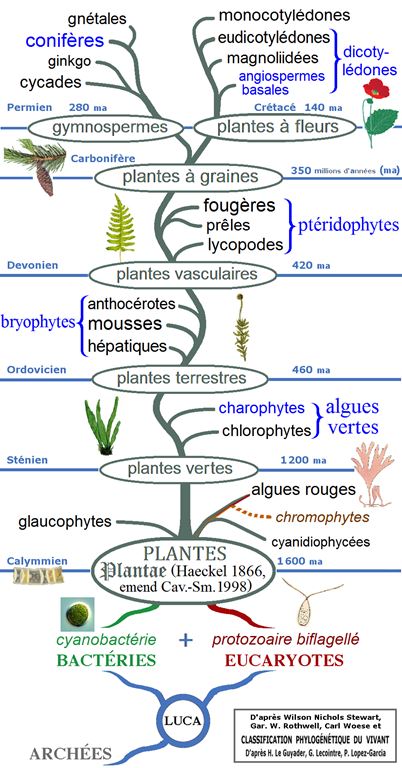
- Phylogénétique :
- Clade 4 : Angiospermes ;
- Clade 3 : Monocotylédones ;
- Clade 2 : Commelinidées ;
- Ordre APN : Poales ;
- Famille APN : Bromeliaceae ;
À droite, cet arbre phylogénétique des plantes montre les principaux clades et groupes traditionnels (monophylétiques en noir et paraphylétiques en bleu).
Dénominations
- Nom botanique : Ananas bracteatus (Lindley) Schultes
- Synonymes français : ananas rouge, ananas tricolor, ananas sauvage, ananas marron
- Synonymes : Ananas bracteatus var. striatus ? ;
- Noms anglais et locaux : Red pineapple, Ananas bravo
Description et culture
Tableau récapitulatif
Parties comes-tibles Note comest. (1-5) Note medic. (1-5) (Zones de) Rusticité Besoins en 
Besoins en  (1-3)
(1-3)Périodes de semis et récoltes Graines au gramme Durée de viabilité Profon-deur semis Espace-ment plants Espace-ment lignes Durée germi-native Durée avant récolte J F M A M J
J A S O N D
J F M A M J
J A S O N D
- dont infos de 0FPI ("FOOD PLANTS INTERNATIONAL", en anglais) :
Description :
Une herbe épineuse. Il atteint 90 cm de haut et 90 cm de large. Les feuilles ont des dents le long du bord. Il est très similaire à l'ananas mais plus épineux et il a des graines. Les fruits sont juteux et sucrés. Ils sont d'un jaune rosé{{{0(+x) (traduction automatique).
Original : A prickly herb. It grows 90 cm high and spreads 90 cm wide. The leaves have teeth along the edge. It is very similar to pineapple but more prickly and it has seeds. The fruit are juicy and sweet. They are a pinkish-yellow{{{0(+x).
Production :
Les fruits pèsent environ 1 kg. Une plante peut produire jusqu'à 6 fruits en 3 ans{{{0(+x) (traduction automatique).
Original : Fruit weigh about 1 kg. One plant can produce up to 6 fruit in 3 years{{{0(+x).
Culture :
Les plantes sont cultivées par division{{{0(+x) (traduction automatique).
Original : Plants are grown by division{{{0(+x).
 Consommation (rapports de comestibilité, parties utilisables et usages alimentaires correspondants)
Consommation (rapports de comestibilité, parties utilisables et usages alimentaires correspondants)Parties comestibles :
fruit{{{0(+x) (traduction automatique). Original : Fruit{{{0(+x).Détails :
La pulpe de fruit est consommée crue et également utilisée pour les boissons{{{0(+x) (traduction automatique).
Original : The fruit pulp is eaten raw and also used for drinks{{{0(+x).
Partie testée :
fruit{{{0(+x) (traduction automatique). Original : Fruit{{{0(+x) Risques et précautions à prendre
Risques et précautions à prendrenéant, inconnus ou indéterminés.
Autres infos
dont infos de 0FPI ("FOOD PLANTS INTERNATIONAL", en anglais) :
Statut :
Il est cultivé{{{0(+x) (traduction automatique).
Original : It is cultivated{{{0(+x).
Distribution :
Une plante tempérée chaude. Il a besoin d'un emplacement ensoleillé et d'un sol bien drainé. Il est endommagé par la sécheresse et le gel. En Argentine, il passe du niveau de la mer à 700 m au-dessus du niveau de la mer. Il convient aux zones de rusticité 9-10{{{0(+x) (traduction automatique).
Original : A warm temperate plant. It needs a sunny location and well-drained soil. It is damaged by drought and frost. In Argentina it grows from sea level to 700 m above sea level. It suits hardiness zones 9-10{{{0(+x).
Localisation :
Argentine, Australie, Bolivie, Brésil *, Colombie, Équateur, Guyanes, Hawaï, Pacifique, Paraguay, Pérou, Amérique du Sud, Suriname, États-Unis{{{0(+x) (traduction automatique).
Original : Argentina, Australia, Bolivia, Brazil*, Colombia, Ecuador, Guianas, Hawaii, Pacific, Paraguay, Peru, South America, Suriname, USA{{{0(+x).
Notes :
Il existe environ 7 espèces d'Ananas{{{0(+x) (traduction automatique).
Original : There are about 7 Ananas species{{{0(+x).
Liens, sources et/ou références
Liens :
Wikipedia ;Sources et/ou références :
bibliographie (liste des sources et/ou références de l'encyclopédie)
dont livres et bases de données : 0FPI ("FOOD PLANTS INTERNATIONAL", en anglais) ;
dont bibliographie/références de 0FPI ("FOOD PLANTS INTERNATIONAL", en anglais) :
Bircher, A. G. & Bircher, W. H., 2000, Encyclopedia of Fruit Trees and Edible Flowering Plants in Egypt and the Subtropics. AUC Press. p 26 (Also as Ananas fritzmuelleri) ; Bodkin, F., 1991, Encyclopedia Botanica. Cornstalk publishing, p 78 ; Bol. Tecn. Inst. Agron. N. 1:16, figs. 2, 3. 1943 (As Ananas fritzmuelleri) ; Coppens d'Eeckenbrugge, G., F.Leal and M.F.Duval. 1997. Germplasm resources of pineapple. Hort. Rev., 21: 133-175. (Also as Ananas fritzmuelleri) ; Cundall, P., (ed.), 2004, Gardening Australia: flora: the gardener's bible. ABC Books. p 149 ; Hibbert, M., 2002, The Aussie Plant Finder 2002, Florilegium. p 27 ; INFOODSUpdatedFGU-list.xls ; Kermath, B. M., et al, 2014, Food Plants in the Americas: A survey of the domesticated, cultivated and wild plants used for Human food in North, Central and South America and the Caribbean. On line draft. p 62 ; Kinupp, V. F., 2007, Plantas alimenticias nao-convencionais da regiao metropolitana de Porto Alegre, RS, Brazil p 70 ; Kinupp, V. F. & Bergman, I., 2008, Protein and minerals of native species, potential vegetables and fruits. Cienc.Tecnol. Aliment. Vol. 28 No. 4 Campinas Oct/Dec. ; Lyle, S., 2006, Discovering fruit and nuts. Land Links. p 64 ; Martin, F. W., et al, 1987, Perennial Edible Fruits of the Tropics. USDA Handbook 642 p 84 ; Pickersgill, B., 1979, Pineapple, in Simmonds N.W.,(ed), Crop Plant Evolution. Longmans. London. p 15 (Also as Ananas fritzmuelleri) ; Smith, L. B. & R. J. Downs, 1979, Bromelioideae (Bromeliaceae), Flora Neotropica, 14(3): 1493--2142 (As Ananas fritzmuelleri) ; Syst. veg. 7(2):1286. 1830 ; www.colecionandofrutas.org
Recherche de/pour :
- "Ananas bracteatus" sur Google (pages et
images) ;
IPNI ("International Plant Names Index", en anglais) ;
TPL ("The Plant List", en anglais) ;
GRIN ("Germplasm Resources Information Network", en anglais) ;
TROPICOS (en anglais) ;
Tela Botanica ;
Pl@ntNet ;
Pl@ntUse ;
"Plants For A Future" (en anglais) ;
"Useful Tropical Plants" (en anglais) ou
"Useful Temperate Plants" (en anglais) ;
- "Ananas requin" sur Google (pages, images et recettes) ;
- "Ananas bracteatus" sur Google (pages et
images) ;
IPNI ("International Plant Names Index", en anglais) ;
TPL ("The Plant List", en anglais) ;
GRIN ("Germplasm Resources Information Network", en anglais) ;
TROPICOS (en anglais) ;
Tela Botanica ;
Pl@ntNet ;
Pl@ntUse ;
"Plants For A Future" (en anglais) ;
"Useful Tropical Plants" (en anglais) ou
"Useful Temperate Plants" (en anglais) ;
Espèces du même genre (Ananas)
6 taxons
Espèces de la même famille (Bromeliaceae)
67 taxons
- Acanthostachys pitcairnioides
- Aechmea bracteata
- Aechmea bromeliifolia
- Aechmea distichantha Lem.
- Aechmea hoppii
- Aechmea kuntzeana Mez
- Aechmea longifolia
- Aechmea magdalenae
- Aechmea mariae-reginae H.Wendl.
- Aechmea racinae L.B.Sm.
- Aechmea warasii E.Pereira
- Ananas ananassoides
- Ananas comosus (L.) Merr. (Ananas)
- Ananas lucidus
- Ananas parguazensis Camargo & L.B.Sm.
- Ananas sagenaria
- Billbergia afonsi-joannis
- Billbergia amoena
- Billbergia distachya
- Bromelia alsodes H.St.John
- Bromelia antiacantha Bertol.
- Bromelia balansae Mez
- Bromelia chrysantha Jacq.
- Bromelia grandiflora Mez
- Bromelia hemisphaerica Lam.
- Bromelia hieronymi Mez
- Bromelia interior L.B.Sm.
- Bromelia karatas L.
- Bromelia laciniosa Mart. ex Schult. & Schult.f.
- Bromelia michaelii Esteves, Hofacker & Scharf
- Bromelia nidus-puellae
- Bromelia pinguin L.
- Bromelia plumieri
- Bromelia regnelii
- Bromelia serra Griseb.
- Bromelia sylvestris Burm.f.
- Bromelia trianae Mez
- Deuterocohnia meziana Kuntze ex Mez
- Disteganthus lateralis
- Dyckia ferox Mez
- Fascicularia bicolor (Fasciculaire bicolore)
- Greigia landbeckii
- Greigia sodiroana Mez
- Greigia sphacelata
- Greigia vulcanica Andr
- Hechtia montana Brandegee
- Karatas plumieri Morren
- Neoglaziovia variegata
- Ochagavia elegans Phil.
- Pseudananas sagenarius
- ...







 donne accès au menu
  - encyclopédies des plantes alimentaires ;
 - page de recherche - reconnaissance (identification) de plantes ;
 - page du calendrier lunaire et son générateur (au format PDF et JPG) ;
 - tableau récapitulatif ;
 - générateur de potées (soupes), avec estimation des apports nutrionnels et du coût;
 - générateur de codes QR ;
 - page des archives avec de nombreux documents sur différents thèmes complémentaires comme la botanique, les légumes,
les champignons, la cuisine, le bien-être ainsi que différents MOOC mais également des liens vers les archives de l'association ;
- page des archives avec de nombreux documents sur différents thèmes complémentaires comme la botanique, les légumes,
les champignons, la cuisine, le bien-être ainsi que différents MOOC mais également des liens vers les archives de l'association ;

 pour le fruit (et/ou les graines, la pulpe, etc...),
 pour les fleurs (et/ou pétales, calice...),
 pour les feuilles (et/ou la tige, les pousses...),
 pour les racines,
 pour le tronc (et/ou l'écorce, la sève...), et enfin
 pour les champignons,
puis les notes alimentaires et médicinales (de 1 à 5 étoiles), la rusticité (résistance au froid/gel)
et pour finir un résumé.
pour les champignons,
puis les notes alimentaires et médicinales (de 1 à 5 étoiles), la rusticité (résistance au froid/gel)
et pour finir un résumé. menant ici 🙂
 ,
,  et
et





 ,
,


 Encyclopédie(s)
 Recherche-Reconnaissance
 Tableau récapitulatif
 Codes QR
 Archives
 Calendrier(s) lunaire(s)
  Potées
 Re-naturation/naturalisation
 Affichettes, herbiers &
co.
Affichettes, herbiers &
co. menu
menu galerie


 (en bas à droite).
 (en bas à gauche).
