Coeur (menu général)

-8/-10/-12°C

Flèche gauche aléatoire Flèche droite

Accueil Rafraichir
     ⬀
Le Menu donne accès au menu
(c'est votre point de repère) 😊 ;

En dessous vous avez la classification, à partir de la vie (Vita, premier rang) jusqu'à la classe au dessus de la plante, dont vous trouvez ensuite le nom scientifique/botanique (latin) puis le nom commun (français), le cas échéant ;
C'est aussi un lien vers la fiche complète (tout comme la ✖, en bas à droite, et le +, en dessous de la description) ;

Vient alors l'illustration (ou ce qui la remplace, en attendant), la comestibilité : Fruit pour le fruit (et/ou les graines, la pulpe, etc...), Fleur pour les fleurs (et/ou pétales, calice...), Feuille pour les feuilles (et/ou la tige, les pousses...), Racine pour les racines, et enfin Tronc pour le tronc (et/ou l'écorce, la sève...), ensuite les notes alimentaires et médicinales (de 1 à 5 étoiles), la rusticité (résistance au froid/gel) et pour finir la description suivie donc d'un + pour continuer vers la fiche complète.

Et en bas aléatoire, pour passer à une autre fiche de manière aléatoire, entre deux flèches (Flèche gauche et Flèche droite) permettant de rejoindre la fiche précédente et la suivante, pour terminer par Accueil qui ra-mène à l'accueil, Retour qui permet de revenir en arrière, Rafraichir qui rafraichit la page, et Aide qui vous amène ici 🙂

     ⬂


Vita > Plantae > Magnoliophyta > Magnoliopsida > Rosales >
Rosaceae > Eriobotrya > Eriobotrya japonica - idu : 13446
! Nouveau site ici !Recherche simple
Flèche gauche Fiche précédente | AVI. O | Fiche suivante Flèche droite
! Nouveau site ici !
Vita > Plantae > Magnoliophyta > Magnoliopsida > Rosales > Rosaceae > Eriobotrya
AVI. O

  
Explications de "AVI.O" :

le A, qui pointe vers le haut, permet de remonter,
le V, qui pointe vers le bas, permet de descendre,
le I permet de dérouler toute la page
(les différentes catégories)
et le O amène ici,
où vous pouvez revenir à l'origine,
en cliquant n'importe où 🙂


À suivre !


Note alimentaire  

MiamMiamMiamMiam     |    

   Note médicinale  

SosSosSos

Flèche gauche aléatoire Flèche droite

Accueil Rafraichir AVI.O


Illustration Eriobotrya japonica, Par Botanical Register (vol. 5: t. 365, 1819) [S. Edwards], via plantillustrations
      Illustration Eriobotrya japonica, Par Botanical Register (vol. 5: t. 365, 1819) [S. Edwards], via plantillustrations  - Fermersuivante Flèche droite

Par Botanical Register (vol. 5: t. 365, 1819) [S. Edwards], via plantillustrations


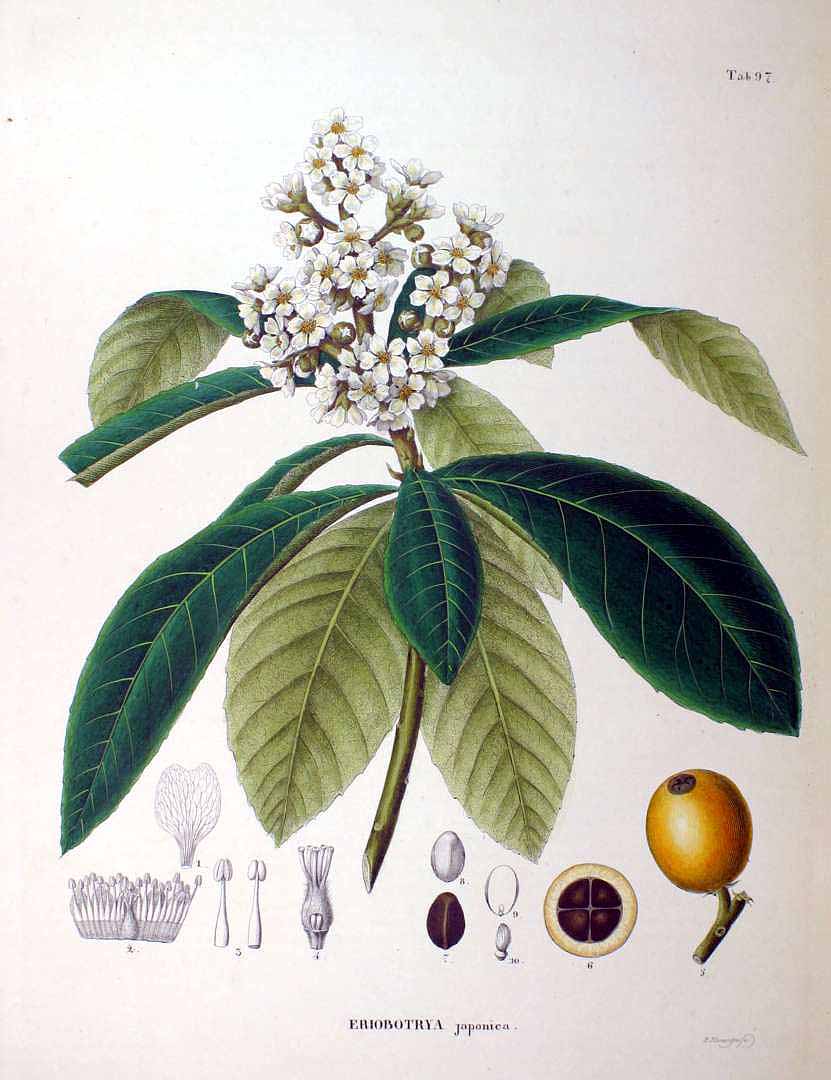
Illustration Eriobotrya japonica, Par Siebold, P.F. von, Zuccarini, J.G., Flora Japonica (1842-1870) Fl. Jap., via plantillustrations
précédente Flèche gaucheIllustration Eriobotrya japonica, Par Siebold, P.F. von, Zuccarini, J.G., Flora Japonica (1842-1870) Fl. Jap., via plantillustrations  - Fermersuivante Flèche droite

Par Siebold, P.F. von, Zuccarini, J.G., Flora Japonica (1842-1870) Fl. Jap., via plantillustrations


Illustration Eriobotrya japonica, Par Jacquin N.J. von (Fragmenta botanica, figuris coloratis illustrata, t. 136, 1809), via plantillustrations
précédente Flèche gaucheIllustration Eriobotrya japonica, Par Jacquin N.J. von (Fragmenta botanica, figuris coloratis illustrata, t. 136, 1809), via plantillustrations  - Fermer      

Par Jacquin N.J. von (Fragmenta botanica, figuris coloratis illustrata, t. 136, 1809), via plantillustrations


  • Dénominations

    :


    • Nom botanique :

      Eriobotrya japonica (Thunb.) Lindl. (1821)

    • Synonymes français

      :

      loquat, bibacier (bibassier), nèfle du Japon {fruit}, bibace (bibasse) {fruit}

    • Noms anglais et locaux

      :

      Japanese-medlar, loquat, lukwart (af), pi ba (cn transcrit), japanische Mispel (de), japanische Wollmispel (de), nespereira (pt), níspero (es), níspero del Japón (es), nispolero (es), japansk mispel (sv), bibasse (local) ;


  • Miam

    Consommation

    (rapports de comestibilité, parties utilisables et usages alimentaires correspondants) :


    Fruitµ0(+x)µ (fruitsµ27(+x)µ {chair/pulpeµ{{{(dp*)µ} mûrs fraisµ{{{0(+x)µ : crusµ27(+x)µ ou cuitsµ(dp*)µ ; et graines grilléesµ{{{0(+x)µ [base boissons/breuvagesµ{{{(dp*)µ {substitut de caféµ{{{0(+x)µ}]) comestibleµ0(+x)µ.

    Détails :

    Les fruits sont utilisés pour la production d'alcool (attention : l'alcool est une cause de cancer).
    Les fruits sont également utilisés en confitures, gelées, sauces, compotes et tartes ; s'ils sont cuits, les graines doivent être enlevées car elles donnent un goût amerµ{{{0(+x)µ. Plante cultivée dans les zones favorables du monde : pays d'origine et zones de l'orangerµ{{{27(+x)µ.


    Partie testée

    : /

    Taux d'humidité Énergie (kj) Énergie (kcal) Protéines (g)
    / / / /

    Pro-
    vitamines A (µg)
    Vitamines C (mg) Fer (mg) Zinc (mg)
    / / / /


  • Précautions

    Risques et précautions à prendre

    :


    néant, inconnus ou indéterminés.


  • Rusticité (résistance face au froid/gel, climat)

    :


    -8/-10/-12°C


  • Liens, sources et/ou références


    • Sources et/ou références :

      Jardin! L'Encyclopédie ; "Fruits of Warm Climates" (livre en anglais, pages 309 à 310, par Julia F. Morton), via Purdue Agriculture (NewCROP) ; auJardin.info ; Tela Botanica ; Wikipedia ; Wikipedia (en anglais) ;

      dont classification :
      "The Plant List" (en anglais) ; "GRIN" (en anglais) ;

      dont livres et bases de données : 0"Food Plants International" (en anglais), 27Dictionnaire des plantes comestibles (livre, page 127, par Louis Bubenicek) ;

      87Le Truffaut du Potager (collectif, éditions Larousse, 2010) / détails du livre

      dont biographie/références de "FOOD PLANTS INTERNATIONAL" :

      Ambasta, S.P. (Ed.), 2000, The Useful Plants of India. CSIR India. p 201 ; Barwick, M., 2004, Tropical and Subtropical Trees. A Worldwide Encyclopedic Guide. Thames and Hudson p 165 ; Bianchini, F., Corbetta, F., and Pistoia, M., 1975, Fruits of the Earth. Cassell. p 134 ; Blamey, M and Grey-Wilson, C., 2005, Wild flowers of the Mediterranean. A & C Black London. p 78 ; Bodkin, F., 1991, Encyclopedia Botanica. Cornstalk publishing, p 396 ; Brickell, C. (Ed.), 1999, The Royal Horticultural Society A-Z Encyclopedia of Garden Plants. Convent Garden Books. p 411 ; Brouk, B., 1975, Plants Consumed by Man. Academic Press, London. p 182 ; Brown, D., 2002, The Royal Horticultural Society encyclopedia of Herbs and their uses. DK Books. p 203 ; Burkill, I.H., 1966, A Dictionary of the Economic Products of the Malay Peninsula. Ministry of Agriculture and Cooperatives, Kuala Lumpur, Malaysia. Vol 1 (A-H) p 952 ; Cheifetz, A., (ed), 1999, 500 popular vegetables, herbs, fruits and nuts for Australian Gardeners. Random House p 191 ; Coronel, R.E., 1982, Fruit Collections in the Philippines. IBPGR Newsletter p 6, 9 ; Cundall, P., (ed.), 2004, Gardening Australia: flora: the gardener's bible. ABC Books. p 556 ; Etherington, K., & Imwold, D., (Eds), 2001, Botanica's Trees & Shrubs. The illustrated A-Z of over 8500 trees and shrubs. Random House, Australia. p 289 ; Facciola, S., 1998, Cornucopia 2: a Source Book of Edible Plants. Kampong Publications, p 198 ; Flora of Australia Volume 49, Oceanic Islands 1, Australian Government Publishing Service, Canberra. (1994) p 163 ; Flowerdew, B., 2000, Complete Fruit Book. Kyle Cathie Ltd., London. p 140 ; Forest Inventory and Planning Institute, 1996, Vietnam Forest Trees. Agriculture Publishing House p 613 ; Fowler, D. G., 2007, Zambian Plants: Their Vernacular Names and Uses. Kew. p 83 ; French, B.R., 1986, Food Plants of Papua New Guinea, A Compendium. Asia Pacific Science Foundation p 268 ; Glowinski, L., 1999, The Complete Book of Fruit Growing in Australia. Lothian. p 46 ; Hedrick, U.P., 1919, (Ed.), Sturtevant's edible plants of the world. p 292 ; Hibbert, M., 2002, The Aussie Plant Finder 2002, Florilegium. p 94 ; Hussey, B.M.J., Keighery, G.J., Cousens, R.D., Dodd, J., Lloyd, S.G., 1997, Western Weeds. A guide to the weeds of Western Australia. Plant Protection Society of Western Australia. p 208 ; Hu, Shiu-ying, 2005, Food Plants of China. The Chinese University Press. p 432 ; Jardin, C., 1970, List of Foods Used In Africa, FAO Nutrition Information Document Series No 2.p 135 ; John, L., & Stevenson, V., 1979, The Complete Book of Fruit. Angus & Robertson p 181 ; Katende, A.B., Birnie, A & Tengnas B., 1995, Useful Trees and Shrubs for Uganda. Identification, Propagation and Management for Agricultural and Pastoral Communities. Technical handbook No 10. Regional Soil Conservation Unit, Nairobi, Kenya. p 276 ; Kiple, K.F. & Ornelas, K.C., (eds), 2000, The Cambridge World History of Food. CUP p 1803 ; Lazarides, M. & Hince, B., 1993, Handbook of Economic Plants of Australia, CSIRO. p 94 ; Trans. Linn. Soc. London 13(1):102. 1821 ; Lord, E.E., & Willis, J.H., 1999, Shrubs and Trees for Australian gardens. Lothian. p 226 ; Lorenzi, H., Bacher, L., Lacerda, M. & Sartori, S., 2006, Brazilian Fruits & Cultivated Exotics. Sao Paulo, Instituto Plantarum de Estuados da Flora Ltda. p 482 ; Lulekal, E., et al, 2011, Wild edible plants in Ethiopia: a review on their potential to combat food insecurity. Afrika Focus - Vol. 24, No 2. pp 71-121 ; Lyle, S., 2006, Discovering fruit and nuts. Land Links. p 192 ; Macmillan, H.F. (Revised Barlow, H.S., et al) 1991, Tropical Planting and Gardening. Sixth edition. Malayan Nature Society. Kuala Lumpur. p 281 ; Manandhar, N.P., 2002, Plants and People of Nepal. Timber Press. Portland, Oregon. p 222 ; Martin, F. W., et al, 1987, Perennial Edible Fruits of the Tropics. USDA Handbook 642 p 54 ; Mbuya, L.P., Msanga, H.P., Ruffo, C.K., Birnie, A & Tengnas, B., 1994, Useful Trees and Shrubs for Tanzania. Regional Soil Conservation Unit. Technical Handbook No 6. p 248 ; Morton, J. F., 1987, Fruits of Warm Climates. Wipf & Stock Publishers p 103 ; Omawale, 1973, Guyana's edible plants. Guyana University, Georgetown p 28 ; Paczkowska, G . & Chapman, A.R., 2000, The Western Australian Flora. A Descriptive Calatogue. Western Australian Herbarium. p 512 ; Perry, F., and Hay, R., 1982, Guide to Tropical and Subtropical Plants. Sun Books p 56 ; Pham-Hoang Ho, 1999, An Illustrated Flora of Vietnam. Nha Xuat Ban Tre. p 776 ; Phon, P., 2000, Plants used in Cambodia. © Pauline Dy Phon, Phnom Penh, Cambodia. p 277 ; Plants For A Future database, The Field, Penpol, Lostwithiel, Cornwall, PL22 0NG, UK. https://www.scs.leeds.ac.uk/pfaf/ ; PROSEA (Plant Resources of South East Asia) handbook, Volume 2, 1991, Edible fruits and nut. p 162 ; Recher, P, 2001, Fruit Spirit Botanical Gardens Plant Index. www.nrg.com.au/~recher/ seedlist.html p 2 ; Royal Botanic Gardens, Kew (1999). Survey of Economic Plants for Arid and Semi-Arid Lands (SEPASAL) database. Published on the Internet; https://www.rbgkew.org.uk/ceb/sepasal/internet [Accessed 10th June 2011] ; Russell, T., Cutler, C., & Walters, M., 2005, The Illustrated Encyclopedia of Trees of the Americas. Lorenz Books. p 159 ; Sharma, B.B., 2005, Growing fruits and vegetables. Publications Division. Ministry of Information and broadcasting. India. p 84 ; Sinclair, V., 1992, The Floral Charm of Cyprus. Interworld Publications. p 132 ; Smith, A.C., 1985, Flora Vitiensis Nova, Lawaii, Kuai, Hawaii, Volume 3 p 41 ; Solomon, C., 2001, Encyclopedia of Asian Food. New Holland. p 223 ; Staples, G.W. and Herbst, D.R., 2005, A tropical Garden Flora. Bishop Museum Press, Honolulu, Hawaii. p 474 (Drawing) ; Swaminathan, M.S., and Kochnar, S.L., 2007, An Atlas of Major Flowering Trees in India. Macmillan. p 100 ; Swaziland's Flora Database https://www.sntc.org.sz/flora ; Tankard, G., 1990, Tropical fruit. An Australian Guide to Growing and using exotic fruit. Viking p 110 ; USDA, ARS, National Genetic Resources Program. Germplasm Resources Information Network - (GRIN). [Online Database] National Germplasm Resources Laboratory, Beltsville, Maryland. Available: www.ars-grin.gov/cgi-bin/npgs/html/econ.pl (10 April 2000) ; Valder, P., 1999, The Garden Plants of China. Florilegium. p 283 ; van Wyk, B., 2005, Food Plants of the World. An illustrated guide. Timber press. p 190 ; Vivien, J., & Faure, J.J., 1996, Fruitiers Sauvages d'Afrique. Especes du Cameroun. CTA p 277 ; Young, J., (Ed.), 2001, Botanica's Pocket Trees and Shrubs. Random House. p 347 ; Yuncker, T.G., 1959, Plants of Tonga, Bernice P. Bishop Museum, Hawaii, Bulletin 220. p 127

    • Recherche de/pour :


Dernière modification le :
vendredi 04 septembre 2026, à 09h28


Wikipedia
Flèche gauche||Flèche droite

Wikimedia
Flèche gauche||Flèche droite

Wikispecies
Flèche gauche||Flèche droite


Semeurs.fr
Flèche gauche||Flèche droite

marmiton
Flèche gauche||Flèche droite


Enregistrer et/ou imprimer cette fiche : Aperçu (format pdf) Enregistrer cette fiche : format pdf

Recherche simple :


Recherche multicritères :


Partie comestible :
Fruit Feuille Fleur
Racine Tronc
Note comestibilité :
* ** *** **** ***** |
Note médicinale :
* ** *** **** *****


Page de recherche


Responsabilité : Le Potager de mes Rêves (ainsi que tout membre de cette association) ne peut être tenu responsable pour toute allergie, maladie ou effet nuisible que toute personne ou animal pourrait subir suite à l'utilisation de toute plante mentionnée sur ce site :
(https://lepotager-demesreves.fr) ;
Cf. "Notes et mises en garde", pour plus d'informations sur les précautions à prendre.


Licence Creative Commons


Partager sur Facebook


Valid XHTML 1.0 Strict CSS Valide !