Erisma japura
Pas d'illustration
pour le moment 😕

Un grand arbre. Le fruit est rouge. Le noyau est comestible (traduction automatique)
→suite


Erisma japura

Un grand arbre. Le fruit est rouge. Le noyau est comestible (traduction automatique)
Pas d'illustration
pour le moment 😕
Pas d'illustration
pour le moment 😕
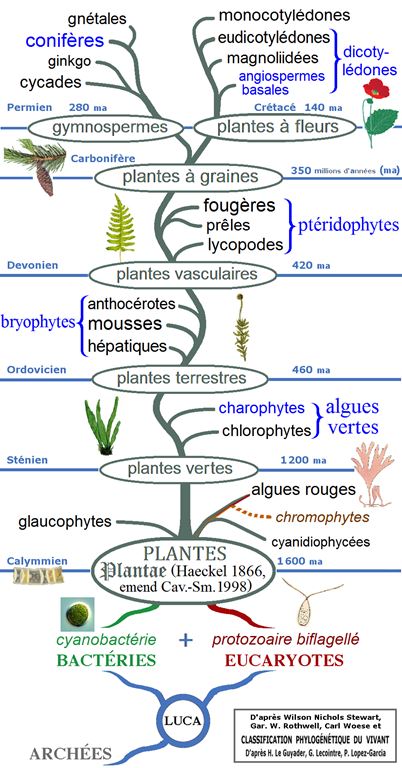
Classification
- Classique : en haut de l'écran, sous le coeur.
- Phylogénétique :
- Clade 4 : Angiospermes ;
- Clade 3 : Dicotylédones_vraies ;
- Clade 2 : Rosidées ;
- Clade 1 : Malvidées ;
- Ordre APN : Myrtales ;
- Famille APN : Vochysiaceae ;
À droite, cet arbre phylogénétique des plantes montre les principaux clades et groupes traditionnels (monophylétiques en noir et paraphylétiques en bleu).
Description et culture
Tableau récapitulatif
Parties comes-tibles Note comest. (1-5) Note medic. (1-5) (Zones de) Rusticité Besoins en 
Besoins en  (1-3)
(1-3)Périodes de semis et récoltes Graines au gramme Durée de viabilité Profon-deur semis Espace-ment plants Espace-ment lignes Durée germi-native Durée avant récolte J F M A M J
J A S O N D
J F M A M J
J A S O N D
- dont infos de 0FPI ("FOOD PLANTS INTERNATIONAL", en anglais) :
 Consommation (rapports de comestibilité, parties utilisables et usages alimentaires correspondants)
Consommation (rapports de comestibilité, parties utilisables et usages alimentaires correspondants)Parties comestibles :
graines{{{0(+x) (traduction automatique). Original : Seeds{{{0(+x).Détails :
L'amande est consommée crue ou bouillie. Les graines sont également bouillies, laissées dans l'eau courante pendant plusieurs semaines puis pilées pour donner une forme de beurre. Attention: Il est toxique sans traitement{{{0(+x) (traduction automatique).
Original : The kernel is eaten raw or boiled. The seeds are also boiled, left in running water for several weeks and then pounded to give a form of butter. Caution: It is poisonous without treatment{{{0(+x).
Partie testée :
/ Risques et précautions à prendre
Risques et précautions à prendrecf. consommation
Autres infos
dont infos de 0FPI ("FOOD PLANTS INTERNATIONAL", en anglais) :
Statut :
Les graines sont très appréciées. Ils sont une importante source de nourriture pour la population locale{{{0(+x) (traduction automatique).
Original : The seeds are highly valued. They are an important source of food for local people{{{0(+x).
Distribution :
Une plante tropicale. Il pousse dans la forêt tropicale. Il pousse dans les basses terres humides. Il se produit dans les zones avec une température annuelle moyenne de 26 ° C et une pluviométrie annuelle d'environ 3 400 mm{{{0(+x) (traduction automatique).
Original : A tropical plant. It grows in the rainforest. It grows in the humid lowlands. It occurs in areas with a average annual temperature of 26°C and an annual rainfall of about 3,400 mm{{{0(+x).
Localisation :
Amazonie, Brésil, Colombie, Guyane, Amérique du Sud, Venezuela{{{0(+x) (traduction automatique).
Original : Amazon, Brazil, Colombia, Guyana, South America, Venezuela{{{0(+x).
Notes :
Il existe 20 espèces Erisma{{{0(+x) (traduction automatique).
Original : There are 20 Erisma species{{{0(+x).
Liens, sources et/ou références
Liens :
/ ;Sources et/ou références :
bibliographie (liste des sources et/ou références de l'encyclopédie)
dont classification : IPNI ("International Plant Names Index", en anglais) ; Kew (POWO - "Plant Of the World Online", "Royal Botanical Garden", en anglais) ;
dont livres et bases de données : 0FPI ("FOOD PLANTS INTERNATIONAL", en anglais) ;
Warning: Undefined variable $prex in /home/waso5761/public_html/inc/fiches.php on line 2607
dont bibliographie/références de 0FPI ("FOOD PLANTS INTERNATIONAL", en anglais) :
Etkin, N.L. (Ed.), 1994, Eating on the Wild Side, Univ. of Arizona. p 122, 137 ; Fern, K., 2012, Tropical Species Database http://theferns.info/tropical/ ; Grandtner, M. M. & Chevrette, J., 2013, Dictionary of Trees, Volume 2: South America: Nomenclature, Taxonomy and Ecology. Academic Press p 222 ; GRIN ; Hedrick, U.P., 1919, (Ed.), Sturtevant's edible plants of the world. p 293 ; Heywood, V.H., Brummitt, R.K., Culham, A., and Seberg, O. 2007, Flowering Plant Families of the World. Royal Botanical Gardens, Kew. p 337 ; Kermath, B. M., et al, 2014, Food Plants in the Americas: A survey of the domesticated, cultivated and wild plants used for Human food in North, Central and South America and the Caribbean. On line draft. p 340 ; Menninger, E.A., 1977, Edible Nuts of the World. Horticultural Books. Florida p 116 ; Smith, N., Mori, S.A., et al, 2004, Flowering Plants of the Neotropics. Princeton. p 398 ; Wickens, G.E., 1995, Edible Nuts. FAO Non-wood forest products. FAO, Rome. p158
Recherche de/pour :
- "Erisma japura" sur Google (pages et
images) ;
TPL ("The Plant List", en anglais) ;
GRIN ("Germplasm Resources Information Network", en anglais) ;
TROPICOS (en anglais) ;
Tela Botanica ;
Pl@ntNet ;
Pl@ntUse ;
"Plants For A Future" (en anglais) ;
"Useful Tropical Plants" (en anglais) ou
"Useful Temperate Plants" (en anglais) ;
- "Erisma japura" sur Google (pages et
images) ;
TPL ("The Plant List", en anglais) ;
GRIN ("Germplasm Resources Information Network", en anglais) ;
TROPICOS (en anglais) ;
Tela Botanica ;
Pl@ntNet ;
Pl@ntUse ;
"Plants For A Future" (en anglais) ;
"Useful Tropical Plants" (en anglais) ou
"Useful Temperate Plants" (en anglais) ;
Espèces du même genre (Erisma)
4 taxons
Espèces de la même famille (Vochysiaceae)
12 taxons







 donne accès au menu
  - encyclopédies des plantes alimentaires ;
 - page de recherche - reconnaissance (identification) de plantes ;
 - page du calendrier lunaire et son générateur (au format PDF et JPG) ;
 - tableau récapitulatif ;
 - générateur de potées (soupes), avec estimation des apports nutrionnels et du coût;
 - générateur de codes QR ;
 - page des archives avec de nombreux documents sur différents thèmes complémentaires comme la botanique, les légumes,
les champignons, la cuisine, le bien-être ainsi que différents MOOC mais également des liens vers les archives de l'association ;
- page des archives avec de nombreux documents sur différents thèmes complémentaires comme la botanique, les légumes,
les champignons, la cuisine, le bien-être ainsi que différents MOOC mais également des liens vers les archives de l'association ;

 pour le fruit (et/ou les graines, la pulpe, etc...),
 pour les fleurs (et/ou pétales, calice...),
 pour les feuilles (et/ou la tige, les pousses...),
 pour les racines,
 pour le tronc (et/ou l'écorce, la sève...), et enfin
 pour les champignons,
puis les notes alimentaires et médicinales (de 1 à 5 étoiles), la rusticité (résistance au froid/gel)
et pour finir un résumé.
pour les champignons,
puis les notes alimentaires et médicinales (de 1 à 5 étoiles), la rusticité (résistance au froid/gel)
et pour finir un résumé. menant ici 🙂
 ,
,  et
et





 ,
,


 Encyclopédie(s)
 Recherche-Reconnaissance
 Tableau récapitulatif
 Codes QR
 Archives
 Calendrier(s) lunaire(s)
  Potées
 Re-naturation/naturalisation
 Affichettes, herbiers &
co.
Affichettes, herbiers &
co. menu
menu galerie


 (en bas à droite).
 (en bas à gauche).
