
Palmier à sucre
(Arenga pinnata)


 |
****
|
****
-2°C
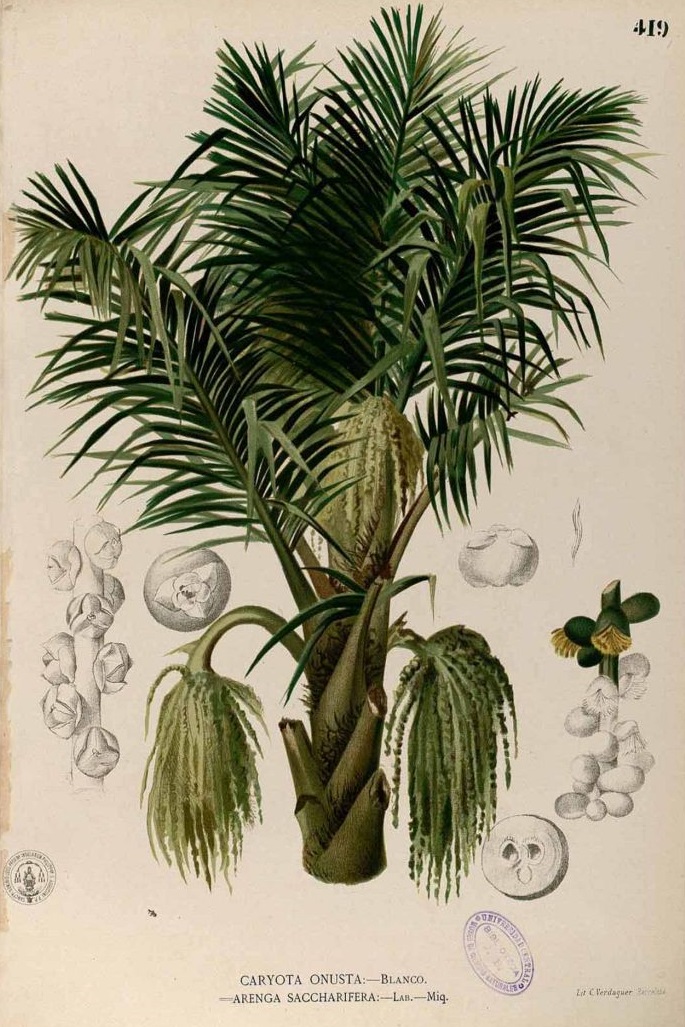
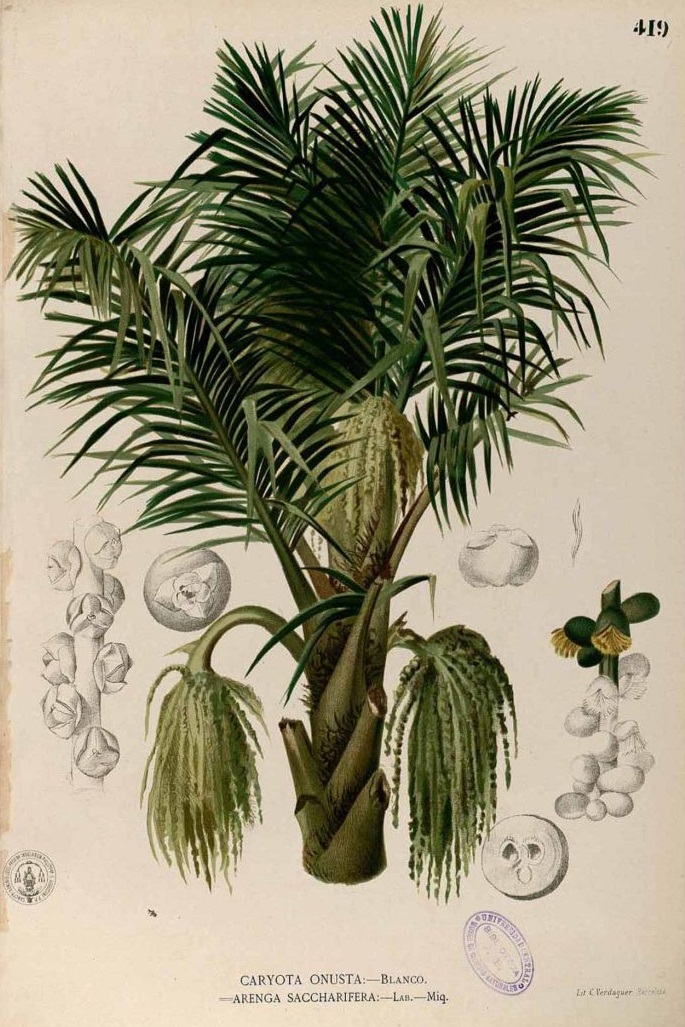
Un grand palmier. Il atteint 18 m de haut. Il forme un tronc de 30 cm de diamètre et recouvert de vieilles bases de feuilles et de fibres noires. Il a des épines de 7,5 cm d ... (traduction automatique)
→suite

Palmier à sucre
Note alimentaire 

Un grand palmier. Il atteint 18 m de haut. Il forme un tronc de 30 cm de diamètre et recouvert de vieilles bases de feuilles et de fibres noires. Il a des épines de 7,5 cm de long. Il a de longues feuilles qui vont vers le haut. Ils ont des folioles le long de la tige composées de 100 paires ou plus. Les feuilles me... (traduction automatique) →suite
Classification
- Classique : en haut de l\'écran, sous le coeur.
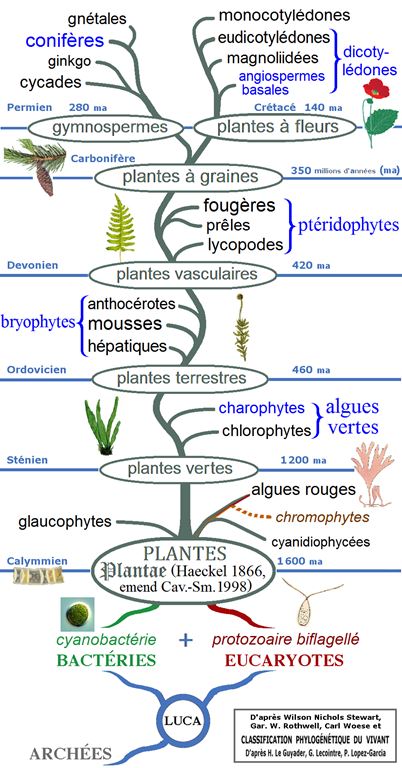
- Phylogénétique :
- Clade 4 : Angiospermes ;
- Clade 3 : Monocotylédones ;
- Clade 2 : Commelinidées ;
- Ordre APN : Arecales ;
- Famille APN : Arecaceae ;
Illustration : cet arbre phylogénétique des plantes montre les principaux clades et groupes traditionnels (monophylétiques en noir et paraphylétiques en bleu).
Dénominations
✖- Nom botanique : Arenga pinnata (Wurmb) Merr. (1917)
- Synonymes français : palmier areng, palmier condiar, faux-sagou, sagou-bâtard
- Synonymes : Arenga saccharifera Labill. ex DC. 1800, Saguerus saccharifer (Labill. ex DC.) Blume 1843 ;
Dont basionyme : Saguerus pinnatus Wurmb 1779 ; - Noms anglais et locaux : areng palm, black-fiber palm, gomuti palm, Malay sago, sugar palm, black Sugar palm, sha tang ye zi (cn transcrit), arengpalm (nl), arenpalm (nl), gomoetoepalm (nl), sagoeweerpalm (nl), suikerpalm (nl), echte Zuckerpalme (de), Gomuti-Palme (de), Molukken-Zuckerpalme (de), Sagwire-Palme (de), Zuckerpalme (de), gomuteira (pt), baru (es), bary (es), palma de azucar (es), sockerpalm (sv), areng (jv), gomuti (local), jaggery (local), kabong (local)
Description et culture
✖Nombre de graines au gramme :
0,26
- dont infos de "FOOD PLANTS INTERNATIONAL" :
Description :
Un grand palmier. Il atteint 18 m de haut. Il forme un tronc de 30 cm de diamètre et recouvert de vieilles bases de feuilles et de fibres noires. Il a des épines de 7,5 cm de long. Il a de longues feuilles qui vont vers le haut. Ils ont des folioles le long de la tige composées de 100 paires ou plus. Les feuilles mesurent 8,5 m de long. Les folioles sont blanchâtres dessous, lobées à l'extrémité et avec des morceaux d'oreille près de la base. Ils ont de grandes tiges florales qui pendent de l'aisselle des feuilles. Plusieurs tiges de fruits se développent du haut vers le bas. Lorsque le palmier est mûr, une pousse florale est envoyée de l'aisselle de la feuille supérieure puis suivie par d'autres fleurs jusqu'à ce que les réserves d'arbres soient épuisées et que le palmier meure. Le fruit est rond et rouge foncé. Ils mesurent 4 cm de diamètre. La pulpe du fruit endommage la peau. Il y a généralement 3 graines par fruit. Ils ont un côté plat{{{0(+x) (traduction automatique).
Original : A large palm. It grows to 18 m high. It forms one trunk 30 cm across and covered with old leaf bases and black fibres. It has spines 7.5 cm long. It has long leaves which reach upwards. They have leaflets along the stalk made up of 100 or more pairs. The leaves are 8.5 m long. The leaflets are whitish beneath, lobed at the tip and with ear like pieces near the base. They have large flower stalks hanging down from the leaf axils. Several fruit stalks develop from the top downwards. When the palm is mature a flowering shoot is sent out from the axil of the upper leaf then followed by other flowers until the tree reserves are exhausted and the palm dies. The fruit are round and dark red. They are 4 cm across. The fruit pulp damages skin. There are usually 3 seeds per fruit. They have one flat side{{{0(+x).
Production :
C'est une croissance rapide et de courte durée. Le rendement estimé en sucre pour 150 à 200 arbres par hectare est de 10 tonnes de sucre commercialisable sur 10 à 15 ans. Un arbre peut produire 2 litres par jour pendant 25 jours. Si la pointe de croissance ou le chou est enlevé, la paume développe généralement des pousses latérales et reste vivante{{{0(+x) (traduction automatique).
Original : It is fast growing and short lived. An estimated sugar yield for 150-200 trees per hectare is 10 tons of marketable sugar over 10-15 years. A tree can yield 2 litres per day for 25 days. If the growing tip or cabbage is removed the palm usually develops side shoots and remains alive{{{0(+x).
Culture :
Les plantes sont cultivées à partir de graines. La graine pousse facilement{{{0(+x) (traduction automatique).
Original : Plants are grown from seed. The seed grow easily{{{0(+x).
 Consommation (rapports de comestibilité, parties utilisables et usages alimentaires correspondants)
✖
Feuilles (jeunes pousses{{{27(+x) [nourriture/aliment{{{(dp*) : légume27(+x)]) et tronc (extrait(dp*) sève : évaporée [sucre]{{{27(+x) ; stipe27(+x) [nourriture/aliment : féculent{{{2(+)(dp*) (sagou27(+x))]) comestibles.
Détails : coeur de palmier{{{0(+x) ; plante importante localement{{{27(+x).
Partie testée :
coeur de palmier{{{0(+x) (traduction automatique). Original : Palm heart{{{0(+x)| Taux d'humidité | Énergie (kj) | Énergie (kcal) | Protéines (g) |
|---|---|---|---|
| 94.7 | 79 | 19 | 0.1 |
| Pro- vitamines A (µg) |
Vitamines C (mg) | Fer (mg) | Zinc (mg) |
| / | / | 0.5 | / |
 Risques et précautions à prendre
✖
néant, inconnus ou indéterminés.
Galerie(s)
✖

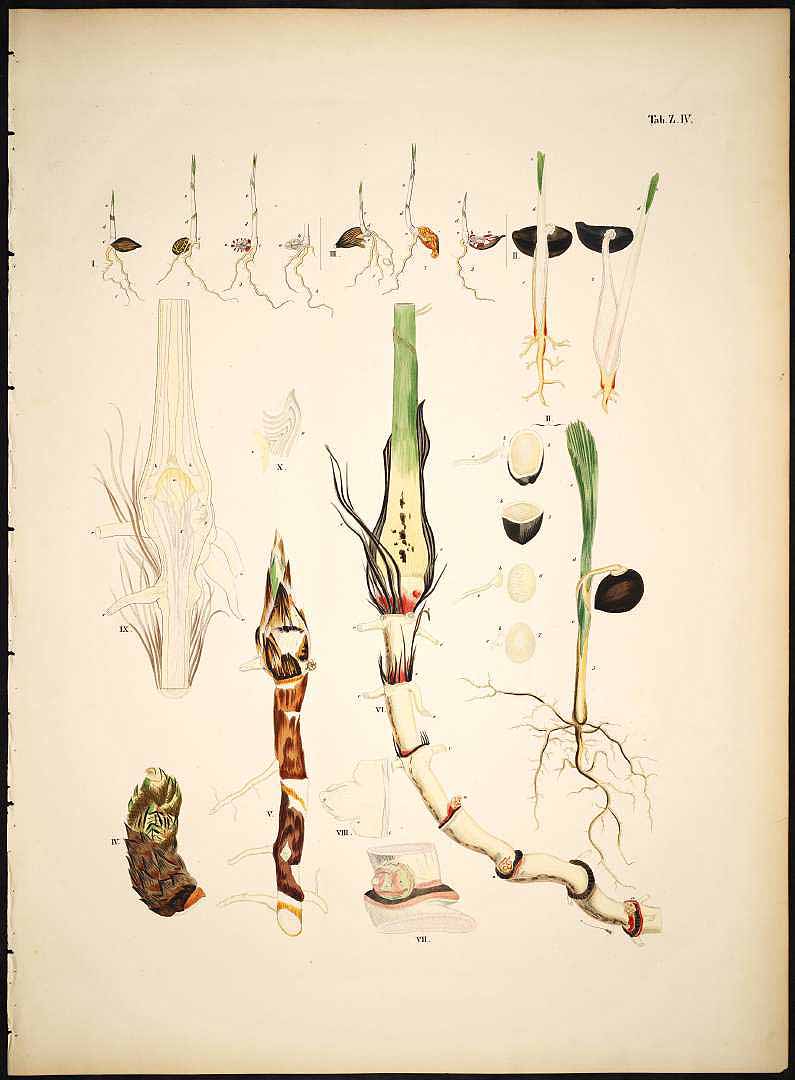

Petite histoire-géo
✖Aire d'origine : Asie tropicale{{{2(+x). :: Plus de détails et d'infos (dont zone(s) de culture) : voir GRIN ("2").
Autres infos
✖dont infos de "FOOD PLANTS INTERNATIONAL" :
Distribution :
Un palmier tropical. Il a besoin de chaleur et d'humidité. Il pousse dans la forêt de plaine jusqu'à 500 m d'altitude. Largement distribué à basse et moyenne altitude dans les zones habitées des Philippines le long des cours d'eau. Il pousse dans les zones calcaires. Il convient aux zones de rusticité 10-12. Dans les jardins botaniques de Cairns. Au Yunnan. À Townsville Palmetum{{{0(+x) (traduction automatique).
Original : A tropical palm. It needs warmth and humidity. It grows in lowland forest up to 500 m altitude. Widely distributed at low and medium altitudes throughout the settled areas of the Philippines along streams. It grows in limestone areas. It suits hardiness zones 10-12. In the Cairns Botanical Gardens. In Yunnan. In Townsville Palmetum{{{0(+x).
Localisation :
Afrique, Asie, Australie, Bangladesh, Bénin, Cambodge, Chine, Afrique de l'Est, Timor oriental, Fidji, Guam, Inde, Indochine, Indonésie, Laos, Malaisie, Myanmar, Nord-est de l'Inde, Pacifique, Papouasie-Nouvelle-Guinée, PNG, Philippines, SE Asie, Sri Lanka, Taiwan, Tanzanie, Thaïlande, Timor-Leste, USA, Vietnam, Afrique de l'Ouest{{{0(+x) (traduction automatique).
Original : Africa, Asia, Australia, Bangladesh, Benin, Cambodia, China, East Africa, East Timor, Fiji, Guam, India, Indochina, Indonesia, Laos, Malaysia, Myanmar, Northeastern India, Pacific, Papua New Guinea, PNG, Philippines, SE Asia, Sri Lanka, Taiwan, Tanzania, Thailand, Timor-Leste, USA, Vietnam, West Africa{{{0(+x).
Notes :
Il existe de 17 à 20 espèces d'Arenga{{{0(+x) (traduction automatique).
Original : There are 17-20 Arenga species{{{0(+x).
Rusticité (résistance face au froid/gel, climat)
✖-2°C
Liens, sources et/ou références
✖Sources et/ou références :
5"Plants For A Future" (en anglais) ;
dont classification : "The Plant List" (en anglais) ; 2"GRIN" (en anglais) ;
dont livres et bases de données : 27Dictionnaire des plantes comestibles (livre, page 33, par Louis Bubenicek) ;
Recherche de/pour :
- "Arenga pinnata" sur Google (pages et
images) ;
TROPICOS (en anglais) ;
Tela Botanica ;
Pl@ntNet ;
Pl@ntUse ;
- "Palmier à sucre" sur Google (pages, images et recettes) ;
- "Arenga pinnata" sur Google (pages et
images) ;
TROPICOS (en anglais) ;
Tela Botanica ;
Pl@ntNet ;
Pl@ntUse ;
Espèces du même genre (Arenga)
✖11 taxons
Espèces de la même famille (Arecaceae)
✖50 taxons (sur 781)
- Acanthophoenix crinita
- Acanthophoenix rubra (Bory) H. Wendl. (Palmiste rouge)
- Acoelorrhaphe wrightii (Griseb. & H.Wendl.) H.Wendl. ex Becc.
- Acrocomia aculeata
- Acrocomia crispa
- Acrocomia media
- Actinorhytis calapparia
- Adonidia merrillii
- Aiphanes deltoidea
- Aiphanes eggersii
- Aiphanes gelatinosa
- Aiphanes grandis
- Aiphanes hirsuta
- Aiphanes horrida (Jacq.) Burret (Palmier ébouriffé)
- Aiphanes lindeniana
- Aiphanes linearis
- Aiphanes macroloba
- Aiphanes minima
- Aiphanes ulei
- Aiphanes verrucosa
- Aiphanes weberbaueri
- Allagoptera arenaria
- Allagoptera brevicalyx
- Allagoptera campestris
- Allagoptera caudescens
- Allagoptera leucocalyx
- Allagoptera maritimum
- Ammandra decasperma
- Aphandra natalia
- Archontophoenix alexandrae
- Archontophoenix cunninghamiana
- Areca caliso
- Areca catechu L. (Palmier à bétel)
- Areca concinna
- Areca glandiformis
- Areca hutchinsoniana
- Areca ipot
- Areca jobiensis
- Areca macrocalyx
- Areca macrocarpa
- Areca montana
- Areca novohibernica
- Areca parens
- Areca triandra
- Areca vestiaria
- Areca whitfordii
- Arenga australasica
- Arenga brevipes
- Arenga engleri
- Arenga listeri
- ...








 pour le fruit (et/ou les graines, la pulpe, etc...),
 pour les fleurs (et/ou pétales, calice...),
 pour les racines,
 pour les champignons,
puis les notes alimentaires et médicinales (de 1 à 5 étoiles), la rusticité (résistance au froid/gel)
et pour finir un résumé.
pour les champignons,
puis les notes alimentaires et médicinales (de 1 à 5 étoiles), la rusticité (résistance au froid/gel)
et pour finir un résumé. menant ici 🙂
 ,
,  ,
,
 ,
,
 ,
,





 ,
,