Holboellia latifolia
Pas d'illustration
pour le moment 😕
 |
***
-
*
|
***
-
*
Un arbuste traînant. Il est persistant et grimpant. Il peut atteindre 6 m de haut. Les feuilles ont des tiges. Ils sont opposés et ont des folioles disposées comme des doig ... (traduction automatique)
→suite


Holboellia latifolia
Note alimentaire 
Note médicinale 

Un arbuste traînant. Il est persistant et grimpant. Il peut atteindre 6 m de haut. Les feuilles ont des tiges. Ils sont opposés et ont des folioles disposées comme des doigts sur une main. Ils mesurent ... (traduction automatique) →suite
Pas d'illustration
pour le moment 😕
Pas d'illustration
pour le moment 😕
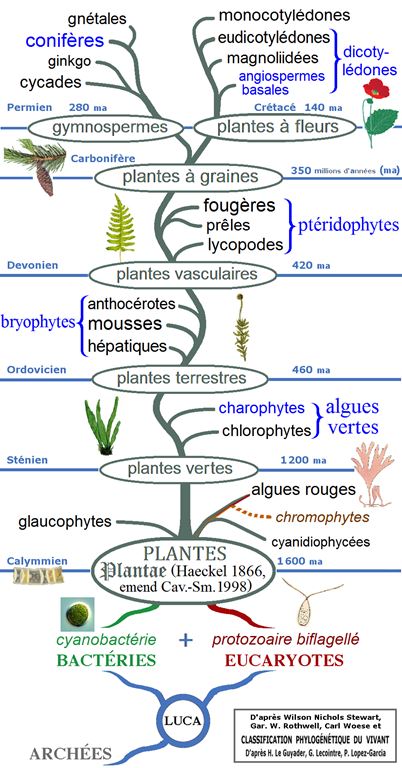
Classification
- Classique : en haut de l'écran, sous le coeur.
- Phylogénétique :
- Clade 4 : Angiospermes ;
- Clade 3 : Dicotylédones_vraies ;
- Ordre APN : Ranunculales ;
- Famille APN : Berberidaceae ;
À droite, cet arbre phylogénétique des plantes montre les principaux clades et groupes traditionnels (monophylétiques en noir et paraphylétiques en bleu).
Dénominations
- Nom botanique : Holboellia latifolia Wall.
- Noms anglais et locaux : Bagul, Dombyem, Ghomphala, Ghopala, Golfa, Gophal, Gophla, Fopla, Gufla, Guphala, Kuolrik, Mi-rang-sa, Sarem, Sa-tymbra, Shulumba, Soh-lygn-kait
Description et culture
Tableau récapitulatif
Parties comes-tibles Note comest. (1-5) Note medic. (1-5) (Zones de) Rusticité Besoins en 
Besoins en  (1-3)
(1-3)Périodes de semis et récoltes Graines au gramme Durée de viabilité Profon-deur semis Espace-ment plants Espace-ment lignes Durée germi-native Durée avant récolte Zones de rusticité : 8, 9, 10, 11 J F M A M J
J A S O N D
J F M A M J
J A S O N D
Types de feuillage :
Persistant
- dont infos de 0FPI ("FOOD PLANTS INTERNATIONAL", en anglais) :
Description :
Un arbuste traînant. Il est persistant et grimpant. Il peut atteindre 6 m de haut. Les feuilles ont des tiges. Ils sont opposés et ont des folioles disposées comme des doigts sur une main. Ils mesurent 3 à 12,5 cm de long sur 0,8 à 6 cm de large. Ils sont oblongs et effilés jusqu'à la pointe. Ils sont coriaces. Les fleurs ont des tiges. Les fleurs sont blanches et parfumées. Ils se produisent le long des tiges avec seulement quelques fleurs. Le fruit est une baie rouge à maturité. Il est ovale ou en forme de saucisse et mesure 5 à 8 cm de long{{{0(+x) (traduction automatique).
Original : A trailing shrub. It is evergreen and climbing. It can grow 6 m high. The leaves have stalks. They are opposite and have leaflets arranged like fingers on a hand. They are 3-12.5 cm long by 0.8-6 cm wide. They are oblong and taper to the tip. They are leathery. The flowers have stalks. The flowers are white and have a scent. They occur along stalks with only a few flowers. The fruit is a berry which is red when ripe. It is oval or sausage shaped and 5-8 cm long{{{0(+x).
Production :
Dans le nord-est de l'Inde, les plantes fleurissent et fructifient de février à novembre{{{0(+x) (traduction automatique).
Original : In NE India plants flower and fruit February to November{{{0(+x).
Culture :
Les plantes sont cultivées à partir de graines fraîches. Des boutures semi-mûres peuvent être utilisées. La pollinisation manuelle facilite la nouaison{{{0(+x) (traduction automatique).
Original : Plants are grown from fresh seed. Semi ripe cuttings can be used. Hand pollination helps fruit set{{{0(+x).
 Consommation (rapports de comestibilité, parties utilisables et usages alimentaires correspondants)
Consommation (rapports de comestibilité, parties utilisables et usages alimentaires correspondants)Parties comestibles :
fruit{{{0(+x) (traduction automatique). Original : Fruit{{{0(+x).Détails :
Les fruits mûrs sont consommés frais{{{0(+x) (traduction automatique).
Original : The ripe fruit are eaten fresh{{{0(+x).
Partie testée :
/ Risques et précautions à prendre
Risques et précautions à prendrenéant, inconnus ou indéterminés.
Autres infos
dont infos de 0FPI ("FOOD PLANTS INTERNATIONAL", en anglais) :
Distribution :
C'est une plante subtropicale. Au Népal, il pousse entre 1500 et 2800 m d'altitude. Au Sikkim, il pousse entre 2 400 et 3 200 m au-dessus du niveau de la mer. Il pousse dans des endroits ouverts comme ombragés. Il a besoin d'un emplacement protégé et d'un mur pour grimper. Les racines doivent être à l'ombre, mais les fruits de la plante poussent mieux au soleil. Il ne peut tolérer que de brèves gelées. Il fait mieux dans les sols riches en matières organiques, la plupart mais bien drainés légèrement acides. Au Sichuan et au Yunnan{{{0(+x) (traduction automatique).
Original : It is a subtropical plant. In Nepal it grows between 1500-2800 m altitude. In Sikkim it grows between 2,400-3,200 m above sea level. It grows in open as well as shady places. It needs a protected location and a wall to climb. The roots need to be in the shade but the plant fruits better growing into the sun. It can only tolerate brief frosts. It does best in organic-rich, most but well-drained slightly acid soils. In Sichuan and Yunnan{{{0(+x).
Localisation :
Asia, Australia, Bhutan, China, Himalayas*, India, Indochina, Myanmar, Nepal, Northeastern India, Pakistan, SE Asia, Sikkim{{{0(+x) (traduction automatique).
Original : Asia, Australia, Bhutan, China, Himalayas*, India, Indochina, Myanmar, Nepal, Northeastern India, Pakistan, SE Asia, Sikkim{{{0(+x).
Notes :
Également mis dans la famille des Lardizabalaceae{{{0(+x) (traduction automatique).
Original : Also put in the family Lardizabalaceae{{{0(+x).
Rusticité (résistance face au froid/gel, climat)
Zones de rusticité : 8, 9, 10, 11
Liens, sources et/ou références
Liens :
/ ;Sources et/ou références :
bibliographie (liste des sources et/ou références de l'encyclopédie)
dont classification : IPNI ("International Plant Names Index", en anglais) ; Kew (POWO - "Plant Of the World Online", "Royal Botanical Garden", en anglais) ;
dont livres et bases de données : 5PFAF ("Plants For A Future", en anglais) ; 0FPI ("FOOD PLANTS INTERNATIONAL", en anglais) ;
dont bibliographie/références de 0FPI ("FOOD PLANTS INTERNATIONAL", en anglais) :
Ambasta, S.P. (Ed.), 2000, The Useful Plants of India. CSIR India. p 270 ; Aryal, K. P., et al, 2018, Diversity and use of wild and non-cultivated edible plants in the Western Himalaya. Journal of Ethnobiology and Ethnomedicine (2018) 14:10 ; Chase, P. & Singh, O. P., 2016, Bioresources of Nagaland: A Case of Wild 4 Edible Fruits in Khonoma Village Forest. in J. Purkayastha (ed.), Bioprospecting of Indigenous Bioresources of North-East India. p 50 ; Facciola, S., 1998, Cornucopia 2: a Source Book of Edible Plants. Kampong Publications, p 138 ; Flora of Pakistan. www.eFloras.org ; Ghimire, S. K., et al, 2008, Non-Timber Forest Products of Nepal Himalaya. WWF Nepal p 89 ; Hedrick, U.P., 1919, (Ed.), Sturtevant's edible plants of the world. p 347 ; Hibbert, M., 2002, The Aussie Plant Finder 2002, Florilegium. p 142 ; Hu, Shiu-ying, 2005, Food Plants of China. The Chinese University Press. p 393 ; Jeeva, S., 2009, Horticultural potential of wild edible fruits used by the Khasi tribes of Meghalaya. Journal or Horticulture and Forestry Vol. 1(9) pp. 182-192 ; Lord, E.E., & Willis, J.H., 1999, Shrubs and Trees for Australian gardens. Lothian. p 331 ; Lyle, S., 2006, Discovering fruit and nuts. Land Links. p 54 ; Manandhar, N.P., 2002, Plants and People of Nepal. Timber Press. Portland, Oregon. p 262 ; Marinelli, J. (Ed), 2004, Plant. DK. p 212 ; Plants for a Future database, The Field, Penpol, Lostwithiel, Cornwall, PL22 0NG, UK. http://www.scs.leeds.ac.uk/pfaf/ ; Polunin, O., & Stainton, A., 2006, Flowers of the Himalaya, Oxford India Paperbacks. p 23 ; Ryan, S., 2008, Dicksonia. Rare Plants Manual. Hyland House. p 76 ; Sawian, J. T., et al, 2007, Wild edible plants of Meghalaya, North-east India. Natural Product Radiance Vol. 6(5): p 418 ; Singh, H.B., Arora R.K.,1978, Wild edible Plants of India. Indian Council of Agricultural Research, New Delhi. p 65 ; Sundriyal, M., et al, 1998, Wild edibles and other useful plants from the Sikkim Himalaya, India. Oecologia Montana 7:43-54 ; Sundriyal, M., et al, 2004, Dietary Use of Wild Plant Resources in the Sikkim Himalaya, India. Economic Botany 58(4) pp 626-638 ; Tent. fl. napal. 249, t. 16. 1826 ; Tsering, J., et al, 2017, Ethnobotanical appraisal on wild edible plants used by the Monpa community of Arunchal Pradesh. Indian Journal of Traditional Knowledge. Vol 16(4), October 2017, pp 626-637 ; Upreti, K., et al, 2010, Diversity and Distribution of Wild Edible Fruit Plants of Uttarakhand. Bioversity Potentials of the Himalaya. p 174 ; Uprety, Y., et al, 2016, Traditional use and management of NTFPs in Kangchenjunga Landscape: implications for conservation and livelihoods. Journal of Ethnobiology and Ethnomedicine (2016) 12:19 ; USDA, ARS, National Genetic Resources Program. Germplasm Resources Information Network - (GRIN). [Online Database] National Germplasm Resources Laboratory, Beltsville, Maryland. Available: www.ars-grin.gov/cgi-bin/npgs/html/econ.pl (10 April 2000) ; www.efloras.org Flora of China Volume 6
Recherche de/pour :
- "Holboellia latifolia" sur Google (pages et
images) ;
TPL ("The Plant List", en anglais) ;
GRIN ("Germplasm Resources Information Network", en anglais) ;
TROPICOS (en anglais) ;
Tela Botanica ;
Pl@ntNet ;
Pl@ntUse ;
"Useful Tropical Plants" (en anglais) ou
"Useful Temperate Plants" (en anglais) ;
- "Holboellia latifolia" sur Google (pages et
images) ;
TPL ("The Plant List", en anglais) ;
GRIN ("Germplasm Resources Information Network", en anglais) ;
TROPICOS (en anglais) ;
Tela Botanica ;
Pl@ntNet ;
Pl@ntUse ;
"Useful Tropical Plants" (en anglais) ou
"Useful Temperate Plants" (en anglais) ;
Espèces du même genre (Holboellia)
5 taxons
Espèces de la même famille (Berberidaceae)
159 taxons
- Bambou sacré
- Berbéris
- Berbéris à feuilles de buis
- Berbéris à grappe
- Berbéris d'Irwin
- Berbéris de Crète
- Berbéris de Gagnepin à feuilles larges
- Berbéris de Thunberg
- Berberis pruineux
- Berbéris verruqueux
- Épine-vinette
- Épine-vinette à feuilles de camarine
- Épine-vinette de darwin
- Épine-vinette de nevin
- Épine-vinette mexicaine
- Léontice d'Eversmann
- Mahonia à feuilles de houx
- Mahonia du Japon
- Podophylle pelté
- Pomme de mai de l'Himalaya
- Sinopodophyllum
- Achlys triphylla DC.
- Berberis actinacantha Mart. ex Schult. & Schult.f.
- Berberis aggregata C.K.Schneid. (Berbéris à grappe)
- Berberis amoena Dunn
- Berberis amurensis Rupr.
- Berberis angulosa Wall. ex Hook.f. & Thomson
- Berberis aquifolium Pursh (Mahonia à feuilles de houx)
- Berberis aristata DC.
- Berberis asiatica Griff.
- Berberis atrocarpa C.K.Schneid.
- Berberis barandana S.Vidal
- Berberis bidentata
- Berberis boliviana Lechl.
- Berberis buxifolia Lam. (Berbéris à feuilles de buis)
- Berberis bykovianas
- Berberis calliantha Mulligan
- Berberis calliobotrys Bien. ex Koehne
- Berberis canadensis Guimpel
- Berberis capillaris Cox ex Ahrendt
- Berberis ceratophylla G.Don
- Berberis chengii
- Berberis chilensis Gillies ex Hook. & Arn.
- Berberis chinensis K.Koch
- Berberis chingii C.Y.Cheng
- Berberis chitria Buch.-Ham. ex Ker Gawl.
- Berberis circumserrata (C.K.Schneid.) C.K.Schneid.
- Berberis commutata Eichler
- Berberis concinna Hook.f.
- Berberis cooperi Ahrendt
- Berberis crataegina DC.
- Berberis cretica L. (Berbéris de Crète)
- Berberis darwinii Hook. (Épine-vinette de darwin)
- Berberis empetrifolia Lam. (Épine-vinette à feuilles de camarine)
- Berberis erythroclada Ahrendt
- Berberis everestiana Ahrendt
- Berberis everstiana
- Berberis fendleri A.Gray
- Berberis flexuosa Ruiz & Pav.
- Berberis gagnepainii C.K.Schneid. (Berbéris de Gagnepin à feuilles larges)
- Berberis ganpinensis H.Lv.
- Berberis georgii
- Berberis glauca Benth.
- Berberis glaucocarpa Stapf
- Berberis glomerata Hook. & Arn.
- Berberis gracilis Hartw. ex Benth. (Épine-vinette mexicaine)
- Berberis haematocarpa Wooton
- Berberis heterophylla Juss. ex Poir.
- Berberis heteropoda Schrenk ex Fisch. & C.A.Mey.
- Berberis holstii Engl.
- Berberis horrida Jungh.
- ...







 donne accès au menu
  - encyclopédies des plantes alimentaires ;
 - page de recherche - reconnaissance (identification) de plantes ;
 - page du calendrier lunaire et son générateur (au format PDF et JPG) ;
 - tableau récapitulatif ;
 - générateur de potées (soupes), avec estimation des apports nutrionnels et du coût;
 - générateur de codes QR ;
 - page des archives avec de nombreux documents sur différents thèmes complémentaires comme la botanique, les légumes,
les champignons, la cuisine, le bien-être ainsi que différents MOOC mais également des liens vers les archives de l'association ;
- page des archives avec de nombreux documents sur différents thèmes complémentaires comme la botanique, les légumes,
les champignons, la cuisine, le bien-être ainsi que différents MOOC mais également des liens vers les archives de l'association ;

 pour le fruit (et/ou les graines, la pulpe, etc...),
 pour les fleurs (et/ou pétales, calice...),
 pour les feuilles (et/ou la tige, les pousses...),
 pour les racines,
 pour le tronc (et/ou l'écorce, la sève...), et enfin
 pour les champignons,
puis les notes alimentaires et médicinales (de 1 à 5 étoiles), la rusticité (résistance au froid/gel)
et pour finir un résumé.
pour les champignons,
puis les notes alimentaires et médicinales (de 1 à 5 étoiles), la rusticité (résistance au froid/gel)
et pour finir un résumé. menant ici 🙂
 ,
,  et
et





 ,
,


 Encyclopédie(s)
 Recherche-Reconnaissance
 Tableau récapitulatif
 Codes QR
 Archives
 Calendrier(s) lunaire(s)
  Potées
 Re-naturation/naturalisation
 Affichettes, herbiers &
co.
Affichettes, herbiers &
co. menu
menu galerie


 (en bas à droite).
 (en bas à gauche).
