Eugenia biflora
Pas d'illustration
pour le moment 😕

Un arbuste ou un petit arbre. Il pousse 3-4 m de haut. Les rameaux ont une couche brune parmi les poils blancs. Les feuilles sont en forme d'épée. Ils mesurent 7 cm de long ... (traduction automatique)
→suite


Eugenia biflora

Un arbuste ou un petit arbre. Il pousse 3-4 m de haut. Les rameaux ont une couche brune parmi les poils blancs. Les feuilles sont en forme d'épée. Ils mesurent 7 cm de long et 1 à 3 cm de large. Il y a ... (traduction automatique) →suite
Pas d'illustration
pour le moment 😕
Pas d'illustration
pour le moment 😕
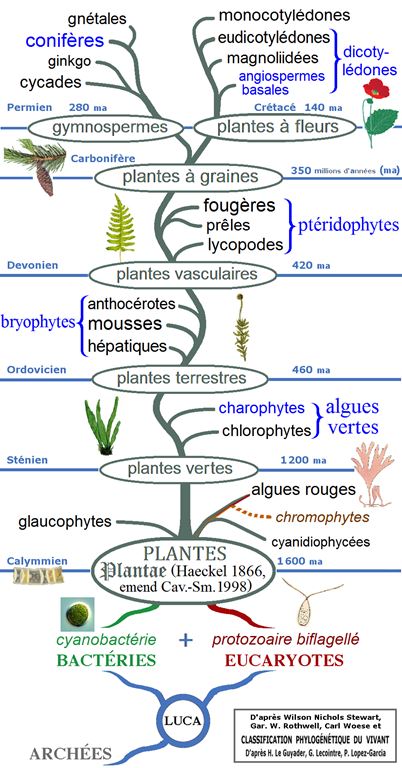
Classification
- Classique : en haut de l'écran, sous le coeur.
- Phylogénétique :
- Clade 4 : Angiospermes ;
- Clade 3 : Dicotylédones_vraies ;
- Clade 2 : Rosidées ;
- Clade 1 : Malvidées ;
- Ordre APN : Myrtales ;
- Famille APN : Myrtaceae ;
À droite, cet arbre phylogénétique des plantes montre les principaux clades et groupes traditionnels (monophylétiques en noir et paraphylétiques en bleu).
Dénominations
- Nom botanique : Eugenia biflora (L.) DC.
- Synonymes : Caryophyllus fruticosus Mill, Eugenia acuminatissima Miq.Eugenia amanuensis Steyerm, Myrtus biflora L
- Noms anglais et locaux : Escobon, Murta
Description et culture
Tableau récapitulatif
Parties comes-tibles Note comest. (1-5) Note medic. (1-5) (Zones de) Rusticité Besoins en 
Besoins en  (1-3)
(1-3)Périodes de semis et récoltes Graines au gramme Durée de viabilité Profon-deur semis Espace-ment plants Espace-ment lignes Durée germi-native Durée avant récolte J F M A M J
J A S O N D
J F M A M J
J A S O N D
- dont infos de 0FPI ("FOOD PLANTS INTERNATIONAL", en anglais) :
Description :
Un arbuste ou un petit arbre. Il pousse 3-4 m de haut. Les rameaux ont une couche brune parmi les poils blancs. Les feuilles sont en forme d'épée. Ils mesurent 7 cm de long et 1 à 3 cm de large. Il y a 3-7 fleurs dans un groupe. Les fleurs sont blanches. Le fruit est une baies rondes légèrement aplaties. Ils mesurent 7 mm de long. Ils peuvent être légèrement côtelés{{{0(+x) (traduction automatique).
Original : A shrub or small tree. It grows 3-4 m high. The twigs have a brown coating amongst white hairs. The leaves are sword shaped. They are 7 cm long and 1-3 cm wide. There are 3-7 flowers in a group. The flowers are white. The fruit is a slightly flattened round berries. They are 7 mm long. They can be slightly ribbed{{{0(+x).
 Consommation (rapports de comestibilité, parties utilisables et usages alimentaires correspondants)
Consommation (rapports de comestibilité, parties utilisables et usages alimentaires correspondants)Parties comestibles :
fruit{{{0(+x) (traduction automatique). Original : Fruit{{{0(+x).Détails :
La pulpe du fruit est consommée crue{{{0(+x) (traduction automatique).
Original : The pulp of the fruit is eaten raw{{{0(+x).
Partie testée :
/ Risques et précautions à prendre
Risques et précautions à prendrenéant, inconnus ou indéterminés.
Autres infos
dont infos de 0FPI ("FOOD PLANTS INTERNATIONAL", en anglais) :
Distribution :
C'est une plante tropicale. À Porto Rico, il pousse jusqu'à 700 m d'altitude{{{0(+x) (traduction automatique).
Original : It is a tropical plant. In Puerto Rico it grows it grows up to 700 m above sea level{{{0(+x).
Localisation :
Belize, Bolivia, Brazil, Caribbean, Central America, Colombia, Costa Rica, Dominican Republic, Ecuador, El Salvador, Guatemala, Guiana, Guianas, Guyana, Haiti, Honduras, Jamaica, Mexico, Nicaragua, North America, Panama, Peru, Puerto Rico, South America, Suriname, USA, Venezuela, West Indies{{{0(+x) (traduction automatique).
Original : Belize, Bolivia, Brazil, Caribbean, Central America, Colombia, Costa Rica, Dominican Republic, Ecuador, El Salvador, Guatemala, Guiana, Guianas, Guyana, Haiti, Honduras, Jamaica, Mexico, Nicaragua, North America, Panama, Peru, Puerto Rico, South America, Suriname, USA, Venezuela, West Indies{{{0(+x).
Liens, sources et/ou références
Liens :
/ ;Sources et/ou références :
bibliographie (liste des sources et/ou références de l'encyclopédie)
dont livres et bases de données : 0FPI ("FOOD PLANTS INTERNATIONAL", en anglais) ;
dont bibliographie/références de 0FPI ("FOOD PLANTS INTERNATIONAL", en anglais) :
Grandtner, M. M., 2008, World Dictionary of Trees. Wood and Forest Science Department. Laval University, Quebec, Qc Canada. (Internet database http://www.wdt.qc.ca) ; Grandtner, M. M. & Chevrette, J., 2013, Dictionary of Trees, Volume 2: South America: Nomenclature, Taxonomy and Ecology. Academic Press p 235 ; Kermath, B. M., et al, 2014, Food Plants in the Americas: A survey of the domesticated, cultivated and wild plants used for Human food in North, Central and South America and the Caribbean. On line draft. p 350 ; Little, E. L., et al, 1974, Trees of Puerto Rico and the Virgin Islands. USDA Handbook 449. Forestry Service. p 644 ; Martin, F.W., C.W. Campbell and R.M. Ruberté, 1987, Perennial edible fruits of the tropics - An inventory. United States Department of Agriculture, Agricultural Research Service, Agriculture Handbook No. 642. Washington, D.C., USA ; NYBG herbarium "edible" ; Plants of Haiti Smithsonian Institute http://botany.si.edu/antilles/West Indies ;
Recherche de/pour :
- "Eugenia biflora" sur Google (pages et
images) ;
IPNI ("International Plant Names Index", en anglais) ;
TPL ("The Plant List", en anglais) ;
GRIN ("Germplasm Resources Information Network", en anglais) ;
TROPICOS (en anglais) ;
Tela Botanica ;
Pl@ntNet ;
Pl@ntUse ;
"Plants For A Future" (en anglais) ;
"Useful Tropical Plants" (en anglais) ou
"Useful Temperate Plants" (en anglais) ;
- "Eugenia biflora" sur Google (pages et
images) ;
IPNI ("International Plant Names Index", en anglais) ;
TPL ("The Plant List", en anglais) ;
GRIN ("Germplasm Resources Information Network", en anglais) ;
TROPICOS (en anglais) ;
Tela Botanica ;
Pl@ntNet ;
Pl@ntUse ;
"Plants For A Future" (en anglais) ;
"Useful Tropical Plants" (en anglais) ou
"Useful Temperate Plants" (en anglais) ;
Espèces du même genre (Eugenia)
171 taxons
- Araza
- Baie de noël
- Beach cherry
- Cagaita
- Cedar bay cherry
- Cerisier de cayenne
- Cerisier de rio grande
- Cerisier du brésil
- Guayabilla
- Jamboisier rouge
- Mülchi
- Perinha
- Pitanga de la savanne
- Pitangatuba
- Pitomba
- Poire brésilienne
- Red stopper
- Spanish stopper
- Ubaia
- White stopper
- Eugenia acapulcensis Steud.
- Eugenia acris Wight & Arn.
- Eugenia aeruginea DC.
- Eugenia aherniana C.B.Rob.
- Eugenia anastomosans DC.
- Eugenia angustissima O.Berg
- Eugenia anomala D.Legrand
- Eugenia arenosa Mattos
- Eugenia arrabidae O.Berg
- Eugenia arthroopoda Baill. ex Drake
- Eugenia aurata O.Berg
- Eugenia axillaris (Sw.) Willd. (White stopper)
- Eugenia azeda Sobral
- Eugenia bimarginata O.Berg
- Eugenia blastantha
- Eugenia boliviana
- Eugenia brasiliensis Lam. (Cerisier du brésil)
- Eugenia brevistyla D.Legrand
- Eugenia brongniartiana Guillaumin
- Eugenia bukobensis Engl.
- Eugenia bullata Pancher ex Guillaumin
- Eugenia calva McVaugh
- Eugenia calycina Cambess. (Pitanga de la savanne)
- Eugenia candolleana DC.
- Eugenia capensis
- Eugenia capuli
- Eugenia catinga Baill.
- Eugenia catingiflora Griseb.
- Eugenia cerasiflora Miq. (Cerisier de rio grande)
- Eugenia cereja D.Legrand
- Eugenia choapamensis Standl.
- Eugenia cloiselii H.Perrier
- Eugenia concava B.Holst & M.L.Kawas.
- Eugenia confusa Cambess. (Red stopper)
- Eugenia convexinervia D.Legrand
- Eugenia copacanabensis
- Eugenia coronata Vahl ex DC.
- Eugenia cotinifolia Jacq.
- Eugenia crenata O.Berg
- Eugenia cribrata McVaugh
- Eugenia cuprea Koord. & Valeton
- Eugenia curvipilosa McVaugh
- Eugenia cyclophylla O.Berg
- Eugenia discolorans C.Wright
- Eugenia discreta McVaugh
- Eugenia disticha
- Eugenia djouat Perr.
- Eugenia dodonaeifolia Cambess.
- Eugenia domingensis O.Berg
- Eugenia dulcis O.Berg
- ...
Espèces de la même famille (Myrtaceae)
772 taxons
- Araca pera
- Araza
- Arbre à thé
- Arbre à thé au parfum citronnné
- Arbre anis (tp* de "aniseed tree")
- Baie de noël
- Beach cherry
- Bois d'inde
- Cabelluda
- Cagaita
- Cajeput
- Cedar bay cherry
- Cerise bleue (tp* de "blue cherry")
- Cerisier d'australie
- Cerisier de cayenne
- Cerisier de rio grande
- Cerisier du brésil
- Ceylon hill cherry
- Coronille
- Eucalyptus
- Eucalyptus à manne
- Eucalyptus à trois fruits
- Eucalyptus à urnes
- Eucalyptus amandier
- Eucalyptus argenté
- Eucalyptus bois-blanc
- Eucalyptus cendré
- Eucalyptus citronné
- Eucalyptus coccifère
- Eucalyptus de Bridges
- Eucalyptus de Johnston
- Eucalyptus de Macarthur
- Eucalyptus de Nichol
- Eucalyptus de Perrin
- Eucalyptus de Smith
- Eucalyptus des marais
- Eucalyptus du mont Delegate
- Eucalyptus du mont Jeffcott
- Eucalyptus linéaire
- Eucalyptus oblique
- Eucalyptus ovale
- Eucalyptus pauciflore
- Eucalyptus pulvérulent
- Eucalyptus rayonnant
- Eucalyptus rougeâtre
- Eucalyptus royal
- Eucalyptus subulé
- Feijoa
- Giroflier
- Gommier bleu
- Acca sellowiana (O. Berg) Burret (Feijoa)
- Aluta maisonneivei
- Amomyrtus luma (Luma)
- Amomyrtus meli
- Angophora floribunda
- Archirhodomyrtus beckleri
- Astartea fascicularis
- Aulomyrcia vaccinifolia
- Austromyrtus dulcis (C.T.White) L.S.Sm.
- Austromyrtus dulcis x tenuifolia
- Austromyrtus tenuifolia
- Backhousia anisata Vickery
- Backhousia citriodora F.Muell. (Myrte citronnée)
- Backhousia myrtifolia Hook. & Harv. (Myrte cannelle)
- Baeckea frutescens L.
- Baeckea gunniana S.Schauer ex Walp.
- Blepharocalyx cruckshanksii
- Blepharocalyx salicifolius
- Callistemon citrinus (Curtis) Skeels (Rince-bouteilles)
- Callistemon polandii F.M.Bailey
- Callistemon viminalis
- Calothamnus quadrifidus R.Br.
- Calothamnus sanguineus Labill.
- Calycolpus calophyllus
- Calycolpus goetheanus
- Calycolpus legrandii Mattos
- Calycolpus moritzianus
- Calycorectes acutatus
- Calycorectes grandifolius O.Berg
- Calycorectes sp.
- Calyptranthes aromatica A.St.-Hil.
- Calyptranthes clusiifolia O.Berg
- Calyptranthes concinna DC.
- Calyptranthes grandifolia O.Berg
- Calyptranthes hintonii Lundell
- Calyptranthes longifolia O.Berg
- Calyptranthes lucida Mart. ex DC.
- Calyptranthes macrophylla O.Berg
- Calyptranthes nigrescens B.Holst
- Calyptranthes pallens Griseb.
- Calyptranthes paniculata Raeusch.
- Calyptranthes plicata McVaugh
- Calyptranthes schiediana
- Calyptranthes speciosa Sagot
- Calyptranthes syzygium
- Calyptranthes variabilis O.Berg
- Calyptranthes widgreniana O.Berg
- Calyptranthes zuzygium Blanco
- Calytrix tetragona Labill.
- Campomanesia adamantium (Cambess.) O.Berg (Guabiroba blanche)
- ...







 donne accès au menu
  - encyclopédies des plantes alimentaires ;
 - page de recherche - reconnaissance (identification) de plantes ;
 - page du calendrier lunaire et son générateur (au format PDF et JPG) ;
 - tableau récapitulatif ;
 - générateur de potées (soupes), avec estimation des apports nutrionnels et du coût;
 - générateur de codes QR ;
 - page des archives avec de nombreux documents sur différents thèmes complémentaires comme la botanique, les légumes,
les champignons, la cuisine, le bien-être ainsi que différents MOOC mais également des liens vers les archives de l'association ;
- page des archives avec de nombreux documents sur différents thèmes complémentaires comme la botanique, les légumes,
les champignons, la cuisine, le bien-être ainsi que différents MOOC mais également des liens vers les archives de l'association ;

 pour le fruit (et/ou les graines, la pulpe, etc...),
 pour les fleurs (et/ou pétales, calice...),
 pour les feuilles (et/ou la tige, les pousses...),
 pour les racines,
 pour le tronc (et/ou l'écorce, la sève...), et enfin
 pour les champignons,
puis les notes alimentaires et médicinales (de 1 à 5 étoiles), la rusticité (résistance au froid/gel)
et pour finir un résumé.
pour les champignons,
puis les notes alimentaires et médicinales (de 1 à 5 étoiles), la rusticité (résistance au froid/gel)
et pour finir un résumé. menant ici 🙂
 ,
,  et
et





 ,
,


 Encyclopédie(s)
 Recherche-Reconnaissance
 Tableau récapitulatif
 Codes QR
 Archives
 Calendrier(s) lunaire(s)
  Potées
 Re-naturation/naturalisation
 Affichettes, herbiers &
co.
Affichettes, herbiers &
co. menu
menu galerie


 (en bas à droite).
 (en bas à gauche).
