Auricularia cornea
Pas d'illustration
pour le moment 😕

Un champignon (traduction automatique)
→suite


Auricularia cornea

Un champignon (traduction automatique)
Champignon (cf. MycoDB)
Pas d'illustration
pour le moment 😕
Pas d'illustration
pour le moment 😕
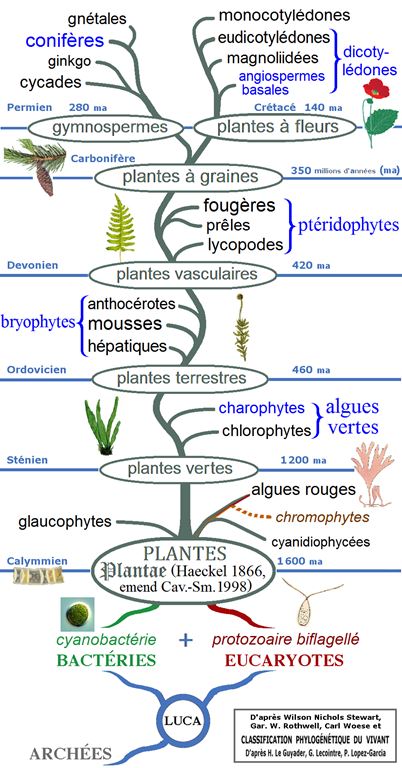
Classification
- Classique : en haut de l'écran, sous le coeur.
- Phylogénétique : Inconnue
À droite, cet arbre phylogénétique des plantes montre les principaux clades et groupes traditionnels (monophylétiques en noir et paraphylétiques en bleu).
Dénominations
- Nom botanique : Auricularia cornea Ehrenb.
- Synonymes : Auricularia poltricha (Mont.) Sacc, Auricularia tenuis (Lev.) Farl, Exidia cornea (Egrenb.) Fr, Exidia polytricha Mont, Hirneola cornea (Ehrenb.) Fr, Hirneola nigra Fr
- Noms anglais et locaux : Ear fungus
Description et culture
Tableau récapitulatif
Parties comes-tibles Note comest. (1-5) Note medic. (1-5) (Zones de) Rusticité Besoins en 
Besoins en  (1-3)
(1-3)Périodes de semis et récoltes Graines au gramme Durée de viabilité Profon-deur semis Espace-ment plants Espace-ment lignes Durée germi-native Durée avant récolte J F M A M J
J A S O N D
J F M A M J
J A S O N D
- dont infos de 0FPI ("FOOD PLANTS INTERNATIONAL", en anglais) :
 Consommation (rapports de comestibilité, parties utilisables et usages alimentaires correspondants)
Consommation (rapports de comestibilité, parties utilisables et usages alimentaires correspondants)Parties comestibles :
champignon{{{0(+x) (traduction automatique). Original : Fungus, Mushroom{{{0(+x).Partie testée :
champignon{{{0(+x) (traduction automatique). Original : Mushroom{{{0(+x) Risques et précautions à prendre
Risques et précautions à prendrenéant, inconnus ou indéterminés.
Autres infos
dont infos de 0FPI ("FOOD PLANTS INTERNATIONAL", en anglais) :
Distribution :
Une plante tropicale{{{0(+x) (traduction automatique).
Original : A tropical plant{{{0(+x).
Localisation :
Afrique, Asie, Australie, Bénin, Burundi, Cameroun, Comores, RD Congo, Côte d'Ivoire, Afrique de l'Est, Éthiopie, Gabon, Ghana, Côte d'Ivoire, Madagascar, Malawi, Mali, Mexique, Nigéria, Pacifique, Philippines, Rwanda, Asie du Sud-Est, Tanzanie, Ouganda, Afrique de l'Ouest, Zambie, Zimbabwe{{{0(+x) (traduction automatique).
Original : Africa, Asia, Australia, Benin, Burundi, Cameroon, Comores, Congo DR, Côte d'Ivoire, East Africa, Ethiopia, Gabon, Ghana, Ivory Coast, Madagascar, Malawi, Mali, Mexico, Nigeria, Pacific, Philippines, Rwanda, SE Asia, Tanzania, Uganda, West Africa, Zambia, Zimbabwe{{{0(+x).
Liens, sources et/ou références
Liens :
/ ;Sources et/ou références :
bibliographie (liste des sources et/ou références de l'encyclopédie)
dont livres et bases de données : 0FPI ("FOOD PLANTS INTERNATIONAL", en anglais) ;
dont bibliographie/références de 0FPI ("FOOD PLANTS INTERNATIONAL", en anglais) :
Boa, E. R., Wild edible fungi and their importance to people. FAO Non Wood Forest Products Booklet 17 ; Degreef, J., et al, 2016, Wild edible mushrooms, a valuable resource for food security and rural development in Burundi and Rwanda. Biotechnol. Agron. Soc. Environ. 2016 20(4), 441-452 ; efta-online.org, Edible Fungi of Tropical Africa, Jardin botanique Meise ; Fuhrer, B., 2005, A field guide to Australian Fungi. Bloomings Books. p 290 ; Kiple, K.F. & Ornelas, K.C., (eds), 2000, The Cambridge World History of Food. CUP p 320 ; Reinking, 1921, ; Ruan-Soto, F. et al, 2009, Use and handling of wild fungi in two communities of the Lacandona Rainforest, Chiapas, Mexico. Revista Mexicana de Micologia. 29, 2009 ; Tibuhwa, 2013, Wild Mushroom - an underutilized healthy food resource and income generator: experience from Tanzania rural areas. Journal of Ethnobiology and Ethnomedicine 9:49
Recherche de/pour :
- "Auricularia cornea" sur Google (pages et
images) ;
IPNI ("International Plant Names Index", en anglais) ;
TPL ("The Plant List", en anglais) ;
GRIN ("Germplasm Resources Information Network", en anglais) ;
TROPICOS (en anglais) ;
Tela Botanica ;
Pl@ntNet ;
Pl@ntUse ;
"Plants For A Future" (en anglais) ;
"Useful Tropical Plants" (en anglais) ou
"Useful Temperate Plants" (en anglais) ;
- "Auricularia cornea" sur Google (pages et
images) ;
IPNI ("International Plant Names Index", en anglais) ;
TPL ("The Plant List", en anglais) ;
GRIN ("Germplasm Resources Information Network", en anglais) ;
TROPICOS (en anglais) ;
Tela Botanica ;
Pl@ntNet ;
Pl@ntUse ;
"Plants For A Future" (en anglais) ;
"Useful Tropical Plants" (en anglais) ou
"Useful Temperate Plants" (en anglais) ;
Espèces du même genre (Auricularia)
13 taxons
- Auricularia auricula
- Auricularia auricula-judae (Oreille-de-Judas)
- Auricularia brasiliensis
- Auricularia delicata
- Auricularia fuscosuccinea
- Auricularia heimuer
- Auricularia mesenterica (Auriculaire mesenterique)
- Auricularia nigrescens
- Auricularia polytricha
- Auricularia porphyra
- Auricularia sambuncina
- Auricularia tenuis
Espèces de la même famille (Auriculariaceae)
16 taxons
- Auricularia auricula
- Auricularia auricula-judae (Oreille-de-Judas)
- Auricularia brasiliensis
- Auricularia delicata
- Auricularia fuscosuccinea
- Auricularia heimuer
- Auricularia mesenterica (Auriculaire mesenterique)
- Auricularia nigrescens
- Auricularia polytricha
- Auricularia porphyra
- Auricularia sambuncina
- Auricularia tenuis
- Clavicorona pyxidata
- Hirneola auricula-judae
- Hirneola polytricha







 donne accès au menu
  - encyclopédies des plantes alimentaires ;
 - page de recherche - reconnaissance (identification) de plantes ;
 - page du calendrier lunaire et son générateur (au format PDF et JPG) ;
 - tableau récapitulatif ;
 - générateur de potées (soupes), avec estimation des apports nutrionnels et du coût;
 - générateur de codes QR ;
 - page des archives avec de nombreux documents sur différents thèmes complémentaires comme la botanique, les légumes,
les champignons, la cuisine, le bien-être ainsi que différents MOOC mais également des liens vers les archives de l'association ;
- page des archives avec de nombreux documents sur différents thèmes complémentaires comme la botanique, les légumes,
les champignons, la cuisine, le bien-être ainsi que différents MOOC mais également des liens vers les archives de l'association ;

 pour le fruit (et/ou les graines, la pulpe, etc...),
 pour les fleurs (et/ou pétales, calice...),
 pour les feuilles (et/ou la tige, les pousses...),
 pour les racines,
 pour le tronc (et/ou l'écorce, la sève...), et enfin
 pour les champignons,
puis les notes alimentaires et médicinales (de 1 à 5 étoiles), la rusticité (résistance au froid/gel)
et pour finir un résumé.
pour les champignons,
puis les notes alimentaires et médicinales (de 1 à 5 étoiles), la rusticité (résistance au froid/gel)
et pour finir un résumé. menant ici 🙂
 ,
,  et
et





 ,
,


 Encyclopédie(s)
 Recherche-Reconnaissance
 Tableau récapitulatif
 Codes QR
 Archives
 Calendrier(s) lunaire(s)
  Potées
 Re-naturation/naturalisation
 Affichettes, herbiers &
co.
Affichettes, herbiers &
co. menu
menu galerie


 (en bas à droite).
 (en bas à gauche).
