Alaire comestible
(Alaria esculenta)


Une algue. C'est olive de jaune-brun. Les frondes sont longues et côtelées. Ils peuvent mesurer 4 m de long et 25 cm de large. Ils sont attachés aux rochers par un support ... (traduction automatique)
→suite


Alaire comestible

Une algue. C'est olive de jaune-brun. Les frondes sont longues et côtelées. Ils peuvent mesurer 4 m de long et 25 cm de large. Ils sont attachés aux rochers par un support à la base. Cela a un stipe fl... (traduction automatique) →suite
Algue (cf. Algaebase)
Pas d'autre illustration
pour le moment 😕
Alaria esculenta
Classification
- Classique : en haut de l'écran, sous le coeur.
- Phylogénétique : Inconnue
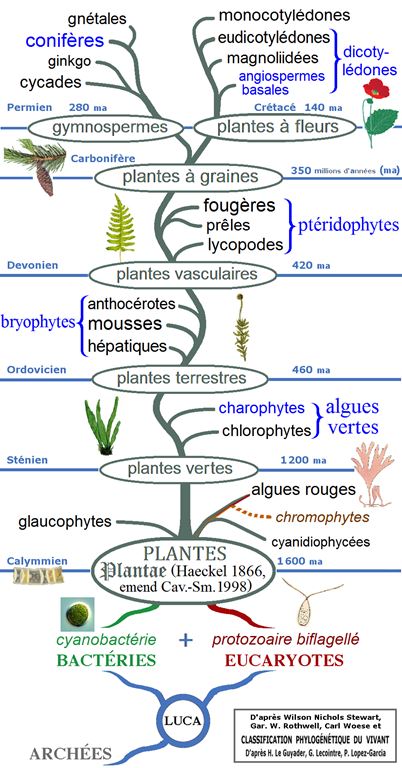
À droite, cet arbre phylogénétique des plantes montre les principaux clades et groupes traditionnels (monophylétiques en noir et paraphylétiques en bleu).
Dénominations
- Nom botanique : Alaria esculenta (L.) Greville
- Synonymes français : wakamé breton, wakamé irlandais
- Synonymes : Laminaria esculenta (Linnaeus) C. Agardh, et beaucoup d'autres
- Noms anglais et locaux : Dabberlocks, Wing kelp, Atlantic wakame
Description et culture
Tableau récapitulatif
Parties comes-tibles Note comest. (1-5) Note medic. (1-5) (Zones de) Rusticité Besoins en 
Besoins en  (1-3)
(1-3)Périodes de semis et récoltes Graines au gramme Durée de viabilité Profon-deur semis Espace-ment plants Espace-ment lignes Durée germi-native Durée avant récolte J F M A M J
J A S O N D
J F M A M J
J A S O N D
- dont infos de 0FPI ("FOOD PLANTS INTERNATIONAL", en anglais) :
Description :
Une algue. C'est olive de jaune-brun. Les frondes sont longues et côtelées. Ils peuvent mesurer 4 m de long et 25 cm de large. Ils sont attachés aux rochers par un support à la base. Cela a un stipe flexible et une ou plusieurs frondes qui y sont attachées. Les structures reproductrices se trouvent sur des folioles (sporophylles) près de la base{{{0(+x) (traduction automatique).
Original : A seaweed. It is olive of yellow-brown. The fronds are long and ribbed. They can be 4 m long and 25 cm wide. They are attached to the rocks by a holdfast at the base. This has a flexible stipe and one or more fronds attached to it. The reproductive structures are on leaflets (sporophylls) near the base{{{0(+x).
 Consommation (rapports de comestibilité, parties utilisables et usages alimentaires correspondants)
Consommation (rapports de comestibilité, parties utilisables et usages alimentaires correspondants)Algues brune comestible. En Asie, elle était en 1985 consommée à titre alimentaire uniquement par les Coréens. Elle est aussi exploitée pour son algine{{{wiki.
Partie testée :
algue{{{0(+x) (traduction automatique). Original : Seaweed{{{0(+x)| Taux d'humidité (%) | Énergie (kj) | Énergie (kcal) | Protéines (g) |
|---|---|---|---|
| / | 0 | 0 | 9.1 |
| Pro- vitamines A (µg) |
Vitamines C (mg) | Fer (mg) | Zinc (mg) |
| 0 | 0 | 0 | 0 |
 Risques et précautions à prendre
Risques et précautions à prendrenéant, inconnus ou indéterminés.
Galerie(s)
Autres infos
dont infos de 0FPI ("FOOD PLANTS INTERNATIONAL", en anglais) :
Distribution :
Il pousse dans les eaux tempérées. Il pousse sur les rochers dans les endroits à marée basse de l'Atlantique nord et peut se produire dans des mares rocheuses{{{0(+x) (traduction automatique).
Original : It grows in temperate waters. It grows on rocks in low tide places in the north Atlantic and can occur in rock pools{{{0(+x).
Localisation :
Alaska, Arctique, Grande-Bretagne, Canada, Danemark, Europe, Iles Féroé, France, Groenland, Islande, Irlande, Japon, Corée, Pays-Bas, Amérique du Nord, Norvège, Russie, Scandinavie, Ecosse, Sibérie, USA{{{0(+x) (traduction automatique).
Original : Alaska, Arctic, Britain, Canada, Denmark, Europe, Faroe Islands, France, Greenland, Iceland, Ireland, Japan, Korea, Netherlands, North America, Norway, Russia, Scandinavia, Scotland, Siberia, USA{{{0(+x).
Liens, sources et/ou références
Liens :
/ ;Sources et/ou références :
bibliographie (liste des sources et/ou références de l'encyclopédie)
dont livres et bases de données : 0FPI ("FOOD PLANTS INTERNATIONAL", en anglais) ;
dont bibliographie/références de 0FPI ("FOOD PLANTS INTERNATIONAL", en anglais) :
Beckstrom-Sternberg, Stephen M., and James A. Duke. "The Foodplant Database."http://probe.nalusda.gov:8300/cgi-bin/browse/foodplantdb.(ACEDB version 4.0 - data version July 1994) ; Cherry, P., et al, 2019, Risks and benefits of consuming edible seaweeds. Nutrition ReviewsVR Vol. 77(5):307–329 ; Eidlitz, M., 1969, Food and Emergency food in the circumpolar area. Uppsala, Sweden. ; Facciola, S., 1998, Cornucopia 2: a Source Book of Edible Plants. Kampong Publications, p 257 ; Hedrick, U.P., 1919, (Ed.), Sturtevant's edible plants of the world. p 369 (As Laminaria esculenta) ; http://www.seavegetables.com ; Irving, M., 2009, The Forager Handbook, A Guide to the Edible Plants of Britain. Ebury Press p 366 ; Johnston, H.W., 1970, The biological and economic importance of algae. Part 3 Edible algae of fresh and brackish water. Tuatara 18:17-35 ; Kiple, K.F. & Ornelas, K.C., (eds), 2000, The Cambridge World History of Food. CUP p 235 ; Kuhnlein, H. V. and Turner, N. J., 1991, Traditional Plant Foods of Canadian Indigenous Peoples. Food and Nutrition in History and Anthropology Volume 8. Gordon and Breach. p 18 ; Mabey, R., 1973, Food for Free. A Guide to the edible wild plants of Britain, Collins. p 119 ; Pereira, L., 2011, A Review of the Nutrient Composition of Selected Edible Seaweeds. In Seaweed. Pomin V. H., (Ed.) Nova Science Publishers, Inc ; Porsild, A.E., 1953, Edible plants of the Arctic. Arctic 6:15-34. ; Surey-Gent, S. & Morris G., 1987, Seaweed. A User's Guide. Whirret Books. London. p 30, 124. ; Svanberg, I., et al, 2012, Edible wild plant use in the Faroe Islands and Iceland. Acta Societatis Botanicorum Poloniae 81(4): 233-238 ; Tozer, F., 2007, The Uses of Wild Plants. Green Man Publishing. p 22 ; Wikipedia ; Yanovsky, E., 1936, Food Plants of the North American Indians. United States Department of Agriculture Miscellaneous Publication No 237. Washington, D.C. p 2 ; Zemke-White, W. L. & Ohno, M., 1999, World seaweed utilisation: An end-of-century summary. Journal of Applied Phycology 11: 369-376
Recherche de/pour :
- "Alaria esculenta" sur Google (pages et
images) ;
IPNI ("International Plant Names Index", en anglais) ;
TPL ("The Plant List", en anglais) ;
GRIN ("Germplasm Resources Information Network", en anglais) ;
TROPICOS (en anglais) ;
Tela Botanica ;
Pl@ntNet ;
Pl@ntUse ;
"Plants For A Future" (en anglais) ;
"Useful Tropical Plants" (en anglais) ou
"Useful Temperate Plants" (en anglais) ;
- "Alaire comestible" sur Google (pages, images et recettes) ;
- "Alaria esculenta" sur Google (pages et
images) ;
IPNI ("International Plant Names Index", en anglais) ;
TPL ("The Plant List", en anglais) ;
GRIN ("Germplasm Resources Information Network", en anglais) ;
TROPICOS (en anglais) ;
Tela Botanica ;
Pl@ntNet ;
Pl@ntUse ;
"Plants For A Future" (en anglais) ;
"Useful Tropical Plants" (en anglais) ou
"Useful Temperate Plants" (en anglais) ;
Espèces du même genre (Alaria)
5 taxons
Espèces de la même famille (Alariaceae)
10 taxons







 donne accès au menu
  - encyclopédies des plantes alimentaires ;
 - page de recherche - reconnaissance (identification) de plantes ;
 - page du calendrier lunaire et son générateur (au format PDF et JPG) ;
 - tableau récapitulatif ;
 - générateur de potées (soupes), avec estimation des apports nutrionnels et du coût;
 - générateur de codes QR ;
 - page des archives avec de nombreux documents sur différents thèmes complémentaires comme la botanique, les légumes,
les champignons, la cuisine, le bien-être ainsi que différents MOOC mais également des liens vers les archives de l'association ;
- page des archives avec de nombreux documents sur différents thèmes complémentaires comme la botanique, les légumes,
les champignons, la cuisine, le bien-être ainsi que différents MOOC mais également des liens vers les archives de l'association ;

 pour le fruit (et/ou les graines, la pulpe, etc...),
 pour les fleurs (et/ou pétales, calice...),
 pour les feuilles (et/ou la tige, les pousses...),
 pour les racines,
 pour le tronc (et/ou l'écorce, la sève...), et enfin
 pour les champignons,
puis les notes alimentaires et médicinales (de 1 à 5 étoiles), la rusticité (résistance au froid/gel)
et pour finir un résumé.
pour les champignons,
puis les notes alimentaires et médicinales (de 1 à 5 étoiles), la rusticité (résistance au froid/gel)
et pour finir un résumé. menant ici 🙂
 ,
,  et
et





 ,
,


 Encyclopédie(s)
 Recherche-Reconnaissance
 Tableau récapitulatif
 Codes QR
 Archives
 Calendrier(s) lunaire(s)
  Potées
 Re-naturation/naturalisation
 Affichettes, herbiers &
co.
Affichettes, herbiers &
co. menu
menu galerie


 (en bas à droite).
 (en bas à gauche).
