Wakamé
(Undaria pinnatifida)
_Suringar_(AM_AK353796-2).jpg)

Une algue brune. Il mesure 1 à 1,5 m de long et 50 à 100 cm de large. Il est en forme d'épée avec des lobes sur le côté (traduction automatique)
→suite


Wakamé

Une algue brune. Il mesure 1 à 1,5 m de long et 50 à 100 cm de large. Il est en forme d'épée avec des lobes sur le côté (traduction automatique)
Algue (cf. Algaebase)

Undaria pinnatifida
Classification
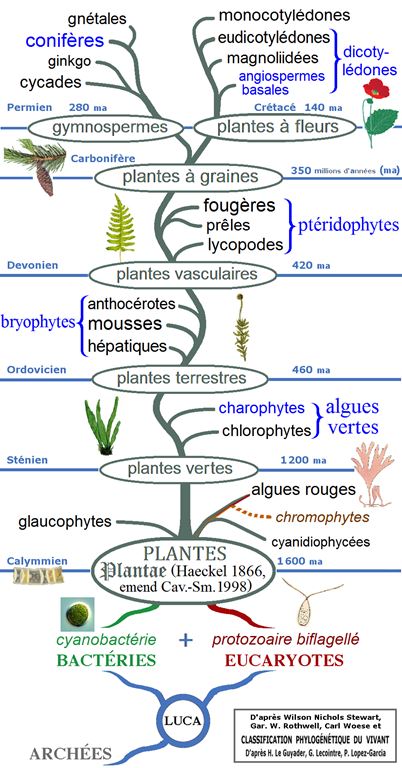
- Classique : en haut de l'écran, sous le coeur.
- Phylogénétique : Inconnue
À droite, cet arbre phylogénétique des plantes montre les principaux clades et groupes traditionnels (monophylétiques en noir et paraphylétiques en bleu).
Dénominations
- Nom botanique : Undaria pinnatifida (Harvey) Suringar
- Synonymes français : fougère des mers
- Noms anglais et locaux : Wakame, Japanese kelp, Apron-ribbon vegetable
Description et culture
Tableau récapitulatif
Parties comes-tibles Note comest. (1-5) Note medic. (1-5) (Zones de) Rusticité Besoins en 
Besoins en  (1-3)
(1-3)Périodes de semis et récoltes Graines au gramme Durée de viabilité Profon-deur semis Espace-ment plants Espace-ment lignes Durée germi-native Durée avant récolte J F M A M J
J A S O N D
J F M A M J
J A S O N D
- dont infos de 0FPI ("FOOD PLANTS INTERNATIONAL", en anglais) :
Description :
Une algue brune. Il mesure 1 à 1,5 m de long et 50 à 100 cm de large. Il est en forme d'épée avec des lobes sur le côté{{{0(+x) (traduction automatique).
Original : A brown seaweed. It is 1-1.5 m long and 50-100 cm wide. It is sword shaped with lobes along the side{{{0(+x).
Production :
Il pousse très rapidement{{{0(+x) (traduction automatique).
Original : It grows very rapidly{{{0(+x).
 Consommation (rapports de comestibilité, parties utilisables et usages alimentaires correspondants)
Consommation (rapports de comestibilité, parties utilisables et usages alimentaires correspondants)C'est une des macroalgues qui est commercialisée sous le nom de wakame, proposée comme ingrédient alimentaire (par exemple dans des pâtes){{{wiki.
Partie testée :
algues - crues{{{0(+x) (traduction automatique). Original : Seaweed - raw{{{0(+x)| Taux d'humidité (%) | Énergie (kj) | Énergie (kcal) | Protéines (g) |
|---|---|---|---|
| 80 | 188 | 45 | 3.0 |
| Pro- vitamines A (µg) |
Vitamines C (mg) | Fer (mg) | Zinc (mg) |
| 36 | 3 | 2.2 | 0.4 |
 Risques et précautions à prendre
Risques et précautions à prendrenéant, inconnus ou indéterminés.
Galerie(s)
Par division, CSIRO, via wikimedia
✖

Par Wilcox, Mike, via wikimedia
✖


Par division, CSIRO, via wikimedia
✖
Autres infos
dont infos de 0FPI ("FOOD PLANTS INTERNATIONAL", en anglais) :
Statut :
C'est très populaire. Il est cultivé dans les eaux chaudes. Il est vendu frais ou séché. C'est un aliment important au Japon, en Corée et en Chine{{{0(+x) (traduction automatique).
Original : It is very popular. It is cultivated in warm waters. It is sold fresh or dried. It is an important food in Japan, Korea and China{{{0(+x).
Distribution :
C'est une plante tempérée. Il pousse rapidement et peut évincer les algues indigènes{{{0(+x) (traduction automatique).
Original : It is a temperate plant. It grows rapidly and can crowd out native seaweeds{{{0(+x).
Localisation :
Adriatique, Argentine, Asie, Australie, Grande-Bretagne, Chine, Europe, France, Italie, Japon, Corée, Mexique, Pays-Bas, Nouvelle-Zélande, Amérique du Nord, Portugal, Russie, Amérique du Sud, Espagne, Tasmanie, USA{{{0(+x) (traduction automatique).
Original : Adriatic, Argentina, Asia, Australia, Britain, China, Europe, France, Italy, Japan, Korea, Mexico, Netherlands, New Zealand, North America, Portugal, Russia, South America, Spain, Tasmania, USA{{{0(+x).
Liens, sources et/ou références
Liens :
/ ;Sources et/ou références :
bibliographie (liste des sources et/ou références de l'encyclopédie)
dont livres et bases de données : 0FPI ("FOOD PLANTS INTERNATIONAL", en anglais) ;
dont bibliographie/références de 0FPI ("FOOD PLANTS INTERNATIONAL", en anglais) :
Breidahl H., 1997, Australian Southern Shores. Lothian. p 126 ; Cherry, P., et al, 2019, Risks and benefits of consuming edible seaweeds. Nutrition ReviewsVR Vol. 77(5):307–329 ; Dawczynski, C et al, 2007, Amino acids, fatty acids, and dietary fibre in edible seaweed products. Food Chemistry 103: 891-899 ; Facciola, S., 1998, Cornucopia 2: a Source Book of Edible Plants. Kampong Publications, p 257 ; Food Composition Tables for use in East Asia FAO http://www.fao.org/infoods/directory No. 725 ; Fujiwara-Arasaki, T. et al, 1984, The protein value in human nutrition of edible marine algae in Japan. Hydrobiologia 116/117, 513-516 ; http://www.seavegetables.com ; Hu, Shiu-ying, 2005, Food Plants of China. The Chinese University Press. p 260 ; Kiple, K.F. & Ornelas, K.C., (eds), 2000, The Cambridge World History of Food. CUP p 236 ; Lee, B., 2008, Seaweed Potential as a marine vegetable. RIRDC Publication No. 08/009 ; Pereira, L., 2011, A Review of the Nutrient Composition of Selected Edible Seaweeds. In Seaweed. Pomin V. H., (Ed.) Nova Science Publishers, Inc ; Pillay, T. V. R. & Kutty, M. N., 2005, Aquaculture Principles and Practices. 2nd edition. Blackwell. p. ; Ruperez, P. et al, 2001, Dietary fibre and physicochemical properties of edible Spanish seaweeds. Eur. Food Res. Technol. 212: 349-354 ; Sanchez-Machado, et al, 2003, High-Performance Liquid Chromatographic Analysis of Amino Acids in Edible Seaweeds after Derivatization with Phenyl Isothiocyanate. Chromatographia 58: 159-163 ; Simoons, F.J., 1991, Food in China. Boca Raton, Fla ; Solomon, C., 2001, Encyclopedia of Asian Food. New Holland. p 335 ; Song, M., et al, 2013, Traditional knowledge of wild edible plants in Jeju Island, Korea. Indian Journal of Traditional Knowledge. 12(2) pp 177-194 ; Teas, J. et al, 2004, Variability of Iodine Content in Common Commercially Available Edible Seaweeds. Thyroid. Vol. 14, No. 10Subba Rao, G.N., 1965, Uses of seaweed directly as human food. Indo-Pacific Fisheries Council Regional Studies 2:1-32 ; Surey-Gent, S. & Morris G., 1987, Seaweed. A User's Guide. Whirret Books. London. p 140 ; Van Ginneken, V. JT., et al, 2011, Polyunsaturated fatty acids in various macroalgal species from north Atlantic and tropical seas. Lipids in Health and Disease 10:104 ; Xia, B., and Abbott, I.A., 1987, Edible seaweeds of China and their place in the Chinese diet. Economic Botany 41:341-53 ; Zemke-White, W. L. & Ohno, M., 1999, World seaweed utilisation: An end-of-century summary. Journal of Applied Phycology 11: 369-376
Recherche de/pour :
- "Undaria pinnatifida" sur Google (pages et
images) ;
IPNI ("International Plant Names Index", en anglais) ;
TPL ("The Plant List", en anglais) ;
GRIN ("Germplasm Resources Information Network", en anglais) ;
TROPICOS (en anglais) ;
Tela Botanica ;
Pl@ntNet ;
Pl@ntUse ;
"Plants For A Future" (en anglais) ;
"Useful Tropical Plants" (en anglais) ou
"Useful Temperate Plants" (en anglais) ;
- "Wakamé" sur Google (pages, images et recettes) ;
- "Undaria pinnatifida" sur Google (pages et
images) ;
IPNI ("International Plant Names Index", en anglais) ;
TPL ("The Plant List", en anglais) ;
GRIN ("Germplasm Resources Information Network", en anglais) ;
TROPICOS (en anglais) ;
Tela Botanica ;
Pl@ntNet ;
Pl@ntUse ;
"Plants For A Future" (en anglais) ;
"Useful Tropical Plants" (en anglais) ou
"Useful Temperate Plants" (en anglais) ;
Espèces de la même famille (Alariaceae)
10 taxons







 donne accès au menu
  - encyclopédies des plantes alimentaires ;
 - page de recherche - reconnaissance (identification) de plantes ;
 - page du calendrier lunaire et son générateur (au format PDF et JPG) ;
 - tableau récapitulatif ;
 - générateur de potées (soupes), avec estimation des apports nutrionnels et du coût;
 - générateur de codes QR ;
 - page des archives avec de nombreux documents sur différents thèmes complémentaires comme la botanique, les légumes,
les champignons, la cuisine, le bien-être ainsi que différents MOOC mais également des liens vers les archives de l'association ;
- page des archives avec de nombreux documents sur différents thèmes complémentaires comme la botanique, les légumes,
les champignons, la cuisine, le bien-être ainsi que différents MOOC mais également des liens vers les archives de l'association ;

 pour le fruit (et/ou les graines, la pulpe, etc...),
 pour les fleurs (et/ou pétales, calice...),
 pour les feuilles (et/ou la tige, les pousses...),
 pour les racines,
 pour le tronc (et/ou l'écorce, la sève...), et enfin
 pour les champignons,
puis les notes alimentaires et médicinales (de 1 à 5 étoiles), la rusticité (résistance au froid/gel)
et pour finir un résumé.
pour les champignons,
puis les notes alimentaires et médicinales (de 1 à 5 étoiles), la rusticité (résistance au froid/gel)
et pour finir un résumé. menant ici 🙂
 ,
,  et
et





 ,
,


 Encyclopédie(s)
 Recherche-Reconnaissance
 Tableau récapitulatif
 Codes QR
 Archives
 Calendrier(s) lunaire(s)
  Potées
 Re-naturation/naturalisation
 Affichettes, herbiers &
co.
Affichettes, herbiers &
co. menu
menu galerie


 (en bas à droite).
 (en bas à gauche).
