Campomanesia guazumifolia
Pas d'illustration
pour le moment 😕

Un arbre. Il atteint une hauteur de 6 à 10 m. La couronne est ouverte. Le tronc est tordu et a des rainures. Il mesure 20-30 cm de diamètre. L'écorce est bouchonneuse et se ... (traduction automatique)
→suite


Campomanesia guazumifolia

Un arbre. Il atteint une hauteur de 6 à 10 m. La couronne est ouverte. Le tronc est tordu et a des rainures. Il mesure 20-30 cm de diamètre. L'écorce est bouchonneuse et se décolle. Les feuilles sont s... (traduction automatique) →suite
Pas d'illustration
pour le moment 😕
Pas d'illustration
pour le moment 😕
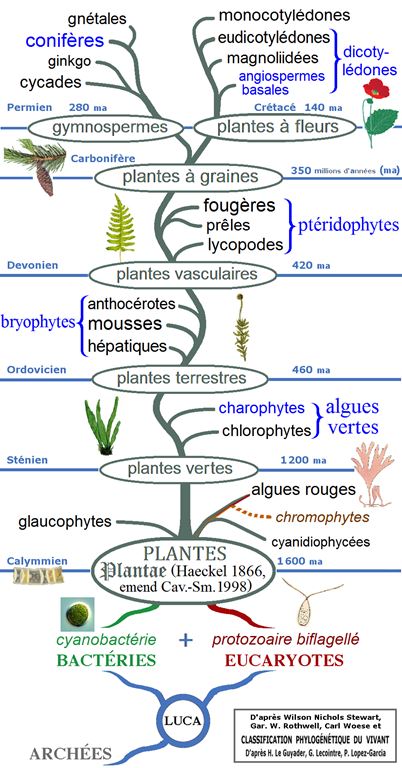
Classification
- Classique : en haut de l'écran, sous le coeur.
- Phylogénétique :
- Clade 4 : Angiospermes ;
- Clade 3 : Dicotylédones_vraies ;
- Clade 2 : Rosidées ;
- Clade 1 : Malvidées ;
- Ordre APN : Myrtales ;
- Famille APN : Myrtaceae ;
À droite, cet arbre phylogénétique des plantes montre les principaux clades et groupes traditionnels (monophylétiques en noir et paraphylétiques en bleu).
Dénominations
- Nom botanique : Campomanesia guazumifolia (Cambess.) O. Berg
- Synonymes : Abbevillea rugosa O. Berg, Britoa sellowiana O. Berg, Britoa guazumaefolia (Cambess.) Legrand, Campomanesia itanarensis Kiaersk, Lascerdia luschnathiana O. Berg, Psidium guazumifolia var. grisea Cambess
- Noms anglais et locaux : Aguaricara
Description et culture
Tableau récapitulatif
Parties comes-tibles Note comest. (1-5) Note medic. (1-5) (Zones de) Rusticité Besoins en 
Besoins en  (1-3)
(1-3)Périodes de semis et récoltes Graines au gramme Durée de viabilité Profon-deur semis Espace-ment plants Espace-ment lignes Durée germi-native Durée avant récolte J F M A M J
J A S O N D
J F M A M J
J A S O N D
- dont infos de 0FPI ("FOOD PLANTS INTERNATIONAL", en anglais) :
Description :
Un arbre. Il atteint une hauteur de 6 à 10 m. La couronne est ouverte. Le tronc est tordu et a des rainures. Il mesure 20-30 cm de diamètre. L'écorce est bouchonneuse et se décolle. Les feuilles sont simples. Il y a des poils en dessous. Les feuilles mesurent 7 à 15 cm de long sur 3 à 6 cm de large. Les fleurs sont grandes et blanches. Les fruits ont une forme ronde aplatie. Ils sont jaunes et mesurent 2-3 cm de diamètre. La chair est juteuse et présente de nombreuses graines molles{{{0(+x) (traduction automatique).
Original : A tree. It grows 6-10 m high. The crown is open. The trunk is crooked and has grooves. It is 20-30 cm across. The bark is corky and peels off. The leaves are simple. There are hairs underneath. The leaves are 7-15 cm long by 3-6 cm wide. The flowers are large and white. The fruit are a flattened round shape. They are yellow and 2-3 cm across. The flesh is juicy and there and many soft seeds{{{0(+x).
Production :
Les plantes poussent lentement dans le champ{{{0(+x) (traduction automatique).
Original : Plants grow slowly in the field{{{0(+x).
Culture :
Les plantes sont cultivées à partir de graines. La graine est retirée de la graine mûre par lavage. Ils ne peuvent être stockés que pendant une courte période. Des graines fraîches sont plantées. Ils germent en 15-30 jours. Les semis sont repiqués après 9 à 10 mois{{{0(+x) (traduction automatique).
Original : Plants are grown from seed. The seed are removed from the ripe seed by washing. They can only be stored for a short time. Fresh seed are planted. They germinate in 15-30 days. Seedlings are transplanted after 9-10 months{{{0(+x).
 Consommation (rapports de comestibilité, parties utilisables et usages alimentaires correspondants)
Consommation (rapports de comestibilité, parties utilisables et usages alimentaires correspondants)Parties comestibles :
fruit{{{0(+x) (traduction automatique). Original : Fruit{{{0(+x).Détails :
Les fruits sont consommés crus. Ils sont également utilisés pour les confitures, les gelées et les plats de fruits{{{0(+x) (traduction automatique).
Original : The fruit are eaten raw. They are also used for jams, jellies and fruit dishes{{{0(+x).
Partie testée :
fruit{{{0(+x) (traduction automatique). Original : Fruit{{{0(+x) Risques et précautions à prendre
Risques et précautions à prendrenéant, inconnus ou indéterminés.
Autres infos
dont infos de 0FPI ("FOOD PLANTS INTERNATIONAL", en anglais) :
Statut :
Il est parfois cultivé comme fruit{{{0(+x) (traduction automatique).
Original : It is occasionally cultivated as a fruit{{{0(+x).
Distribution :
Une plante subtropicale. En Argentine, il pousse entre 100 et 1000 m d'altitude{{{0(+x) (traduction automatique).
Original : A subtropical plant. In Argentina it grows between 100-1,000 m above sea level{{{0(+x).
Localisation :
Argentine, Brésil *, Cuba, Paraguay, Amérique du Sud{{{0(+x) (traduction automatique).
Original : Argentina, Brazil*, Cuba, Paraguay, South America{{{0(+x).
Notes :
Il existe au moins 11 espèces de Campomanesia. Le fruit est riche en vitamine C{{{0(+x) (traduction automatique).
Original : There are at least 11 Campomanesia species. The fruit is high in Vitamin C{{{0(+x).
Liens, sources et/ou références
Liens :
/ ;Sources et/ou références :
bibliographie (liste des sources et/ou références de l'encyclopédie)
dont livres et bases de données : 0FPI ("FOOD PLANTS INTERNATIONAL", en anglais) ;
dont bibliographie/références de 0FPI ("FOOD PLANTS INTERNATIONAL", en anglais) :
Fouqué, A., 1972, Espèces fruitières d'Amérique tropicale. Institut français de recherches fruitierès outre-mer (As Britoa sellowiana) ; Grandtner, M. M. & Chevrette, J., 2013, Dictionary of Trees, Volume 2: South America: Nomenclature, Taxonomy and Ecology. Academic Press p 96 ; Hermandez Bermejo, J.E., and Leon, J. (Eds.), 1994, Neglected Crops. 1492 from a different perspective. FAO Plant Production and Protection Series No 26. FAO, Rome. p16 ; Kinupp, V. F., 2007, Plantas alimenticias nao-convencionais da regiao metropolitana de Porto Alegre, RS, Brazil p 85 ; Kujawska, M. & Luczaj, L., 2015, Wild Edible Plants Used by the Polish Community in Misiones, Argentina. Human Ecology 43:855-869 ; Lorenzi, H., 2002, Brazilian Trees. A Guide to the Identification and Cultivation of Brazilian Native Trees. Vol. 01 Nova Odessa, SP, Instituto Plantarum p 271 ; Lorenzi, H., Bacher, L., Lacerda, M. & Sartori, S., 2006, Brazilian Fruits & Cultivated Exotics. Sao Paulo, Instituto Plantarum de Estuados da Flora Ltda. p 182 ; Martin, F.W., C.W. Campbell and R.M. Ruberté, 1987, Perennial edible fruits of the tropics - An inventory. United States Department of Agriculture, Agricultural Research Service, Agriculture Handbook No. 642. Washington, D.C., USA ; C. F. P. Martius, Fl. bras. 14(1):457. 1857 ; Miguel, E., et al, 1989, A checklist of the cultivated plants of Cuba. Kulturpflanze 37. 1989, 211-357 (As Britoa guazumaefolia) ; TodaFruta.com.br ; USDA, ARS, National Genetic Resources Program. Germplasm Resources Information Network - (GRIN). [Online Database] National Germplasm Resources Laboratory, Beltsville, Maryland. Available: www.ars-grin.gov/cgi-bin/npgs/html/econ.pl (10 April 2000) ; www.colecionandofrutas.org
Recherche de/pour :
- "Campomanesia guazumifolia" sur Google (pages et
images) ;
IPNI ("International Plant Names Index", en anglais) ;
TPL ("The Plant List", en anglais) ;
GRIN ("Germplasm Resources Information Network", en anglais) ;
TROPICOS (en anglais) ;
Tela Botanica ;
Pl@ntNet ;
Pl@ntUse ;
"Plants For A Future" (en anglais) ;
"Useful Tropical Plants" (en anglais) ou
"Useful Temperate Plants" (en anglais) ;
- "Campomanesia guazumifolia" sur Google (pages et
images) ;
IPNI ("International Plant Names Index", en anglais) ;
TPL ("The Plant List", en anglais) ;
GRIN ("Germplasm Resources Information Network", en anglais) ;
TROPICOS (en anglais) ;
Tela Botanica ;
Pl@ntNet ;
Pl@ntUse ;
"Plants For A Future" (en anglais) ;
"Useful Tropical Plants" (en anglais) ou
"Useful Temperate Plants" (en anglais) ;
Espèces du même genre (Campomanesia)
48 taxons
- Campomanesia adamantium (Cambess.) O.Berg (Guabiroba blanche)
- Campomanesia aromatica
- Campomanesia aurea O.Berg
- Campomanesia caerulea O.Berg
- Campomanesia cagateira
- Campomanesia cornifolia Kunth
- Campomanesia corymbosa
- Campomanesia crenata O.Berg
- Campomanesia cyanea O.Berg
- Campomanesia desertorum O.Berg
- Campomanesia dichotoma
- Campomanesia discolor O.Berg
- Campomanesia eugenioides
- Campomanesia grandiflora
- Campomanesia guaviroba (DC.) Kiaersk. (Guabiroba)
- Campomanesia heterophylla O.Berg
- Campomanesia hirsuta Gardner
- Campomanesia laurifolia Gardner
- Campomanesia lineatifolia Ruiz & Pav. (Goyavier parfumé)
- Campomanesia malifolia O.Berg
- Campomanesia martiana O.Berg
- Campomanesia maschalantha
- Campomanesia mediterranea
- Campomanesia microcarpa O.Berg
- Campomanesia multiflora
- Campomanesia neriiflora
- Campomanesia obscura O.Berg
- Campomanesia obversa
- Campomanesia phaea
- Campomanesia pohliana O.Berg
- Campomanesia pubescens (Mart. ex DC.) O.Berg (Guavirami)
- Campomanesia reitziana D.Legrand
- Campomanesia reticulata O.Berg
- Campomanesia rhombea O.Berg
- Campomanesia rufa
- Campomanesia salviaefolia
- Campomanesia schlechtendaliana
- Campomanesia sessiliflora
- Campomanesia sp.
- Campomanesia suaveolens
- Campomanesia suffruticosa O.Berg
- Campomanesia triflora
- Campomanesia velutina
- Campomanesia verrucosa
- Campomanesia warmingiana Kiaersk.
- Campomanesia x anthocarpa O.Berg (Guayubira)
- Campomanesia xanthocarpa
Espèces de la même famille (Myrtaceae)
772 taxons
- Araca pera
- Araza
- Arbre à thé
- Arbre à thé au parfum citronnné
- Arbre anis (tp* de "aniseed tree")
- Baie de noël
- Beach cherry
- Bois d'inde
- Cabelluda
- Cagaita
- Cajeput
- Cedar bay cherry
- Cerise bleue (tp* de "blue cherry")
- Cerisier d'australie
- Cerisier de cayenne
- Cerisier de rio grande
- Cerisier du brésil
- Ceylon hill cherry
- Coronille
- Eucalyptus
- Eucalyptus à manne
- Eucalyptus à trois fruits
- Eucalyptus à urnes
- Eucalyptus amandier
- Eucalyptus argenté
- Eucalyptus bois-blanc
- Eucalyptus cendré
- Eucalyptus citronné
- Eucalyptus coccifère
- Eucalyptus de Bridges
- Eucalyptus de Johnston
- Eucalyptus de Macarthur
- Eucalyptus de Nichol
- Eucalyptus de Perrin
- Eucalyptus de Smith
- Eucalyptus des marais
- Eucalyptus du mont Delegate
- Eucalyptus du mont Jeffcott
- Eucalyptus linéaire
- Eucalyptus oblique
- Eucalyptus ovale
- Eucalyptus pauciflore
- Eucalyptus pulvérulent
- Eucalyptus rayonnant
- Eucalyptus rougeâtre
- Eucalyptus royal
- Eucalyptus subulé
- Feijoa
- Giroflier
- Gommier bleu
- Acca sellowiana (O. Berg) Burret (Feijoa)
- Aluta maisonneivei
- Amomyrtus luma (Luma)
- Amomyrtus meli
- Angophora floribunda
- Archirhodomyrtus beckleri
- Astartea fascicularis
- Aulomyrcia vaccinifolia
- Austromyrtus dulcis (C.T.White) L.S.Sm.
- Austromyrtus dulcis x tenuifolia
- Austromyrtus tenuifolia
- Backhousia anisata Vickery
- Backhousia citriodora F.Muell. (Myrte citronnée)
- Backhousia myrtifolia Hook. & Harv. (Myrte cannelle)
- Baeckea frutescens L.
- Baeckea gunniana S.Schauer ex Walp.
- Blepharocalyx cruckshanksii
- Blepharocalyx salicifolius
- Callistemon citrinus (Curtis) Skeels (Rince-bouteilles)
- Callistemon polandii F.M.Bailey
- Callistemon viminalis
- Calothamnus quadrifidus R.Br.
- Calothamnus sanguineus Labill.
- Calycolpus calophyllus
- Calycolpus goetheanus
- Calycolpus legrandii Mattos
- Calycolpus moritzianus
- Calycorectes acutatus
- Calycorectes grandifolius O.Berg
- Calycorectes sp.
- Calyptranthes aromatica A.St.-Hil.
- Calyptranthes clusiifolia O.Berg
- Calyptranthes concinna DC.
- Calyptranthes grandifolia O.Berg
- Calyptranthes hintonii Lundell
- Calyptranthes longifolia O.Berg
- Calyptranthes lucida Mart. ex DC.
- Calyptranthes macrophylla O.Berg
- Calyptranthes nigrescens B.Holst
- Calyptranthes pallens Griseb.
- Calyptranthes paniculata Raeusch.
- Calyptranthes plicata McVaugh
- Calyptranthes schiediana
- Calyptranthes speciosa Sagot
- Calyptranthes syzygium
- Calyptranthes variabilis O.Berg
- Calyptranthes widgreniana O.Berg
- Calyptranthes zuzygium Blanco
- Calytrix tetragona Labill.
- Campomanesia adamantium (Cambess.) O.Berg (Guabiroba blanche)
- ...







 donne accès au menu
  - encyclopédies des plantes alimentaires ;
 - page de recherche - reconnaissance (identification) de plantes ;
 - page du calendrier lunaire et son générateur (au format PDF et JPG) ;
 - tableau récapitulatif ;
 - générateur de potées (soupes), avec estimation des apports nutrionnels et du coût;
 - générateur de codes QR ;
 - page des archives avec de nombreux documents sur différents thèmes complémentaires comme la botanique, les légumes,
les champignons, la cuisine, le bien-être ainsi que différents MOOC mais également des liens vers les archives de l'association ;
- page des archives avec de nombreux documents sur différents thèmes complémentaires comme la botanique, les légumes,
les champignons, la cuisine, le bien-être ainsi que différents MOOC mais également des liens vers les archives de l'association ;

 pour le fruit (et/ou les graines, la pulpe, etc...),
 pour les fleurs (et/ou pétales, calice...),
 pour les feuilles (et/ou la tige, les pousses...),
 pour les racines,
 pour le tronc (et/ou l'écorce, la sève...), et enfin
 pour les champignons,
puis les notes alimentaires et médicinales (de 1 à 5 étoiles), la rusticité (résistance au froid/gel)
et pour finir un résumé.
pour les champignons,
puis les notes alimentaires et médicinales (de 1 à 5 étoiles), la rusticité (résistance au froid/gel)
et pour finir un résumé. menant ici 🙂
 ,
,  et
et





 ,
,


 Encyclopédie(s)
 Recherche-Reconnaissance
 Tableau récapitulatif
 Codes QR
 Archives
 Calendrier(s) lunaire(s)
  Potées
 Re-naturation/naturalisation
 Affichettes, herbiers &
co.
Affichettes, herbiers &
co. menu
menu galerie


 (en bas à droite).
 (en bas à gauche).
