

Capillaire 
Note alimentaire 
Note médicinale 
Note autre usage 

Pas de description pour le moment 😕
Adiantum capillus-veneris
Classification
- Classique : en haut de l'écran, sous le coeur.
- Phylogénétique : Inconnue
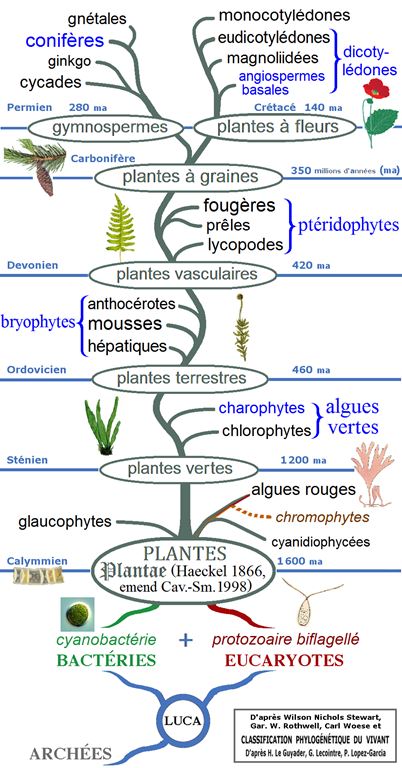
À droite, cet arbre phylogénétique des plantes montre les principaux clades et groupes traditionnels (monophylétiques en noir et paraphylétiques en bleu).
Dénominations
- Nom botanique : Adiantum capillus-veneris L. (1753)
- Synonymes : Adiantum capillis-veneris L. (nom invalide [erreur = écriture/orthographe incorrecte/fausse/erronée] ou variante orthographique valide ? (qp*)) ;
- Noms anglais et locaux : True Maidenhair fern, common maidenhair, true maidenhair fern, adiant (cat)
 Consommation (rapports de comestibilité, parties utilisables et usages alimentaires correspondants)
Consommation (rapports de comestibilité, parties utilisables et usages alimentaires correspondants)Feuilles - aromatisant, feuilles - thé, légume{{{0(+x). Les frondes séchées sont utilisées pour faire une sorte de thé ; elles ont été utilisées comme aromatisant pour les boissons gazeuses ; les jeunes feuilles sont utilisées dans les salades et cuites comme légume{{{0(+x) (ex. : comme potherbe{{{(dp*)).
Partie testée :
/ Risques et précautions à prendre
Risques et précautions à prendrenéant, inconnus ou indéterminés.
Galerie(s)
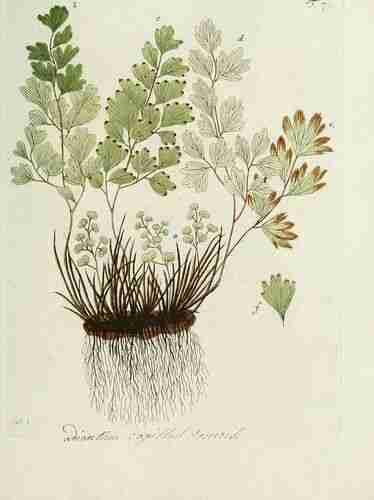
Par Jacquin N.J. von (Miscellanea Austriaca, vol. 2: t. 7 ; 1839), via plantillustrations.org
✖

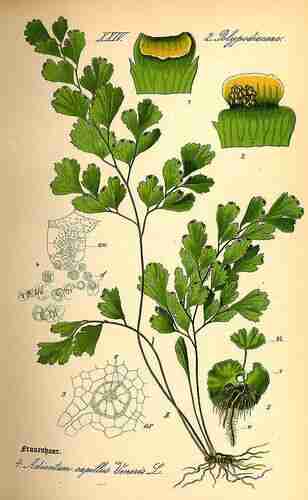
Par Thomé O.W. (Flora von Deutschland Österreich und der Schweiz, Tafeln, vol. 1: t. 4 ; 1885), via plantillustrations.org
✖

Liens, sources et/ou références
Liens :
/ ;Sources et/ou références :
bibliographie (liste des sources et/ou références de l'encyclopédie)
dont classification : IPNI ("International Plant Names Index", en anglais) ; TPL ("The Plant List", en anglais) ; Kew (POWO - "Plant Of the World Online", "Royal Botanical Garden", en anglais) ; Tela Botanica ;
dont livres et bases de données : 5PFAF ("Plants For A Future", en anglais) ; 0FPI ("FOOD PLANTS INTERNATIONAL", en anglais) ;
dont bibliographie/références de 0FPI ("FOOD PLANTS INTERNATIONAL", en anglais) :
Ambasta S.P. (Ed.), 2000, The Useful Plants of India. CSIR India. p 15 ; Andrews, S.B., 1990, Ferns of Queensland. A handbook to the ferns and fern allies. Queensland DPI p 10 ; Blamey, M and Grey-Wilson, C., 2005, Wild flowers of the Mediterranean. A & C Black London. p 531 ; Bodkin, F., 1991, Encyclopedia Botanica. Cornstalk publishing, p 49 ; Bremness, L., 1994, Herbs. Collins Eyewitness Handbooks. Harper Collins. p 286 ; Brickell, C. (Ed.), 1999, The Royal Horticultural Society A-Z Encyclopedia of Garden Plants. Convent Garden Books. p 78 ; Brown, D., 2002, The Royal Horticultural Society encyclopedia of Herbs and their uses. DK Books. p 103 ; Chaffey, C.H., 1999, Australian Ferns. Growing them successfully. Kangaroo Press. p 75 ; Cundall, P., (ed.), 2004, Gardening Australia: flora: the gardener's bible. ABC Books. p 99 ; Facciola, S., 1998, Cornucopia 2: a Source Book of Edible Plants. Kampong Publications. p 2 ; Hedrick, U.P., 1919, (Ed.), Sturtevant's edible plants of the world. p 26 ; Jardin, C., 1970, List of Foods Used In Africa, FAO Nutrition Information Document Series No 2.p 112 ; Mabey, R., 1973, Food for Free. A Guide to the edible wild plants of Britain, Collins. p 120 ; Manandhar, N.P., 2002, Plants and People of Nepal. Timber Press. Portland, Oregon. p 72 ; Marinelli, J. (Ed), 2004, Plant. DK. p 312 ; Paczkowska, G . & Chapman, A.R., 2000, The Western Australian Flora. A Descriptive Catalogue. Western Australian Herbarium. p 21 ; Pham-Hoang Ho, 1999, An Illustrated Flora of Vietnam. Nha Xuat Ban Tre. p 55 ; Plants For A Future database, The Field, Penpol, Lostwithiel, Cornwall, PL22 0NG, UK. https://www.scs.leeds.ac.uk/pfaf/ ; Redzic, S. J., 2006, Wild Edible Plants and their Traditional Use in the Human Nutrition in Bosnia-Herzegovina. Ecology of Food and Nutrition, 45:189-232 ; Sarker, S. K., & Enayet Hossain, A. B. M., 2009, Pteridophytes of Greater Mymensingh District of Bangladesh used as Vegetables and Medicines. Bangladesh J. Plant Taxon. 16(1) 47-56. p 49 ; Sp. pl. 2:1096. 1753 ; Staples, G.W. and Herbst, D.R., 2005, A tropical Garden Flora. Bishop Museum Press, Honolulu, Hawaii. p 49 ; Yuncker, T.G., 1959, Plants of Tonga, Bernice P. Bishop Museum, Hawaii, Bulletin 220. p 35
Recherche de/pour :
- "Adiantum capillus-veneris" sur Google (pages et
images) ;
GRIN ("Germplasm Resources Information Network", en anglais) ;
TROPICOS (en anglais) ;
Pl@ntNet ;
Pl@ntUse ;
"Useful Tropical Plants" (en anglais) ou
"Useful Temperate Plants" (en anglais) ;
- "Capillaire" sur Google (pages, images et recettes) ;
- "Adiantum capillus-veneris" sur Google (pages et
images) ;
GRIN ("Germplasm Resources Information Network", en anglais) ;
TROPICOS (en anglais) ;
Pl@ntNet ;
Pl@ntUse ;
"Useful Tropical Plants" (en anglais) ou
"Useful Temperate Plants" (en anglais) ;
Espèces du même genre (Adiantum)
7 taxons
Espèces de la même famille (Pteridaceae)
35 taxons
- Acrostic doré
- Cératoptéride faux-pigamon
- Ptéride à deux oreillettes
- Ptéris de Crète
- Pteris multifide
- Acrostichum aureum L. (Acrostic doré)
- Acrostichum danaeifolium Langsd. & Fisch.
- Acrostichum speciosum C.Presl
- Adiantopsis pteroides
- Adiantum aethiopicum L.
- Adiantum caudatum L.
- Adiantum deflectens Mart.
- Adiantum flabellulatum Wall.
- Adiantum lunulatum Burm.f.
- Adiantum pedatum Raddi
- Ceratopteris cornuta (P.Beauv.) Le Prieur (Cératoptéride faux-pigamon)
- Ceratopteris pteridoides (Hook.) Hieron.
- Ceratopteris thalictroides (L.) Brongn.
- Cheilanthes pteridioides
- Coniogramme emeiensis Ching & K.H.Shing
- Coniogramme falcata
- Coniogramme fraxinea (D.Don) Fe ex Diels
- Coniogramme intermedia Hieron.
- Coniogramme japonica (Thunb.) Diels
- Coniogramme jinggangshanensis Ching & K.H.Shing
- Coniogramme robusta Christ
- Coniogramme rosthornii Hieron.
- Coniogramme simileima Ching
- Coniogramme taipaishanensis Ching & Y.T.Hsieh
- Coniogramme wilsoni
- Pellaea mucronata Fe
- Pteris biaurita L. (Ptéride à deux oreillettes)
- Pteris cretica L. (Ptéris de Crète)
- Pteris ensiformis Burm.f.
- Pteris moluccana Blume
- Pteris multifida Roxb. (Pteris multifide)
- Pteris semipinnata L.
- Pteris vitata
- Pteris wallichiana C.Presl
Par Thomé O.W. (Flora von Deutschland Österreich und der Schweiz, Tafeln, vol. 1: t. 4 ; 1885), via plantillustrations.org







 donne accès au menu
  - encyclopédies des plantes alimentaires ;
 - page de recherche - reconnaissance (identification) de plantes ;
 - page du calendrier lunaire et son générateur (au format PDF et JPG) ;
 - tableau récapitulatif ;
 - générateur de potées (soupes), avec estimation des apports nutrionnels et du coût;
 - générateur de codes QR ;
 - page des archives avec de nombreux documents sur différents thèmes complémentaires comme la botanique, les légumes,
les champignons, la cuisine, le bien-être ainsi que différents MOOC mais également des liens vers les archives de l'association ;
- page des archives avec de nombreux documents sur différents thèmes complémentaires comme la botanique, les légumes,
les champignons, la cuisine, le bien-être ainsi que différents MOOC mais également des liens vers les archives de l'association ;

 pour le fruit (et/ou les graines, la pulpe, etc...),
 pour les fleurs (et/ou pétales, calice...),
 pour les feuilles (et/ou la tige, les pousses...),
 pour les racines,
 pour le tronc (et/ou l'écorce, la sève...), et enfin
 pour les champignons,
puis les notes alimentaires et médicinales (de 1 à 5 étoiles), la rusticité (résistance au froid/gel)
et pour finir un résumé.
pour les champignons,
puis les notes alimentaires et médicinales (de 1 à 5 étoiles), la rusticité (résistance au froid/gel)
et pour finir un résumé. menant ici 🙂
 ,
,  et
et





 ,
,


 Encyclopédie(s)
 Recherche-Reconnaissance
 Tableau récapitulatif
 Codes QR
 Archives
 Calendrier(s) lunaire(s)
  Potées
 Re-naturation/naturalisation
 Affichettes, herbiers &
co.
Affichettes, herbiers &
co. menu
menu galerie


 (en bas à droite).
 (en bas à gauche).
