Bangia fuscopurpurea
Pas d'illustration
pour le moment 😕

Une algue. C'est noir et comme des cheveux (traduction automatique)
→suite


Bangia fuscopurpurea

Une algue. C'est noir et comme des cheveux (traduction automatique)
Pas d'illustration
pour le moment 😕
Pas d'illustration
pour le moment 😕
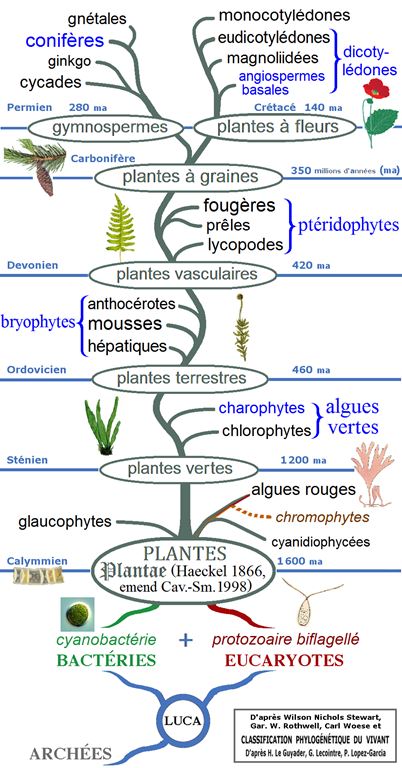
Classification
- Classique : en haut de l'écran, sous le coeur.
- Phylogénétique : Inconnue
À droite, cet arbre phylogénétique des plantes montre les principaux clades et groupes traditionnels (monophylétiques en noir et paraphylétiques en bleu).
Dénominations
- Nom botanique : Bangia fuscopurpurea (Dillwyn) Lyngbye
- Synonymes : Conferva fuscopurpurea Dillwyn, et d'autres
- Noms anglais et locaux : Hair plant
Description et culture
Tableau récapitulatif
Parties comes-tibles Note comest. (1-5) Note medic. (1-5) (Zones de) Rusticité Besoins en 
Besoins en  (1-3)
(1-3)Périodes de semis et récoltes Graines au gramme Durée de viabilité Profon-deur semis Espace-ment plants Espace-ment lignes Durée germi-native Durée avant récolte J F M A M J
J A S O N D
J F M A M J
J A S O N D
- dont infos de 0FPI ("FOOD PLANTS INTERNATIONAL", en anglais) :
 Consommation (rapports de comestibilité, parties utilisables et usages alimentaires correspondants)
Consommation (rapports de comestibilité, parties utilisables et usages alimentaires correspondants)Parties comestibles :
algues, fronde, algues{{{0(+x) (traduction automatique). Original : Algae, Frond, Seaweed{{{0(+x).Détails :
Il est utilisé dans les salades et les soupes. Il est sans goût mais absorbe le goût des autres aliments et ajoute une texture glissante aux aliments{{{0(+x) (traduction automatique).
Original : It is used in salads and soups. It is without taste but absorbs the taste of other foods and adds slippery texture to foods{{{0(+x).
Partie testée :
algue{{{0(+x) (traduction automatique). Original : Seaweed{{{0(+x) Risques et précautions à prendre
Risques et précautions à prendrenéant, inconnus ou indéterminés.
Autres infos
dont infos de 0FPI ("FOOD PLANTS INTERNATIONAL", en anglais) :
Distribution :
Une plante tropicale{{{0(+x) (traduction automatique).
Original : A tropical plant{{{0(+x).
Localisation :
Afrique, Alaska, Antarctique, Argentine, Asie, Australie, Bénin, Bermudes, Brésil, Grande-Bretagne, Bulgarie, Canada, Îles Canaries, Afrique centrale, Amérique centrale, Chine, Corse, Costa Rica, France, Gabon, Allemagne, Ghana, Groenland, Hawaï, Islande, Indochine, Irlande, Israël, Italie, Japon, Corée, Méditerranée, Maroc, Afrique du Nord, Amérique du Nord, Pacifique, Pérou, Portugal, Roumanie, Russie, Scandinavie, Asie du Sud-Est, Sénégal, Amérique du Sud, Espagne, Suède, Taiwan, Tunisie, Turquie, Uruguay, USA, Vietnam, Afrique de l'Ouest{{{0(+x) (traduction automatique).
Original : Africa, Alaska, Antarctica, Argentina, Asia, Australia, Benin, Bermuda, Brazil, Britain, Bulgaria, Canada, Canary Islands, Central Africa, Central America, China, Corsica, Costa Rica, France, Gabon, Germany, Ghana, Greenland, Hawaii, Iceland, Indochina, Ireland, Israel, Italy, Japan, Korea, Mediterranean, Morocco, North Africa, North America, Pacific, Peru, Portugal, Romania, Russia, Scandinavia, SE Asia, Senegal, South America, Spain, Sweden, Taiwan, Tunisia, Turkey, Uruguay, USA, Vietnam, West Africa{{{0(+x).
Liens, sources et/ou références
Liens :
/ ;Sources et/ou références :
bibliographie (liste des sources et/ou références de l'encyclopédie)
dont livres et bases de données : 0FPI ("FOOD PLANTS INTERNATIONAL", en anglais) ;
dont bibliographie/références de 0FPI ("FOOD PLANTS INTERNATIONAL", en anglais) :
Facciola, S., 1998, Cornucopia 2: a Source Book of Edible Plants. Kampong Publications, p 257 ; Kiple, K.F. & Ornelas, K.C., (eds), 2000, The Cambridge World History of Food. CUP p 236 ; Montagne, M.C., 1946-7, Un dernier mot sur le Nostoc edule de la Chine. Revue botanique, 2:363-5 ; Surey-Gent, S. & Morris G., 1987, Seaweed. A User's Guide. Whirret Books. London. p 140 ; Xia, B., and Abbott, I.A., 1987, Edible seaweeds of China and their place in the Chinese diet. Economic Botany 41:341-53
Recherche de/pour :
- "Bangia fuscopurpurea" sur Google (pages et
images) ;
IPNI ("International Plant Names Index", en anglais) ;
TPL ("The Plant List", en anglais) ;
GRIN ("Germplasm Resources Information Network", en anglais) ;
TROPICOS (en anglais) ;
Tela Botanica ;
Pl@ntNet ;
Pl@ntUse ;
"Plants For A Future" (en anglais) ;
"Useful Tropical Plants" (en anglais) ou
"Useful Temperate Plants" (en anglais) ;
- "Bangia fuscopurpurea" sur Google (pages et
images) ;
IPNI ("International Plant Names Index", en anglais) ;
TPL ("The Plant List", en anglais) ;
GRIN ("Germplasm Resources Information Network", en anglais) ;
TROPICOS (en anglais) ;
Tela Botanica ;
Pl@ntNet ;
Pl@ntUse ;
"Plants For A Future" (en anglais) ;
"Useful Tropical Plants" (en anglais) ou
"Useful Temperate Plants" (en anglais) ;
Espèces de la même famille (Bangiaceae)
34 taxons
- Porphyra abbottae
- Porphyra angusta
- Porphyra atropurpurea
- Porphyra columbina
- Porphyra dentata
- Porphyra dioica (Porphyre dioïque)
- Porphyra haitanensis
- Porphyra kuniedae
- Porphyra laciniata (Porphyre laciniée)
- Porphyra lanceolata
- Porphyra linearis
- Porphyra marcosii
- Porphyra marginata
- Porphyra monosporangia
- Porphyra oligospermatangia
- Porphyra pseudolanceolata
- Porphyra purpurea (Porphyre pourpre)
- Porphyra seriata
- Porphyra spiralis
- Porphyra suborbiculata
- Porphyra tenera (Gim)
- Porphyra torta
- Porphyra umbilicalis (Nori)
- Porphyra vietnamensis
- Porphyra vulgaris
- Porphyra yezoensis (Susabi-nori)
- Pyropia abbottiae
- Pyropia acanthophora
- Pyropia columbina
- Pyropia dentata
- Pyropia fallax
- Pyropia leucosticta (Cochayuyo)
- Pyropia perforata







 donne accès au menu
  - encyclopédies des plantes alimentaires ;
 - page de recherche - reconnaissance (identification) de plantes ;
 - page du calendrier lunaire et son générateur (au format PDF et JPG) ;
 - tableau récapitulatif ;
 - générateur de potées (soupes), avec estimation des apports nutrionnels et du coût;
 - générateur de codes QR ;
 - page des archives avec de nombreux documents sur différents thèmes complémentaires comme la botanique, les légumes,
les champignons, la cuisine, le bien-être ainsi que différents MOOC mais également des liens vers les archives de l'association ;
- page des archives avec de nombreux documents sur différents thèmes complémentaires comme la botanique, les légumes,
les champignons, la cuisine, le bien-être ainsi que différents MOOC mais également des liens vers les archives de l'association ;

 pour le fruit (et/ou les graines, la pulpe, etc...),
 pour les fleurs (et/ou pétales, calice...),
 pour les feuilles (et/ou la tige, les pousses...),
 pour les racines,
 pour le tronc (et/ou l'écorce, la sève...), et enfin
 pour les champignons,
puis les notes alimentaires et médicinales (de 1 à 5 étoiles), la rusticité (résistance au froid/gel)
et pour finir un résumé.
pour les champignons,
puis les notes alimentaires et médicinales (de 1 à 5 étoiles), la rusticité (résistance au froid/gel)
et pour finir un résumé. menant ici 🙂
 ,
,  et
et





 ,
,


 Encyclopédie(s)
 Recherche-Reconnaissance
 Tableau récapitulatif
 Codes QR
 Archives
 Calendrier(s) lunaire(s)
  Potées
 Re-naturation/naturalisation
 Affichettes, herbiers &
co.
Affichettes, herbiers &
co. menu
menu galerie


 (en bas à droite).
 (en bas à gauche).
