Enteromorpha compressa
Pas d'illustration
pour le moment 😕

Une algue verte (traduction automatique)
→suite


Enteromorpha compressa

Une algue verte (traduction automatique)
Algue (cf. Algaebase)
Pas d'illustration
pour le moment 😕
Pas d'illustration
pour le moment 😕
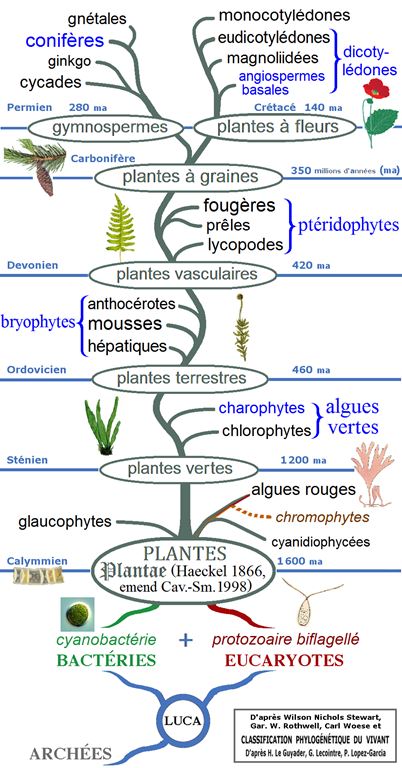
Classification
- Classique : en haut de l'écran, sous le coeur.
- Phylogénétique : Inconnue
À droite, cet arbre phylogénétique des plantes montre les principaux clades et groupes traditionnels (monophylétiques en noir et paraphylétiques en bleu).
Dénominations
- Nom botanique : Enteromorpha compressa (L.) Grev.
- Noms anglais et locaux : Green algae, Stone hair, Green nori
Description et culture
Tableau récapitulatif
Parties comes-tibles Note comest. (1-5) Note medic. (1-5) (Zones de) Rusticité Besoins en 
Besoins en  (1-3)
(1-3)Périodes de semis et récoltes Graines au gramme Durée de viabilité Profon-deur semis Espace-ment plants Espace-ment lignes Durée germi-native Durée avant récolte J F M A M J
J A S O N D
J F M A M J
J A S O N D
- dont infos de 0FPI ("FOOD PLANTS INTERNATIONAL", en anglais) :
 Consommation (rapports de comestibilité, parties utilisables et usages alimentaires correspondants)
Consommation (rapports de comestibilité, parties utilisables et usages alimentaires correspondants)Parties comestibles :
fronde, algues, algues{{{0(+x) (traduction automatique). Original : Frond, Seaweed, Algae{{{0(+x).Détails :
Il peut être consommé cru, séché ou cuit. Les algues séchées sont en poudre et saupoudrées sur du riz, des gâteaux salés et des craquelins de riz{{{0(+x) (traduction automatique).
Original : It can be eaten raw, dried or cooked. The dried algae is powdered and sprinkled on rice, savoury cakes and rice crackers{{{0(+x).
Partie testée :
/ Risques et précautions à prendre
Risques et précautions à prendrenéant, inconnus ou indéterminés.
Autres infos
dont infos de 0FPI ("FOOD PLANTS INTERNATIONAL", en anglais) :
Distribution :
Une plante tropicale. Il pousse dans les eaux peu profondes dans les zones balnéaires calmes{{{0(+x) (traduction automatique).
Original : A tropical plant. It grows in shallow water in quiet seaside areas{{{0(+x).
Localisation :
Africa, Antarctica, Asia, Cape Verde, China, Ghana, Indonesia, Japan, Korea, Malaysia, Mediterranean, New Zealand, Pacific, Papua New Guinea, PNG, Philippines, SE Asia, Taiwan, West Africa{{{0(+x) (traduction automatique).
Original : Africa, Antarctica, Asia, Cape Verde, China, Ghana, Indonesia, Japan, Korea, Malaysia, Mediterranean, New Zealand, Pacific, Papua New Guinea, PNG, Philippines, SE Asia, Taiwan, West Africa{{{0(+x).
Notes :
Il est riche en protéines et en minéraux{{{0(+x) (traduction automatique).
Original : It is rich in protein and minerals{{{0(+x).
Liens, sources et/ou références
Liens :
/ ;Sources et/ou références :
bibliographie (liste des sources et/ou références de l'encyclopédie)
dont livres et bases de données : 0FPI ("FOOD PLANTS INTERNATIONAL", en anglais) ;
dont bibliographie/références de 0FPI ("FOOD PLANTS INTERNATIONAL", en anglais) :
Burkill, H. M., 1985, The useful plants of west tropical Africa, Vol. 5. Kew. ; Burkill, I.H., 1966, A Dictionary of the Economic Products of the Malay Peninsula. Ministry of Agriculture and Cooperatives, Kuala Lumpur, Malaysia. Vol 1 (A-H) p 943 ; Crowe, A., 1997, A Field Guide to the Native Edible Plants of New Zealand. Penguin. p 146 ; Facciola, S., 1998, Cornucopia 2: a Source Book of Edible Plants. Kampong Publications, p 261 ; Hedrick, U.P., 1919, (Ed.), Sturtevant's edible plants of the world. p 290 ; http://www.seavegetables.com ; Hu, Shiu-ying, 2005, Food Plants of China. The Chinese University Press. p 258 ; Kiple, K.F. & Ornelas, K.C., (eds), 2000, The Cambridge World History of Food. CUP p 234 ; Surey-Gent, S. & Morris G., 1987, Seaweed. A User's Guide. Whirret Books. London. p 24 ; Tanaka, ; Velasquez, G.T., 1972, Studies and utilization of the Philippine marine algae. In Proceedings of the Seventh International Seaweed Symposium, ed. K Nisizawa, 62-5. New York. ; Wang, Wei-Lung and Chiang, Young-Meng, 1994, Potential Economic Seaweeds of Hengchun Peninsula, Taiwan, Economic Botany, Vol. 48, No. 2, pp. 182-189 ; Zemke-White, W. L. & Ohno, M., 1999, World seaweed utilisation: An end-of-century summary. Journal of Applied Phycology 11: 369-376 ; Xia, B., and Abbott, I.A., 1987, Edible seaweeds of China and their place in the Chinese diet. Economic Botany 41:341-53 ; Zaneveld, J.S., 1955, Economic marine algae of tropical South and East Asia and their utilization. Indo-Pacific Special Publications, No 3 Bangkok.
Recherche de/pour :
- "Enteromorpha compressa" sur Google (pages et
images) ;
IPNI ("International Plant Names Index", en anglais) ;
TPL ("The Plant List", en anglais) ;
GRIN ("Germplasm Resources Information Network", en anglais) ;
TROPICOS (en anglais) ;
Tela Botanica ;
Pl@ntNet ;
Pl@ntUse ;
"Plants For A Future" (en anglais) ;
"Useful Tropical Plants" (en anglais) ou
"Useful Temperate Plants" (en anglais) ;
- "Enteromorpha compressa" sur Google (pages et
images) ;
IPNI ("International Plant Names Index", en anglais) ;
TPL ("The Plant List", en anglais) ;
GRIN ("Germplasm Resources Information Network", en anglais) ;
TROPICOS (en anglais) ;
Tela Botanica ;
Pl@ntNet ;
Pl@ntUse ;
"Plants For A Future" (en anglais) ;
"Useful Tropical Plants" (en anglais) ou
"Useful Temperate Plants" (en anglais) ;
Espèces du même genre (Enteromorpha)
7 taxons
Espèces de la même famille (Ulvaceae)
25 taxons
- Enteromorpha flexuosa
- Enteromorpha linza
- Enteromorpha nitidum
- Enteromorpha plumosa
- Enteromorpha prolifera
- Enteromorpha tubulosa
- Ulva australis
- Ulva californica
- Ulva clathrata
- Ulva compressa (Entéromorphe)
- Ulva conglobata
- Ulva fasciata
- Ulva fenestrata
- Ulva flexuosa
- Ulva intestinalis (Ulve en tube)
- Ulva lactuca (Laitue de mer)
- Ulva linza
- Ulva nematoidea
- Ulva pappenfussii
- Ulva prolifera
- Ulva reticulata
- Ulva rigida
- Ulva rotundata
- Ulva stenophylla







 donne accès au menu
  - encyclopédies des plantes alimentaires ;
 - page de recherche - reconnaissance (identification) de plantes ;
 - page du calendrier lunaire et son générateur (au format PDF et JPG) ;
 - tableau récapitulatif ;
 - générateur de potées (soupes), avec estimation des apports nutrionnels et du coût;
 - générateur de codes QR ;
 - page des archives avec de nombreux documents sur différents thèmes complémentaires comme la botanique, les légumes,
les champignons, la cuisine, le bien-être ainsi que différents MOOC mais également des liens vers les archives de l'association ;
- page des archives avec de nombreux documents sur différents thèmes complémentaires comme la botanique, les légumes,
les champignons, la cuisine, le bien-être ainsi que différents MOOC mais également des liens vers les archives de l'association ;

 pour le fruit (et/ou les graines, la pulpe, etc...),
 pour les fleurs (et/ou pétales, calice...),
 pour les feuilles (et/ou la tige, les pousses...),
 pour les racines,
 pour le tronc (et/ou l'écorce, la sève...), et enfin
 pour les champignons,
puis les notes alimentaires et médicinales (de 1 à 5 étoiles), la rusticité (résistance au froid/gel)
et pour finir un résumé.
pour les champignons,
puis les notes alimentaires et médicinales (de 1 à 5 étoiles), la rusticité (résistance au froid/gel)
et pour finir un résumé. menant ici 🙂
 ,
,  et
et





 ,
,


 Encyclopédie(s)
 Recherche-Reconnaissance
 Tableau récapitulatif
 Codes QR
 Archives
 Calendrier(s) lunaire(s)
  Potées
 Re-naturation/naturalisation
 Affichettes, herbiers &
co.
Affichettes, herbiers &
co. menu
menu galerie


 (en bas à droite).
 (en bas à gauche).
