Onoclea struthiopteris
Pas d'illustration
pour le moment 😕


Une fougère à feuilles caduques. Il atteint 90 à 150 cm de haut et 60 à 90 cm de large. Les frondes forment un anneau extérieur de frondes stériles. Celles-ci sont là ...
→suite


Onoclea struthiopteris

Une fougère à feuilles caduques. Il atteint 90 à 150 cm de haut et 60 à 90 cm de large. Les frondes forment un anneau extérieur de frondes stériles. Celles-ci sont légèrement arquées et jaune-vert. Ils peuvent mesurer 90 c... →suite
Pas d'illustration
pour le moment 😕
Pas d'illustration
pour le moment 😕
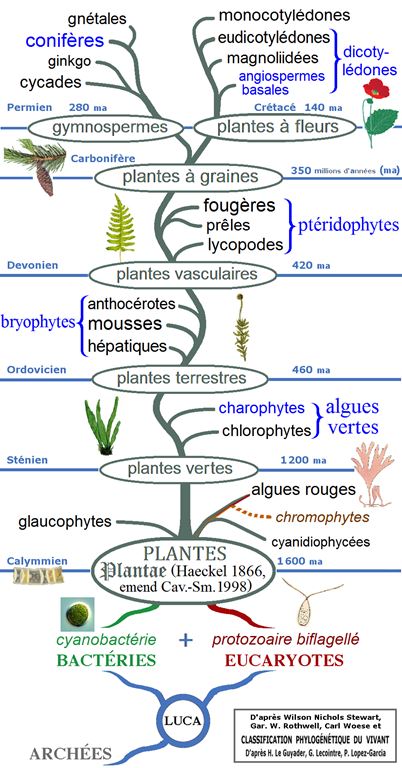
Classification
- Classique : en haut de l'écran, sous le coeur.
- Phylogénétique : Inconnue
À droite, cet arbre phylogénétique des plantes montre les principaux clades et groupes traditionnels (monophylétiques en noir et paraphylétiques en bleu).
Dénominations
- Nom botanique : Onoclea struthiopteris (L.) Roth
- Synonymes : Matteuccia nodulosa Fernald; Matteuccia pensylvanica (Willd.) Raymond; Matteuccia struthiopteris (L.) Todaro; Matteuccia struthiopteris var. pensylvanica (Willd.) C.V. Morton; Struthiopteris nodulosa Desv.; Struthiopteris pensylvanica Willd.; and several others ;
- Noms anglais et locaux : Bai jue, Chaduna, Da yi, Gvimra, Huangguaxiang, Jitoucai, Jiwacai, Jiercai, Le yi, Navadna peru?a, Sorma,
Description et culture
Tableau récapitulatif
Parties comes-tibles Note comest. (1-5) Note medic. (1-5) (Zones de) Rusticité Besoins en 
Besoins en  (1-3)
(1-3)Périodes de semis et récoltes Graines au gramme Durée de viabilité Profon-deur semis Espace-ment plants Espace-ment lignes Durée germi-native Durée avant récolte J F M A M J
J A S O N D
J F M A M J
J A S O N D
Description :
Une fougère à feuilles caduques. Il atteint 90 à 150 cm de haut et 60 à 90 cm de large. Les frondes forment un anneau extérieur de frondes stériles. Celles-ci sont légèrement arquées et jaune-vert. Ils peuvent mesurer 90 cm de long. Les frondes brun verdâtre plus courtes sont fertiles. Les frondes sont largement en forme de lance, très fines et profondément découpées. Ils ont des nervures médianes brun noirâtre.
- dont infos de 0FPI ("FOOD PLANTS INTERNATIONAL", en anglais) :
 Consommation (rapports de comestibilité, parties utilisables et usages alimentaires correspondants)
Consommation (rapports de comestibilité, parties utilisables et usages alimentaires correspondants)Parties comestibles :
Frondes, feuilles, racines, légumes,{{{0(+x) (traduction automatique). Original : Fronds, Leaves, Root, Vegetable{{{0(+x).Détails :
Les frondes enroulées sont mangées. Ils se consomment crus ou cuits. Ils sont également cuisinés dans des plats sautés et des soupes. Les épaisses feuilles déroulées sont salées et bouillies et servies sur du pain grillé avec de l'huile ou du beurre. L'amidon des rhizomes est utilisé pour les nouilles. Les porte-greffes se consomment bouillis ou rôtis.{{{0(+x) (traduction automatique).
Original : The coiled fronds are eaten. They are eaten raw or cooked. They are also cooked in stir fried dishes and soups. The thick unrolled fronds are salted and boiled and served on toast with oil or butter. The starch in the rhizomes are used for noodles. The rootstocks are eaten boiled or roasted{{{0(+x).
Partie testée :
/ Risques et précautions à prendre
Risques et précautions à prendrenéant, inconnus ou indéterminés.
Autres infos
dont infos de 0FPI ("FOOD PLANTS INTERNATIONAL", en anglais) :
Statut :
Il est couramment utilisé au Yunnan. Les crosses de violon sont vendues sur les marchés. Ils sont disponibles frais sur les marchés ou congelés ou en conserve. Ils sont récoltés et consommés dans les restaurants en Suède.{{{0(+x) (traduction automatique).
Original : It is commonly used in Yunnan. The fiddleheads are sold in markets. They are available fresh in markets or frozen or canned. They are foraged and eaten in restaurants in Sweden{{{0(+x).
Distribution :
C'est une plante tempérée. Il est résistant au gel. Il lui faut des conditions humides. Il a besoin d'une bonne lumière mais pas de soleil direct. Il convient aux zones de rusticité 3 à 10. Au Sichuan.{{{0(+x) (traduction automatique).
Original : It is a temperate plant. It is frost hardy. It needs damp conditions. It needs good light but not direct sun. It suits hardiness zones 3-10. In Sichuan{{{0(+x).
Localisation :
Alaska, Asie, Australie, Autriche, Biélorussie, Belgique, Grande-Bretagne, Canada, Caucase, Chine, République tchèque, Danemark, Europe, Finlande, France, Géorgie, Allemagne, Hongrie, Iran, Irlande, Italie, Japon, Kazakhstan, Corée, Mandchourie, Méditerranée, Moyen-Orient, Mongolie, Amérique du Nord, Norvège, Pologne, Roumanie, Russie, Sibérie, Slovénie, Suède, Tibet, Turquie, Turquie, Ukraine, États-Unis, Yougoslavie,{{{0(+x) (traduction automatique).
Original : Alaska, Asia, Australia, Austria, Belarus, Belgium, Britain, Canada, Caucasus, China, Czech Republic, Denmark, Europe, Finland, France, Georgia, Germany, Hungary, Iran, Ireland, Italy, Japan, Kazakhstan, Korea, Manchuria, Mediterranean, Middle East, Mongolia, North America, Norway, Poland, Romania, Russia, Siberia, Slovenia, Sweden, Tibet, Turkey, Türkiye, Ukraine, USA, Yugoslavia{{{0(+x).
Notes :
Il existe 3 ou 4 espèces de Matteuccia. Également mis dans la famille des Woodsiaceae.{{{0(+x) (traduction automatique).
Original : There are 3 or 4 Matteuccia species. Also put in the family Woodsiaceae{{{0(+x).
Liens, sources et/ou références
Liens :
/ ;Sources et/ou références :
bibliographie (liste des sources et/ou références de l'encyclopédie)
dont livres et bases de données :
dont bibliographie/références de 0FPI ("FOOD PLANTS INTERNATIONAL", en anglais) :
Bowser, M., 2017, Handout on Edible Plants of the Kenai Peninsula. USFWS Kenai National Wildlife Refuge p 8 (As Matteuccia struthiopteris)Brickell, C. (Ed.), 1999, The Royal Horticultural Society A-Z Encyclopedia of Garden Plants. Convent Garden Books. p 660 (As Matteuccia pensylvanica)Bussman, R. W., et al, 2016, A comparative ethnobotany of Khevsureti, Samtskhe-Javakheti, Tusheti, Svaneti, and Racha-Lechkhumi, Republic of Georgia (Sakartvelo), Caucasus. Journal of Ethnobiology and Ethnomedicine (2016) 12:4 (As Matteuccia struthiopteris)Chen, B. & Qiu, Z., Consumer's Attitudes towards Edible Wild Plants, Ishikawa Prefecture, Japan. p 24 www.hindawi.com/journals/ijfr/aip/872413.pdf (As Matteuccia struthiopteris)Crawford, M., 2012, How to grow Perennial Vegetables. Green Books. p 142 (As Matteuccia struthiopteris)Cundall, P., (ed.), 2004, Gardening Australia: flora: the gardener's bible. ABC Books. p 877 (As Matteuccia struthiopteris)Elias, T.S. & Dykeman P.A., 1990, Edible Wild Plants. A North American Field guide. Sterling, New York p 58 (As Matteuccia pensylvanica)Esperanca, M. J., 1988. Surviving in the wild. A glance at the wild plants and their uses. Vol. 2. p 122 (As Matteuccia struthiopteris)Facciola, S., 1998, Cornucopia 2: a Source Book of Edible Plants. Kampong Publications, p 164 (See Matteuccia pensylvanica)Flora of North America. www.eFloras.org (var. pensylvanica)Giorn. Sci. Nat. Econ. Palermo 1:235. 1866 (As Matteuccia struthiopteris)Hibbert, M., 2002, The Aussie Plant Finder 2002, Florilegium. p 194 (As Matteuccia struthiopteris)http://www.botanic-gardens-ljubljana.com/en/plants (As Matteuccia struthiopteris)Jackes, D. A., Edible Forest Gardens (As Matteuccia struthiopteris)Joyce, D., 1998, The Garden Plant Selector. Ryland, Peters and Small. p 335 (As Matteuccia struthiopteris)Ju, Y., et al, 2013, Eating from the wild: diversity of wild edible plants used by Tibetans in Shangri-la region, Yunnan, China, Journal of Ethnobiology and Ethno medicine 9:28 (As Matteuccia struthiopteris)Kang, Y., et al, 2012, Wild food plants and wild edible fungi in two valleys on the Qinling Mountains (Shaanxi, central China) Journal of Ethnobiology and Ethnomedicine; 9:26 (As Matteuccia struthiopteris)Kang, Y., et al, 2014, Wild food plants used by the Tibetans of Gongba Valley (Zouqu country, Gansu, China) Journal of Ethnobiology and Ethnomedicine 10:20 (As Matteuccia struthiopteris)Kermath, B. M., et al, 2014, Food Plants in the Americas: A survey of the domesticated, cultivated and wild plants used for Human food in North, Central and South America and the Caribbean. On line draft. p 525 (As Matteuccia struthiopteris)Kiple, K.F. & Ornelas, K.C., (eds), 2000, The Cambridge World History of Food. CUP p 1773 (As Matteuccia struthiopteris)Kuhnlein, H. V. and Turner, N. J., 1991, Traditional Plant Foods of Canadian Indigenous Peoples. Food and Nutrition in History and Anthropology Volume 8. Gordon and Breach. p 31 (As Matteuccia struthiopteris)Kuhnlein, H. V., et al, 2009, Indigenous Peoples' food systems. FAO Rome p 148 (As Matteuccia struthiopteris)Lim, T. K., 2015, Edible Medicinal and Non Medicinal Plants. Volume 9, Modified Stems, Roots, Bulbs. Springer p 54 (As Matteuccia struthiopteris)Liu, Y., et al, 2012, Food uses of ferns in China: a review. Acta Societatis Botanicorum Poloniae 84(4): 263-270 (As Matteuccia struthiopteris)Luczaj, L. et al, 2012, Wild food plant use in 21st century Europe: the disappearance of old traditions and the search for new cuisines involving wild edibles. Acta Soc Bot Pol 81(4):359?370 (As Matteuccia struthiopteris)MacKinnon, A., et al, 2009, Edible & Medicinal Plants of Canada. Lone Pine. p 378 (As Matteuccia struthiopteris)Moerman, D. F., 2010, Native American Ethnobotany. Timber Press. p 337 (As Matteuccia struthiopteris)Plants for a Future database, The Field, Penpol, Lostwithiel, Cornwall, PL22 0NG, UK. http://www.scs.leeds.ac.uk/pfaf/ (As Matteuccia struthiopteris)Plants for a Future database, The Field, Penpol, Lostwithiel, Cornwall, PL22 0NG, UK. http://www.scs.leeds.ac.uk/pfaf/ (As Matteuccia pensylvanica)Romanowski, N., 2007, Edible Water Gardens. Hyland House. p 89 (As Matteuccia struthiopteris)Ryan, S., 2008, Dicksonia. Rare Plants Manual. Hyland House. p 107 (As Matteuccia struthiopteris)Schneider, E., 2001, Vegetables from Amaranth to Zucchini: The essential reference. HarperCollins. p 288 (As Matteuccia struthiopteris)Slocum, P.D. & Robinson, P., 1999, Water Gardening. Water Lilies and Lotuses. Timber Press. p 127 (As Matteuccia struthiopteris)Turner, N. J. et al, 2011, Edible and Tended Wild Plants, Traditional Ecological Knowledge and Agroecology. Critical Reviews in Plant Sciences, 30:198-225 (As Matteuccia struthiopteris)Ulian, T., et al, 2020, Unlocking plant resources to support food security and promote sustainable agriculture. Plants, People, Planet. 2020;2:421?445.Urgamal, M., et al, 2014, Conspectus of the Vascular Plants of Mongolia. Mongolia Academy of Sciences Institute of Botany and National University of Mongolia Department of Biology. p 34 (As Matteuccia struthiopteris)USDA, ARS, National Genetic Resources Program. Germplasm Resources Information Network - (GRIN). [Online Database] National Germplasm Resources Laboratory, Beltsville, Maryland. Available: www.ars-grin.gov/cgi-bin/npgs/html/econ.pl (10 April 2000) (As Matteuccia pensylvanica)Wang, J. et al, 2013, A Study on the Utilization of Wild Plants for Food in Liangshan Yi Autonomous Prefecture. Plant Diversity and Resources. 35(4): 416-471 (As Matteuccia struthiopteris)World Checklist of Useful Plant Species 2020. Royal Botanic Gardens, KewWujisguleng, W., & Khasbagen. K., 2010, An integrated assessment of wild vegetable resources in Inner Mongolian Autonomous Region, China. Journal of Ethnobiology and Ethnomedicine 6:34 (As Matteuccia struthiopteris)
Recherche de/pour :
- "Onoclea struthiopteris" sur Google (pages et
images) ;
IPNI ("International Plant Names Index", en anglais) ;
TPL ("The Plant List", en anglais) ;
GRIN ("Germplasm Resources Information Network", en anglais) ;
TROPICOS (en anglais) ;
Tela Botanica ;
Pl@ntNet ;
Pl@ntUse ;
"Plants For A Future" (en anglais) ;
"Useful Tropical Plants" (en anglais) ou
"Useful Temperate Plants" (en anglais) ;
- "Onoclea struthiopteris" sur Google (pages et
images) ;
IPNI ("International Plant Names Index", en anglais) ;
TPL ("The Plant List", en anglais) ;
GRIN ("Germplasm Resources Information Network", en anglais) ;
TROPICOS (en anglais) ;
Tela Botanica ;
Pl@ntNet ;
Pl@ntUse ;
"Plants For A Future" (en anglais) ;
"Useful Tropical Plants" (en anglais) ou
"Useful Temperate Plants" (en anglais) ;
Espèces de la même famille (Aspleniaceae)
36 taxons
- Asplenium acrobryum Christ
- Asplenium adiantum-nigrum L. (Asplénie noire de Silésie)
- Asplenium affine L.
- Asplenium antiquum Makino
- Asplenium australasicum Hook.
- Asplenium bantamense
- Asplenium bulbiferum L.
- Asplenium cymbifolium Christ
- Asplenium ensiforme Wall. ex Hook. & Grev.
- Asplenium falcatum Thunb.
- Asplenium laserpitiifolium Lam.
- Asplenium nidus L. (Asplénie)
- Asplenium oblongifolium L.
- Asplenium officinarum Willd.
- Asplenium phyllitidis D.Don
- Asplenium polypodioides L.
- Asplenium ruta muraria
- Asplenium ruta-muraria L.
- Asplenium scolopendrium L. (Scolopendre)
- Asplenium scolopendropsis F. Muell.
- Asplenium septentrionale (L.) Hoffm.
- Asplenium trichomanes L. (Capillaire des murailles)
- Asplenium unilaterale Lam.
- Ceterach officinarum Willd.
- Ctenitis sp.
- Lomagramma sinuata C.Chr.
- Loxoscaphe gibberosum
- Pleocnemia cumingiana C. Presl.
- Pleocnemia irregularis
- Telmatoblechnum serrulatum (Rich,) Perrie, D. J. Ohlsen & Brownsey
- Thelypteris alatella (Christ) C. F. Reed
- Thelypteris gongylodes (Schkuhr) Small
- Thelypteris papuana (Holttum) Christenh.
- Thelypteris protecta (Copel.) C. F. Reed
- Thelypteris subpubescens (Blume) K. Iwats.







 donne accès au menu
  - encyclopédies des plantes alimentaires ;
 - page de recherche - reconnaissance (identification) de plantes ;
 - page du calendrier lunaire et son générateur (au format PDF et JPG) ;
 - tableau récapitulatif ;
 - générateur de potées (soupes), avec estimation des apports nutrionnels et du coût;
 - générateur de codes QR ;
 - page des archives avec de nombreux documents sur différents thèmes complémentaires comme la botanique, les légumes,
les champignons, la cuisine, le bien-être ainsi que différents MOOC mais également des liens vers les archives de l'association ;
- page des archives avec de nombreux documents sur différents thèmes complémentaires comme la botanique, les légumes,
les champignons, la cuisine, le bien-être ainsi que différents MOOC mais également des liens vers les archives de l'association ;

 pour le fruit (et/ou les graines, la pulpe, etc...),
 pour les fleurs (et/ou pétales, calice...),
 pour les feuilles (et/ou la tige, les pousses...),
 pour les racines,
 pour le tronc (et/ou l'écorce, la sève...), et enfin
 pour les champignons,
puis les notes alimentaires et médicinales (de 1 à 5 étoiles), la rusticité (résistance au froid/gel)
et pour finir un résumé.
pour les champignons,
puis les notes alimentaires et médicinales (de 1 à 5 étoiles), la rusticité (résistance au froid/gel)
et pour finir un résumé. menant ici 🙂
 ,
,  et
et





 ,
,


 Encyclopédie(s)
 Recherche-Reconnaissance
 Tableau récapitulatif
 Codes QR
 Archives
 Calendrier(s) lunaire(s)
  Potées
 Re-naturation/naturalisation
 Affichettes, herbiers &
co.
Affichettes, herbiers &
co. menu
menu galerie


 (en bas à droite).
 (en bas à gauche).
