Laccocephalium mylittae
Pas d'illustration
pour le moment 😕

Un grand champignon souterrain. Ceux-ci peuvent peser 20 kg. Ceux-ci sont bruns à l'extérieur et sont fermes et jaunes à l'intérieur. Ils peuvent mesurer 12 cm de diamètr ... (traduction automatique)
→suite


Laccocephalium mylittae

Un grand champignon souterrain. Ceux-ci peuvent peser 20 kg. Ceux-ci sont bruns à l'extérieur et sont fermes et jaunes à l'intérieur. Ils peuvent mesurer 12 cm de diamètre. La chair à l'intérieur la... (traduction automatique) →suite
Champignon (cf. MycoDB)
Pas d'illustration
pour le moment 😕
Pas d'illustration
pour le moment 😕
Classification
- Classique : en haut de l'écran, sous le coeur.
- Phylogénétique : Inconnue
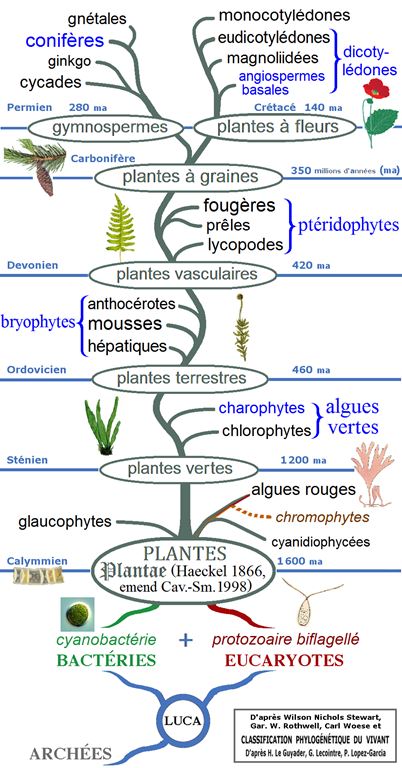
À droite, cet arbre phylogénétique des plantes montre les principaux clades et groupes traditionnels (monophylétiques en noir et paraphylétiques en bleu).
Dénominations
- Nom botanique : Laccocephalium mylittae (Cook & Massee) Nunez & Ryvarden
- Synonymes : Polyporus mylittae M.C. Cooke & G.E. Massee, Mylittae australis M.J. Berkley
- Noms anglais et locaux : Native bread, Blackfellow's Bread
Description et culture
Tableau récapitulatif
Parties comes-tibles Note comest. (1-5) Note medic. (1-5) (Zones de) Rusticité Besoins en 
Besoins en  (1-3)
(1-3)Périodes de semis et récoltes Graines au gramme Durée de viabilité Profon-deur semis Espace-ment plants Espace-ment lignes Durée germi-native Durée avant récolte J F M A M J
J A S O N D
J F M A M J
J A S O N D
- dont infos de 0FPI ("FOOD PLANTS INTERNATIONAL", en anglais) :
Description :
Un grand champignon souterrain. Ceux-ci peuvent peser 20 kg. Ceux-ci sont bruns à l'extérieur et sont fermes et jaunes à l'intérieur. Ils peuvent mesurer 12 cm de diamètre. La chair à l'intérieur laisse passer la lumière. Il peut produire un champignon au-dessus du sol{{{0(+x) (traduction automatique).
Original : A large underground fungus. These can be 20 kg in weight. These are brown on the outside and and are firm and yellow inside. They can be 12 cm across. The flesh inside lets light through. It can produce a toadstool above the ground{{{0(+x).
 Consommation (rapports de comestibilité, parties utilisables et usages alimentaires correspondants)
Consommation (rapports de comestibilité, parties utilisables et usages alimentaires correspondants)Parties comestibles :
champignon{{{0(+x) (traduction automatique). Original : Fungus{{{0(+x).Détails :
Les sclérotes sont consommés{{{0(+x) (traduction automatique).
Original : The sclerotia is eaten{{{0(+x).
Partie testée :
/ Risques et précautions à prendre
Risques et précautions à prendrenéant, inconnus ou indéterminés.
Autres infos
dont infos de 0FPI ("FOOD PLANTS INTERNATIONAL", en anglais) :
Distribution :
C'est une plante tempérée. Il se produit dans la forêt d'Eucalyptus{{{0(+x) (traduction automatique).
Original : It is a temperate plant. It occurs in Eucalypt forest{{{0(+x).
Localisation :
Asie, Australie *, Chine, Tasmanie *{{{0(+x) (traduction automatique).
Original : Asia, Australia*, China, Tasmania*{{{0(+x).
Liens, sources et/ou références
Liens :
/ ;Sources et/ou références :
bibliographie (liste des sources et/ou références de l'encyclopédie)
dont livres et bases de données : 0FPI ("FOOD PLANTS INTERNATIONAL", en anglais) ;
dont bibliographie/références de 0FPI ("FOOD PLANTS INTERNATIONAL", en anglais) :
Boa, E. R., 2004, Wild edible fungi and their importance to people. FAO Non Wood Forest Products Booklet 17 ; Bougher, N.L. & Syme, K., 1998, Fungi of Southern Australia. UWA Press p 328 (As Polyporus mylittae) ; Clarke, P. A., 2013, The Aboriginal Ethnobotany of the Adelaide Region, South Australia. Transactions of the Royal Society of South Australia. (2013), 137(1): 97-126 ; Cribb, A.B. & J.W., 1976, Wild Food in Australia, Fontana. p 204 (As Polyporus mylittae) ; Fuhrer, B., 2005, A field guide to Australian Fungi. Bloomings Books. p 250 ; Gott, B & Conran, J., 1991, Victorian Koorie Plants. PO Box 666 Hamilton, Victoria 3300, Australia. p 24 (As Polyporus mylittae) ; Hall, I. R., et al, 2003, Edible and Poisonous Mushrooms of the World. Timber Press. p 258 ; Irving, 1957, (As Mylitta australis) ; Kiple, K.F. & Ornelas, K.C., (eds), 2000, The Cambridge World History of Food. CUP p 321 (As Mylitta australis) ; Low, T., 1992, Bush Tucker. Australiaâ's Wild Food Harvest. Angus & Robertson. p 164 (As Polyporus mylittae)
Recherche de/pour :
- "Laccocephalium mylittae" sur Google (pages et
images) ;
IPNI ("International Plant Names Index", en anglais) ;
TPL ("The Plant List", en anglais) ;
GRIN ("Germplasm Resources Information Network", en anglais) ;
TROPICOS (en anglais) ;
Tela Botanica ;
Pl@ntNet ;
Pl@ntUse ;
"Plants For A Future" (en anglais) ;
"Useful Tropical Plants" (en anglais) ou
"Useful Temperate Plants" (en anglais) ;
- "Laccocephalium mylittae" sur Google (pages et
images) ;
IPNI ("International Plant Names Index", en anglais) ;
TPL ("The Plant List", en anglais) ;
GRIN ("Germplasm Resources Information Network", en anglais) ;
TROPICOS (en anglais) ;
Tela Botanica ;
Pl@ntNet ;
Pl@ntUse ;
"Plants For A Future" (en anglais) ;
"Useful Tropical Plants" (en anglais) ou
"Useful Temperate Plants" (en anglais) ;
Espèces de la même famille (Polyporaceae)
113 taxons
- Lentin tigre
- Polypore bai
- Polypore du bouleau
- Polypore ecailleux
- Polypore en ombelle
- Polypore en touffes
- Polypore geant
- Polypore pied-de-chèvre
- Polypore soufré
- Tramete versicolore ; Polypore versicolore
- Albetrellus confluens
- Boletopsis leucomelaena
- Cerrena unicolor
- Coriolus sp.
- Coriolus versicolor
- Coriolus zonatus
- Cymatoderma dendriticum
- Daedalea flavida
- Echinochaete brachypora
- Grifola frondosa (Polypore en touffes)
- Grifola gargal
- Grifola gigantea
- Hexagona subcaperata
- Laetiporus cincinnatus
- Laetiporus gilbertsonii
- Laetiporus sulphureus (Polypore soufré)
- Lentinus araucariae
- Lentinus badius
- Lentinus brunneofloccosus
- Lentinus citrinus
- Lentinus cladopus
- Lentinus conatus
- Lentinus concavus
- Lentinus conchatus
- Lentinus crinitus
- Lentinus cubensis
- Lentinus esculenta
- Lentinus fasciatus
- Lentinus glabratus
- Lentinus lepideus
- Lentinus nepalensis
- Lentinus novae-zelandiae
- Lentinus novopommeranus
- Lentinus polychrous
- Lentinus praerigidus
- Lentinus prolifer
- Lentinus pruinosa
- Lentinus retinervis
- Lentinus sajor-caju
- Lentinus scleropus
- Lentinus spp
- Lentinus squarrosulus
- Lentinus strigosus
- Lentinus subnudus
- Lentinus suffrutescens
- Lentinus tephroleucus
- Lentinus tigrinus (Lentin tigre)
- Lentinus torulosus
- Lentinus tuber-regium
- Lentinus umbrinus
- ...







 donne accès au menu
  - encyclopédies des plantes alimentaires ;
 - page de recherche - reconnaissance (identification) de plantes ;
 - page du calendrier lunaire et son générateur (au format PDF et JPG) ;
 - tableau récapitulatif ;
 - générateur de potées (soupes), avec estimation des apports nutrionnels et du coût;
 - générateur de codes QR ;
 - page des archives avec de nombreux documents sur différents thèmes complémentaires comme la botanique, les légumes,
les champignons, la cuisine, le bien-être ainsi que différents MOOC mais également des liens vers les archives de l'association ;
- page des archives avec de nombreux documents sur différents thèmes complémentaires comme la botanique, les légumes,
les champignons, la cuisine, le bien-être ainsi que différents MOOC mais également des liens vers les archives de l'association ;

 pour le fruit (et/ou les graines, la pulpe, etc...),
 pour les fleurs (et/ou pétales, calice...),
 pour les feuilles (et/ou la tige, les pousses...),
 pour les racines,
 pour le tronc (et/ou l'écorce, la sève...), et enfin
 pour les champignons,
puis les notes alimentaires et médicinales (de 1 à 5 étoiles), la rusticité (résistance au froid/gel)
et pour finir un résumé.
pour les champignons,
puis les notes alimentaires et médicinales (de 1 à 5 étoiles), la rusticité (résistance au froid/gel)
et pour finir un résumé. menant ici 🙂
 ,
,  et
et





 ,
,


 Encyclopédie(s)
 Recherche-Reconnaissance
 Tableau récapitulatif
 Codes QR
 Archives
 Calendrier(s) lunaire(s)
  Potées
 Re-naturation/naturalisation
 Affichettes, herbiers &
co.
Affichettes, herbiers &
co. menu
menu galerie


 (en bas à droite).
 (en bas à gauche).
