Manilkara maxima
Pas d'illustration
pour le moment 😕

Un arbre. Il atteint 10 à 30 m de haut. Le tronc mesure 30 à 60 cm de diamètre.
→suite


Manilkara maxima

Un arbre. Il atteint 10 à 30 m de haut. Le tronc mesure 30 à 60 cm de diamètre.
Pas d'illustration
pour le moment 😕
Pas d'illustration
pour le moment 😕
Classification
- Classique : en haut de l'écran, sous le coeur.
- Phylogénétique :
- Clade 4 : Angiospermes ;
- Clade 3 : Dicotylédones_vraies ;
- Clade 2 : Astéridées ;
- Ordre APN : Ericales ;
- Famille APN : Sapotaceae ;
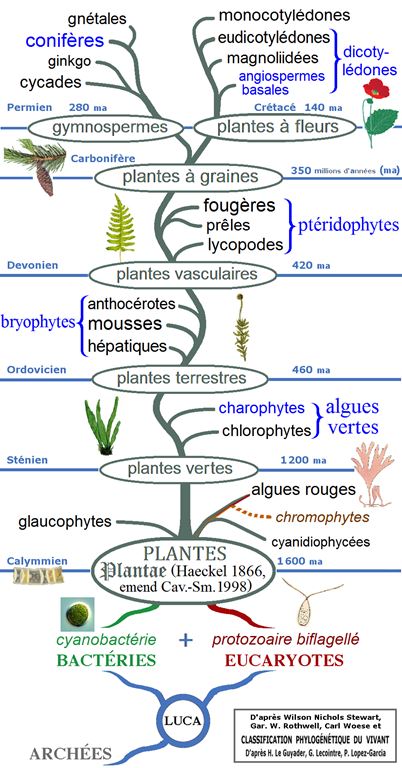
À droite, cet arbre phylogénétique des plantes montre les principaux clades et groupes traditionnels (monophylétiques en noir et paraphylétiques en bleu).
Dénominations
- Nom botanique : Manilkara maxima T. D. Penn.
- Noms anglais et locaux : Macaranduba vermelha,
Description et culture
Tableau récapitulatif
Parties comes-tibles Note comest. (1-5) Note medic. (1-5) (Zones de) Rusticité Besoins en 
Besoins en  (1-3)
(1-3)Périodes de semis et récoltes Graines au gramme Durée de viabilité Profon-deur semis Espace-ment plants Espace-ment lignes Durée germi-native Durée avant récolte J F M A M J
J A S O N D
J F M A M J
J A S O N D
Description :
Un arbre. Il atteint 10 à 30 m de haut. Le tronc mesure 30 à 60 cm de diamètre.
 Consommation (rapports de comestibilité, parties utilisables et usages alimentaires correspondants)
Consommation (rapports de comestibilité, parties utilisables et usages alimentaires correspondants)Parties comestibles :
Fruit ?,{{{0(+x) (traduction automatique). Original : Fruit ?{{{0(+x).Partie testée :
/ Risques et précautions à prendre
Risques et précautions à prendrenéant, inconnus ou indéterminés.
Liens, sources et/ou références
Liens :
/ ;Sources et/ou références :
bibliographie (liste des sources et/ou références de l'encyclopédie)
dont livres et bases de données :
dont bibliographie/références de 0FPI ("FOOD PLANTS INTERNATIONAL", en anglais) :
Ferns, Useful Tropical Plants
Recherche de/pour :
- "Manilkara maxima" sur Google (pages et
images) ;
IPNI ("International Plant Names Index", en anglais) ;
TPL ("The Plant List", en anglais) ;
GRIN ("Germplasm Resources Information Network", en anglais) ;
TROPICOS (en anglais) ;
Tela Botanica ;
Pl@ntNet ;
Pl@ntUse ;
"Plants For A Future" (en anglais) ;
"Useful Tropical Plants" (en anglais) ou
"Useful Temperate Plants" (en anglais) ;
- "Manilkara maxima" sur Google (pages et
images) ;
IPNI ("International Plant Names Index", en anglais) ;
TPL ("The Plant List", en anglais) ;
GRIN ("Germplasm Resources Information Network", en anglais) ;
TROPICOS (en anglais) ;
Tela Botanica ;
Pl@ntNet ;
Pl@ntUse ;
"Plants For A Future" (en anglais) ;
"Useful Tropical Plants" (en anglais) ou
"Useful Temperate Plants" (en anglais) ;
Espèces du même genre (Manilkara)
29 taxons
- Manilkara bidentata
- Manilkara butugi Chiov.
- Manilkara chicle
- Manilkara concolor
- Manilkara dardonoi
- Manilkara dawei
- Manilkara discolor (Sond.) J.H.Hemsl.
- Manilkara elata
- Manilkara excelsa
- Manilkara hexandra (Roxb.) Dubard
- Manilkara huberi
- Manilkara inundata (Ducke) Ducke
- Manilkara jaimiqui
- Manilkara kauki (L.) Dubard (Sapotillier kecik)
- Manilkara lacera
- Manilkara littoralis
- Manilkara malcoleus
- Manilkara mochisia (Baker) Dubard
- Manilkara obovata (Sabine & G.Don) J.H.Hemsl.
- Manilkara pleeana
- Manilkara rufula
- Manilkara salzmannii
- Manilkara sansibarensis
- Manilkara staminodella Gilly
- Manilkara subsericea
- Manilkara sulcata
- Manilkara valenzuelana
- Manilkara zapota (L.) P. Royen (Sapotillier)
Espèces de la même famille (Sapotaceae)
423 taxons
- Abiu
- Arganier
- Armadillo fruit
- Beurre d'Orère
- Caïmitier
- Caïmitier à fruit blanc
- Caïmitier africain
- Canistel
- Cerisier espagnol
- Fruit miracle
- Jacan
- Karité
- Lamut
- Lucuma
- Lucuma sauvage
- Makoré
- Mimusope coriace
- Munga
- Omuma
- Pomme noire
- Sapotier
- Sapotier vert
- Sapotillier
- Sapotillier kecik
- Satinleaf
- Argania spinosa (L.) Skeels (Arganier)
- Autranella congolensis
- Baillonella toxisperma Pierre (Beurre d'Orère)
- Beccariella brownlessiana
- Beccariella macrocarpa
- Beccariella papyracea
- Bumelia lanuginosa
- Bumelia lycioides
- Bumelia tenax
- Burckella banikiensis
- Burckella fijiensis
- Burckella macropoda
- Burckella majus
- Burckella obovata
- Burckella richii
- Burckella sorei P.Royen
- Burckella sp megahilum
- Burckella thurstonii
- Chromolucuma rubiflora
- Chrysophyllum africanum A.DC. (Caïmitier africain)
- Chrysophyllum albidum G.Don (Caïmitier à fruit blanc)
- Chrysophyllum amazonicum T.D.Penn.
- Chrysophyllum arenarium Allemo
- Chrysophyllum argenteum Jacq.
- Chrysophyllum bangweolense R.E.Fr. & Pellegr.
- Chrysophyllum boivinianum
- Chrysophyllum bombycinum T.D.Penn.
- Chrysophyllum brenesii Cronquist
- Chrysophyllum cainito L. (Caïmitier)
- Chrysophyllum colombianum (Aubrev.) T. D. Penn.
- Chrysophyllum cuneifolium
- Chrysophyllum eximium Ducke
- Chrysophyllum flexuosum Mart.
- Chrysophyllum giganteum A.Chev.
- Chrysophyllum gonocarpum
- Chrysophyllum gorungosanum Engl.
- Chrysophyllum imperiale
- Chrysophyllum inornatum Mart.
- Chrysophyllum lacourtianum De Wild.
- Chrysophyllum lucentifolium Cronquist
- Chrysophyllum macoucou Aubl.
- Chrysophyllum manaosense
- Chrysophyllum marginatum
- Chrysophyllum mexicanum Brandegee
- Chrysophyllum michino H. B. & Kunth
- Chrysophyllum obovatum Sabine & G.Don
- Chrysophyllum oliviforme L. (Satinleaf)
- Chrysophyllum ovale Rusby
- Chrysophyllum paranaense T.D.Penn.
- Chrysophyllum perpulchrum Mildbr. ex Hutch. & Dalziel
- ...







 donne accès au menu
  - encyclopédies des plantes alimentaires ;
 - page de recherche - reconnaissance (identification) de plantes ;
 - page du calendrier lunaire et son générateur (au format PDF et JPG) ;
 - tableau récapitulatif ;
 - générateur de potées (soupes), avec estimation des apports nutrionnels et du coût;
 - générateur de codes QR ;
 - page des archives avec de nombreux documents sur différents thèmes complémentaires comme la botanique, les légumes,
les champignons, la cuisine, le bien-être ainsi que différents MOOC mais également des liens vers les archives de l'association ;
- page des archives avec de nombreux documents sur différents thèmes complémentaires comme la botanique, les légumes,
les champignons, la cuisine, le bien-être ainsi que différents MOOC mais également des liens vers les archives de l'association ;

 pour le fruit (et/ou les graines, la pulpe, etc...),
 pour les fleurs (et/ou pétales, calice...),
 pour les feuilles (et/ou la tige, les pousses...),
 pour les racines,
 pour le tronc (et/ou l'écorce, la sève...), et enfin
 pour les champignons,
puis les notes alimentaires et médicinales (de 1 à 5 étoiles), la rusticité (résistance au froid/gel)
et pour finir un résumé.
pour les champignons,
puis les notes alimentaires et médicinales (de 1 à 5 étoiles), la rusticité (résistance au froid/gel)
et pour finir un résumé. menant ici 🙂
 ,
,  et
et





 ,
,


 Encyclopédie(s)
 Recherche-Reconnaissance
 Tableau récapitulatif
 Codes QR
 Archives
 Calendrier(s) lunaire(s)
  Potées
 Re-naturation/naturalisation
 Affichettes, herbiers &
co.
Affichettes, herbiers &
co. menu
menu galerie


 (en bas à droite).
 (en bas à gauche).
