Vigna lanceolata
Pas d'illustration
pour le moment 😕

Une plante grimpante. Il y a un tubercule sous le sol à partir duquel les pousses repoussent chaque année. Les tiges peuvent avoir quelques poils. Les feuilles sont composé ... (traduction automatique)
→suite


Vigna lanceolata

Une plante grimpante. Il y a un tubercule sous le sol à partir duquel les pousses repoussent chaque année. Les tiges peuvent avoir quelques poils. Les feuilles sont composées et alternes. Les tiges des ... (traduction automatique) →suite
Pas d'illustration
pour le moment 😕
Pas d'illustration
pour le moment 😕
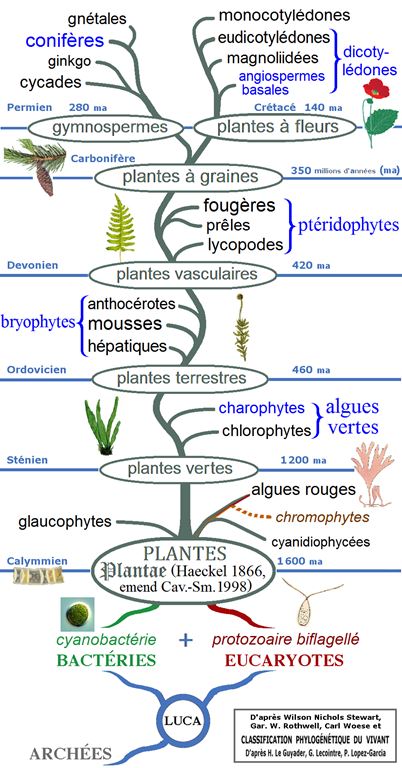
Classification
- Classique : en haut de l'écran, sous le coeur.
- Phylogénétique :
- Clade 4 : Angiospermes ;
- Clade 3 : Dicotylédones_vraies ;
- Clade 2 : Rosidées ;
- Clade 1 : Fabidées ;
- Ordre APN : Fabales ;
- Famille APN : Fabaceae ;
À droite, cet arbre phylogénétique des plantes montre les principaux clades et groupes traditionnels (monophylétiques en noir et paraphylétiques en bleu).
Dénominations
- Nom botanique : Vigna lanceolata Benth.
- Noms anglais et locaux : Bush potato, Pencil yam, Maloga bean
Description et culture
Tableau récapitulatif
Parties comes-tibles Note comest. (1-5) Note medic. (1-5) (Zones de) Rusticité Besoins en 
Besoins en  (1-3)
(1-3)Périodes de semis et récoltes Graines au gramme Durée de viabilité Profon-deur semis Espace-ment plants Espace-ment lignes Durée germi-native Durée avant récolte J F M A M J
J A S O N D
J F M A M J
J A S O N D
- dont infos de 0FPI ("FOOD PLANTS INTERNATIONAL", en anglais) :
Description :
Une plante grimpante. Il y a un tubercule sous le sol à partir duquel les pousses repoussent chaque année. Les tiges peuvent avoir quelques poils. Les feuilles sont composées et alternes. Les tiges des feuilles mesurent 2 à 6 mm de long. Les folioles mesurent 2 à 10 cm de long et 1 à 3 cm de large. Ils peuvent avoir des poils. La nervure médiane sur la face supérieure est souvent de couleur argentée. Les fleurs sont groupées à l'aisselle des feuilles. Les fleurs sont jaunes ou violet pâle. La norme mesure 6 à 10 mm de long. Le fruit est une gousse. Il est vert avec des marbrures sombres. La gousse mesure 2 à 5 cm de long et 3 à 6 mm de large. Il y a 3-8 graines{{{0(+x) (traduction automatique).
Original : A climbing plant. There is a tuber under the ground from which the shoots re-grow each year. The stems can have a few hairs. The leaves are compound and alternate. The leaf stalks are 2-6 mm long. The leaflets are 2-10 cm long and 1-3 cm wide. They can have hairs. The midrib on the upper side is often silver coloured. The flowers are in a group in the axils of leaves. The flowers are yellow or pale purple. The standard is 6-10 mm long. The fruit is a pod. It is green with dark mottles. The pod is 2-5 cm long and 3-6 mm wide. There are 3-8 seeds{{{0(+x).
 Consommation (rapports de comestibilité, parties utilisables et usages alimentaires correspondants)
Consommation (rapports de comestibilité, parties utilisables et usages alimentaires correspondants)Parties comestibles :
racine, gousses{{{0(+x) (traduction automatique). Original : Root, Pods{{{0(+x).Détails :
Le tubercule est pelé, cuit et mangé{{{0(+x) (traduction automatique).
Original : The tuber is peeled, cooked and eaten{{{0(+x).
Partie testée :
racine{{{0(+x) (traduction automatique). Original : Root{{{0(+x)| Taux d'humidité (%) | Énergie (kj) | Énergie (kcal) | Protéines (g) |
|---|---|---|---|
| 0.6 | 295 | 71 | 71 2.3 |
| Pro- vitamines A (µg) |
Vitamines C (mg) | Fer (mg) | Zinc (mg) |
| 0 | 1 | 295 15.4 | 0.6 |
 Risques et précautions à prendre
Risques et précautions à prendrenéant, inconnus ou indéterminés.
Autres infos
dont infos de 0FPI ("FOOD PLANTS INTERNATIONAL", en anglais) :
Distribution :
Une plante tropicale. Il pousse dans les forêts de mousson et les bois. Dans le Queensland tropical, il passe du niveau de la mer à 840 m d'altitude. Il peut pousser dans des endroits arides{{{0(+x) (traduction automatique).
Original : A tropical plant. It grows in monsoon forest and woodland. In tropical Queensland it grows from sea level to 840 m altitude. It can grow in arid places{{{0(+x).
Localisation :
Australie*{{{0(+x) (traduction automatique).
Original : Australia*{{{0(+x).
Notes :
Il existe environ 150 espèces de Vigna. Ils sont principalement sous les tropiques{{{0(+x) (traduction automatique).
Original : There are about 150 Vigna species. They are mostly in the tropics{{{0(+x).
Liens, sources et/ou références
Liens :
/ ;Sources et/ou références :
bibliographie (liste des sources et/ou références de l'encyclopédie)
dont classification : IPNI ("International Plant Names Index", en anglais) ; Kew (POWO - "Plant Of the World Online", "Royal Botanical Garden", en anglais) ;
dont livres et bases de données : 0FPI ("FOOD PLANTS INTERNATIONAL", en anglais) ;
dont bibliographie/références de 0FPI ("FOOD PLANTS INTERNATIONAL", en anglais) :
Bindon, P., 1996, Useful Bush Plants. Western Australian Museum. p 262 ; Cherikoff V. & Isaacs, J., The Bush Food Handbook. How to gather, grow, process and cook Australian Wild Foods. Ti Tree Press, Australia p 191 ; Cooper, W. and Cooper, W., 2004, Fruits of the Australian Tropical Rainforest. Nokomis Editions, Victoria, Australia. p 218 ; Crawford, I. M., 1982, Traditional Aboriginal Plant Resources in the Kalumburu Area: Aspects in Ethno-economics. Records of the Western Australian Museum Supplement No. 15 ; Cribb, A.B. & J.W., 1976, Wild Food in Australia, Fontana. p 144 ; Dunlop, C.R., Leach, G.J. & Cowie, I.D., 1995, Flora of the Darwin Region. Vol 2. Northern Territory Botanical Bulletin No 20. p 113 ; Garde, M., et al, 2003, A Preliminary List of Kundedjnjenghmi Plant Names. Northern Land Council. (Arnhem Land, Australia) ; Green, J., (Ed.), 2003, Anmatyerr Plant Stories. AID Press. p 2 ; Hedrick, U.P., 1919, (Ed.), Sturtevant's edible plants of the world. p 679 ; Hiddins, L., 1999, Explore Wild Australia with the Bush Tucker Man. Penguin Books/ABC Books. p 150 ; Isaacs, J., 1987, Bush Food, Aboriginal Food and Herbal Medicine. Weldons. p 97 ; Jones, D.L. & Gray, B., 1977, Australian Climbing Plants. Reed. p 61 ; Kenneally, K.E., Edinger, D. C., and Willing T., 1996, Broome and Beyond, Plants and People of the Dampier Peninsula, Kimberley, Western Australia. Department of Conservation and Land Management. p 162 ; Kiple, K.F. & Ornelas, K.C., (eds), 2000, The Cambridge World History of Food. CUP p 1808 ; Latz, P.K., 1996, Bushfires and Bushtucker: Aboriginal plant use in Central Australia. IAD Press Alice Springs p 296 ; Latz, P & Wightman, G., 1995, Desert Bush Tucker Identikit. Common Native Food Plants of Central Australia. Parks & Wild Commission Northern territory. p 44 ; Lazarides, M. & Hince, B., 1993, Handbook of Economic Plants of Australia, CSIRO. p 246 ; Levitt, D., 1981, Plants and people. Aboriginal uses of plants on Groote Eylandt. Australian Institute of Aboriginal Studies, Canberra. p 115 (As var. filiformis) ; Lim, T. K., 2015, Edible Medicinal and Non Medicinal Plants. Volume 9, Modified Stems, Roots, Bulbs. Springer p 85 ; Low, T., 1991, Wild Food Plants of Australia. Australian Nature FieldGuide, Angus & Robertson. p 162 ; Low, T., 1992, Bush Tucker. Australiaâ's Wild Food Harvest. Angus & Robertson. p 98, 99 ; T. L. Mitchell, J. exped. trop. Australia 350. 1848 ; Paczkowska, G . & Chapman, A.R., 2000, The Western Australian Flora. A Descriptive Calatogue. Western Australian Herbarium. p 453 ; Macmillan, H.F. (Revised Barlow, H.S., et al) 1991, Tropical Planting and Gardening. Sixth edition. Malayan Nature Society. Kuala Lumpur. p 330 ; RIRDC, 2010, New Root Vegetables for the Native Food Industry, Australian Government RIRDC Publication 9/161 ; Smith, Nicholas et al. 1993, Ngarinyman Ethnobotany: Aboriginal Plant Use from the Victoria River Area Northern Australia. Northern Territory Botanical Bulletin No 16. Parks and Wildlife Commission of the Northern Territory. p 47 ; Vigilante, T., et al, 2013, Island country: Aboriginal connections, values and knowledge of the Western Kimberley islands in the context of an island biological survey. Records of the Western Australian Museum Supplement 81: 145-182 ; Wheeler, J.R.(ed.), 1992, Flora of the Kimberley Region. CALM, Western Australian Herbarium, p 456 ; Wightman, Glenn et al. 1994, Gurindji Ethnobotany: Aboriginal Plant Use from Daguragu Northern Australia. Northern Territory Botanical Bulletin No 18. Parks and Wildlife Commission of the Northern Territory. p 53 ; Wightman, Glenn et al. 1992. Mudburra Ethnobotany: Aboriginal Plant Use from Kulumindini (Elliott) Northern Australia. Northern Territory Botanical Bulletin No 14. Parks and Wildlife Commission of the Northern Territory. p 33. ; Yunupinu Banjgul, Laklak Yunupinu-Marika, et al. 1995, Rirratjinu Ethnobotany: Aboriginal Plant Use from Yirrkala, Arnhem Land, Australia. Northern Territory Botanical Bulletin No 21. Parks and Wildlife Commission of the Northern Territory. p 76.
Recherche de/pour :
- "Vigna lanceolata" sur Google (pages et
images) ;
TPL ("The Plant List", en anglais) ;
GRIN ("Germplasm Resources Information Network", en anglais) ;
TROPICOS (en anglais) ;
Tela Botanica ;
Pl@ntNet ;
Pl@ntUse ;
"Plants For A Future" (en anglais) ;
"Useful Tropical Plants" (en anglais) ou
"Useful Temperate Plants" (en anglais) ;
- "Vigna lanceolata" sur Google (pages et
images) ;
TPL ("The Plant List", en anglais) ;
GRIN ("Germplasm Resources Information Network", en anglais) ;
TROPICOS (en anglais) ;
Tela Botanica ;
Pl@ntNet ;
Pl@ntUse ;
"Plants For A Future" (en anglais) ;
"Useful Tropical Plants" (en anglais) ou
"Useful Temperate Plants" (en anglais) ;
Espèces du même genre (Vigna)
45 taxons
- Haricot azuki
- Haricot mat
- Haricot mungo
- Haricot riz
- Haricot urd
- Kuanga
- Niébé
- Pois bambara
- Pois marron
- Pois poison
- Vigne escargot
- Vigna aconitifolia (Jacq.) Maréchal (Haricot mat)
- Vigna adenantha (G. Mey.) Maréchal et al. (Pois marron)
- Vigna angivensis Baker
- Vigna angularis (Willd.) Ohwi & H.Ohashi (Haricot azuki)
- Vigna antunesii Harms
- Vigna bourneae Gamble
- Vigna bracteata
- Vigna caracalla (L.) Verdc. (Vigne escargot)
- Vigna dalzelliana
- Vigna decipiens Harv.
- Vigna dinteri Harms
- Vigna frutescens A.Rich.
- Vigna gracilis
- Vigna grahamiana
- Vigna heterophylla A.Rich.
- Vigna juncea Milne-Redh.
- Vigna khandalensis
- Vigna kirkii
- Vigna lobatifolia Baker
- Vigna luteola (Jacq.) Benth. (Kuanga)
- Vigna luteola (Jacq.) Benth.
- Vigna macrorhyncha
- Vigna marginata
- Vigna marina
- Vigna membranacea A.Rich.
- Vigna minima
- Vigna monantha Thulin
- Vigna monophylla Taub.
- Vigna mungo (L.) Hepper (Haricot urd)
- Vigna oblongifolia A.Rich.
- Vigna parkeri Baker
- Vigna pilosa Backer ex K.Heyne
- Vigna populnea Piper
- Vigna radiata (L.) R. Wilczek (Haricot mungo)
- Vigna reticulata Hook.f.
- Vigna ricciardiana
- Vigna schimperi Baker
- Vigna stenophylla Harms
- Vigna subterranea (L.) Verdc. (Pois bambara)
- Vigna triloba Walp.
- Vigna trilobata
- Vigna umbellata (Thunb.) Ohwi & H. Ohashi (Haricot riz)
- Vigna unguiculata (L.) Walp. (Niébé)
- Vigna vexillata (L.) A. Rich. (Pois poison)
Espèces de la même famille (Fabaceae)
2019 taxons
- Acacia à bois noir
- Acacia à feuilles de podalyria
- Acacia couteau
- Acacia cyclope
- Acacia de Farnèse
- Acacia des oueds{{{69
- Acacia doré
- Acacia du Soudan
- Acacia élégant (tp*)
- Acacia en forme d'oreillette
- Acacia grimpant (tp*)
- Acacia jaune
- Acacia mangium
- Acacia paradoxal
- Acacia rose
- Acacia Sénégal
- Acacia sophora
- Agathi
- Ajonc d'Europe
- Albizia
- Amorphe buissonnante
- Anthyllide vulnéraire
- Arachide
- Arbre à fleurs d'orchidée
- Arbre a miel
- Arbre à pluie
- Arbre à savon
- Arbre aux orchidées
- Arbre corail
- Arbre de corail
- Arbre de judée
- Arbre orchidée
- Arbre sapucaia
- Astragale
- Astragale à feuilles de Réglisse
- Astragale à hameçon
- Astragale chinoise
- Astragale d'Andalousie
- Astragale faux Sésame
- Baguenaudier
- Bakuchiol
- Baton casse
- Bauhinie pourpre
- Bauhinie tomenteuse
- Bergtee
- Bois de condori
- Bugrane
- Bugrane de Simonkai
- Bugrane épineuse
- Caesalpine des haies
- Abrus cantoniensis Hance
- Abrus fruticulosus Wall. ex Wight & Arn.
- Abrus precatorius L.
- Abrus pulchellus Wall. ex Thwaites
- Acacia abyssinica Hochst. ex Benth.
- Acacia acatlensis Benth.
- Acacia acradenia F.Muell.
- Acacia acuminata Benth.
- Acacia adoxa Pedley
- Acacia adsurgens Maiden & Blakeley
- Acacia aff. Cuthbertsonii Maiden et Blakely
- Acacia albida Delile
- Acacia ammobia Maconochie
- Acacia ampliceps Maslin
- Acacia amythethophylla Steud. ex A. Rich.
- Acacia anaticeps Tindale
- Acacia ancistrocarpa Maiden & Blakely
- Acacia aneura F.Muell. ex Benth. (Mulga)
- Acacia angustissima (Mill.) Kuntze
- Acacia ankokib (Mill.) Kuntze
- Acacia aromo Hook. & Arn.
- Acacia asak (Forssk.) Willd.
- Acacia ataxacantha DC.
- Acacia aulococarpa
- Acacia auriculiformis A. Cunn. ex Benth. (Acacia en forme d'oreillette)
- Acacia baileyana F.Muell. (Mimosa de Bailey)
- Acacia beauverdiana Ewart & Sharman
- Acacia bidwillii Benth.
- Acacia bilimekii J.F.Macbr.
- Acacia bilimekii J.F.Macbr.
- Acacia bivenosa DC.
- Acacia blakelyi Maiden
- Acacia blakelyi Maiden
- Acacia brachystachya Benth.
- Acacia burkei Benth.
- Acacia bussei Harms ex B. Y. Sjostedt
- Acacia caffra (Thunb.) Willd.
- Acacia calamifolia (Thunb.) Willd.
- Acacia calcicola Forde & Ising
- Acacia cambagei R.T. Baker
- Acacia catechu (L. f.) Willd.
- Acacia caven
- Acacia choriophylla Benth.
- Acacia chundra (Rottler) Willd.
- Acacia citrinoviridis Tindale & Maslin
- Acacia cochliacantha Humb. & Bonpl. ex Willd.
- Acacia colei Maslin & M.A.J. Thomson
- Acacia complanata A. Cunn. ex Benth.
- Acacia concinna (Willd.) DC
- Acacia concurrens Pedley
- ...







 donne accès au menu
  - encyclopédies des plantes alimentaires ;
 - page de recherche - reconnaissance (identification) de plantes ;
 - page du calendrier lunaire et son générateur (au format PDF et JPG) ;
 - tableau récapitulatif ;
 - générateur de potées (soupes), avec estimation des apports nutrionnels et du coût;
 - générateur de codes QR ;
 - page des archives avec de nombreux documents sur différents thèmes complémentaires comme la botanique, les légumes,
les champignons, la cuisine, le bien-être ainsi que différents MOOC mais également des liens vers les archives de l'association ;
- page des archives avec de nombreux documents sur différents thèmes complémentaires comme la botanique, les légumes,
les champignons, la cuisine, le bien-être ainsi que différents MOOC mais également des liens vers les archives de l'association ;

 pour le fruit (et/ou les graines, la pulpe, etc...),
 pour les fleurs (et/ou pétales, calice...),
 pour les feuilles (et/ou la tige, les pousses...),
 pour les racines,
 pour le tronc (et/ou l'écorce, la sève...), et enfin
 pour les champignons,
puis les notes alimentaires et médicinales (de 1 à 5 étoiles), la rusticité (résistance au froid/gel)
et pour finir un résumé.
pour les champignons,
puis les notes alimentaires et médicinales (de 1 à 5 étoiles), la rusticité (résistance au froid/gel)
et pour finir un résumé. menant ici 🙂
 ,
,  et
et





 ,
,


 Encyclopédie(s)
 Recherche-Reconnaissance
 Tableau récapitulatif
 Codes QR
 Archives
 Calendrier(s) lunaire(s)
  Potées
 Re-naturation/naturalisation
 Affichettes, herbiers &
co.
Affichettes, herbiers &
co. menu
menu galerie


 (en bas à droite).
 (en bas à gauche).
