Poivre de mer
(Osmundea pinnatifida)


Une algue. C'est une algue rouge. Les frondes sont plates et ramifiées en alternance (traduction automatique)
→suite


Poivre de mer

Une algue. C'est une algue rouge. Les frondes sont plates et ramifiées en alternance (traduction automatique)
Pas d'autre illustration
pour le moment 😕
Osmundea pinnatifida
Classification
- Classique : en haut de l'écran, sous le coeur.
- Phylogénétique : Inconnue
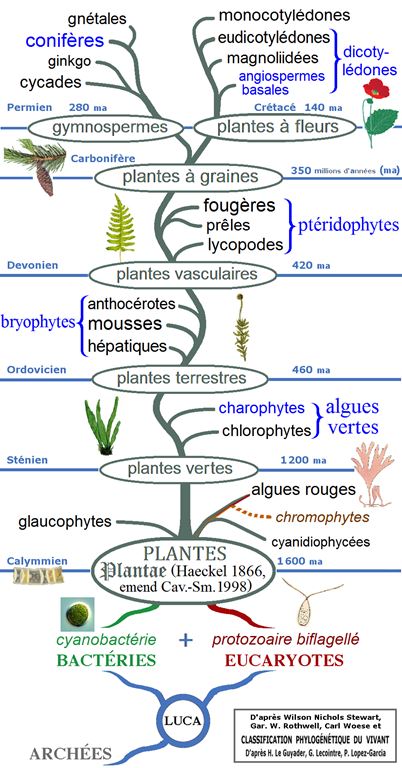
À droite, cet arbre phylogénétique des plantes montre les principaux clades et groupes traditionnels (monophylétiques en noir et paraphylétiques en bleu).
Dénominations
- Nom botanique : Osmundea pinnatifida (Hudson) Stackhouse
- Synonymes français : poivre des mers, dulse poivrée, dulce poivrée, algue poivre
- Synonymes : Laurencia pinnatifida ;
- Noms anglais et locaux : Pepper dulse, Prickly tang
Description et culture
Tableau récapitulatif
Parties comes-tibles Note comest. (1-5) Note medic. (1-5) (Zones de) Rusticité Besoins en 
Besoins en  (1-3)
(1-3)Périodes de semis et récoltes Graines au gramme Durée de viabilité Profon-deur semis Espace-ment plants Espace-ment lignes Durée germi-native Durée avant récolte J F M A M J
J A S O N D
J F M A M J
J A S O N D
- dont infos de 0FPI ("FOOD PLANTS INTERNATIONAL", en anglais) :
 Consommation (rapports de comestibilité, parties utilisables et usages alimentaires correspondants)
Consommation (rapports de comestibilité, parties utilisables et usages alimentaires correspondants)Algue alimentaire. En Irlande, comme la plupart des algues, elles sont beaucoup récoltées et notamment utilisées dans la fabrication de gin ou séchées, comme épice aromatisée au curry{{{wiki.
Partie testée :
algue{{{0(+x) (traduction automatique). Original : Seaweed{{{0(+x)| Taux d'humidité (%) | Énergie (kj) | Énergie (kcal) | Protéines (g) |
|---|---|---|---|
| / | 0 | 0 | 20.8 |
| Pro- vitamines A (µg) |
Vitamines C (mg) | Fer (mg) | Zinc (mg) |
| 0 | 0 | 0 | 0 |
 Risques et précautions à prendre
Risques et précautions à prendrenéant, inconnus ou indéterminés.
Autres infos
dont infos de 0FPI ("FOOD PLANTS INTERNATIONAL", en anglais) :
Distribution :
C'est une plante tempérée{{{0(+x) (traduction automatique).
Original : It is a temperate plant{{{0(+x).
Localisation :
Afrique, Australie, Açores, Brésil, Grande-Bretagne, Bulgarie, Îles Canaries, Chili, Égypte, Europe, Grèce, Irlande, Israël, Italie, Maroc, Afrique du Nord, Amérique du Nord, Pérou, Portugal, Roumanie, Scandinavie, Amérique du Sud, Espagne, Suède, Tunisie, Turquie, USA, Venezuela, Yémen{{{0(+x) (traduction automatique).
Original : Africa, Australia, Azores, Brazil, Britain, Bulgaria, Canary Islands, Chile, Egypt, Europe, Greece, Ireland, Israel, Italy, Morocco, North Africa, North America, Peru, Portugal, Romania, Scandinavia, South America, Spain, Sweden, Tunisia, Turkey, USA, Venezuela, Yemen{{{0(+x).
Liens, sources et/ou références
Liens :
/ ;Sources et/ou références :
bibliographie (liste des sources et/ou références de l'encyclopédie)
dont livres et bases de données : 0FPI ("FOOD PLANTS INTERNATIONAL", en anglais) ;
dont bibliographie/références de 0FPI ("FOOD PLANTS INTERNATIONAL", en anglais) :
Chapman, V.J. and Chapman, D.J., 1980, Seaweeds and their uses. London. (As Laurencia pinnatifida) ; Cherry, P., et al, 2019, Risks and benefits of consuming edible seaweeds. Nutrition ReviewsVR Vol. 77(5):307–329 ; Cribb, A.B. & J.W., 1976, Wild Food in Australia, Fontana. p 196 (As Laurencia pinnatifida) ; Hedrick, U.P., 1919, (Ed.), Sturtevant's edible plants of the world. p 374 (As Laurencia pinnatifida) ; http://www.seavegetables.com (As Laurencia pinnatifida) ; Irving, M., 2009, The Forager Handbook, A Guide to the Edible Plants of Britain. Ebury Press p 371 ; Kiple, K.F. & Ornelas, K.C., (eds), 2000, The Cambridge World History of Food. CUP p 238 (As Laurencia pinnatifida) ; Mabey, R., 1973, Food for Free. A Guide to the edible wild plants of Britain, Collins. p 119 (As Laurencia pinnatifida) ; Marsham, S., et al, 2007, Comparison of nutritive chemistry of a range of temperate seaweeds. Food Chemistry 100: 1331-1336 ; Seidemann J., 2005, World Spice Plants. Economic Usage, Botany, Taxonomy. Springer. p 199 (As Laurencia pinnatifida) ; Zemke-White, W. L. & Ohno, M., 1999, World seaweed utilisation: An end-of-century summary. Journal of Applied Phycology 11: 369-376 (As Laurencia pinnatifida)
Recherche de/pour :
- "Osmundea pinnatifida" sur Google (pages et
images) ;
IPNI ("International Plant Names Index", en anglais) ;
TPL ("The Plant List", en anglais) ;
GRIN ("Germplasm Resources Information Network", en anglais) ;
TROPICOS (en anglais) ;
Tela Botanica ;
Pl@ntNet ;
Pl@ntUse ;
"Plants For A Future" (en anglais) ;
"Useful Tropical Plants" (en anglais) ou
"Useful Temperate Plants" (en anglais) ;
- "Poivre de mer" sur Google (pages, images et recettes) ;
- "Osmundea pinnatifida" sur Google (pages et
images) ;
IPNI ("International Plant Names Index", en anglais) ;
TPL ("The Plant List", en anglais) ;
GRIN ("Germplasm Resources Information Network", en anglais) ;
TROPICOS (en anglais) ;
Tela Botanica ;
Pl@ntNet ;
Pl@ntUse ;
"Plants For A Future" (en anglais) ;
"Useful Tropical Plants" (en anglais) ou
"Useful Temperate Plants" (en anglais) ;
Espèces de la même famille (Rhodomelaceae)
22 taxons
- Acanthophora spicifera (Vahl) Borgesen
- Bostrychia tenella
- Chondria armata
- Chondria capillaris
- Chondria crassicaulis
- Digenea simplex
- Laurencia botryoides
- Laurencia brongniartii
- Laurencia gracilis
- Laurencia intricata
- Laurencia johnstonii
- Laurencia obtusa
- Laurencia okamurae
- Laurencia papillosa
- Laurencia pinnata
- Laurencia seticulosa
- Laurencia tropica
- Laurencia undulata
- Odonthalia dentata
- Rhodomela confervoides
- Vertebrata lanosa







 donne accès au menu
  - encyclopédies des plantes alimentaires ;
 - page de recherche - reconnaissance (identification) de plantes ;
 - page du calendrier lunaire et son générateur (au format PDF et JPG) ;
 - tableau récapitulatif ;
 - générateur de potées (soupes), avec estimation des apports nutrionnels et du coût;
 - générateur de codes QR ;
 - page des archives avec de nombreux documents sur différents thèmes complémentaires comme la botanique, les légumes,
les champignons, la cuisine, le bien-être ainsi que différents MOOC mais également des liens vers les archives de l'association ;
- page des archives avec de nombreux documents sur différents thèmes complémentaires comme la botanique, les légumes,
les champignons, la cuisine, le bien-être ainsi que différents MOOC mais également des liens vers les archives de l'association ;

 pour le fruit (et/ou les graines, la pulpe, etc...),
 pour les fleurs (et/ou pétales, calice...),
 pour les feuilles (et/ou la tige, les pousses...),
 pour les racines,
 pour le tronc (et/ou l'écorce, la sève...), et enfin
 pour les champignons,
puis les notes alimentaires et médicinales (de 1 à 5 étoiles), la rusticité (résistance au froid/gel)
et pour finir un résumé.
pour les champignons,
puis les notes alimentaires et médicinales (de 1 à 5 étoiles), la rusticité (résistance au froid/gel)
et pour finir un résumé. menant ici 🙂
 ,
,  et
et





 ,
,


 Encyclopédie(s)
 Recherche-Reconnaissance
 Tableau récapitulatif
 Codes QR
 Archives
 Calendrier(s) lunaire(s)
  Potées
 Re-naturation/naturalisation
 Affichettes, herbiers &
co.
Affichettes, herbiers &
co. menu
menu galerie


 (en bas à droite).
 (en bas à gauche).
