Icacina mannii
Pas d'illustration
pour le moment 😕

Un arbuste qui se trouve sur ou est un grimpeur. Il atteint 6 m de haut. Il a une grosse racine tubéreuse (traduction automatique)
→suite


Icacina mannii

Un arbuste qui se trouve sur ou est un grimpeur. Il atteint 6 m de haut. Il a une grosse racine tubéreuse (traduction automatique)
Pas d'illustration
pour le moment 😕
Pas d'illustration
pour le moment 😕
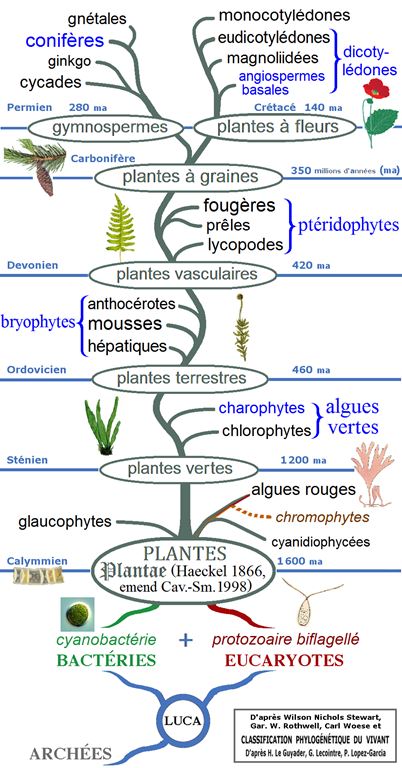
Classification
- Classique : en haut de l'écran, sous le coeur.
- Phylogénétique :
- Ordre APN : n/a ;
- Famille APN : Icacinaceae ;
À droite, cet arbre phylogénétique des plantes montre les principaux clades et groupes traditionnels (monophylétiques en noir et paraphylétiques en bleu).
Dénominations
- Nom botanique : Icacina mannii Oliv.
- Noms anglais et locaux : Akin, Banje, Buntumatuge, Mutuo, Ututo ogiri
Description et culture
Tableau récapitulatif
Parties comes-tibles Note comest. (1-5) Note medic. (1-5) (Zones de) Rusticité Besoins en 
Besoins en  (1-3)
(1-3)Périodes de semis et récoltes Graines au gramme Durée de viabilité Profon-deur semis Espace-ment plants Espace-ment lignes Durée germi-native Durée avant récolte J F M A M J
J A S O N D
J F M A M J
J A S O N D
- dont infos de 0FPI ("FOOD PLANTS INTERNATIONAL", en anglais) :
 Consommation (rapports de comestibilité, parties utilisables et usages alimentaires correspondants)
Consommation (rapports de comestibilité, parties utilisables et usages alimentaires correspondants)Parties comestibles :
racines - amidon, tubercules{{{0(+x) (traduction automatique). Original : Roots - starch, Tubers{{{0(+x).Détails :
L'amidon de racine est probablement plus un médicament. Attention: Il contient du cyanure, des oxalates et des phytates{{{0(+x) (traduction automatique).
Original : The root starch is probably more as a medicine. Caution: It contains cyanide, oxalates and phytates{{{0(+x).
Partie testée :
/ Risques et précautions à prendre
Risques et précautions à prendrenéant, inconnus ou indéterminés.
Autres infos
dont infos de 0FPI ("FOOD PLANTS INTERNATIONAL", en anglais) :
Distribution :
C'est une plante tropicale{{{0(+x) (traduction automatique).
Original : It is a tropical plant{{{0(+x).
Localisation :
Afrique, Angola, Afrique centrale, RD Congo, Côte d'Ivoire, Gabon, Ghana, Côte d'Ivoire, Nigéria, Sierra Leone, Afrique de l'Ouest{{{0(+x) (traduction automatique).
Original : Africa, Angola, Central Africa, Congo DR, Côte d'Ivoire, Gabon, Ghana, Ivory Coast, Nigeria, Sierra Leone, West Africa{{{0(+x).
Liens, sources et/ou références
Liens :
/ ;Sources et/ou références :
bibliographie (liste des sources et/ou références de l'encyclopédie)
dont classification : IPNI ("International Plant Names Index", en anglais) ; Kew (POWO - "Plant Of the World Online", "Royal Botanical Garden", en anglais) ;
dont livres et bases de données : 0FPI ("FOOD PLANTS INTERNATIONAL", en anglais) ;
dont bibliographie/références de 0FPI ("FOOD PLANTS INTERNATIONAL", en anglais) :
Antai, S. J. & Obong, U. S., 1992, The effect of fermenatation on the nutrient status and on some toxic components of Icacinia manni . Plant Foods for Human Nutrition. 42:219-224 ; Lim, T. K., 2015, Edible Medicinal and Non Medicinal Plants. Volume 9, Modified Stems, Roots, Bulbs. Springer p 47
Recherche de/pour :
- "Icacina mannii" sur Google (pages et
images) ;
TPL ("The Plant List", en anglais) ;
GRIN ("Germplasm Resources Information Network", en anglais) ;
TROPICOS (en anglais) ;
Tela Botanica ;
Pl@ntNet ;
Pl@ntUse ;
"Plants For A Future" (en anglais) ;
"Useful Tropical Plants" (en anglais) ou
"Useful Temperate Plants" (en anglais) ;
- "Icacina mannii" sur Google (pages et
images) ;
TPL ("The Plant List", en anglais) ;
GRIN ("Germplasm Resources Information Network", en anglais) ;
TROPICOS (en anglais) ;
Tela Botanica ;
Pl@ntNet ;
Pl@ntUse ;
"Plants For A Future" (en anglais) ;
"Useful Tropical Plants" (en anglais) ou
"Useful Temperate Plants" (en anglais) ;
Espèces du même genre (Icacina)
4 taxons
Espèces de la même famille (Icacinaceae)
43 taxons
- Alsodeiopsis rowlandii Engl.
- Alsodeiopsis schumannii (Engl.) Engl.
- Alsodeiopsis staudtii Engl.
- Alsodeiopsis zenkeri Engl.
- Apodytes dimidiata E.Mey. ex Arn. (Apodyte dimidié)
- Calatola costaricensis Standl.
- Calatola laevigata Standl.
- Calatola mollis Standl.
- Casimirella ampla (Miers) R.A.Howard
- Casimirella rupestris (Ducke) R.A.Howard
- Cassinopsis ilicifolia (Hochst.) Sleumer
- Emmotum acuminata
- Emmotum fagifolium Desv.
- Emmotum nitens (Benth.) Miers
- Icacina guessfeldtii Asch. ex Engl.
- Icacina oliviformis (Poir.) J.Raynal
- Icacina trichantha Oliv.
- Iodes sequinii
- Lavigeria macrocarpa (Oliv.) Pierre
- Mappianthus iodoides Hand.-Mazz.
- Medusanthera laxiflora (Miers) R.A.Howard
- Merrilodendrum megacarpum
- Natsiatum herpeticum Buch.-Ham. ex Arn.
- Oecopetalum mexicanum Greenm. & C.H.Thomps.
- Pennantia corymbosa Endl.
- Phytocrene gigantea Wall.
- Phytocrene oblonga Wall.
- Phytocrene palmata Wall.
- Pittosporopsis kerrii Craib
- Polyporandra scandens Becc.
- Poraqueiba guianensis Aubl.
- Poraqueiba paraensis Ducke
- Poraqueiba sericea Tul.
- Pyrenacantha kaurabassana Baill.
- Pyrenacantha scandens Planch. ex Harv.
- Pyrenacantha spp.
- Rhaphiostylis beninensis (Hook.f. ex Planch.) Planch. ex Benth.
- Rhyticaryum elegans
- Rhyticaryum longifolium
- Rhyticaryum oleraceum
- Sarcostigma kleinii Wight & Arn.
- Stemonurus scorpioides Becc.







 donne accès au menu
  - encyclopédies des plantes alimentaires ;
 - page de recherche - reconnaissance (identification) de plantes ;
 - page du calendrier lunaire et son générateur (au format PDF et JPG) ;
 - tableau récapitulatif ;
 - générateur de potées (soupes), avec estimation des apports nutrionnels et du coût;
 - générateur de codes QR ;
 - page des archives avec de nombreux documents sur différents thèmes complémentaires comme la botanique, les légumes,
les champignons, la cuisine, le bien-être ainsi que différents MOOC mais également des liens vers les archives de l'association ;
- page des archives avec de nombreux documents sur différents thèmes complémentaires comme la botanique, les légumes,
les champignons, la cuisine, le bien-être ainsi que différents MOOC mais également des liens vers les archives de l'association ;

 pour le fruit (et/ou les graines, la pulpe, etc...),
 pour les fleurs (et/ou pétales, calice...),
 pour les feuilles (et/ou la tige, les pousses...),
 pour les racines,
 pour le tronc (et/ou l'écorce, la sève...), et enfin
 pour les champignons,
puis les notes alimentaires et médicinales (de 1 à 5 étoiles), la rusticité (résistance au froid/gel)
et pour finir un résumé.
pour les champignons,
puis les notes alimentaires et médicinales (de 1 à 5 étoiles), la rusticité (résistance au froid/gel)
et pour finir un résumé. menant ici 🙂
 ,
,  et
et





 ,
,


 Encyclopédie(s)
 Recherche-Reconnaissance
 Tableau récapitulatif
 Codes QR
 Archives
 Calendrier(s) lunaire(s)
  Potées
 Re-naturation/naturalisation
 Affichettes, herbiers &
co.
Affichettes, herbiers &
co. menu
menu galerie


 (en bas à droite).
 (en bas à gauche).
