


Chenopodium 


Pas de description pour le moment 😕
Pas d'illustration
pour le moment 😕
Pas d'illustration
pour le moment 😕
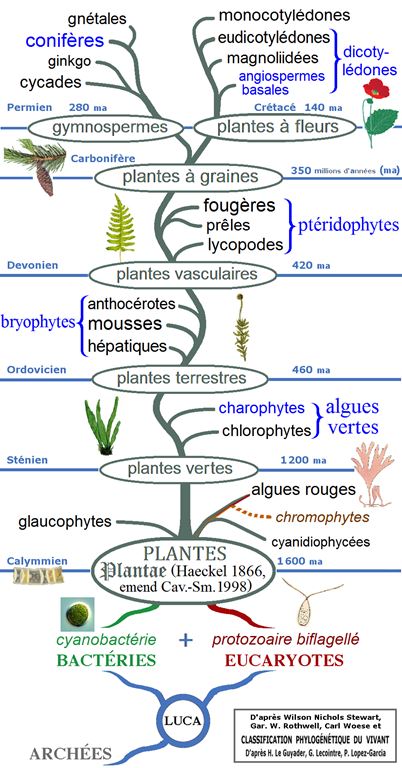
Classification
- Classique : en haut de l'écran, sous le coeur.
- Phylogénétique :
- Clade 4 : Angiospermes ;
- Clade 3 : Dicotylédones_vraies ;
- Ordre APN : Caryophyllales ;
- Famille APN : Amaranthaceae ;
À droite, cet arbre phylogénétique des plantes montre les principaux clades et groupes traditionnels (monophylétiques en noir et paraphylétiques en bleu).
 Consommation (rapports de comestibilité, parties utilisables et usages alimentaires correspondants)
Consommation (rapports de comestibilité, parties utilisables et usages alimentaires correspondants)Grainesµ1, feuille (jeunes et/ou tendres pousses et tiges)1 et fleur1 (jeunes inflorescences (dont bourgeons))1 comestibles.(1*)
Détails :
Feuilles (jeunes et/ou tendres pousses) cuites (ex. : comme potherbe, substitut d'épinard){{{(dp*).
Partie testée :
/ Risques et précautions à prendre
Risques et précautions à prendre(1*)ATTENTION : présence de saponines et d'acide oxalique, pouvant être toxiques à fortes doses : voir fiches toxines, pour plus d'infos{{{(dp*).
Liens, sources et/ou références
Liens :
/ ;Sources et/ou références :
bibliographie (liste des sources et/ou références de l'encyclopédie)
dont livres et bases de données : 1Plantes sauvages comestibles (livre pages 126 à 128, par S.G. Fleischhauer, J. Guthmann et R. Spiegelberger) ; 1Plantes sauvages comestibles (de S.G. Fleischhauer, J. Guthmann et R. Spiegelberger, éditions Ulmer, 2012) / détails du livre
Recherche de/pour :
- "Chenopodium" sur Google (pages et
images) ;
IPNI ("International Plant Names Index", en anglais) ;
TPL ("The Plant List", en anglais) ;
GRIN ("Germplasm Resources Information Network", en anglais) ;
TROPICOS (en anglais) ;
Tela Botanica ;
Pl@ntNet ;
Pl@ntUse ;
"Plants For A Future" (en anglais) ;
"Useful Tropical Plants" (en anglais) ou
"Useful Temperate Plants" (en anglais) ;
- "Chenopodium" sur Google (pages et
images) ;
IPNI ("International Plant Names Index", en anglais) ;
TPL ("The Plant List", en anglais) ;
GRIN ("Germplasm Resources Information Network", en anglais) ;
TROPICOS (en anglais) ;
Tela Botanica ;
Pl@ntNet ;
Pl@ntUse ;
"Plants For A Future" (en anglais) ;
"Useful Tropical Plants" (en anglais) ou
"Useful Temperate Plants" (en anglais) ;
Espèces de ce genre (Chenopodium)
50 taxons
- Ansérine des villages
- Ansérine hybride
- Canihua
- Chénopode
- Chénopode à feuilles d'obier
- Chénopode à graines nombreuses
- Chénopode blanc
- Chénopode bon Henri
- Chénopode bouc
- Chénopode de Berlandier
- Chénopode de Suède
- Chénopode des murs
- Chénopode fétide
- Chénopode glauque
- Chénopode rouge
- Chénopode tardif
- Épinard arbre
- Épinard d'Australie
- Épinard fraise
- Épinard-fraise
- Huauzontle
- Quinoa
- Chenopodium acuminatum Schur
- Chenopodium album L. (Chénopode blanc)
- Chenopodium auricomum Lindl. (Épinard d'Australie)
- Chenopodium berlandieri Moq. (Chénopode de Berlandier)
- Chenopodium bonus-henricus L. (Chénopode bon Henri)
- Chenopodium botrys L.
- Chenopodium bryoniifolium Bunge
- Chenopodium bushianum Aellen
- Chenopodium californicum
- Chenopodium canihua O.F.Cook
- Chenopodium capitatum (L.) Asch. (Épinard fraise)
- Chenopodium carnosulum Moq.
- Chenopodium chenopodioides
- Chenopodium cornutum
- Chenopodium cristatum
- Chenopodium erosum R.Br.
- Chenopodium ficifolium Sm. (Chénopode tardif)
- Chenopodium foliosum (Moench) Asch. (Épinard-fraise)
- Chenopodium formosanum Koidz.
- Chenopodium fremontii S.Watson
- Chenopodium giganteum D.Don (Épinard arbre)
- Chenopodium glaucum L. (Chénopode glauque)
- Chenopodium graveolens Lag. & Rodr.
- Chenopodium hircinum Schrad. (Chénopode bouc)
- Chenopodium hybridum L. (Ansérine hybride)
- Chenopodium incanum
- Chenopodium incisum Poir.
- Chenopodium leptophyllum (Chénopode)
- Chenopodium murale L. (Chénopode des murs)
- Chenopodium nitrariaceum (Chénopode)
- Chenopodium nuttalliae Saff. (Huauzontle)
- Chenopodium oahense
- Chenopodium opulifolium Schrad. ex W.D.J.Koch & Ziz (Chénopode à feuilles d'obier)
- Chenopodium overi Aellen
- Chenopodium pallidicaule Aellen (Canihua)
- Chenopodium petiolare M.Martens & Galeotti
- Chenopodium polyspermum L. (Chénopode à graines nombreuses)
- Chenopodium pratericola Rydb. (Chénopode)
- Chenopodium quinoa Willd. (Quinoa)
- Chenopodium rubrum L. (Chénopode rouge)
- Chenopodium schraderianum Schult.
- Chenopodium serotinum L.
- Chenopodium simplex
- Chenopodium sosnowskyi Kapeller
- Chenopodium stenophyllum
- Chenopodium suecicum Murr (Chénopode de Suède)
- Chenopodium urbicum L. (Ansérine des villages)
- Chenopodium virgatum Thunb.
- Chenopodium viride L.
- Chenopodium vulvaria L. (Chénopode fétide)
Genres de la même famille (Amaranthaceae)
358 taxons
- Achyranthes
- Acroglochin
- Aerva
- Agriophyllum
- Allenrolfea
- Allmania
- Alternanthera
- Amaranthus
- Anabasis
- Arthrocnemum
- Atriplex
- Axyris
- Bassia
- Beta
- Blutaparon
- Bosea
- Brayulinia
- Calicorema
- Camphorosma
- Caroxylon
- Celosia
- Centemopsis
- Centrostachys
- Chamissoa
- Corispermum
- Cornulaca
- Cyathula
- Cycloloma
- Deeringia
- Digera
- Dondia
- Dysphania
- Einadia
- Enchylaena
- Forma
- Gomphrena
- Guilleminea
- Halimione
- Halogeton
- Halosarcia
- Haloxylon
- Hammada
- Hermbstaedtia
- Heterostachys
- Holmbergia
- Iresine
- Maireana
- Monolepis
- Noaea
- Nothosaerva
- ...







 donne accès au menu
  - encyclopédies des plantes alimentaires ;
 - page de recherche - reconnaissance (identification) de plantes ;
 - page du calendrier lunaire et son générateur (au format PDF et JPG) ;
 - tableau récapitulatif ;
 - générateur de potées (soupes), avec estimation des apports nutrionnels et du coût;
 - générateur de codes QR ;
 - page des archives avec de nombreux documents sur différents thèmes complémentaires comme la botanique, les légumes,
les champignons, la cuisine, le bien-être ainsi que différents MOOC mais également des liens vers les archives de l'association ;
- page des archives avec de nombreux documents sur différents thèmes complémentaires comme la botanique, les légumes,
les champignons, la cuisine, le bien-être ainsi que différents MOOC mais également des liens vers les archives de l'association ;

 pour le fruit (et/ou les graines, la pulpe, etc...),
 pour les fleurs (et/ou pétales, calice...),
 pour les feuilles (et/ou la tige, les pousses...),
 pour les racines,
 pour le tronc (et/ou l'écorce, la sève...), et enfin
 pour les champignons,
puis les notes alimentaires et médicinales (de 1 à 5 étoiles), la rusticité (résistance au froid/gel)
et pour finir un résumé.
pour les champignons,
puis les notes alimentaires et médicinales (de 1 à 5 étoiles), la rusticité (résistance au froid/gel)
et pour finir un résumé. menant ici 🙂
 ,
,  et
et





 ,
,


 Encyclopédie(s)
 Recherche-Reconnaissance
 Tableau récapitulatif
 Codes QR
 Archives
 Calendrier(s) lunaire(s)
  Potées
 Re-naturation/naturalisation
 Affichettes, herbiers &
co.
Affichettes, herbiers &
co. menu
menu galerie


 (en bas à droite).
 (en bas à gauche).
