Amyema linophylla
Pas d'illustration
pour le moment 😕

Un arbuste qui pousse attaché aux arbres. Il vit en partie des tiges. Il pousse sur les plantes Casuarina. Les fleurs sont rouges et roses (traduction automatique)
→suite


Amyema linophylla

Un arbuste qui pousse attaché aux arbres. Il vit en partie des tiges. Il pousse sur les plantes Casuarina. Les fleurs sont rouges et roses (traduction automatique)
Pas d'illustration
pour le moment 😕
Pas d'illustration
pour le moment 😕
Classification
- Classique : en haut de l'écran, sous le coeur.
- Phylogénétique :
- Clade 4 : Angiospermes ;
- Clade 3 : Dicotylédones_vraies ;
- Ordre APN : Santalales ;
- Famille APN : Loranthaceae ;
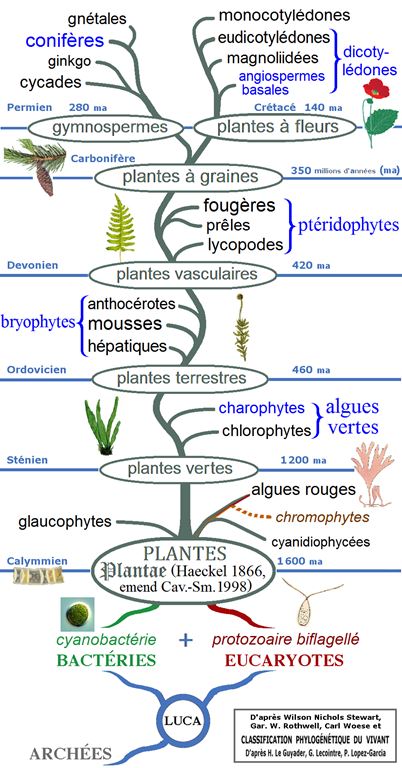
À droite, cet arbre phylogénétique des plantes montre les principaux clades et groupes traditionnels (monophylétiques en noir et paraphylétiques en bleu).
Dénominations
- Nom botanique : Amyema linophylla (Fenzl) Tieghem
- Synonymes : Dendrophthoe linophylla (Fenzl) Steud, Loranthus linophyllus Fenzl
- Noms anglais et locaux : Mistletoe
Description et culture
Tableau récapitulatif
Parties comes-tibles Note comest. (1-5) Note medic. (1-5) (Zones de) Rusticité Besoins en 
Besoins en  (1-3)
(1-3)Périodes de semis et récoltes Graines au gramme Durée de viabilité Profon-deur semis Espace-ment plants Espace-ment lignes Durée germi-native Durée avant récolte J F M A M J
J A S O N D
J F M A M J
J A S O N D
- dont infos de 0FPI ("FOOD PLANTS INTERNATIONAL", en anglais) :
Description :
Un arbuste qui pousse attaché aux arbres. Il vit en partie des tiges. Il pousse sur les plantes Casuarina. Les fleurs sont rouges et roses{{{0(+x) (traduction automatique).
Original : A shrub that grows attached to trees. It partly lives from the stems. It grows on Casuarina plants. The flowers are red and pink{{{0(+x).
 Consommation (rapports de comestibilité, parties utilisables et usages alimentaires correspondants)
Consommation (rapports de comestibilité, parties utilisables et usages alimentaires correspondants)Parties comestibles :
fruit{{{0(+x) (traduction automatique). Original : Fruit{{{0(+x).Partie testée :
/ Risques et précautions à prendre
Risques et précautions à prendrenéant, inconnus ou indéterminés.
Autres infos
dont infos de 0FPI ("FOOD PLANTS INTERNATIONAL", en anglais) :
Distribution :
Il pousse dans les endroits subtropicaux et tempérés{{{0(+x) (traduction automatique).
Original : It grows in subtropical and temperate places{{{0(+x).
Localisation :
Australie*{{{0(+x) (traduction automatique).
Original : Australia*{{{0(+x).
Notes :
Il existe environ 90 à 100 espèces d'Amyema{{{0(+x) (traduction automatique).
Original : There are about 90-100 Amyema species{{{0(+x).
Liens, sources et/ou références
Liens :
/ ;Sources et/ou références :
bibliographie (liste des sources et/ou références de l'encyclopédie)
dont livres et bases de données : 0FPI ("FOOD PLANTS INTERNATIONAL", en anglais) ;
dont bibliographie/références de 0FPI ("FOOD PLANTS INTERNATIONAL", en anglais) :
Lazarides, M. & Hince, B., 1993, Handbook of Economic Plants of Australia, CSIRO. p 19 ; Paczkowska, G. & Chapman, A.R., 2000, The Western Australian Flora. A Descriptive Catalogue. Western Australian Herbarium. p 284 ; Steenbeeke, Greg as part of the Plants Directory project. List of plant species from northern NSW that may be used as food plants p 6 (As subsp. orientale)
Recherche de/pour :
- "Amyema linophylla" sur Google (pages et
images) ;
IPNI ("International Plant Names Index", en anglais) ;
TPL ("The Plant List", en anglais) ;
GRIN ("Germplasm Resources Information Network", en anglais) ;
TROPICOS (en anglais) ;
Tela Botanica ;
Pl@ntNet ;
Pl@ntUse ;
"Plants For A Future" (en anglais) ;
"Useful Tropical Plants" (en anglais) ou
"Useful Temperate Plants" (en anglais) ;
- "Amyema linophylla" sur Google (pages et
images) ;
IPNI ("International Plant Names Index", en anglais) ;
TPL ("The Plant List", en anglais) ;
GRIN ("Germplasm Resources Information Network", en anglais) ;
TROPICOS (en anglais) ;
Tela Botanica ;
Pl@ntNet ;
Pl@ntUse ;
"Plants For A Future" (en anglais) ;
"Useful Tropical Plants" (en anglais) ou
"Useful Temperate Plants" (en anglais) ;
Espèces du même genre (Amyema)
17 taxons
Espèces de la même famille (Loranthaceae)
68 taxons
- Actinanthella menyharthii
- Amyema bifurcata
- Amyema cambagei
- Amyema congener
- Amyema fitzgeraldii
- Amyema gaudichaudii
- Amyema gibberula
- Amyema lucasii
- Amyema maidenii
- Amyema miquelii
- Amyema miraculosa
- Amyema pendula
- Amyema pendulum
- Amyema preissii
- Amyema quandang
- Amyema sanguinea
- Amyema thalassia Barlow
- Bakerella sp.
- Decaisnina signata
- Dendrophthoe acacioides
- Dendrophthoe falcata
- Dendrophthoe glabrescens
- Dendrophthoe pentandra
- Erianthemum dregei
- Globimetula braunii
- Helixanthera ligustrina
- Helixanthera parasitica Lour.
- Ileostylis micranthus
- Korthalsella salicornioides (A.Cunn.) Tiegh.
- Ligaria cuneifolia
- Loranthus discolor Schinz
- Loranthus exocarpi Behr
- Loranthus odoratus Wall.
- Loranthus philippensis Cham. & Schltdl.
- Loranthus sp.
- Lysiana casuarinae
- Lysiana exocarpi Tiegh.
- Lysiana murrayi
- Lysiana spathulata
- Lysiana subfalcata
- Muellerina eucalyptoides
- Nuytsia floribunda
- Phragmanthera kamerunensis
- Phthirusa pyrifolia
- Plicosepalus acaciae
- Plicosepalus kalachariensis
- Psittacanthus schiedeanus
- Scurrula atropurpurea
- Scurrula cordifolia
- Scurrula elata
- ...







 donne accès au menu
  - encyclopédies des plantes alimentaires ;
 - page de recherche - reconnaissance (identification) de plantes ;
 - page du calendrier lunaire et son générateur (au format PDF et JPG) ;
 - tableau récapitulatif ;
 - générateur de potées (soupes), avec estimation des apports nutrionnels et du coût;
 - générateur de codes QR ;
 - page des archives avec de nombreux documents sur différents thèmes complémentaires comme la botanique, les légumes,
les champignons, la cuisine, le bien-être ainsi que différents MOOC mais également des liens vers les archives de l'association ;
- page des archives avec de nombreux documents sur différents thèmes complémentaires comme la botanique, les légumes,
les champignons, la cuisine, le bien-être ainsi que différents MOOC mais également des liens vers les archives de l'association ;

 pour le fruit (et/ou les graines, la pulpe, etc...),
 pour les fleurs (et/ou pétales, calice...),
 pour les feuilles (et/ou la tige, les pousses...),
 pour les racines,
 pour le tronc (et/ou l'écorce, la sève...), et enfin
 pour les champignons,
puis les notes alimentaires et médicinales (de 1 à 5 étoiles), la rusticité (résistance au froid/gel)
et pour finir un résumé.
pour les champignons,
puis les notes alimentaires et médicinales (de 1 à 5 étoiles), la rusticité (résistance au froid/gel)
et pour finir un résumé. menant ici 🙂
 ,
,  et
et





 ,
,


 Encyclopédie(s)
 Recherche-Reconnaissance
 Tableau récapitulatif
 Codes QR
 Archives
 Calendrier(s) lunaire(s)
  Potées
 Re-naturation/naturalisation
 Affichettes, herbiers &
co.
Affichettes, herbiers &
co. menu
menu galerie


 (en bas à droite).
 (en bas à gauche).
