Hypnea spinella
Pas d'illustration
pour le moment 😕

Une algue. Il forme des touffes atteignant 30 cm de long. Ils peuvent être attachés à des roches en plusieurs points. Les branches principales ont une épine mince comme de ... (traduction automatique)
→suite


Hypnea spinella

Une algue. Il forme des touffes atteignant 30 cm de long. Ils peuvent être attachés à des roches en plusieurs points. Les branches principales ont une épine mince comme de petites branches. Les plantes... (traduction automatique) →suite
Pas d'illustration
pour le moment 😕
Pas d'illustration
pour le moment 😕
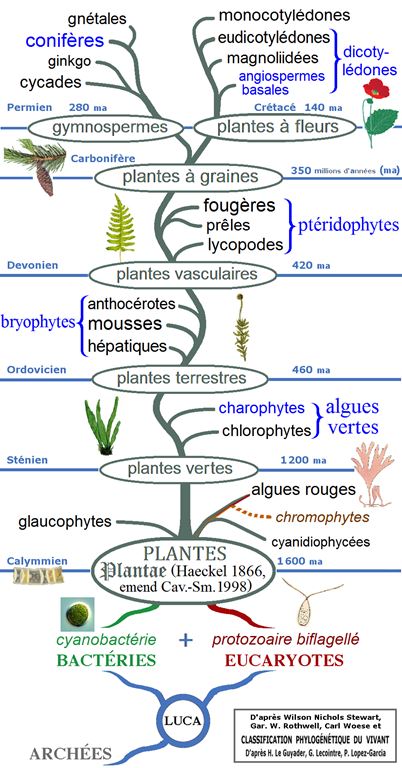
Classification
- Classique : en haut de l'écran, sous le coeur.
- Phylogénétique : Inconnue
À droite, cet arbre phylogénétique des plantes montre les principaux clades et groupes traditionnels (monophylétiques en noir et paraphylétiques en bleu).
Dénominations
- Nom botanique : Hypnea spinella (J. Agardh) Kutzing
- Synonymes : Hypnea cervicornis J. Agardh
- Noms anglais et locaux : Boeloeng, Sa ts'ai
Description et culture
Tableau récapitulatif
Parties comes-tibles Note comest. (1-5) Note medic. (1-5) (Zones de) Rusticité Besoins en 
Besoins en  (1-3)
(1-3)Périodes de semis et récoltes Graines au gramme Durée de viabilité Profon-deur semis Espace-ment plants Espace-ment lignes Durée germi-native Durée avant récolte J F M A M J
J A S O N D
J F M A M J
J A S O N D
- dont infos de 0FPI ("FOOD PLANTS INTERNATIONAL", en anglais) :
Description :
Une algue. Il forme des touffes atteignant 30 cm de long. Ils peuvent être attachés à des roches en plusieurs points. Les branches principales ont une épine mince comme de petites branches. Les plantes peuvent être jaunes, roses ou violet terne{{{0(+x) (traduction automatique).
Original : A seaweed. It forms clumps up to 30 cm long. They can be attached to rocks at several points. The main branches have slender spine like small branches. Plants can be yellow, pink or dull purple{{{0(+x).
 Consommation (rapports de comestibilité, parties utilisables et usages alimentaires correspondants)
Consommation (rapports de comestibilité, parties utilisables et usages alimentaires correspondants)Parties comestibles :
algues, fronde, algues{{{0(+x) (traduction automatique). Original : Algae, Frond, Seaweed{{{0(+x).Partie testée :
/ Risques et précautions à prendre
Risques et précautions à prendrenéant, inconnus ou indéterminés.
Autres infos
dont infos de 0FPI ("FOOD PLANTS INTERNATIONAL", en anglais) :
Distribution :
Il pousse dans des endroits chauds et tropicaux. Il pousse dans les zones intertidales inférieures. Il se trouve sur des rives abritées ou légèrement exposées{{{0(+x) (traduction automatique).
Original : It grows in warm and tropical places. It grows in the lower intertidal zones. It is on sheltered or slightly exposed shores{{{0(+x).
Localisation :
Afrique, Asie, Australie, Barbade, Belize, Bermudes, Brésil, Îles Canaries, Cap-Vert, Afrique centrale, Amérique centrale, Chine, Colombie, Cuba, Équateur, Europe, Gabon, Gambie, Ghana, Grèce, Hawaï, Hispaniola, Indochine, Iran, Italie, Jamaïque, Japon, Corée, Libéria, Amérique du Nord, Pacifique, Panama, Papouasie-Nouvelle-Guinée, PNG, Philippines, Sao Tomé-et-Principe, Sierra Leone, Îles Salomon, Amérique du Sud, Espagne, Taïwan, Trinidad, États-Unis, Venezuela , Vietnam, Iles Vierges, Afrique de l'Ouest{{{0(+x) (traduction automatique).
Original : Africa, Asia, Australia, Barbados, Belize, Bermuda, Brazil, Canary Islands, Cape Verde, Central Africa, Central America, China, Colombia, Cuba, Ecuador, Europe, Gabon, Gambia, Ghana, Greece, Hawaii, Hispaniola, Indochina, Iran, Italy, Jamaica, Japan, Korea, Liberia, North America, Pacific, Panama, Papua New Guinea, PNG, Philippines, Sao Tome and Principe, Sierra Leone, Solomon Islands, South America, Spain, Taiwan, Trinidad, USA, Venezuela, Vietnam, Virgin Islands, West Africa{{{0(+x).
Liens, sources et/ou références
Liens :
/ ;Sources et/ou références :
bibliographie (liste des sources et/ou références de l'encyclopédie)
dont livres et bases de données : 0FPI ("FOOD PLANTS INTERNATIONAL", en anglais) ;
dont bibliographie/références de 0FPI ("FOOD PLANTS INTERNATIONAL", en anglais) :
Cribb, A.B., 1996, Seaweeds of Queensland A Naturalist's Guide. The Queensland Naturalists' Club Handbook No. 2. p 95 (As Hypnea cervicornis) ; Kiple, K.F. & Ornelas, K.C., (eds), 2000, The Cambridge World History of Food. CUP p 237 (As Hypnea cervicornis) ; Millar, A. J., et al, 1999, Annotated and Illustrated Survey of the Marine Macroalgae from Motupore Island and Vicinity (Port Moresby area, Papua New Guinea). 111. Rhodophyta. Australian Systematic Botany 12, 549-591 (As Hypnea spinella) ; Tseng, C.K., 1935, Economic seaweeds of Kwangtung Province, S.China. Lingnan Science Journal 14:93-104 (As Hypnea cervicornis) ; Wang, Wei-Lung and Chiang, Young-Meng, 1994, Potential Economic Seaweeds of Hengchun Peninsula, Taiwan, Economic Botany, Vol. 48, No. 2, pp. 182-189 (As Hypnea cervicornis) ; Womersley, H.B. S. & Bailey, A., 1970, Marine algae of the Solomon Islands. Philosophical Transactions of the Royal Society of London. B. Biological Sciences 259:257-352 (As Hypnea cervicornis) ; Xia, B., and Abbott, I.A., 1987, Edible seaweeds of China and their place in the Chinese diet. Economic Botany 41:341-53 (As Hypnea cervicornis)
Recherche de/pour :
- "Hypnea spinella" sur Google (pages et
images) ;
IPNI ("International Plant Names Index", en anglais) ;
TPL ("The Plant List", en anglais) ;
GRIN ("Germplasm Resources Information Network", en anglais) ;
TROPICOS (en anglais) ;
Tela Botanica ;
Pl@ntNet ;
Pl@ntUse ;
"Plants For A Future" (en anglais) ;
"Useful Tropical Plants" (en anglais) ou
"Useful Temperate Plants" (en anglais) ;
- "Hypnea spinella" sur Google (pages et
images) ;
IPNI ("International Plant Names Index", en anglais) ;
TPL ("The Plant List", en anglais) ;
GRIN ("Germplasm Resources Information Network", en anglais) ;
TROPICOS (en anglais) ;
Tela Botanica ;
Pl@ntNet ;
Pl@ntUse ;
"Plants For A Future" (en anglais) ;
"Useful Tropical Plants" (en anglais) ou
"Useful Temperate Plants" (en anglais) ;
Espèces du même genre (Hypnea)
12 taxons
Espèces de la même famille (Hypneaceae)
12 taxons







 donne accès au menu
  - encyclopédies des plantes alimentaires ;
 - page de recherche - reconnaissance (identification) de plantes ;
 - page du calendrier lunaire et son générateur (au format PDF et JPG) ;
 - tableau récapitulatif ;
 - générateur de potées (soupes), avec estimation des apports nutrionnels et du coût;
 - générateur de codes QR ;
 - page des archives avec de nombreux documents sur différents thèmes complémentaires comme la botanique, les légumes,
les champignons, la cuisine, le bien-être ainsi que différents MOOC mais également des liens vers les archives de l'association ;
- page des archives avec de nombreux documents sur différents thèmes complémentaires comme la botanique, les légumes,
les champignons, la cuisine, le bien-être ainsi que différents MOOC mais également des liens vers les archives de l'association ;

 pour le fruit (et/ou les graines, la pulpe, etc...),
 pour les fleurs (et/ou pétales, calice...),
 pour les feuilles (et/ou la tige, les pousses...),
 pour les racines,
 pour le tronc (et/ou l'écorce, la sève...), et enfin
 pour les champignons,
puis les notes alimentaires et médicinales (de 1 à 5 étoiles), la rusticité (résistance au froid/gel)
et pour finir un résumé.
pour les champignons,
puis les notes alimentaires et médicinales (de 1 à 5 étoiles), la rusticité (résistance au froid/gel)
et pour finir un résumé. menant ici 🙂
 ,
,  et
et





 ,
,


 Encyclopédie(s)
 Recherche-Reconnaissance
 Tableau récapitulatif
 Codes QR
 Archives
 Calendrier(s) lunaire(s)
  Potées
 Re-naturation/naturalisation
 Affichettes, herbiers &
co.
Affichettes, herbiers &
co. menu
menu galerie


 (en bas à droite).
 (en bas à gauche).
