Grewia retinervis
Pas d'illustration
pour le moment 😕

Un arbuste ou un petit arbre. Il peut mesurer 4 m de haut. L'écorce est brune. Les branches sont rondes et non à 4 angles. Les feuilles sont lisses. Les veines forment un fi ... (traduction automatique)
→suite


Grewia retinervis

Un arbuste ou un petit arbre. Il peut mesurer 4 m de haut. L'écorce est brune. Les branches sont rondes et non à 4 angles. Les feuilles sont lisses. Les veines forment un filet. Les feuilles sont oblongu... (traduction automatique) →suite
Pas d'illustration
pour le moment 😕
Pas d'illustration
pour le moment 😕
Classification
- Classique : en haut de l'écran, sous le coeur.
- Phylogénétique :
- Clade 4 : Angiospermes ;
- Clade 3 : Dicotylédones_vraies ;
- Clade 2 : Rosidées ;
- Clade 1 : Malvidées ;
- Ordre APN : Malvales ;
- Famille APN : Malvaceae ;
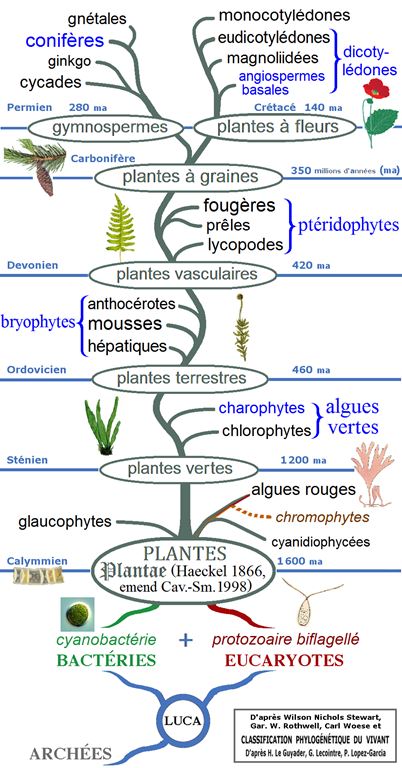
À droite, cet arbre phylogénétique des plantes montre les principaux clades et groupes traditionnels (monophylétiques en noir et paraphylétiques en bleu).
Dénominations
- Nom botanique : Grewia retinervis Burret
- Synonymes : Grewia deserticola Ulbr
- Noms anglais et locaux : Kalahari grewia, Kalahari sand raisin
Description et culture
Tableau récapitulatif
Parties comes-tibles Note comest. (1-5) Note medic. (1-5) (Zones de) Rusticité Besoins en 
Besoins en  (1-3)
(1-3)Périodes de semis et récoltes Graines au gramme Durée de viabilité Profon-deur semis Espace-ment plants Espace-ment lignes Durée germi-native Durée avant récolte J F M A M J
J A S O N D
J F M A M J
J A S O N D
- dont infos de 0FPI ("FOOD PLANTS INTERNATIONAL", en anglais) :
Description :
Un arbuste ou un petit arbre. Il peut mesurer 4 m de haut. L'écorce est brune. Les branches sont rondes et non à 4 angles. Les feuilles sont lisses. Les veines forment un filet. Les feuilles sont oblongues et mesurent 2,5 à 5 cm de long sur 1 à 3 cm de large. Les fleurs sont jaune vif et mesurent 1,5 cm de diamètre. Ils se produisent en groupes de 2-3 à l'aisselle des feuilles. Le fruit est rouge-brun, brillant et rond. Les fruits sont comestibles{{{0(+x) (traduction automatique).
Original : A shrub or small tree. It can be 4 m high. The bark is brown. The branches are round, not 4 angled. The leaves are smooth. The veins form a net. The leaves are oblong and 2.5-5 cm long by 1-3 cm wide. The flowers are bright yellow and 1.5 cm across. The occur in groups of 2-3 in the axils of leaves. The fruit are red-brown, shiny and round. The fruit are edible{{{0(+x).
 Consommation (rapports de comestibilité, parties utilisables et usages alimentaires correspondants)
Consommation (rapports de comestibilité, parties utilisables et usages alimentaires correspondants)Parties comestibles :
fruit{{{0(+x) (traduction automatique). Original : Fruit{{{0(+x).Détails :
Les fruits sont consommés crus ou séchés. Le fruit peut être séché et conservé. Le fruit peut être écrasé et transformé en boisson{{{0(+x) (traduction automatique).
Original : The fruit are eaten raw or dried.The fruit can be dried and stored. The fruit can be crushed and made into a drink{{{0(+x).
Partie testée :
fruit{{{0(+x) (traduction automatique). Original : Fruit{{{0(+x)| Taux d'humidité (%) | Énergie (kj) | Énergie (kcal) | Protéines (g) |
|---|---|---|---|
| 6.9 | 929 | 222 | 6.3 |
| Pro- vitamines A (µg) |
Vitamines C (mg) | Fer (mg) | Zinc (mg) |
| 0 | 0 | 2.5 | 2.3 |
 Risques et précautions à prendre
Risques et précautions à prendrenéant, inconnus ou indéterminés.
Autres infos
dont infos de 0FPI ("FOOD PLANTS INTERNATIONAL", en anglais) :
Statut :
Ils constituent un aliment de base important{{{0(+x) (traduction automatique).
Original : They are an important staple food{{{0(+x).
Distribution :
Une plante tropicale. Il pousse dans les endroits sablonneux secs. C'est souvent dans le sable du Kalahari. Il pousse dans les zones avec une pluviométrie annuelle comprise entre 200 et 600 mm. Il pousse entre 410 et 1950 m d'altitude. Il peut pousser dans des endroits arides{{{0(+x) (traduction automatique).
Original : A tropical plant. It grows in dry sandy places. It is often in Kalahari sand. It grows in areas with an annual rainfall between 200-600 mm. It grows between 410-1950 m above sea level. It can grow in arid places{{{0(+x).
Localisation :
Afrique, Angola, Botswana, Afrique centrale, Afrique de l'Est, Namibie, Afrique du Sud, Afrique australe, Zambie, Zimbabwe{{{0(+x) (traduction automatique).
Original : Africa, Angola, Botswana, Central Africa, East Africa, Namibia, South Africa, Southern Africa, Zambia, Zimbabwe{{{0(+x).
Notes :
Il existe environ 200 espèces de Grewia. Ils sont pour la plupart tropicaux. Le fruit de la plupart peut être comestible. Celles-ci étaient dans les Sparrmanniaceae et les Tiliaceae{{{0(+x) (traduction automatique).
Original : There are about 200 Grewia species. They are mostly tropical. The fruit of most may be edible. These were in the Sparrmanniaceae and the Tiliaceae{{{0(+x).
Liens, sources et/ou références
Liens :
/ ;Sources et/ou références :
bibliographie (liste des sources et/ou références de l'encyclopédie)
dont classification : IPNI ("International Plant Names Index", en anglais) ; Kew (POWO - "Plant Of the World Online", "Royal Botanical Garden", en anglais) ;
dont livres et bases de données : 0FPI ("FOOD PLANTS INTERNATIONAL", en anglais) ;
dont bibliographie/références de 0FPI ("FOOD PLANTS INTERNATIONAL", en anglais) :
Bot. Jahrb. Syst. 45:170. 1910 ; Exell, A.W. et al, (Ed), 1963, Flora Zambesiaca Vol 2 Part 1 Crown Agents, London. p 45 ; Fowler, D. G., 2007, Zambian Plants: Their Vernacular Names and Uses. Kew. p 45 ; Fox, F. W. & Young, M. E. N., 1982, Food from the Veld. Delta Books. p 353 ; Heinz & Maguire, 1978, ; INFOODS:FAO/INFOODS Databases ; Larson, T. J., 1970, Hambukushu Ethno-botany. Botswana Notes and Records. Vol 13. ; Lee, 1979, ; Leger, S., 1997, A Description of Today's Use of Plants in West Bushmanland (Namibia). German Development Service. PO Box 220035, 14061 Berlin, Germany. http://www.sigridleger.de/book/ ; Maguire, 1978, ; Mannheimer, C. A. & Curtis. B.A. (eds), 2009, Le Roux and Muller's Field Guide to the Trees and Shrubs of Namibia. Windhoek: Macmillan Education Namibia. p 324 ; Marshall, 1976, ; Neelo, J., et al, 2015, Ethnobotanical Survey of Woody Plants in Shorobe and Xobe Villages, Northwest Region of Botswana. Ethnobotany Research & Applications 14:367-379 ; Neudeck, L. et al, 2012, The Contribution of Edible Wild Plants to Food Security, Dietary Diversity and Income of Households in Shorobe Village, Northern Botswana. Ethnobotany Research & Applications 10:449-462 ; Palgrave, K.C., 1996, Trees of Southern Africa. Struik Publishers. p 578 ; Palmer, E and Pitman, N., 1972, Trees of Southern Africa. Vol. 2. A.A. Balkema, Cape Town p 1434 ; Peters, C. R., O'Brien, E. M., and Drummond, R.B., 1992, Edible Wild plants of Sub-saharan Africa. Kew. p 193 ; Plowes, N. J. & Taylor, F. W., 1997, The Processing of Indigenous Fruits and other Wildfoods of Southern Africa. in Smartt, L. & Haq. (Eds) Domestication, Production and Utilization of New Crops. ICUC p 192 ; Rodin, 1985, ; Roodt, V., 1998, Trees & Shrubs of the Okavango Delta. Medicinal Uses and Nutritional value. The Shell Field Guide Series: Part 1. Shell Botswana. p 83 ; Royal Botanic Gardens, Kew (1999). Survey of Economic Plants for Arid and Semi-Arid Lands (SEPASAL) database. Published on the Internet; http://www.rbgkew.org.uk/ceb/sepasal/internet [Accessed 11th June 2011] ; Schmidt, E., Lotter, M., & McCleland, W., 2007, Trees and shrubs of Mpumalanga and Kruger National Park. Jacana Media p 408 ; Silberbauer, 1965, 1981, ; Story, 1958, ; Tanaka, 1976, 1980, ; Wehmeyer, A. S, 1986, Edible Wild Plants of Southern Africa. Data on the Nutrient Contents of over 300 species
Recherche de/pour :
- "Grewia retinervis" sur Google (pages et
images) ;
TPL ("The Plant List", en anglais) ;
GRIN ("Germplasm Resources Information Network", en anglais) ;
TROPICOS (en anglais) ;
Tela Botanica ;
Pl@ntNet ;
Pl@ntUse ;
"Plants For A Future" (en anglais) ;
"Useful Tropical Plants" (en anglais) ou
"Useful Temperate Plants" (en anglais) ;
- "Grewia retinervis" sur Google (pages et
images) ;
TPL ("The Plant List", en anglais) ;
GRIN ("Germplasm Resources Information Network", en anglais) ;
TROPICOS (en anglais) ;
Tela Botanica ;
Pl@ntNet ;
Pl@ntUse ;
"Plants For A Future" (en anglais) ;
"Useful Tropical Plants" (en anglais) ou
"Useful Temperate Plants" (en anglais) ;
Espèces du même genre (Grewia)
112 taxons
- Grewia abutilifolia Vent. ex Juss.
- Grewia arborea Roxb. ex Rottler
- Grewia asiatica L. (Phalsa)
- Grewia avellana Hiern
- Grewia balensis Kirkup & Sebsebe
- Grewia barteri Burret
- Grewia bicolor Roth
- Grewia bracteata Baker
- Grewia breviflora Benth.
- Grewia brunnea K.Schum.
- Grewia burttii Exell
- Grewia caffra Meisn.
- Grewia calymmatosepala K.Schum.
- Grewia capitellata Bojer
- Grewia carpinifolia B.Heyne ex Roth
- Grewia cerasifera
- Grewia chungii Merr.
- Grewia cissoides Hutch. & Dalziel
- Grewia conocarpa K.Schum.
- Grewia conocarpoides Burret
- Grewia coriacea Mast.
- Grewia crenata
- Grewia damine Gaertn.
- Grewia disperma Rottler ex Spreng.
- Grewia elastica Royle
- Grewia eriocarpa Juss.
- Grewia erythraea Schweinf.
- Grewia falcistipula K.Schum.
- Grewia fallax K.Schum.
- Grewia ferruginea Hochst. ex A.Rich.
- Grewia flava DC.
- Grewia flavescens Juss.
- Grewia floribunda Mast.
- Grewia forbesii Harv. ex Mast.
- Grewia goetzeana K.Schum.
- Grewia gracillima Wild
- Grewia grevei Baill.
- Grewia helicterifolia Wall. ex G.Don
- Grewia herbacea Hiern
- Grewia heterotricha Mast.
- Grewia hexamita Burret
- Grewia hirsuta Sm.
- Grewia holstii Burret
- Grewia hookeriana Exell & Mendona
- Grewia hornbyi Wild
- Grewia inaequilatera Garcke
- Grewia kakothamnos K.Schum.
- Grewia laevigata Vahl
- Grewia lasiocarpa E.Mey. ex Harv.
- Grewia lasiodiscus K.Schum.
- ...
Espèces de la même famille (Malvaceae)
686 taxons
- Abutilon
- Abutilon à feuilles de vigne
- Abutilon à feuilles en losange
- Abutilon comestible (tp* de "Abutilon esculentum"
- Abutilon d'avicenne
- Abutilon de Sherard
- Abutilon du Chili
- Abutilon épineux
- Abutilon grimpant
- Abutilon hérissé
- Abutilon Miller
- Abutilon pourpre
- Abutilon strié
- Aibika
- Ambrette
- Anode
- Baobab
- Baobab de grandidier
- Bâton ivre
- Cacao de monte
- Cacao du Pérou
- Cacaoti
- Cacaoyer
- Chanvre ambari
- Chanvre de Calcutta
- Corchore à trois loges
- Corète potagère
- Cotonnier
- Cotonnier créole
- Cotonnier herbacé
- Cotonnier mexicain
- Cupuassu
- Cupui
- Dian bala{{{69
- Durian
- Durian manjit
- Faux colatier
- Flamme
- Flamme australienne
- Fromager
- Gombo
- Gombo ouest-africain
- Gouane à feuilles de tilleul
- Grewie occidentale
- Guazume à feuilles d'orme
- Guimauve officinale
- Héritière littorale
- Hibiscus à cinq fruits
- Hibiscus d'Afrique
- Hibiscus des marais
- Abelmoschus angulosus Wall. ex Wight & Arn.
- Abelmoschus caillei (A.Chev.) Stevels (Gombo ouest-africain)
- Abelmoschus crinitus Wall.
- Abelmoschus esculentus (L.) Moench (Gombo)
- Abelmoschus ficulneus (L.) Wight & Arn. (Ketmie faux ficus)
- Abelmoschus manihot (L.) Medik (Aibika)
- Abelmoschus mauritianum (Jacq.) Medic.
- Abelmoschus moschatus Medik (Ambrette)
- Abelmoschus pannosum (Forst. f.) Schlechtend.
- Abroma angusta (L) Willd.
- Abutilon angulatum (Guill. & Perr.) Mast.
- Abutilon cabrae De Wild. et Th.Dur.
- Abutilon fruticosum Guill. & Perr.
- Abutilon glaucum (Cav.) Sweet
- Abutilon grandifolium (Willd.) Sweet (Abutilon)
- Abutilon hirtum (Lam.) Sweet (Abutilon hérissé)
- Abutilon indicum (L.) Sweet (Mauve pays)
- Abutilon leucopetalum (F. Muell.) Benth.
- Abutilon longicuspe Hochst. ex A. Rich.
- Abutilon mauritianum (Jacq.) Medic.
- Abutilon megapotamicum (Spreng.) A. St.-Hil. & Naudin. (Abutilon grimpant)
- Abutilon ochsenii
- Abutilon otocarpum F.Muell.
- Abutilon pannosum (Forst. f.) Schlechtend.
- Abutilon pictum Gillies. ex Hook. & Arn.) Walp. (Abutilon strié)
- Abutilon purpurascens
- Abutilon ramosum (Cav.) Guill. & Perr.
- Abutilon species
- Abutilon theophrasti Medik. (Abutilon d'avicenne)
- Abutilon vitifolium (Abutilon à feuilles de vigne)
- Abutilon x hybridum hort. ex Siebert. & Voss. (Lanterne chinoise)
- Abutilon x milleri auct./hort. (Abutilon Miller)
- Abutilon x suntense
- Adansonia digitata L. (Baobab)
- Adansonia grandidieri Baill. (Baobab de grandidier)
- Adansonia gregorii F.Muell.
- Adansonia madagascariensis Baill.
- Adansonia perrieri Capuron
- Adansonia suarezensis H.Perrier
- Adansonia za Baill.
- Alcea apterocarpa
- Alcea flavovirens
- Alcea hohenacheri
- Alcea kurdica
- Alcea pallida
- Alcea rosea L. (Rose trémière)
- Alcea rugosa Alef.
- Alcea setosa (Rose-trémière)
- Althaea armeniaca Ten.
- Althaea officinalis L. (Guimauve officinale)
- ...







 donne accès au menu
  - encyclopédies des plantes alimentaires ;
 - page de recherche - reconnaissance (identification) de plantes ;
 - page du calendrier lunaire et son générateur (au format PDF et JPG) ;
 - tableau récapitulatif ;
 - générateur de potées (soupes), avec estimation des apports nutrionnels et du coût;
 - générateur de codes QR ;
 - page des archives avec de nombreux documents sur différents thèmes complémentaires comme la botanique, les légumes,
les champignons, la cuisine, le bien-être ainsi que différents MOOC mais également des liens vers les archives de l'association ;
- page des archives avec de nombreux documents sur différents thèmes complémentaires comme la botanique, les légumes,
les champignons, la cuisine, le bien-être ainsi que différents MOOC mais également des liens vers les archives de l'association ;

 pour le fruit (et/ou les graines, la pulpe, etc...),
 pour les fleurs (et/ou pétales, calice...),
 pour les feuilles (et/ou la tige, les pousses...),
 pour les racines,
 pour le tronc (et/ou l'écorce, la sève...), et enfin
 pour les champignons,
puis les notes alimentaires et médicinales (de 1 à 5 étoiles), la rusticité (résistance au froid/gel)
et pour finir un résumé.
pour les champignons,
puis les notes alimentaires et médicinales (de 1 à 5 étoiles), la rusticité (résistance au froid/gel)
et pour finir un résumé. menant ici 🙂
 ,
,  et
et





 ,
,


 Encyclopédie(s)
 Recherche-Reconnaissance
 Tableau récapitulatif
 Codes QR
 Archives
 Calendrier(s) lunaire(s)
  Potées
 Re-naturation/naturalisation
 Affichettes, herbiers &
co.
Affichettes, herbiers &
co. menu
menu galerie


 (en bas à droite).
 (en bas à gauche).
