Gelidiella acerosa


Une algue. C'est une plante raide. La branche principale peut être droite ou courbe. Il a des branches latérales qui sont minces et ressemblent à des dents sur un peigne. C ... (traduction automatique)
→suite


Gelidiella acerosa

Une algue. C'est une plante raide. La branche principale peut être droite ou courbe. Il a des branches latérales qui sont minces et ressemblent à des dents sur un peigne. Ceux-ci peuvent être sur un ou... (traduction automatique) →suite
Pas d'autre illustration
pour le moment 😕
Classification
- Classique : en haut de l'écran, sous le coeur.
- Phylogénétique : Inconnue
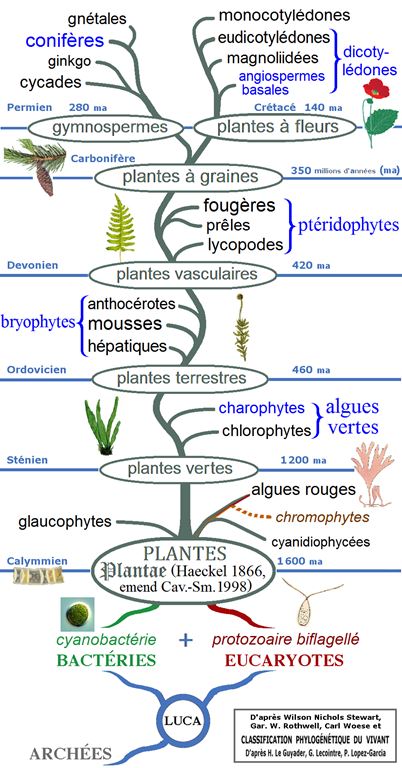
À droite, cet arbre phylogénétique des plantes montre les principaux clades et groupes traditionnels (monophylétiques en noir et paraphylétiques en bleu).
Dénominations
- Nom botanique : Gelidiella acerosa (Forssk.) Feldm. et Ham.
- Noms anglais et locaux : Culot, Comb weed
Description et culture
Tableau récapitulatif
Parties comes-tibles Note comest. (1-5) Note medic. (1-5) (Zones de) Rusticité Besoins en 
Besoins en  (1-3)
(1-3)Périodes de semis et récoltes Graines au gramme Durée de viabilité Profon-deur semis Espace-ment plants Espace-ment lignes Durée germi-native Durée avant récolte J F M A M J
J A S O N D
J F M A M J
J A S O N D
- dont infos de 0FPI ("FOOD PLANTS INTERNATIONAL", en anglais) :
Description :
Une algue. C'est une plante raide. La branche principale peut être droite ou courbe. Il a des branches latérales qui sont minces et ressemblent à des dents sur un peigne. Ceux-ci peuvent être sur un ou deux côtés. Les plantes peuvent être brun pâle ou jaune dans les endroits bien ensoleillés. Ils sont brun foncé ou violets dans les endroits ombragés{{{0(+x) (traduction automatique).
Original : A seaweed. It is a wiry plant. The main branch can be straight or curved. It has side branches which are slender and like teeth on a comb. These can be along one or two sides. The plants can be pale brown or yellow in places with good sunlight. They are darker brown or purple in shaded places{{{0(+x).
 Consommation (rapports de comestibilité, parties utilisables et usages alimentaires correspondants)
Consommation (rapports de comestibilité, parties utilisables et usages alimentaires correspondants)Algue alimentaire{{{wiki.
Partie testée :
/ Risques et précautions à prendre
Risques et précautions à prendrenéant, inconnus ou indéterminés.
Autres infos
dont infos de 0FPI ("FOOD PLANTS INTERNATIONAL", en anglais) :
Distribution :
C'est une plante tropicale. Il pousse dans la zone intertidale inférieure sur les rives abritées{{{0(+x) (traduction automatique).
Original : It is a tropical plant. It grows in the lower intertidal zone on sheltered shores{{{0(+x).
Localisation :
Asia, Australia, China, Fiji, Haiti, Hispaniola, India, Indochina, Japan, Malaysia, Pacific, Papua New Guinea, PNG, Philippines, Samoa, SE Asia, Solomon Islands, Taiwan, Vietnam, Yemen{{{0(+x) (traduction automatique).
Original : Asia, Australia, China, Fiji, Haiti, Hispaniola, India, Indochina, Japan, Malaysia, Pacific, Papua New Guinea, PNG, Philippines, Samoa, SE Asia, Solomon Islands, Taiwan, Vietnam, Yemen{{{0(+x).
Notes :
Il existe 23 espèces de Gelidiella. Il est riche en calcium et en potassium{{{0(+x) (traduction automatique).
Original : There are 23 Gelidiella species. It is high in Calcium and Potassium{{{0(+x).
Liens, sources et/ou références
Liens :
/ ;Sources et/ou références :
bibliographie (liste des sources et/ou références de l'encyclopédie)
dont livres et bases de données : 0FPI ("FOOD PLANTS INTERNATIONAL", en anglais) ;
dont bibliographie/références de 0FPI ("FOOD PLANTS INTERNATIONAL", en anglais) :
Ambasta, S.P. (Ed.), 2000, The Useful Plants of India. CSIR India. p 233 ; Cribb, A.B. & J.W., 1976, Wild Food in Australia, Fontana. p 196 ; Cribb, A.B., 1996, Seaweeds of Queensland A Naturalist's Guide. The Queensland Naturalists' Club Handbook No. 2. p 83 ; http://www.seavegetables.com ; Kiple, K.F. & Ornelas, K.C., (eds), 2000, The Cambridge World History of Food. CUP p 237 ; Lee, B., 2008, Seaweed Potential as a marine vegetable. RIRDC Publication No. 08/009 ; Novaczek, I., 2001, A Guide to the Common Edible and Medicinal Plants of the Pacific Islands. SPC. p 17 ; Velasquez, G.T., 1972, Studies and utilization of the Philippine marine algae. In Proceedings of the Seventh International Seaweed Symposium, ed. K Nisizawa, 62-5. New York. ; Wang, Wei-Lung and Chiang, Young-Meng, 1994, Potential Economic Seaweeds of Hengchun Peninsula, Taiwan, Economic Botany, Vol. 48, No. 2, pp. 182-189 ; Womersley, H.B. S. & Bailey, A., 1970, Marine algae of the Solomon Islands. Philosophical Transactions of the Royal Society of London. B. Biological Sciences 259:257-352 ; Xia, B., and Abbott, I.A., 1987, Edible seaweeds of China and their place in the Chinese diet. Economic Botany 41:341-53 ; Zemke-White, W. L. & Ohno, M., 1999, World seaweed utilisation: An end-of-century summary. Journal of Applied Phycology 11: 369-376
Recherche de/pour :
- "Gelidiella acerosa" sur Google (pages et
images) ;
IPNI ("International Plant Names Index", en anglais) ;
TPL ("The Plant List", en anglais) ;
GRIN ("Germplasm Resources Information Network", en anglais) ;
TROPICOS (en anglais) ;
Tela Botanica ;
Pl@ntNet ;
Pl@ntUse ;
"Plants For A Future" (en anglais) ;
"Useful Tropical Plants" (en anglais) ou
"Useful Temperate Plants" (en anglais) ;
- "Gelidiella acerosa" sur Google (pages et
images) ;
IPNI ("International Plant Names Index", en anglais) ;
TPL ("The Plant List", en anglais) ;
GRIN ("Germplasm Resources Information Network", en anglais) ;
TROPICOS (en anglais) ;
Tela Botanica ;
Pl@ntNet ;
Pl@ntUse ;
"Plants For A Future" (en anglais) ;
"Useful Tropical Plants" (en anglais) ou
"Useful Temperate Plants" (en anglais) ;







 donne accès au menu
  - encyclopédies des plantes alimentaires ;
 - page de recherche - reconnaissance (identification) de plantes ;
 - page du calendrier lunaire et son générateur (au format PDF et JPG) ;
 - tableau récapitulatif ;
 - générateur de potées (soupes), avec estimation des apports nutrionnels et du coût;
 - générateur de codes QR ;
 - page des archives avec de nombreux documents sur différents thèmes complémentaires comme la botanique, les légumes,
les champignons, la cuisine, le bien-être ainsi que différents MOOC mais également des liens vers les archives de l'association ;
- page des archives avec de nombreux documents sur différents thèmes complémentaires comme la botanique, les légumes,
les champignons, la cuisine, le bien-être ainsi que différents MOOC mais également des liens vers les archives de l'association ;

 pour le fruit (et/ou les graines, la pulpe, etc...),
 pour les fleurs (et/ou pétales, calice...),
 pour les feuilles (et/ou la tige, les pousses...),
 pour les racines,
 pour le tronc (et/ou l'écorce, la sève...), et enfin
 pour les champignons,
puis les notes alimentaires et médicinales (de 1 à 5 étoiles), la rusticité (résistance au froid/gel)
et pour finir un résumé.
pour les champignons,
puis les notes alimentaires et médicinales (de 1 à 5 étoiles), la rusticité (résistance au froid/gel)
et pour finir un résumé. menant ici 🙂
 ,
,  et
et





 ,
,


 Encyclopédie(s)
 Recherche-Reconnaissance
 Tableau récapitulatif
 Codes QR
 Archives
 Calendrier(s) lunaire(s)
  Potées
 Re-naturation/naturalisation
 Affichettes, herbiers &
co.
Affichettes, herbiers &
co. menu
menu galerie


 (en bas à droite).
 (en bas à gauche).
