Digitaria exilis
Pas d'illustration
pour le moment 😕

Une herbe de millet. Il est dressé. Il pousse à partir de graines chaque année. Il pousse environ 50 cm de haut. Il forme des talles ou de nouvelles pousses sont la base de ... (traduction automatique)
→suite


Digitaria exilis

Une herbe de millet. Il est dressé. Il pousse à partir de graines chaque année. Il pousse environ 50 cm de haut. Il forme des talles ou de nouvelles pousses sont la base de la tige. Les feuilles sont é... (traduction automatique) →suite
Pas d'illustration
pour le moment 😕
Pas d'illustration
pour le moment 😕
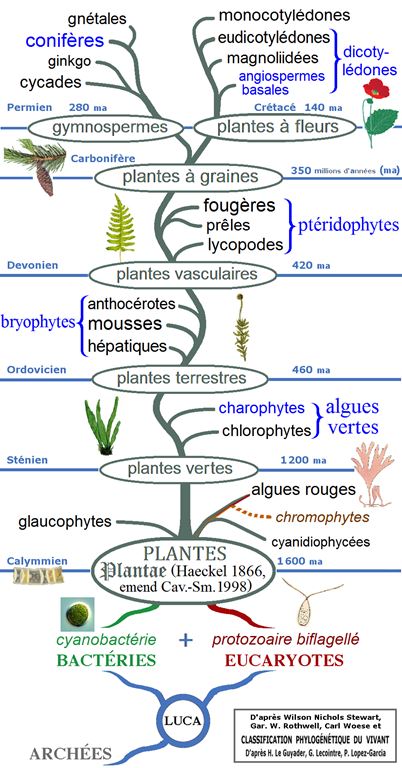
Classification
- Classique : en haut de l'écran, sous le coeur.
- Phylogénétique :
- Clade 4 : Angiospermes ;
- Clade 3 : Monocotylédones ;
- Clade 2 : Commelinidées ;
- Ordre APN : Poales ;
- Famille APN : Poaceae ;
À droite, cet arbre phylogénétique des plantes montre les principaux clades et groupes traditionnels (monophylétiques en noir et paraphylétiques en bleu).
Dénominations
- Nom botanique : Digitaria exilis (Kippist) Stapf
- Synonymes : Paspalum exile Kippist, Paspalum longiflorum Cheval non Retz, Syntherisma exilis (Kippist) Newbold
- Noms anglais et locaux : Hungry rice, Fonio
Description et culture
Tableau récapitulatif
Parties comes-tibles Note comest. (1-5) Note medic. (1-5) (Zones de) Rusticité Besoins en 
Besoins en  (1-3)
(1-3)Périodes de semis et récoltes Graines au gramme Durée de viabilité Profon-deur semis Espace-ment plants Espace-ment lignes Durée germi-native Durée avant récolte J F M A M J
J A S O N D
J F M A M J
J A S O N D
- dont infos de 0FPI ("FOOD PLANTS INTERNATIONAL", en anglais) :
Description :
Une herbe de millet. Il est dressé. Il pousse à partir de graines chaque année. Il pousse environ 50 cm de haut. Il forme des talles ou de nouvelles pousses sont la base de la tige. Les feuilles sont étroites. Ils peuvent mesurer 15 cm de long. Il a 2 à 4 racèmes par inflorescence. Ceux-ci mesurent 15 cm de long. Les grains sont très petits et généralement jaunes. Ils mesurent environ 1,5 mm de diamètre{{{0(+x) (traduction automatique).
Original : A millet grass. It is erect. It grows from seed every year. It grows about 50 cm high. It forms tillers or new shoots are the base of the stem. The leaves are narrow. They can be 15 cm long. It has 2 to 4 racemes per inflorescence. These are 15 cm long. The grains are very small and usually yellow. They are about 1.5 mm across{{{0(+x).
Production :
La période de croissance est de 3-4 mois. Les plantes sont récoltées avec une faucille et attachées dans des gaines. Ceux-ci sont séchés puis battus et décortiqués avec un mortier. Les rendements de 600 à 800 kg par hectare sont moyens. Certaines variétés arrivent à maturité en 40 jours{{{0(+x) (traduction automatique).
Original : The growing period is 3-4 months. The plants are harvested with a sickle and tied into sheaths. These are dried then threshed and hulled with a mortar. Yields of 600-800 kg per hectare are average. Some varieties reach maturity in 40 days{{{0(+x).
Culture :
Les plantes sont cultivées à partir de graines. Les graines sont semées très rapprochées. Ils ont probablement besoin d'une température supérieure à 25 ° C pour germer{{{0(+x) (traduction automatique).
Original : Plants are grown from seed. Seed are sown very close together. They probably need a temperature above 25°C to germinate{{{0(+x).
 Consommation (rapports de comestibilité, parties utilisables et usages alimentaires correspondants)
Consommation (rapports de comestibilité, parties utilisables et usages alimentaires correspondants)Graines brutes/crues{{{0(+x).
Partie testée :
graine crue{{{0(+x) (traduction automatique). Original : Seed raw{{{0(+x)| Taux d'humidité (%) | Énergie (kj) | Énergie (kcal) | Protéines (g) |
|---|---|---|---|
| 211.2 | 1470 | 332 | 7.1 |
| Pro- vitamines A (µg) |
Vitamines C (mg) | Fer (mg) | Zinc (mg) |
| 0 | 0 | 8.5 | 0.8 |
 Risques et précautions à prendre
Risques et précautions à prendrenéant, inconnus ou indéterminés.
Autres infos
dont infos de 0FPI ("FOOD PLANTS INTERNATIONAL", en anglais) :
Statut :
Il est récolté sur environ 325 000 hectares. Il nourrit environ 3 millions de personnes pendant les mois les plus difficiles de l'année. C'est important en Guinée{{{0(+x) (traduction automatique).
Original : It is harvested from about 325,000 hectares. It feeds about 3 million people during the most difficult months of the year. It is important in Guinea{{{0(+x).
Distribution :
Une plante tropicale. Il peut pousser sur des sols pauvres et peu profonds. Il pousse en bordure du Sahel. Il pousse dans la savane. Il peut tolérer la sécheresse. Il pousse dans des endroits arides. Il peut pousser avec une pluviométrie moyenne de 400 mm. Il peut pousser dans des sols acides à haute teneur en aluminium. Il peut pousser dans des endroits arides. Il pousse dans les zones où la température est comprise entre 20 ° C et 30 ° C. En Afrique de l'Ouest, il pousse entre le niveau de la mer et 1 500 m d'altitude{{{0(+x) (traduction automatique).
Original : A tropical plant. It can grow on poor, shallow soils. It grows on the edge of the Sahel. It grows in the savannah. It can tolerate drought. It grows in arid locations. It can grow with 400 mm average rainfall. It can grow in acidic soils with a high aluminium content. It can grow in arid places. It grows in areas with a temperature between 20°C to 30°C. In West Africa it grows between sea level and 1,500 m above sea level{{{0(+x).
Localisation :
Afrique, Bénin, Burkina Faso, Cameroun, Afrique centrale, Tchad, Côte d'Ivoire, Afrique de l'Est, Éthiopie, Gambie, Ghana, Guinée, Guinée, Guinée-Bissau, Côte d'Ivoire, Libéria, Mali, Mauritanie, Niger , Nigeria, Sahel, Sénégal, Sierra Leone, Soudan, Togo, Afrique de l'Ouest{{{0(+x) (traduction automatique).
Original : Africa, Benin, Burkina Faso, Cameroon, Central Africa, Chad, Côte d'Ivoire, East Africa, Ethiopia, Gambia, Ghana, Guinea, Guinée, Guinea-Bissau, Ivory Coast, Liberia, Mali, Mauritania, Niger, Nigeria, Sahel, Senegal, Sierra Leone, Sudan, Togo, West Africa{{{0(+x).
Notes :
Il existe environ 250 espèces de Digitaria. La teneur en protéines n'est que de 6 à 8%{{{0(+x) (traduction automatique).
Original : There are about 250 Digitaria species. The protein content is only 6-8%{{{0(+x).
Liens, sources et/ou références
Liens :
/ ;Sources et/ou références :
bibliographie (liste des sources et/ou références de l'encyclopédie)
dont livres et bases de données : 0FPI ("FOOD PLANTS INTERNATIONAL", en anglais) ;
dont bibliographie/références de 0FPI ("FOOD PLANTS INTERNATIONAL", en anglais) :
Bull. Misc. Inform. Kew 1915:385. 1915 ; Burkill, H. M., 1985, The useful plants of west tropical Africa, Vol. 2. Kew. ; Busson, 1965, ; Cobley, L.S. (rev. Steele, W.M.) 2nd Ed., 1976, An Introduction to the Botany of Tropical Crops. Longmans. p 60 ; Dansi, A., et al, 2012, Diversity of the Neglected and Underutilized Crop Species of Importance in Benin. The Scientific World Journal. Volume 2012, Article ID 932947, 19 pages ; Facciola, S., 1998, Cornucopia 2: a Source Book of Edible Plants. Kampong Publications, p 175 ; Grivetti, L. E., 1980, Agricultural development: present and potential role of edible wild plants. Part 2: Sub-Saharan Africa, Report to the Department of State Agency for International Development. p 30, 32 ; Heywood, V.H., Brummitt, R.K., Culham, A., and Seberg, O., 2007, Flowering Plant Families of the World. Royal Botanical Gardens, Kew. p 394 ; Jardin, C., 1970, List of Foods Used In Africa, FAO Nutrition Information Document Series No 2.p 2 ; Jideani, I. A., R. K. Owusu, R. K. & Muller, H. G., 1994, Proteins of acha (Digitaria exilis Stapf): Solubility fractionation, gel filtration, and electrophoresis of protein fractions. Food Chemistry 51:51-59 ; Kiple, K.F. & Ornelas, K.C., (eds), 2000, The Cambridge World History of Food. CUP p 116, 1175 ; National Research Council, 1996, Lost Crops of Africa. Volume 1: Grains. National Academy Press, Washington, D.C. p 59 ; Nyadanu, D., et al, 2015, Agro-biodiversity and challenges of on-farm conservation: the case of plant genetic resources of neglected and underutilized crop species in Ghana. Genet. Resourc. Crop Evol. 62(7): ; Peters, C. R., O'Brien, E. M., and Drummond, R.B., 1992, Edible Wild plants of Sub-saharan Africa. Kew. p 21 ; PROSEA (Plant Resources of South East Asia) handbook Volume 10 Cereals. p 151 ; PROTEA ; Purseglove, J.W., 1972, Tropical Crops. Monocotyledons. Longmans p 142 ; Segnon, A. C. & Achigan-Dako, E. G., 2014, Comparative analysis of diversity and utilization of edible plants in arid and semi-arid areas in Benin. Journal of Ethnobiology and Ethnomedicine 2014, 10:80 ; Small, E., 2009, Top 100 Food Plants. The world's most important culinary crops. NRC Research Press. p 270 ; Uphof, ; USDA, ARS, National Genetic Resources Program. Germplasm Resources Information Network - (GRIN). [Online Database] National Germplasm Resources Laboratory, Beltsville, Maryland. Available: www.ars-grin.gov/cgi-bin/npgs/html/econ.pl (10 April 2000) ; van Wyk, B., 2005, Food Plants of the World. An illustrated guide. Timber press. p 175 ; Vickery, M.L. and Vickery, B., 1979, Plant Products of Tropical Africa, Macmillan. p 12 ; Vodouhe, R. S. et al, Fonio: A treasure for West Africa. Genetic Resources Multiplication and Utilization p 219 ; Vodouhè, S.R. & Achigan Dako, E.G., 2006. Digitaria exilis (Kippist) Stapf. [Internet] Record from Protabase. Brink, M. & Belay, G. (Editors). PROTA (Plant Resources of Tropical Africa), Wageningen, Netherlands. < http://database.prota.org/search.htm>. Accessed 15 October 2009.
Recherche de/pour :
- "Digitaria exilis" sur Google (pages et
images) ;
IPNI ("International Plant Names Index", en anglais) ;
TPL ("The Plant List", en anglais) ;
GRIN ("Germplasm Resources Information Network", en anglais) ;
TROPICOS (en anglais) ;
Tela Botanica ;
Pl@ntNet ;
Pl@ntUse ;
"Plants For A Future" (en anglais) ;
"Useful Tropical Plants" (en anglais) ou
"Useful Temperate Plants" (en anglais) ;
- "Digitaria exilis" sur Google (pages et
images) ;
IPNI ("International Plant Names Index", en anglais) ;
TPL ("The Plant List", en anglais) ;
GRIN ("Germplasm Resources Information Network", en anglais) ;
TROPICOS (en anglais) ;
Tela Botanica ;
Pl@ntNet ;
Pl@ntUse ;
"Plants For A Future" (en anglais) ;
"Useful Tropical Plants" (en anglais) ou
"Useful Temperate Plants" (en anglais) ;
Espèces du même genre (Digitaria)
18 taxons
- Digitaire à fleurs longues
- Digitaire chétive
- Digitaire commune
- Digitaire horizontale
- Digitaire nue
- Fonio cilié
- Digitaria barbinodis Henrard
- Digitaria ciliaris Vanderyst (Fonio cilié)
- Digitaria compacta
- Digitaria cruciata
- Digitaria debilis (Digitaire chétive)
- Digitaria delicatula Stapf
- Digitaria diagonalis
- Digitaria frutescens
- Digitaria gayana
- Digitaria horizontalis Willd. (Digitaire horizontale)
- Digitaria iburua Stapf
- Digitaria leptorhachis
- Digitaria longiflora (Digitaire à fleurs longues)
- Digitaria nuda Schumach. (Digitaire nue)
- Digitaria sanguinalis (L.) Scop. (Digitaire commune)
- Digitaria ternata
- Digitaria velutina
Espèces de la même famille (Poaceae)
881 taxons
- Agrostide blanche
- Alpiste
- Alpiste à épi court
- Alpiste de Rotgès
- Alpiste mineur
- Amidonnier
- Amidonnier sauvage
- Amourette commune
- Aristide
- Aristide de l'Ascension
- Aristide sétacée
- Avoine
- Avoine à fourrage
- Avoine à gruau
- Avoine barbue
- Avoine d'Espagne
- Avoine d'Orient
- Avoine de Ludovic
- Avoine élevée
- Avoine odorante
- Bambou
- Bambou à rayures jaunes
- Bambou asper
- Bambou bhaluka
- Bambou carré
- Bambou chocolat
- Bambou commun
- Bambou de Veitch
- Bambou doré
- Bambou fastuosa (p*)
- Bambou flexueux
- Bambou géant
- Bambou glauca
- Bambou hamiltonii
- Bambou makinoi (p*)
- Bambou marbré
- Bambou médicinal
- Bambou membranaceus
- Bambou moso
- Bambou noir
- Bambou nuda
- Bambou pagode
- Bambou sasa palmata
- Bambou soufré à tige verte
- Bambou violacé
- Bambou viridiglaucescens
- Bambou yunnanicus
- Bardanette
- Bardanette rameuse
- Blé de Khorasan
- Achnatherum hymenoides (Roem. & Schult.) Ricker ex Piper
- Acidosasa chinensis C.D.Chu & C.S.Chao ex Keng f.
- Acidosasa edulis (T.H.Wen) T.H.Wen
- Acidosasa purpurea (Hsueh & T.P.Yi) Keng f.
- Acroceras amplectens Stapf
- Aegilops geniculata Fig. & De Not. (Égilope genouillé)
- Aegilops speltoides Tausch. (Égilope faux épeautre)
- Aegilops triuncialis L. (Égilope à 3 arêtes)
- Aeluropus lagopoides (Élurope)
- Agrostis perennans
- Agrostis stolonifera L. (Agrostide blanche)
- Agrotriticum x sp
- Aira caespitosa Muhl.
- Alopecurus aequalis Sobol. (Vulpin fauve)
- Alopecurus pratensis Bourg. ex Lange (Vulpin des prés de Linné)
- Ammophila arenaria (L.) Link (Oyat)
- Amphipogon caricinus F.Muell.
- Andropogon canaliculatus Schumach.
- Andropogon gayanus Kunth
- Andropogon gerardii
- Andropogon pinguipes Stapf
- Andropogon pseudapricus Stapf
- Andropogon sorghum
- Andropogon tectorum Schumach. & Thonn.
- Anthephora nigritana Stapf & C.E.Hubb.
- Anthephora pubescens Nees
- Anthoxanthum odoratum L. (Flouve odorante)
- Aristida acuta S.T.Blake
- Aristida adscensionis L. (Aristide de l'Ascension)
- Aristida congesta Roem. & Schult. (Aristide)
- Aristida inaequiglumis Domin
- Aristida publifolia
- Aristida pungens Desf.
- Aristida setacea Steud. (Aristide sétacée)
- Aristida stipoides R.Br.
- Arrhenatherum elatius (Avoine élevée)
- Arundinaria faberi Rendle
- Arundinaria gigantea
- Arundinaria hookeriana Munro
- Arundinaria niitakayamensis Hayata
- Arundinaria spp
- Arundinella setosa Trin.
- Arundo donax L. (Roseau)
- Astrebla lappacea
- Astrebla pectinata
- Astrebla squarrosa C.E.Hubb.
- Avena abyssinica Hochst.
- Avena barbata Pott ex Link (Avoine barbue)
- Avena brevis Roth (Avoine à fourrage)
- Avena byzantina K.Koch
- ...







 donne accès au menu
  - encyclopédies des plantes alimentaires ;
 - page de recherche - reconnaissance (identification) de plantes ;
 - page du calendrier lunaire et son générateur (au format PDF et JPG) ;
 - tableau récapitulatif ;
 - générateur de potées (soupes), avec estimation des apports nutrionnels et du coût;
 - générateur de codes QR ;
 - page des archives avec de nombreux documents sur différents thèmes complémentaires comme la botanique, les légumes,
les champignons, la cuisine, le bien-être ainsi que différents MOOC mais également des liens vers les archives de l'association ;
- page des archives avec de nombreux documents sur différents thèmes complémentaires comme la botanique, les légumes,
les champignons, la cuisine, le bien-être ainsi que différents MOOC mais également des liens vers les archives de l'association ;

 pour le fruit (et/ou les graines, la pulpe, etc...),
 pour les fleurs (et/ou pétales, calice...),
 pour les feuilles (et/ou la tige, les pousses...),
 pour les racines,
 pour le tronc (et/ou l'écorce, la sève...), et enfin
 pour les champignons,
puis les notes alimentaires et médicinales (de 1 à 5 étoiles), la rusticité (résistance au froid/gel)
et pour finir un résumé.
pour les champignons,
puis les notes alimentaires et médicinales (de 1 à 5 étoiles), la rusticité (résistance au froid/gel)
et pour finir un résumé. menant ici 🙂
 ,
,  et
et





 ,
,


 Encyclopédie(s)
 Recherche-Reconnaissance
 Tableau récapitulatif
 Codes QR
 Archives
 Calendrier(s) lunaire(s)
  Potées
 Re-naturation/naturalisation
 Affichettes, herbiers &
co.
Affichettes, herbiers &
co. menu
menu galerie


 (en bas à droite).
 (en bas à gauche).
