Entolome en bouclier
(Entoloma clypeatum)


Un champignon (traduction automatique)
→suite


_P._Kumm_362786.jpg)
Entoloma clypeatum
Classification
- Classique : en haut de l'écran, sous le coeur.
- Phylogénétique : Inconnue
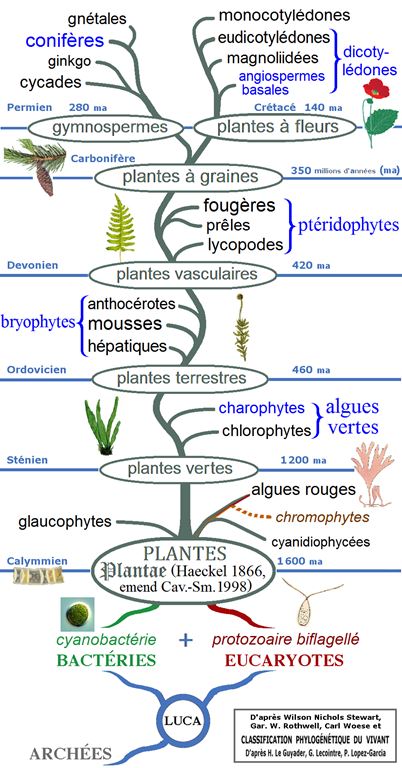
À droite, cet arbre phylogénétique des plantes montre les principaux clades et groupes traditionnels (monophylétiques en noir et paraphylétiques en bleu).
Dénominations
- Nom botanique : Entoloma clypeatum Fries.
- Noms anglais et locaux : Shield-shaped Enteloma
Description et culture
Tableau récapitulatif
Dessus du chapeau Taille : 0/0cm Couleur : / Forme : / Surface : / Marge Type : Couleur : / Dessous du chapeau (lames) Type : lamelles Couleur : / Oxydation : non Type de lamelles : normal ; Espace entre elles : / Lien entre chapeau et pied : lames Position : centrale Pied Longueur : / Couleur : / Forme : / Creux ou plein : pied plein Surface : / Couleur base : / Chair Couleur : / Oxydation : Fermeté : / Odeur : / Latex : non Autres infos Pousse en touffe : non Période : janvier ; janvier (le plus tôt) à decembre ; decembre (le plus tard) Milieu : / Pousse sur du bois : non Commentaires : /
Données du site identifier-les-champignons.com
- dont infos de 0FPI ("FOOD PLANTS INTERNATIONAL", en anglais) :
 Consommation (rapports de comestibilité, parties utilisables et usages alimentaires correspondants)
Consommation (rapports de comestibilité, parties utilisables et usages alimentaires correspondants)Parties comestibles :
champignon{{{0(+x) (traduction automatique). Original : Mushroom, Fungus{{{0(+x).Détails :
Le corps du fruit est frit{{{0(+x) (traduction automatique).
Original : The fruit body is fried{{{0(+x).
Partie testée :
/ Risques et précautions à prendre
Risques et précautions à prendrenéant, inconnus ou indéterminés.


Autres infos
dont infos de 0FPI ("FOOD PLANTS INTERNATIONAL", en anglais) :
Statut :
Il est vendu sur les marchés locaux{{{0(+x) (traduction automatique).
Original : It is sold in local markets{{{0(+x).
Distribution :
Une plante tropicale et subtropicale. Au Yunnan{{{0(+x) (traduction automatique).
Original : A tropical and subtropical plant. In Yunnan{{{0(+x).
Localisation :
Asia, China, Indochina, Japan, Jordan, Mexico, North America, Romania{{{0(+x) (traduction automatique).
Original : Asia, China, Indochina, Japan, Jordan, Mexico, North America, Romania{{{0(+x).
Liens, sources et/ou références
Liens :
/ ;Sources et/ou références :
bibliographie (liste des sources et/ou références de l'encyclopédie)
dont livres et bases de données : 0FPI ("FOOD PLANTS INTERNATIONAL", en anglais) ;
dont bibliographie/références de 0FPI ("FOOD PLANTS INTERNATIONAL", en anglais) :
Boa, E. R., 2004, Wild edible fungi and their importance to people. FAO Non Wood Forest Products Booklet 17 ; Burkill, I.H., 1966, A Dictionary of the Economic Products of the Malay Peninsula. Ministry of Agriculture and Cooperatives, Kuala Lumpur, Malaysia. Vol 1 (A-H) p 944 ; Estrada-Martinez, E., et al, 2009, Contribucion al conocimiento etnomicologico de los Hongos Comestibles Silvestres de Mercados Regionales y Comunidades de la Sierra Nevada (Mexico). Intercienca Jan 2009 Vol. 34 No. 1 ; Geng, Y., et al, 2016, Traditional knowledge and its transmission of wild edibles used by the Naxi in Baidi Village, northwest Yunnan province. Journal of Ethnobiology and Ethnomedicine. 12:10 ; Imai, 1938, ; Kaufmann, B. et al, 1999, The Great Encyclopedia of Mushrooms. Konemann. p 118 ; Kiple, K.F. & Ornelas, K.C., (eds), 2000, The Cambridge World History of Food. CUP p 319 ; Luczaj, L., et al, 2015, Wild food plants and fungi used by Ukrainians in the western part of the Maramureş region in Romania. Acta Soc Bot Pol 84(3):339–346 ; Montoya, A., et al, 2014, Availability of Wild Edible Fungi in La Malinche National park, Mexico. Journal of Mycology. Article ID 241896, 15 pages ; Pace, G., 1998, Mushrooms of the world. Firefly books. p 83 ; Perez-Moreno, J. et al, 2008, Wild Mushroom Markets in Central Mexico and a Case Study at Ozumba. Economic Botany, 62(3), 2008, pp. 425–436 ; Perez-Moreno, J., et al, 2009, Social and Biotechnological Studies of Wild Edible Mushrooms in Mexico. Acta Botanica Yunnanica Suppl. XV1: 55-61
Recherche de/pour :
- "Entoloma clypeatum" sur Google (pages et
images) ;
IPNI ("International Plant Names Index", en anglais) ;
TPL ("The Plant List", en anglais) ;
GRIN ("Germplasm Resources Information Network", en anglais) ;
TROPICOS (en anglais) ;
Tela Botanica ;
Pl@ntNet ;
Pl@ntUse ;
"Plants For A Future" (en anglais) ;
"Useful Tropical Plants" (en anglais) ou
"Useful Temperate Plants" (en anglais) ;
- "Entolome en bouclier" sur Google (pages, images et recettes) ;
- "Entoloma clypeatum" sur Google (pages et
images) ;
IPNI ("International Plant Names Index", en anglais) ;
TPL ("The Plant List", en anglais) ;
GRIN ("Germplasm Resources Information Network", en anglais) ;
TROPICOS (en anglais) ;
Tela Botanica ;
Pl@ntNet ;
Pl@ntUse ;
"Plants For A Future" (en anglais) ;
"Useful Tropical Plants" (en anglais) ou
"Useful Temperate Plants" (en anglais) ;
Espèces du même genre (Entoloma)
11 taxons
Espèces de la même famille (Entolomataceae)
15 taxons
- Clitopilus caespitosus
- Clitopilus prunulus (Meunier)
- Entoloma abortivum
- Entoloma aprile
- Entoloma argyropus
- Entoloma bloxami
- Entoloma lividoalbum
- Entoloma macrocarpum
- Entoloma microcarpum
- Entoloma prunuloides
- Entoloma saundersii
- Entoloma sepium (Entolome des haies)
- Rhodocybe gemina (Rhodocybe tronqué)
- Rhodocybe truncata







 donne accès au menu
  - encyclopédies des plantes alimentaires ;
 - page de recherche - reconnaissance (identification) de plantes ;
 - page du calendrier lunaire et son générateur (au format PDF et JPG) ;
 - tableau récapitulatif ;
 - générateur de potées (soupes), avec estimation des apports nutrionnels et du coût;
 - générateur de codes QR ;
 - page des archives avec de nombreux documents sur différents thèmes complémentaires comme la botanique, les légumes,
les champignons, la cuisine, le bien-être ainsi que différents MOOC mais également des liens vers les archives de l'association ;
- page des archives avec de nombreux documents sur différents thèmes complémentaires comme la botanique, les légumes,
les champignons, la cuisine, le bien-être ainsi que différents MOOC mais également des liens vers les archives de l'association ;

 pour le fruit (et/ou les graines, la pulpe, etc...),
 pour les fleurs (et/ou pétales, calice...),
 pour les feuilles (et/ou la tige, les pousses...),
 pour les racines,
 pour le tronc (et/ou l'écorce, la sève...), et enfin
 pour les champignons,
puis les notes alimentaires et médicinales (de 1 à 5 étoiles), la rusticité (résistance au froid/gel)
et pour finir un résumé.
pour les champignons,
puis les notes alimentaires et médicinales (de 1 à 5 étoiles), la rusticité (résistance au froid/gel)
et pour finir un résumé. menant ici 🙂
 ,
,  et
et





 ,
,


 Encyclopédie(s)
 Recherche-Reconnaissance
 Tableau récapitulatif
 Codes QR
 Archives
 Calendrier(s) lunaire(s)
  Potées
 Re-naturation/naturalisation
 Affichettes, herbiers &
co.
Affichettes, herbiers &
co. menu
menu galerie


 (en bas à droite).
 (en bas à gauche).
