Sageretia thea
Pas d'illustration
pour le moment 😕


Un arbuste à feuilles persistantes. Les branches sont rigides et minces et peuvent se terminer par une épine. Les feuilles sont étroitement ovales et peuvent être rugueuse ... (traduction automatique)
→suite


Sageretia thea

Un arbuste à feuilles persistantes. Les branches sont rigides et minces et peuvent se terminer par une épine. Les feuilles sont étroitement ovales et peuvent être rugueuses. Il y a de petites dents sur... (traduction automatique) →suite
Pas d'illustration
pour le moment 😕
Pas d'illustration
pour le moment 😕
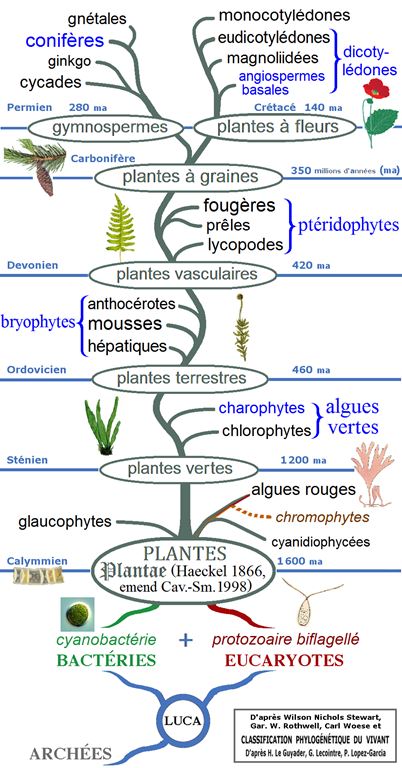
Classification
- Classique : en haut de l'écran, sous le coeur.
- Phylogénétique :
- Clade 4 : Angiospermes ;
- Clade 3 : Dicotylédones_vraies ;
- Clade 2 : Rosidées ;
- Clade 1 : Fabidées ;
- Ordre APN : Rosales ;
- Famille APN : Rhamnaceae ;
À droite, cet arbre phylogénétique des plantes montre les principaux clades et groupes traditionnels (monophylétiques en noir et paraphylétiques en bleu).
Dénominations
- Nom botanique : Sageretia thea (Osbeck) M.C.Johnst.
- Synonymes : Rhamnus thea Osback, Rhamnus theezans Linn, Sageretia theezens (L.) Brogn, Sageretia theezans var. glabrescens Kitam
- Noms anglais et locaux : Millet thorn, Sweet plum
Description et culture
Tableau récapitulatif
Parties comes-tibles Note comest. (1-5) Note medic. (1-5) (Zones de) Rusticité Besoins en 
Besoins en  (1-3)
(1-3)Périodes de semis et récoltes Graines au gramme Durée de viabilité Profon-deur semis Espace-ment plants Espace-ment lignes Durée germi-native Durée avant récolte J F M A M J
J A S O N D
J F M A M J
J A S O N D
- dont infos de 0FPI ("FOOD PLANTS INTERNATIONAL", en anglais) :
Description :
Un arbuste à feuilles persistantes. Les branches sont rigides et minces et peuvent se terminer par une épine. Les feuilles sont étroitement ovales et peuvent être rugueuses. Il y a de petites dents sur le pourtour. Ils mesurent 1 à 4 cm de long sur 1 à 2 cm de large. Les fleurs sont en groupes interrompus le long d'une tige. Les fleurs mesurent 3 mm de diamètre. Le fruit mesure 4 à 5 mm de long. Il est noir ou brun foncé. Ils ont 3 lobes. Habituellement, il y a 3 graines. Il existe quelques variétés botaniques{{{0(+x) (traduction automatique).
Original : An evergreen shrub. The branches are stiff and slender and can end in a thorn. The leaves are narrowly oval and can be rough. There are small teeth around the edge. They are 1-4 cm long by 1-2 cm wide. The flowers are in interrupted groups along a stalk. The flowers are 3 mm across. The fruit is 4-5 mm long. It is black or dark brown. They have 3 lobes. Usually there are 3 seeds. There are some botanical varieties{{{0(+x).
 Consommation (rapports de comestibilité, parties utilisables et usages alimentaires correspondants)
Consommation (rapports de comestibilité, parties utilisables et usages alimentaires correspondants)Parties comestibles :
fruits, feuilles - thé{{{0(+x) (traduction automatique). Original : Fruit, Leaves - tea{{{0(+x).Détails :
Les fruits sont consommés crus. Ils sont également utilisés dans le brassage. Les feuilles sont parfois utilisées comme substitut du thé{{{0(+x) (traduction automatique).
Original : The fruit are eaten raw. They are also used in brewing. The leaves are sometimes used as a substitute for tea{{{0(+x).
Partie testée :
/ Risques et précautions à prendre
Risques et précautions à prendrenéant, inconnus ou indéterminés.
Autres infos
dont infos de 0FPI ("FOOD PLANTS INTERNATIONAL", en anglais) :
Statut :
Les fruits sont surtout consommés par les enfants{{{0(+x) (traduction automatique).
Original : The fruit are eaten especially by children{{{0(+x).
Distribution :
C'est une plante tropicale. En Chine, il pousse dans les forêts de montagne à moins de 2 100 m d'altitude. Au Sichuan et au Yunnan{{{0(+x) (traduction automatique).
Original : It is a tropical plant. In China it grows in mountain forests below 2,100 m above sea level. In Sichuan and Yunnan{{{0(+x).
Localisation :
Afghanistan, Afrique, Arabie, Asie, Chine, Afrique de l'Est, Éthiopie, Himalaya, Inde, Indochine, Iran, Japon, Corée, Myanmar, Afrique du Nord, Pakistan, Asie du Sud-Est, Taïwan, Thaïlande, Tibet, Vietnam{{{0(+x) (traduction automatique).
Original : Afghanistan, Africa, Arabia, Asia, China, East Africa, Ethiopia, Himalayas, India, Indochina, Iran, Japan, Korea, Myanmar, North Africa, Pakistan, SE Asia, Taiwan, Thailand, Tibet, Vietnam{{{0(+x).
Liens, sources et/ou références
Liens :
/ ;Sources et/ou références :
bibliographie (liste des sources et/ou références de l'encyclopédie)
dont classification : IPNI ("International Plant Names Index", en anglais) ; Kew (POWO - "Plant Of the World Online", "Royal Botanical Garden", en anglais) ;
dont livres et bases de données : 0FPI ("FOOD PLANTS INTERNATIONAL", en anglais) ;
dont bibliographie/références de 0FPI ("FOOD PLANTS INTERNATIONAL", en anglais) :
Addis, G., et al, 2005, Ethnobotanical Study of Edible Wild Plants in Some Selected Districts of Ethiopia. Human Ecology, Vol. 33, No. 1, pp. 83-118 ; Altschul, S.V.R., 1973, Drugs and Foods from Little-known Plants. Notes in Harvard University Herbaria. Harvard Univ. Press. Massachusetts. no. 2631 ; Ambasta, S.P. (Ed.), 2000, The Useful Plants of India. CSIR India. p 539 ; Facciola, S., 1998, Cornucopia 2: a Source Book of Edible Plants. Kampong Publications, p 191 (As Sageretia theezans) ; Flora of Pakistan. www.eFloras.org ; Hedrick, U.P., 1919, (Ed.), Sturtevant's edible plants of the world. p 586 (As Sageretia theezans) ; Hu, Shiu-ying, 2005, Food Plants of China. The Chinese University Press. p 530 ; Hwang, H., et al, 2013, A Study on the Flora of 15 Islands in the Western Sea of Jeollanamdo Province, Korea. Journal of Asia-Pacific Biodiversity Vol. 6, No. 2 281-310 (As Sageretia theezans) ; J. Arnold Arbor. 49:378. 1968 ; Ju, Y., et al, 2013, Eating from the wild: diversity of wild edible plants used by Tibetans in Shangri-la region, Yunnan, China, Journal of Ethnobiology and Ethno medicine 9:28 ; Lulekal, E., et al, 2011, Wild edible plants in Ethiopia: a review on their potential to combat food insecurity. Afrika Focus - Vol. 24, No 2. pp 71-121 ; Singh, H.B., Arora R.K.,1978, Wild edible Plants of India. Indian Council of Agricultural Research, New Delhi. p 71 ; Song, M., et al, 2013, Traditional knowledge of wild edible plants in Jeju Island, Korea. Indian Journal of Traditional Knowledge. 12(2) pp 177-194 (As Sageretia theezans) ; Uphof,
Recherche de/pour :
- "Sageretia thea" sur Google (pages et
images) ;
TPL ("The Plant List", en anglais) ;
GRIN ("Germplasm Resources Information Network", en anglais) ;
TROPICOS (en anglais) ;
Tela Botanica ;
Pl@ntNet ;
Pl@ntUse ;
"Plants For A Future" (en anglais) ;
"Useful Tropical Plants" (en anglais) ou
"Useful Temperate Plants" (en anglais) ;
- "Sageretia thea" sur Google (pages et
images) ;
TPL ("The Plant List", en anglais) ;
GRIN ("Germplasm Resources Information Network", en anglais) ;
TROPICOS (en anglais) ;
Tela Botanica ;
Pl@ntNet ;
Pl@ntUse ;
"Plants For A Future" (en anglais) ;
"Useful Tropical Plants" (en anglais) ou
"Useful Temperate Plants" (en anglais) ;
Espèces du même genre (Sageretia)
5 taxons
Espèces de la même famille (Rhamnaceae)
158 taxons
- Birdplum
- Bourdaine
- Cascara
- Céanote d'Amérique
- Colubrina d'Asie
- Épine-du-Christ
- Gray thorn
- Ivoire rose
- Jujubier
- Jujubier du Brésil
- Lotus des anciens
- Nerprun à feuilles d'aulne
- Nerprun de Munoz Garmendia
- Nerprun purgatif
- Pomme-surette
- Raisinier de chine
- Alphitonia excelsa (Fenzl) Reissek ex T.Mitch.
- Ampelozizyphus sp.
- Berchemia discolor (Klotzsch) Hemsl. (Birdplum)
- Berchemia edgeworthii M.A.Lawson
- Berchemia flavescens (Wall.) Wall. ex Brongn.
- Berchemia floribunda (Wall.) Brongn.
- Berchemia hirtella H.T.Tsai & K.M.Feng
- Berchemia lineata Benth.
- Berchemia racemosa Siebold & Zucc.
- Berchemia sinica C.K.Schneid.
- Berchemia yunnanensis Franch.
- Berchemia zeyheri (Sond.) Grubov (Ivoire rose)
- Ceanothus americanus L. (Céanote d'Amérique)
- Ceanothus cuneatus A.Gray
- Ceanothus depressus Benth.
- Ceanothus fendleri A.Gray
- Ceanothus herbaceus Raf.
- Ceanothus integerrimus Hook. & Arn.
- Ceanothus ovatus Desf.
- Ceanothus prostratus Benth.
- Ceanothus sanguineus Nutt.
- Ceanothus velutinus Douglas ex Hook.
- Colubrina arborescens (Mill.) Sarg.
- Colubrina asiatica (L.) Brongn. (Colubrina d'Asie)
- Colubrina elliptica (Sw.) Brizicky & W.L.Stern
- Colubrina greggii S.Watson
- Colubrina longipes Backer
- Colubrina texensis (Torr. & A.Gray) A.Gray
- Condalia brandegeei I.M.Johnst.
- Condalia buxifolia Reissek
- Condalia correllii M.C.Johnst.
- Condalia globosa I.M.Johnst.
- Condalia hookeri M.C.Johnst.
- Condalia mexicana Schltdl.
- Condalia microphylla Cav.
- Condalia montana A.Cast.
- Condalia obovata Hook.
- Condalia spathulata A.Gray
- Condalia velutina I.M.Johnst.
- Condalia warnockii M.C.Johnst.
- Condalia weberbaueri G.Perkins
- Frangula alnus Mill. (Bourdaine)
- Frangula betulifolia (Greene) Grubov
- Frangula californica (Eschsch.) A.Gray
- Frangula caroliniana (Walter) A.Gray
- Frangula purshiana Cooper (Cascara)
- Frangula sphaerosperma (Sw.) Kartesz & Gandhi
- Gouania longipetala Hemsl.
- Gouania longispicata Engl.
- Gouania lupuloides (L.) Urb.
- ...







 donne accès au menu
  - encyclopédies des plantes alimentaires ;
 - page de recherche - reconnaissance (identification) de plantes ;
 - page du calendrier lunaire et son générateur (au format PDF et JPG) ;
 - tableau récapitulatif ;
 - générateur de potées (soupes), avec estimation des apports nutrionnels et du coût;
 - générateur de codes QR ;
 - page des archives avec de nombreux documents sur différents thèmes complémentaires comme la botanique, les légumes,
les champignons, la cuisine, le bien-être ainsi que différents MOOC mais également des liens vers les archives de l'association ;
- page des archives avec de nombreux documents sur différents thèmes complémentaires comme la botanique, les légumes,
les champignons, la cuisine, le bien-être ainsi que différents MOOC mais également des liens vers les archives de l'association ;

 pour le fruit (et/ou les graines, la pulpe, etc...),
 pour les fleurs (et/ou pétales, calice...),
 pour les feuilles (et/ou la tige, les pousses...),
 pour les racines,
 pour le tronc (et/ou l'écorce, la sève...), et enfin
 pour les champignons,
puis les notes alimentaires et médicinales (de 1 à 5 étoiles), la rusticité (résistance au froid/gel)
et pour finir un résumé.
pour les champignons,
puis les notes alimentaires et médicinales (de 1 à 5 étoiles), la rusticité (résistance au froid/gel)
et pour finir un résumé. menant ici 🙂
 ,
,  et
et





 ,
,


 Encyclopédie(s)
 Recherche-Reconnaissance
 Tableau récapitulatif
 Codes QR
 Archives
 Calendrier(s) lunaire(s)
  Potées
 Re-naturation/naturalisation
 Affichettes, herbiers &
co.
Affichettes, herbiers &
co. menu
menu galerie


 (en bas à droite).
 (en bas à gauche).
