Calandrinia eremaea
Pas d'illustration
pour le moment 😕


Une succulente plante herbacée annuelle. Il peut être dressé ou couché au sol. Il atteint 5 à 30 cm de haut. Les feuilles sont succulentes, charnues et aplaties. Les ...
→suite


Calandrinia eremaea

Une succulente plante herbacée annuelle. Il peut être dressé ou couché au sol. Il atteint 5 à 30 cm de haut. Les feuilles sont succulentes, charnues et aplaties. Les fleurs sont blanches, roses ou violettes. La gousse mesure ... →suite
Pas d'illustration
pour le moment 😕
Pas d'illustration
pour le moment 😕
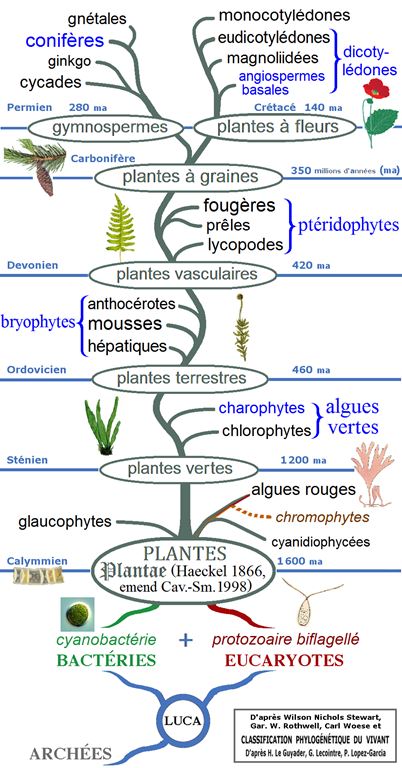
Classification
- Classique : en haut de l'écran, sous le coeur.
- Phylogénétique :
- Clade 4 : Angiospermes ;
- Clade 3 : Magnoliidées ;
- Ordre APN : Laurales ;
- Famille APN : Monimiaceae ;
À droite, cet arbre phylogénétique des plantes montre les principaux clades et groupes traditionnels (monophylétiques en noir et paraphylétiques en bleu).
Description et culture
Tableau récapitulatif
Parties comes-tibles Note comest. (1-5) Note medic. (1-5) (Zones de) Rusticité Besoins en 
Besoins en  (1-3)
(1-3)Périodes de semis et récoltes Graines au gramme Durée de viabilité Profon-deur semis Espace-ment plants Espace-ment lignes Durée germi-native Durée avant récolte J F M A M J
J A S O N D
J F M A M J
J A S O N D
Description :
Une succulente plante herbacée annuelle. Il peut être dressé ou couché au sol. Il atteint 5 à 30 cm de haut. Les feuilles sont succulentes, charnues et aplaties. Les fleurs sont blanches, roses ou violettes. La gousse mesure 5 mm de long et a la forme d'une spirale.
 Consommation (rapports de comestibilité, parties utilisables et usages alimentaires correspondants)
Consommation (rapports de comestibilité, parties utilisables et usages alimentaires correspondants)Parties comestibles :
Graines, feuilles, racines,{{{0(+x) (traduction automatique). Original : Seeds, Leaves, Roots{{{0(+x).Détails :
Les racines se consomment crues ou cuites.{{{0(+x) (traduction automatique).
Original : The roots are eaten raw or cooked{{{0(+x).
Partie testée :
Feuilles{{{0(+x) (traduction automatique). Original : Leaves{{{0(+x) Risques et précautions à prendre
Risques et précautions à prendrenéant, inconnus ou indéterminés.
Autres infos
dont infos de 0FPI ("FOOD PLANTS INTERNATIONAL", en anglais) :
Distribution :
C'est une plante tempérée. Il pousse sur des sols sableux et graveleux. Il peut pousser dans des endroits arides. Herbier de Tasmanie.{{{0(+x) (traduction automatique).
Original : It is a temperate plant. It grows on sandy and gravelly soils. It can grow in arid places. Tasmania Herbarium{{{0(+x).
Localisation :
Australie*, Tasmanie,{{{0(+x) (traduction automatique).
Original : Australia*, Tasmania{{{0(+x).
Notes :
Il existe entre 50 et 100 espèces de Calandrinia. Il a également été placé dans la famille des Portulacaceae.{{{0(+x) (traduction automatique).
Original : There are between 50-100 Calandrinia species. It has also been put in the family Portulacaceae{{{0(+x).
Liens, sources et/ou références
Liens :
/ ;Sources et/ou références :
bibliographie (liste des sources et/ou références de l'encyclopédie)
dont livres et bases de données :
dont bibliographie/références de 0FPI ("FOOD PLANTS INTERNATIONAL", en anglais) :
Cancilla, D., 2018, Ethnobotanical and Ethnozoological Values Desktop Assessment - Eliwana Project. p 41Cherikoff V. & Isaacs, J., The Bush Food Handbook. How to gather, grow, process and cook Australian Wild Foods. Ti Tree Press, Australia p 189Dashorst, G.R.M., and Jessop, J.P., 1998, Plants of the Adelaide Plains & Hills. Botanic Gardens of Adelaide and State Herbarium. p 54Hunter, J. T. & Sheringham, P., 2006, Vegetation and Floristics of Melville Range Nature Reserve. A Report to the New South Wales Parks and Wildlife Service. p 165Hunter, J., 2012, Vegetation and Floristics of Gilwarny and Wingadee Nature Reserves. A Report to the New South Wales National Parks and Wildlife Service p 110Hunter, J., 2015, Vegetation and flora of Naree and Yantabulla. A Draft Report to the Bush Heritage AustraliaHunter, J.T., 2017, Is there a relationship between contemporary high Aboriginal plant resource locations and mapped vegetation communities? Cunninghamia 17:27-34. The Royal Botanic Garden Sydney. ISSN 2200 - 405XLatz, P.K., 1996, Bushfires and Bushtucker: Aboriginal plant use in Central Australia. IAD Press Alice Springs p 134Lazarides, M. & Hince, B., 1993, Handbook of Economic Plants of Australia, CSIRO. p 42Lim, T. K., 2015, Edible Medicinal and Non Medicinal Plants. Volume 9, Modified Stems, Roots, Bulbs. Springer p 22McKerney, M. & White, H., 2011, Bush Tucker, Boomerangs & Bandages. Border River-Gwyder Catchment Management Authority p 181Paczkowska, G . & Chapman, A.R., 2000, The Western Australian Flora. A Descriptive Catalogue. Western Australian Herbarium. p 462Steenbeeke, Greg as part of the Plants Directory project. List of plant species from northern NSW that may be used as food plants p 13Tasmanian Herbarium Vascular Plants list p 46
Recherche de/pour :
- "Calandrinia eremaea" sur Google (pages et
images) ;
IPNI ("International Plant Names Index", en anglais) ;
TPL ("The Plant List", en anglais) ;
GRIN ("Germplasm Resources Information Network", en anglais) ;
TROPICOS (en anglais) ;
Tela Botanica ;
Pl@ntNet ;
Pl@ntUse ;
"Plants For A Future" (en anglais) ;
"Useful Tropical Plants" (en anglais) ou
"Useful Temperate Plants" (en anglais) ;
- "Calandrinia eremaea" sur Google (pages et
images) ;
IPNI ("International Plant Names Index", en anglais) ;
TPL ("The Plant List", en anglais) ;
GRIN ("Germplasm Resources Information Network", en anglais) ;
TROPICOS (en anglais) ;
Tela Botanica ;
Pl@ntNet ;
Pl@ntUse ;
"Plants For A Future" (en anglais) ;
"Useful Tropical Plants" (en anglais) ou
"Useful Temperate Plants" (en anglais) ;
Espèces du même genre (Calandrinia)
12 taxons
- Calandrinia acaulis Kunth
- Calandrinia balonensis Lindl. (Parakeelya)
- Calandrinia calyptrata Hook.f.
- Calandrinia caulescens Kunth
- Calandrinia ciliata (Ruiz & Pav.) DC.
- Calandrinia eremea
- Calandrinia menziesii
- Calandrinia micrantha Schltdl.
- Calandrinia polyandra Benth.
- Calandrinia remota J.M.Black
- Calandrinia strophiolata
Espèces de la même famille (Montiaceae)
5 taxons







 donne accès au menu
  - encyclopédies des plantes alimentaires ;
 - page de recherche - reconnaissance (identification) de plantes ;
 - page du calendrier lunaire et son générateur (au format PDF et JPG) ;
 - tableau récapitulatif ;
 - générateur de potées (soupes), avec estimation des apports nutrionnels et du coût;
 - générateur de codes QR ;
 - page des archives avec de nombreux documents sur différents thèmes complémentaires comme la botanique, les légumes,
les champignons, la cuisine, le bien-être ainsi que différents MOOC mais également des liens vers les archives de l'association ;
- page des archives avec de nombreux documents sur différents thèmes complémentaires comme la botanique, les légumes,
les champignons, la cuisine, le bien-être ainsi que différents MOOC mais également des liens vers les archives de l'association ;

 pour le fruit (et/ou les graines, la pulpe, etc...),
 pour les fleurs (et/ou pétales, calice...),
 pour les feuilles (et/ou la tige, les pousses...),
 pour les racines,
 pour le tronc (et/ou l'écorce, la sève...), et enfin
 pour les champignons,
puis les notes alimentaires et médicinales (de 1 à 5 étoiles), la rusticité (résistance au froid/gel)
et pour finir un résumé.
pour les champignons,
puis les notes alimentaires et médicinales (de 1 à 5 étoiles), la rusticité (résistance au froid/gel)
et pour finir un résumé. menant ici 🙂
 ,
,  et
et





 ,
,


 Encyclopédie(s)
 Recherche-Reconnaissance
 Tableau récapitulatif
 Codes QR
 Archives
 Calendrier(s) lunaire(s)
  Potées
 Re-naturation/naturalisation
 Affichettes, herbiers &
co.
Affichettes, herbiers &
co. menu
menu galerie


 (en bas à droite).
 (en bas à gauche).
