Typha
(Typha latifolia)


 |
*****
-
***
|
*****
-
***
 -25°C
-25°CUne herbe. C'est un roseau qui pousse dans l'eau. Ils se propagent par des rhizomes souterrains. Les feuilles sont vert bleuâtre et ressemblent à des bretelles. Ils peuvent ... (traduction automatique)
→suite


Typha
Note alimentaire 
Note médicinale 
Note autre usage 

Une herbe. C'est un roseau qui pousse dans l'eau. Ils se propagent par des rhizomes souterrains. Les feuilles sont vert bleuâtre et ressemblent à des bretelles. Ils peuvent mesurer de 2 à 2,5 m de long ... (traduction automatique) →suite

Typha latifolia
Classification
- Classique : en haut de l'écran, sous le coeur.
- Phylogénétique :
- Clade 4 : Angiospermes ;
- Clade 3 : Monocotylédones ;
- Clade 2 : Commelinidées ;
- Ordre APN : Poales ;
- Famille APN : Typhaceae ;
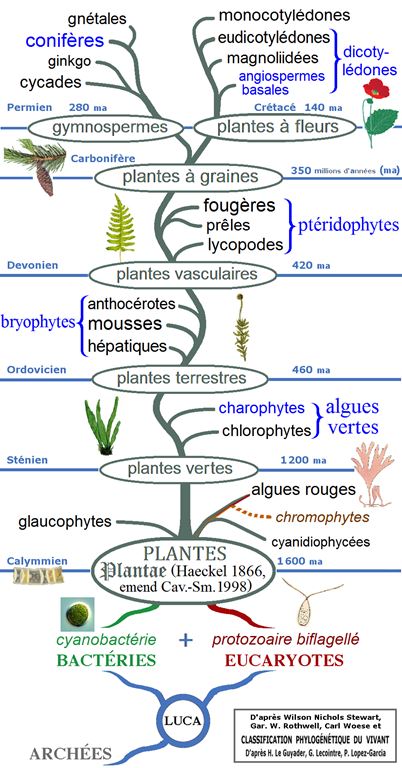
À droite, cet arbre phylogénétique des plantes montre les principaux clades et groupes traditionnels (monophylétiques en noir et paraphylétiques en bleu).
Dénominations
- Nom botanique : Typha latifolia L. (1753)
- Synonymes français : massette à larges feuilles, roseau à massette, rauche, quenouille, roseau de Champagne
- Synonymes : Typha capensis (Rohrb.) N. E. Br, Typha australis auct. nov Schum. & Thonn
- Noms anglais et locaux : Bulrush, Greater reedmace, Cattail, Cossack asparagus, Pat, Reedmace, Rogoz velelisni, Å¡irokolistni rogoz, Toiby
Description et culture
Tableau récapitulatif
Parties comes-tibles Note comest. (1-5) Note medic. (1-5) (Zones de) Rusticité Besoins en 
Besoins en  (1-3)
(1-3)Périodes de semis et récoltes Graines au gramme Durée de viabilité Profon-deur semis Espace-ment plants Espace-ment lignes Durée germi-native Durée avant récolte -25°C J F M A M J
J A S O N D
J F M A M J
J A S O N D
- dont infos de 0FPI ("FOOD PLANTS INTERNATIONAL", en anglais) :
Description :
Une herbe. C'est un roseau qui pousse dans l'eau. Ils se propagent par des rhizomes souterrains. Les feuilles sont vert bleuâtre et ressemblent à des bretelles. Ils peuvent mesurer de 2 à 2,5 m de long et 2,5 cm de large. Les capitules forment un cylindre compact. Il mesure 15 à 23 cm de long et 2,5 cm de diamètre. La partie supérieure est masculine et jaune. La partie inférieure est féminine et reste brun foncé. Ceux-ci ne sont pas séparés. Les graines ont des poils qui leur sont attachés{{{0(+x) (traduction automatique).
Original : A herb. It is a reed which grows in water. They spread by underground rhizomes. The leaves are bluish-green and like straps. They can be 2-2.5 m long and 2.5 cm wide. The flower heads form a compact cylinder. This is 15-23 cm long and 2.5 cm across. The upper part is male and yellow. The lower part is female and stays dark brown. These are not separated. The seeds have hairs attached to them{{{0(+x).
Culture :
Les plantes peuvent être cultivées par division. Il peut également être cultivé par graines{{{0(+x) (traduction automatique).
Original : Plants can be grown by division. It can also be grown by seed{{{0(+x).
 Consommation (rapports de comestibilité, parties utilisables et usages alimentaires correspondants)
Consommation (rapports de comestibilité, parties utilisables et usages alimentaires correspondants)Feuille (jeunes pousses (blancs semblables aux poireaux) ; crues1 ou cuites1)µ, racine (cuites (préparation)1)) et fleur1 (inflorescences grattées (cuites1) ; pollen (farine1) comestibles.
Détails :
jeunes pousses crues ou cuites (ex. : comme potherbe{{{(dp*)(1)).
Partie testée :
/ Risques et précautions à prendre
Risques et précautions à prendrenéant, inconnus ou indéterminés.
Galerie(s)
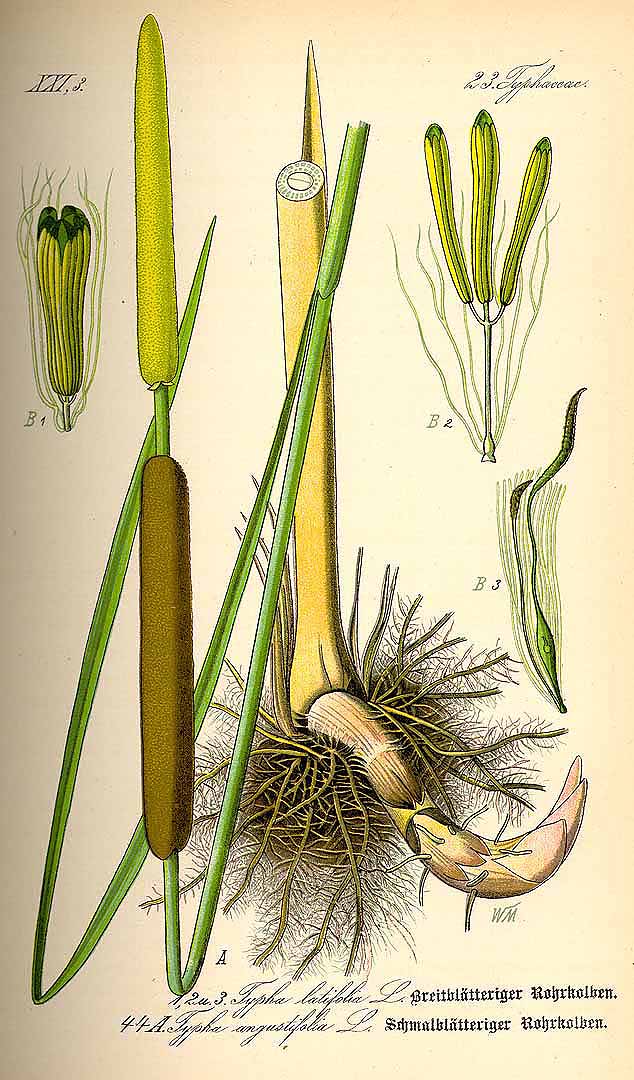
Par Lindman, C.A.M., Bilder ur Nordens Flora Bilder Nordens Fl. vol. 3 (1922) t. 493, via plantillustrations
✖

Par Thomé, O.W., Flora von Deutschland Österreich und der Schweiz (1886-1889) Fl. Deutschl. vol. 1 (1885) t. 44 f. 1,2,3 , via plantillustrations
✖

Autres infos
dont infos de 0FPI ("FOOD PLANTS INTERNATIONAL", en anglais) :
Statut :
Les pousses tendres sont considérées comme un mets délicat. Ils sont vendus pour des banquets{{{0(+x) (traduction automatique).
Original : The tender shoots are considered a delicacy. They are sold for banquets{{{0(+x).
Distribution :
Il pousse dans les endroits tropicaux et tempérés. Deccan. Il pousse dans les marais. Il a besoin de sols limoneux riches et d'une position ouverte et ensoleillée. Il est difficile de geler. Il pousse entre le niveau de la mer et 1 950 m d'altitude. Il peut pousser dans les sols salés. Il pousse dans les zones humides. Il peut pousser dans des endroits arides. Herbier de Tasmanie. dans le Sichuan et le Yunnan{{{0(+x) (traduction automatique).
Original : It grows in tropical and temperate places. Deccan. It grows in swamps. It needs rich silty soils and an open, sunny position. It is hardy to frost. It grows between sea level and 1,950 m above sea level. It can grow in salty soils. It grows in wetlands. It can grow in arid places. Tasmanian Herbarium. in Sichuan and Yunnan{{{0(+x).
Localisation :
Afghanistan, Afrique, Alaska, Arctique, Argentine, Asie, Australie, Balkans, Bosnie, Botswana, Brésil, Grande-Bretagne, Canada, Afrique centrale, Chine, Congo, République tchèque, Afrique de l'Est, Eswatini, Europe *, Gabon, Géorgie, Guatemala, Afrique du Sud, Hongrie, Inde, Irlande, Israël, Japon, Kazakhstan, Kenya, Kirghizistan, Lesotho, Méditerranée, Mexique, Maroc, Mozambique, Namibie, Népal, Nigéria, Amérique du Nord, Pakistan, Paraguay, Russie, Slovénie, Sud Amérique, Afrique australe, Swaziland, Syrie, Tadjikistan, Tasmanie, Tibet, Turkménistan, Ouganda, USA, Ouzbékistan, Afrique de l'Ouest, Zimbabwe{{{0(+x) (traduction automatique).
Original : Afghanistan, Africa, Alaska, Arctic, Argentina, Asia, Australia, Balkans, Bosnia, Botswana, Brazil, Britain, Canada, Central Africa, China, Congo, Czech Republic, East Africa, Eswatini, Europe*, Gabon, Georgia, Guatemala, Hungary, India, Ireland, Israel, Japan, Kazakhstan, Kenya, Kyrgyzstan, Lesotho, Mediterranean, Mexico, Morocco, Mozambique, Namibia, Nepal, Nigeria, North Africa, North America, Pakistan, Paraguay, Russia, Slovenia, South Africa, South America, Southern Africa, Swaziland, Syria, Tajikistan, Tasmania, Tibet, Turkmenistan, Uganda, USA, Uzbekistan, West Africa, Zimbabwe{{{0(+x).
Notes :
Composition chimique (racine): Protéine - 6%. Matières grasses = 0,29%. Glucides = 17,5% (dont 15,4% d'amidon). Cendres = 2,54%. Il existe 10 espèces de Typha{{{0(+x) (traduction automatique).
Original : Chemical composition (root): Protein - 6%. Fat = 0.29%. Carbohydrate = 17.5% (including 15.4% starch). Ash = 2.54%. There are 10 Typha species{{{0(+x).
Rusticité (résistance face au froid/gel, climat)
-25°C Arôme et/ou texture
pousse de bambou, châtaignes (bouillie de racines)1
Liens, sources et/ou références
Liens :
/ ;Sources et/ou références :
bibliographie (liste des sources et/ou références de l'encyclopédie)
dont classification : IPNI ("International Plant Names Index", en anglais) ; TPL ("The Plant List", en anglais) ; Kew (POWO - "Plant Of the World Online", "Royal Botanical Garden", en anglais) ; Tela Botanica ;
dont livres et bases de données : 5PFAF ("Plants For A Future", en anglais) ; 1Plantes sauvages comestibles (livre pages 19 et 20, par S.G. Fleischhauer, J. Guthmann et R. Spiegelberger) ; 1Plantes sauvages comestibles (de S.G. Fleischhauer, J. Guthmann et R. Spiegelberger, éditions Ulmer, 2012) / détails du livre
dont bibliographie/références de 0FPI ("FOOD PLANTS INTERNATIONAL", en anglais) :
Beckstrom-Sternberg, Stephen M., and James A. Duke. "The Foodplant Database."http://probe.nalusda.gov:8300/cgi-bin/browse/foodplantdb.(ACEDB version 4.0 - data version July 1994) ; Bocek, B. R., 1984, Ethnobotany of Costanoan Indians, California, Based on Collections by John P. Harrington. Economic Botany 38(2): 240-255 ; Bodkin, F., 1991, Encyclopedia Botanica. Cornstalk publishing, p 997 ; Brickell, C. (Ed.), 1999, The Royal Horticultural Society A-Z Encyclopedia of Garden Plants. Convent Garden Books. p 1035 ; Burkill, H. M., 1985, The useful plants of west tropical Africa, Vol. 5. Kew. ; Cerne, M., 1992, Wild Plants from Slovenia used as Vegetables. Acta Horticulturae 318. ; Couture, M. D., 1978, Recent and Contemporary Foraging Practices of the Harney Valley Paiute. Thesis, Portland State University ; Curtis, W.M., & Morris, D.I., 1994, The Student's Flora of Tasmania. Part 4B St David's Park Publishing, Tasmania, p 363 ; Dangol, D. R. et al, 2017, Wild Edible Plants in Nepal. Proceedings of 2nd National Workshop on CUAOGR, 2017. ; Denes, A., et al, 2012, Wild plants used for food by Hungarian ethnic groups living in the Carpathian Basin. Acta Societatis Botanicorum Poloniae 81 (4): 381-396 ; Elias, T.S. & Dykeman P.A., 1990, Edible Wild Plants. A North American Field guide. Sterling, New York p 69 ; Esperanca, M. J., 1988. Surviving in the wild. A glance at the wild plants and their uses. Vol. 1. p 198 ; Facciola, S., 1998, Cornucopia 2: a Source Book of Edible Plants. Kampong Publications, p 243 ; Flora of Pakistan. www.eFloras.org ; Hedrick, U.P., 1919, (Ed.), Sturtevant's edible plants of the world. p 662 ; Heller, C. A., 1962, Wild Edible and Poisonous Plants of Alaska. Univ. of Alaska Extension Service. p 61 ; https://en.wikibooks.org/wiki/Adventist_Youth_Honors_Answer_Book/Nature/Edible_Wild_Plants ; http://www.botanic-gardens-ljubljana.com/en/plants ; Hu, Shiu-ying, 2005, Food Plants of China. The Chinese University Press. p 280 ; Irving, M., 2009, The Forager Handbook, A Guide to the Edible Plants of Britain. Ebury Press p 317 ; Kermath, B. M., et al, 2014, Food Plants in the Americas: A survey of the domesticated, cultivated and wild plants used for Human food in North, Central and South America and the Caribbean. On line draft. p 885 ; Lazarides, M. & Hince, B., 1993, Handbook of Economic Plants of Australia, CSIRO. p 242 ; Lim, T. K., 2015, Edible Medicinal and Non Medicinal Plants. Volume 9, Modified Stems, Roots, Bulbs. Springer p 83 ; MacKinnon, A., et al, 2009, Edible & Medicinal Plants of Canada. Lone Pine. p 316 ; Marinelli, J. (Ed), 2004, Plant. DK. p 278 ; Menninger, E.A., 1977, Edible Nuts of the World. Horticultural Books. Florida p 152 ; Moerman, D. F., 2010, Native American Ethnobotany. Timber Press. p 573 ; Morley, B.D., & Toelken, H.R., (Eds), 1983, Flowering Plants in Australia. Rigby. p 403 ; Morley, B. & Everard, B., 1970, Wild Flowers of the World. Ebury press. Plate 23 ; Nassif, F., & Tanji, A., 2013, Gathered food plants in Morocco: The long forgotten species in Ethnobotanical Research. Life Science Leaflets 3:17-54 ; Plants for a Future database, The Field, Penpol, Lostwithiel, Cornwall, PL22 0NG, UK. http://www.scs.leeds.ac.uk/pfaf/ ; READ, ; Redzic, S. J., 2006, Wild Edible Plants and their Traditional Use in the Human Nutrition in Bosnia-Herzegovina. Ecology of Food and Nutrition, 45:189-232 ; Romanowski, N., 2007, Edible Water Gardens. Hyland House. p 71 ; Royal Botanic Gardens, Kew (1999). Survey of Economic Plants for Arid and Semi-Arid Lands (SEPASAL) database. Published on the Internet; http://www.rbgkew.org.uk/ceb/sepasal/internet [Accessed 13th June 2011] ; Saunders, C.F., 1948, Edible and Useful Wild Plants. Dover. New York. p 40 ; Simkova, K. et al, 2014, Ethnobotanical review of wild edible plants used in the Czech Republic. Journal of Applied Botany and Food Quality 88, 49-67 ; Slocum, P.D. & Robinson, P., 1999, Water Gardening. Water Lilies and Lotuses. Timber Press. p 103 ; Sp. pl. 2:971. 1753 ; Tasmanian Herbarium Vascular Plants list p 92 ; Tredgold, M.H., 1986, Food Plants of Zimbabwe. Mambo Press. p 28 ; Turner, N., 1997, Food Plants of Interior First Peoples. Royal BC Museum Handbook p 76 ; WATT, ; Wujisguleng, W., & Khasbagen. K., 2010, An integrated assessment of wild vegetable resources in Inner Mongolian Autonomous Region, China. Journal of Ethnobiology and Ethnomedicine 6:34 ; www.ediblewildfood.com ; Zhang, Y., et al, 2014, Diversity of wetland plants used traditionally in China: a literature review. Journal of Ethnobiology and Ethnomedicine. 10:72
Recherche de/pour :
- "Typha latifolia" sur Google (pages et
images) ;
GRIN ("Germplasm Resources Information Network", en anglais) ;
TROPICOS (en anglais) ;
Pl@ntNet ;
Pl@ntUse ;
"Useful Tropical Plants" (en anglais) ou
"Useful Temperate Plants" (en anglais) ;
- "Typha" sur Google (pages, images et recettes) ;
- "Typha latifolia" sur Google (pages et
images) ;
GRIN ("Germplasm Resources Information Network", en anglais) ;
TROPICOS (en anglais) ;
Pl@ntNet ;
Pl@ntUse ;
"Useful Tropical Plants" (en anglais) ou
"Useful Temperate Plants" (en anglais) ;
Espèces du même genre (Typha)
12 taxons
- Typha angustifolia L. (Massette à feuilles étroites)
- Typha bungeana C.Presl
- Typha capensis (Rohrb.) N.E.Br.
- Typha davidiana (Kronf.) Hand.-Mazz.
- Typha domingensis Pers. (Massette australe)
- Typha elephantina Roxb.
- Typha glauca Seg.-Vianna
- Typha laxmannii Lepech. (Massette de Laxmann)
- Typha minima Hoffm. (Massette grêle)
- Typha orientalis C.Presl
- Typha x glauca Godr. (Massette glauque)
Espèces de la même famille (Typhaceae)
18 taxons
- Massette à feuilles étroites
- Massette australe
- Massette de Laxmann
- Massette glauque
- Massette grêle
- Rubanier d'eau
- Sparganium americanum Nutt.
- Sparganium androcladum (Engelm.) Morong
- Sparganium erectum L. (Rubanier d'eau)
- Sparganium eurycarpum Engelm.
- Sparganium longifolium
- Sparganium stoloniferum (Buch.-Ham. ex Graebn.) Buch.-Ham. ex Juz.
- Typha angustifolia L. (Massette à feuilles étroites)
- Typha bungeana C.Presl
- Typha capensis (Rohrb.) N.E.Br.
- Typha davidiana (Kronf.) Hand.-Mazz.
- Typha domingensis Pers. (Massette australe)
- Typha elephantina Roxb.
- Typha glauca Seg.-Vianna
- Typha laxmannii Lepech. (Massette de Laxmann)
- Typha minima Hoffm. (Massette grêle)
- Typha orientalis C.Presl
- Typha x glauca Godr. (Massette glauque)
Par Thomé, O.W., Flora von Deutschland Österreich und der Schweiz (1886-1889) Fl. Deutschl. vol. 1 (1885) t. 44 f. 1,2,3 , via plantillustrations







 donne accès au menu
  - encyclopédies des plantes alimentaires ;
 - page de recherche - reconnaissance (identification) de plantes ;
 - page du calendrier lunaire et son générateur (au format PDF et JPG) ;
 - tableau récapitulatif ;
 - générateur de potées (soupes), avec estimation des apports nutrionnels et du coût;
 - générateur de codes QR ;
 - page des archives avec de nombreux documents sur différents thèmes complémentaires comme la botanique, les légumes,
les champignons, la cuisine, le bien-être ainsi que différents MOOC mais également des liens vers les archives de l'association ;
- page des archives avec de nombreux documents sur différents thèmes complémentaires comme la botanique, les légumes,
les champignons, la cuisine, le bien-être ainsi que différents MOOC mais également des liens vers les archives de l'association ;

 pour le fruit (et/ou les graines, la pulpe, etc...),
 pour les fleurs (et/ou pétales, calice...),
 pour les feuilles (et/ou la tige, les pousses...),
 pour les racines,
 pour le tronc (et/ou l'écorce, la sève...), et enfin
 pour les champignons,
puis les notes alimentaires et médicinales (de 1 à 5 étoiles), la rusticité (résistance au froid/gel)
et pour finir un résumé.
pour les champignons,
puis les notes alimentaires et médicinales (de 1 à 5 étoiles), la rusticité (résistance au froid/gel)
et pour finir un résumé. menant ici 🙂
 ,
,  et
et





 ,
,


 Encyclopédie(s)
 Recherche-Reconnaissance
 Tableau récapitulatif
 Codes QR
 Archives
 Calendrier(s) lunaire(s)
  Potées
 Re-naturation/naturalisation
 Affichettes, herbiers &
co.
Affichettes, herbiers &
co. menu
menu galerie


 (en bas à droite).
 (en bas à gauche).
