Thelypteris truncata
Pas d'illustration
pour le moment 😕

Une grande fougère. Il a un tronc dressé et une couronne de frondes au sommet. Les frondes mesurent 80 à 120 cm de long. Ils sont divisés deux fois.
→suite


Thelypteris truncata

Une grande fougère. Il a un tronc dressé et une couronne de frondes au sommet. Les frondes mesurent 80 à 120 cm de long. Ils sont divisés deux fois.
Pas d'illustration
pour le moment 😕
Pas d'illustration
pour le moment 😕
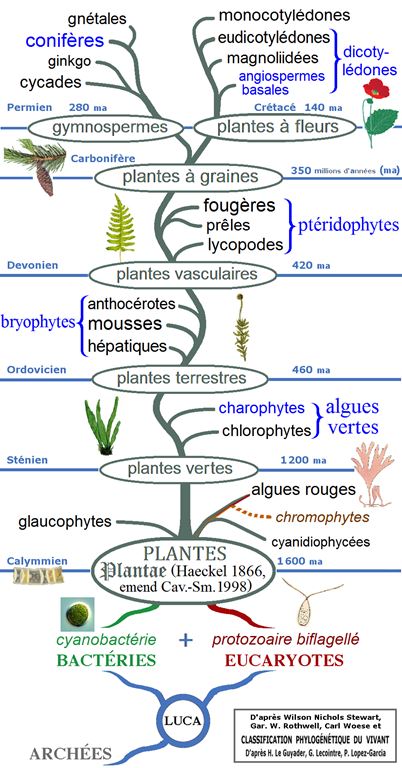
Classification
- Classique : en haut de l'écran, sous le coeur.
- Phylogénétique : Inconnue
À droite, cet arbre phylogénétique des plantes montre les principaux clades et groupes traditionnels (monophylétiques en noir et paraphylétiques en bleu).
Dénominations
- Nom botanique : Thelypteris truncata (Poir.) K. Iwats.
- Synonymes : Aspidium abortivum Blume; Dryopteris truncata (Poir.) Kuntze; Nephrodium truncatum (Poir.) C. Presl; Polypodium truncatum Poir.; Polystichum truncatum (Poir.) Gaudich.; Thelypteris truncata (Poir.) K. Iwats.; and several others ;
Description et culture
Tableau récapitulatif
Parties comes-tibles Note comest. (1-5) Note medic. (1-5) (Zones de) Rusticité Besoins en 
Besoins en  (1-3)
(1-3)Périodes de semis et récoltes Graines au gramme Durée de viabilité Profon-deur semis Espace-ment plants Espace-ment lignes Durée germi-native Durée avant récolte J F M A M J
J A S O N D
J F M A M J
J A S O N D
Description :
Une grande fougère. Il a un tronc dressé et une couronne de frondes au sommet. Les frondes mesurent 80 à 120 cm de long. Ils sont divisés deux fois.
 Consommation (rapports de comestibilité, parties utilisables et usages alimentaires correspondants)
Consommation (rapports de comestibilité, parties utilisables et usages alimentaires correspondants)Parties comestibles :
Frondes, feuilles,{{{0(+x) (traduction automatique). Original : Fronds, Leaves{{{0(+x).Partie testée :
/ Risques et précautions à prendre
Risques et précautions à prendrenéant, inconnus ou indéterminés.
Autres infos
dont infos de 0FPI ("FOOD PLANTS INTERNATIONAL", en anglais) :
Distribution :
Une plante tropicale.{{{0(+x) (traduction automatique).
Original : A tropical plant{{{0(+x).
Localisation :
Asie, Australie, Bangladesh, Chine, Île Christmas, Inde, Indochine, Indonésie, Malaisie, Myanmar, Nouvelle-Calédonie, Pacifique, Papouasie-Nouvelle-Guinée, PNG, Philippines, Asie du Sud-Est, Sri Lanka, Taiwan, Thaïlande, Tibet, Vietnam,{{{0(+x) (traduction automatique).
Original : Asia, Australia, Bangladesh, China, Christmas Island, India, Indochina, Indonesia, Malaysia, Myanmar, New Caledonia, Pacific, Papua New Guinea, PNG, Philippines, SE Asia, Sri Lanka, Taiwan, Thailand, Tibet, Vietnam{{{0(+x).
Notes :
Il existe environ 200 espèces de Dryopteris.{{{0(+x) (traduction automatique).
Original : There are about 200 Dryopteris species{{{0(+x).
Liens, sources et/ou références
Liens :
/ ;Sources et/ou références :
bibliographie (liste des sources et/ou références de l'encyclopédie)
dont livres et bases de données :
dont bibliographie/références de 0FPI ("FOOD PLANTS INTERNATIONAL", en anglais) :
Powell, J.M., Ethnobotany. In Paijmans, K., 1976, New Guinea Vegetation. Australian National University Press. p 109 (As Pneumatopteris truncata)World Checklist of Useful Plant Species 2020. Royal Botanic Gardens, Kew
Recherche de/pour :
- "Thelypteris truncata" sur Google (pages et
images) ;
IPNI ("International Plant Names Index", en anglais) ;
TPL ("The Plant List", en anglais) ;
GRIN ("Germplasm Resources Information Network", en anglais) ;
TROPICOS (en anglais) ;
Tela Botanica ;
Pl@ntNet ;
Pl@ntUse ;
"Plants For A Future" (en anglais) ;
"Useful Tropical Plants" (en anglais) ou
"Useful Temperate Plants" (en anglais) ;
- "Thelypteris truncata" sur Google (pages et
images) ;
IPNI ("International Plant Names Index", en anglais) ;
TPL ("The Plant List", en anglais) ;
GRIN ("Germplasm Resources Information Network", en anglais) ;
TROPICOS (en anglais) ;
Tela Botanica ;
Pl@ntNet ;
Pl@ntUse ;
"Plants For A Future" (en anglais) ;
"Useful Tropical Plants" (en anglais) ou
"Useful Temperate Plants" (en anglais) ;
Espèces du même genre (Thelypteris)
15 taxons
- Thelypteris alatella (Christ) C. F. Reed
- Thelypteris arbuscula (Willd.) K. Iwats.
- Thelypteris ciliata
- Thelypteris gongylodes (Schkuhr) Small
- Thelypteris multilineata
- Thelypteris nudata
- Thelypteris opulenta
- Thelypteris palustris Schott (Théliptéris des marécages)
- Thelypteris papuana (Holttum) Christenh.
- Thelypteris protecta (Copel.) C. F. Reed
- Thelypteris sp.
- Thelypteris subochthodes Ching
- Thelypteris subpubescens (Blume) K. Iwats.
- Thelypteris xylodes
Espèces de la même famille (Thelypteridaceae)
34 taxons
- Amblovenatum opulentum
- Ampelopteris kunze
- Ampelopteris prolifera (Ampéloptéride prolifère)
- Christella dentata (Christelle dentée)
- Christella parasitica (Christelle parasite)
- Chrystella parasitica
- Cyclosorus aridus
- Cyclosorus auriculata
- Cyclosorus gongylodes
- Cyclosorus heterocarpus
- Cyclosorus interruptus
- Cyclosorus kotoensis
- Cyclosorus magnificus
- Cyclosorus sp
- Cyclosorus sp. (8226/DCRS 339)
- Cyclosorus truncatus
- Paranthelypteris glanduligera
- Parathelypteris glanduligera (Kunze) Ching
- Parathelypteris noveboracensis
- Pneumatopteris callosa
- Pneumatopteris pennigera
- Pneumatopteris sogerensis
- Pneumatopteris truncata
- Sphaerostephanos unijuga Copel.
- Thelypteris ciliata
- Thelypteris multilineata
- Thelypteris nudata
- Thelypteris opulenta
- Thelypteris palustris Schott (Théliptéris des marécages)
- Thelypteris sp.
- Thelypteris subochthodes Ching
- Thelypteris xylodes
- Trigonospora ciliata







 donne accès au menu
  - encyclopédies des plantes alimentaires ;
 - page de recherche - reconnaissance (identification) de plantes ;
 - page du calendrier lunaire et son générateur (au format PDF et JPG) ;
 - tableau récapitulatif ;
 - générateur de potées (soupes), avec estimation des apports nutrionnels et du coût;
 - générateur de codes QR ;
 - page des archives avec de nombreux documents sur différents thèmes complémentaires comme la botanique, les légumes,
les champignons, la cuisine, le bien-être ainsi que différents MOOC mais également des liens vers les archives de l'association ;
- page des archives avec de nombreux documents sur différents thèmes complémentaires comme la botanique, les légumes,
les champignons, la cuisine, le bien-être ainsi que différents MOOC mais également des liens vers les archives de l'association ;

 pour le fruit (et/ou les graines, la pulpe, etc...),
 pour les fleurs (et/ou pétales, calice...),
 pour les feuilles (et/ou la tige, les pousses...),
 pour les racines,
 pour le tronc (et/ou l'écorce, la sève...), et enfin
 pour les champignons,
puis les notes alimentaires et médicinales (de 1 à 5 étoiles), la rusticité (résistance au froid/gel)
et pour finir un résumé.
pour les champignons,
puis les notes alimentaires et médicinales (de 1 à 5 étoiles), la rusticité (résistance au froid/gel)
et pour finir un résumé. menant ici 🙂
 ,
,  et
et





 ,
,


 Encyclopédie(s)
 Recherche-Reconnaissance
 Tableau récapitulatif
 Codes QR
 Archives
 Calendrier(s) lunaire(s)
  Potées
 Re-naturation/naturalisation
 Affichettes, herbiers &
co.
Affichettes, herbiers &
co. menu
menu galerie


 (en bas à droite).
 (en bas à gauche).
